
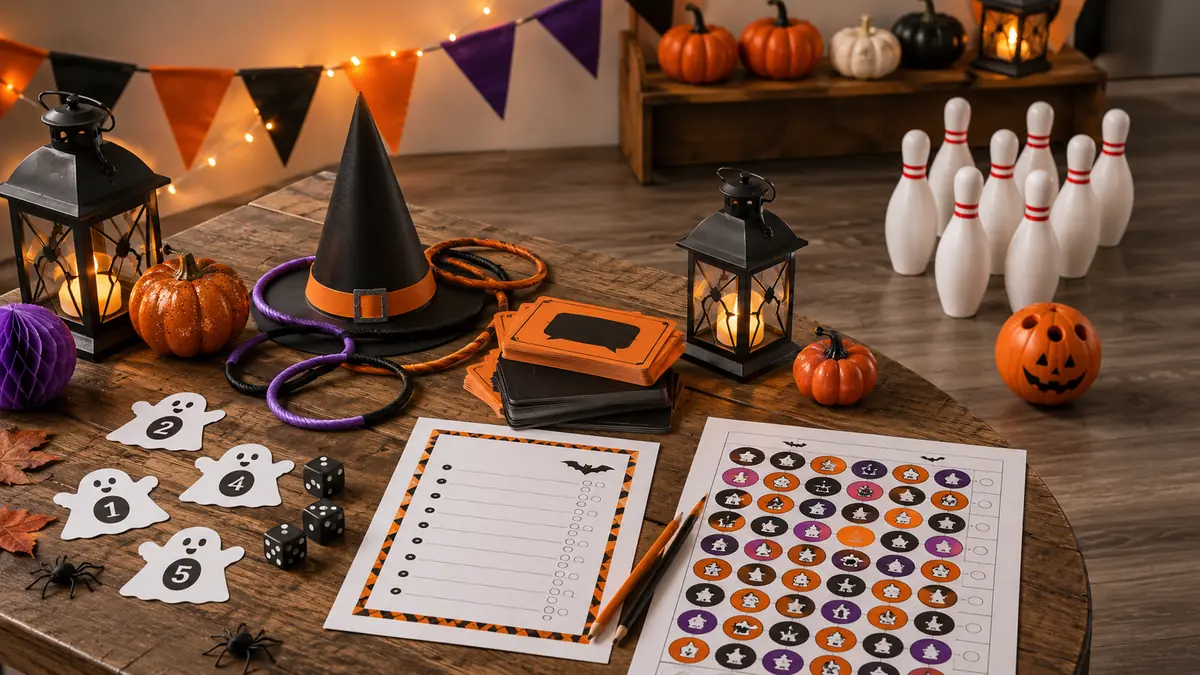
Planning Halloween games gets much easier once you know who is coming, how much space you have, and how long guests actually want to play. This guide brings together 20 party games for adults, kids, families, and mixed-age groups, with practical details on setup, group size, timing, and space so you can build a party plan that fits your event.
The best Halloween party games are not necessarily the most complicated ones. A simple game that fits your guests, available space, and party schedule will usually work better than an elaborate activity that takes too long to explain or prepare.
This guide includes 20 Halloween games for adults, kids, families, and mixed-age groups. Each idea includes recommended group sizes, setup needs, approximate playing time, and practical instructions so you can quickly choose games that fit your party.
Instead of trying to play every game on the list, choose two or three main activities and keep one simple backup ready. For a broader game night, you can also explore Gaming Station’s guide to the best party games for adults, families, and large groups.
More Halloween Game Guides
If you want ready-made Halloween activities, explore these related guides:
- Halloween scavenger hunt clues for indoor, outdoor, kids, teens, and adult hunts.
- Halloween charades and Pictionary ideas for parties, classrooms, and family game nights.
Halloween Party Games at a Glance
Use the table below to narrow your options by age group, number of players, available time, preparation level, and space. For most parties, a mix of one active game, one social or team game, and one quieter backup gives guests enough variety without overloading the schedule.
| Game | Cost | Best for | Group size | Time | Prep | Space |
| Murder Mystery Lite | $ | Adults and teens | 6–12 | 30–60 min | High | Seated room |
| Monster Charades | Free | Mixed ages | 4–20+ | 15–30 min | Low | Small room |
| Halloween Trivia | Free | Adults, teens, families | 4–30+ | 20–30 min | Medium | Any |
| Costume Pitch Contest | Free–$ | Adults and teens | 4–20 | 15–25 min | Low | Any |
| Forbidden Halloween Word | $ | Adults and mixed groups | 6–30+ | Ongoing | Low | Any |
| Mystery Box Challenge | $ | Adults, teens, older kids | 4–16 | 15–25 min | Medium | Table |
| Halloween Categories | Free | Adults and teens | 3–12 | 15–25 min | Low | Table |
| Creepy Story Circle | Free | Adults, teens, older kids | 4–12 | 20–30 min | None | Quiet room |
| Pumpkin Bowling | $ | Kids and families | 4–12 | 15–25 min | Medium | Open floor |
| Mummy Wrap Relay | $ | Kids and mixed groups | 6–20 | 10–20 min | Low | Open floor |
| Spider Web Obstacle Course | $ | Kids | 3–10 | 15–25 min | Medium | Hallway/room |
| Feed the Monster Toss | $ | Young kids | 2–12 | 10–20 min | Medium | Small room |
| Witch’s Hat Ring Toss | $ | Kids and families | 2–12 | 10–20 min | Medium | Small room |
| Freeze Dance: Monster Edition | Free | Kids and mixed groups | 4–20+ | 10–20 min | Low | Open floor |
| Flashlight Ghost Hunt | $ | Kids and families | 3–15 | 15–25 min | Medium | Dim room |
| Eyeball Spoon Relay | $ | Kids and families | 6–20 | 10–20 min | Low | Open floor |
| Halloween Bingo | Free–$ | Mixed ages | 4–30+ | 15–30 min | Medium | Seated area |
| Candy Guessing Jar | $ | Mixed ages | Any | Ongoing | Low | Any |
| Halloween Pictionary | Free | Mixed ages | 4–20+ | 20–30 min | Low | Wall/table |
| Spooky Scavenger Hunt | Free–$ | Mixed ages | 4–24 | 20–40 min | High | Multiple areas |
Cost guide: Free = items most households already have; $ = a few basic supplies may be needed. Actual costs vary depending on what you already own.
Quick Picks by Party Type
If you do not want to compare all 20 options, start with these quick combinations:
- Adult party: Murder Mystery Lite, Halloween Trivia, and Halloween Categories
- Kids’ party: Pumpkin Bowling, Freeze Dance, and Feed the Monster Toss
- Mixed-age party: Monster Charades, Halloween Bingo, and Halloween Pictionary
- Large group: Team Trivia, Monster Charades, Bingo, or a team scavenger hunt
- Small indoor space: Halloween Categories, Creepy Story Circle, Bingo, or a Candy Guessing Jar
- Minimal preparation: Creepy Story Circle, Monster Charades, Halloween Categories, or Freeze Dance
Choose one main activity, one second option with a different energy level, and one backup that can start quickly if the schedule changes.
Best Halloween Party Games for Adults
Halloween party games for adults work best when they give guests something to discuss, solve, perform, or create. However, an adult game does not have to be explicit or alcohol-based; a clear social activity is usually more important.
1. Murder Mystery Lite
Best for: 6–12 adults or older teens who enjoy deduction
You need: Role cards, one secret culprit card, clue cards, pens, and a timer
First, create a fictional mystery with one culprit, several suspects, and three rounds of clues. Next, secretly assign each guest a role. Players then talk in character, exchange the information on their cards, and record a final guess after the last clue.
Keep the plot simple enough to solve in under an hour. Also, place every important fact on at least one card, and keep a solution sheet ready in case the discussion stalls. Finally, avoid assigning romantic, embarrassing, or physically demanding roles without consent.
2. Monster Charades
Best for: 4–20 or more players
You need: Slips of paper, a bowl, and a timer
First, write Halloween prompts such as “a vampire at the dentist,” “a zombie learning to dance,” or “a witch with a broken broom.” Then, divide the group into teams. One player silently acts out a prompt while teammates try to guess it before time expires.
Use recognizable characters for a mixed group and more absurd scenarios for adults. However, if performing may feel uncomfortable, let players act in pairs or allow one free pass per round.
3. Halloween Trivia
Best for: 4–30 or more adults, teens, or families
You need: Question sheet, answer sheets, and pens
To begin, prepare four short rounds, such as Halloween traditions, family-friendly movies, folklore, and spooky music. Teams write one answer per question and then exchange sheets for scoring. As a result, a 20-question game usually fits comfortably into 20–30 minutes.
Before the party, verify every answer and avoid questions that depend on disputed legends. For mixed-age play, also include one child-friendly round and one visual round using symbols, silhouettes, or emoji clues.
4. Costume Pitch Contest
Best for: 4–20 adults or teens
You need: Costume or character prompt cards; optional craft scraps
First, give each player or team two random prompts, such as “vampire” and “office worker.” They then have three minutes to invent a costume concept and 30 seconds to pitch it. Award points for originality, clarity, and how realistically the costume could be made.
This is one of the easiest Halloween party games for adults when guests arrive without costumes. Still, keep judging focused on the invented concept rather than anyone’s body, clothing budget, or appearance.
5. Forbidden Halloween Word
Best for: 6–30 or more guests at a mingling party
You need: Clothespins, tokens, or stickers
First, choose one common word guests cannot say, such as “costume,” “candy,” or “Halloween.” Next, give everyone three tokens. If a player hears someone use the forbidden word, the listener claims one of the speaker’s tokens. Finally, the player with the most tokens at a set time wins.
Announce a clear end time so the game does not dominate the entire party. Alternatively, track how long the full group can go without saying the word.
6. Mystery Box Challenge
Best for: 4–16 adults, teens, or older children
You need: Covered containers and clean, allergy-aware objects
First, place ordinary objects inside boxes with hand openings. Players then feel one object without looking and write a guess. For example, cooked pasta can suggest “worms,” peeled grapes can represent “eyeballs,” and a soft sponge can become a “monster brain.” The most correct guesses win.
Before play, tell guests that all items are harmless, allow anyone to skip, and identify food allergens. Most importantly, do not use sharp, hot, sticky, spoiled, or difficult-to-clean materials.
7. Halloween Categories
Best for: 3–12 adults or teens
You need: Paper, pens, category list, and letter slips
First, choose a letter. Then, give players two minutes to write one answer for each category: costume, creature, movie, party food, object in a haunted house, and something a witch might own. Unique valid answers earn two points; meanwhile, duplicated answers earn one.
Before starting, agree whether proper nouns, titles, and invented answers count. In addition, groups that like easy card-based games may enjoy GamingStation’s party games using a standard deck.
8. Creepy Story Circle
Best for: 4–12 adults, teens, or older kids
You need: Nothing; optional prompt cards
One player begins a spooky story with two sentences. Afterward, each person adds one or two sentences while keeping earlier details consistent. Finally, end after two complete rounds or when the group reaches a natural conclusion.
For a more structured version, reveal prompts such as “a locked attic,” “a phone that rings by itself,” or “footprints that stop at the wall.” However, set the expected scare level first; suspenseful and silly stories are better choices for mixed-age groups than graphic horror.
Best Halloween Party Games for Kids and Families
Halloween party games for kids should have simple rules, short waits, and easy ways to rejoin after a mistake. Therefore, use soft props for younger children and avoid blindfolds, elimination, open flames, and small prizes that could be choking hazards.
9. Pumpkin Bowling
Best for: 4–12 kids or families
You need: A small round pumpkin or soft orange ball and six to ten lightweight pins
First, set paper cups or empty plastic bottles in a triangle. Next, mark a throwing line and give each player two rolls to knock down as many pins as possible. Then, reset the pins after each turn and play three frames.
A soft orange ball rolls more predictably and is safer indoors than a real pumpkin. In addition, keep the lane clear of decorations, cords, and hard furniture edges.
10. Mummy Wrap Relay
Best for: 6–20 kids or mixed-age teams
You need: Crepe-paper streamers or toilet paper
First, split players into teams. Next, each team chooses one standing “mummy.” On the signal, teammates wrap paper around the mummy’s clothing. Finally, stop after 60–90 seconds and judge coverage, creativity, or neatness.
Keep paper loose, leave the face and neck completely uncovered, and do not bind arms or legs. Before walking, players should tear the paper away. Alternatively, use a seated cardboard cutout for very young children.
11. Spider Web Obstacle Course
Best for: 3–10 kids
You need: Painter’s tape or soft yarn
First, create a pretend web across a hallway or between sturdy chairs at several heights. Children then take turns moving through the gaps without touching the strands. For an extra challenge, add a bell to one strand.
Never tie yarn around a child or stretch it near the neck. Also, keep strands visible, use tape that releases easily, supervise the course, and remove tripping hazards from the floor.
12. Feed the Monster Toss
Best for: 2–12 younger kids
You need: A decorated cardboard box and soft beanbags
First, cut a large mouth in a monster face drawn on a box. Players then stand behind a line and toss three beanbags into the opening. For younger children, move the line closer; for older players, move it farther away.
Award one point per successful toss. Alternatively, play cooperatively until the group “feeds” the monster 20 beanbags. In either version, use soft, securely sealed bags that are too large to swallow.
13. Witch’s Hat Ring Toss
Best for: 2–12 kids or families
You need: A stable cone-shaped hat and soft rings
First, place a witch’s hat or decorated traffic cone on the floor. Each player then throws three rings from a marked line. Score one point for each ring that lands over the cone.
In a small room, use foam or rope rings rather than rigid hoops. Also, give each age group a different throwing line so adults do not have an unfair advantage.
14. Freeze Dance: Monster Edition
Best for: 4–20 or more kids
You need: Music and a clear floor
Players dance like zombies, skeletons, ghosts, or other monsters. When the music stops, everyone freezes. However, instead of eliminating someone who moves, give that player a new monster style to lead during the next round.
As a result, the no-elimination rule keeps younger guests involved. Before the music starts, set a boundary away from tables, cords, candles, and fragile decorations.
15. Flashlight Ghost Hunt
Best for: 3–15 kids or families
You need: Paper ghosts, removable tape, and flashlights
First, hide numbered paper ghosts around one safe room. Next, dim the lights without making the space fully dark. Players then use flashlights to find the ghosts and record their numbers; the first player or team to find the complete set wins.
Meanwhile, keep stairs and off-limit rooms brightly lit. The U.S. Consumer Product Safety Commission recommends flameless, battery-operated lights in places children can access and keeping burning candles away from items that can catch fire. See the CPSC’s Halloween décor safety advice.
16. Eyeball Spoon Relay
Best for: 6–20 kids or families
You need: Spoons and lightweight plastic eyeballs or decorated ping-pong balls
First, divide players into teams. One player at a time carries an “eyeball” on a spoon to a marker and back. Then, the player passes it to the next teammate. If the ball falls, the player returns to the last marker rather than leaving the game.
Use oversized lightweight balls around younger children and collect every piece after play. In addition, walking-only rules make the relay safer in a living room.
Best Halloween Party Games for Mixed-Age Groups
Mixed-age Halloween parties work best with games that can be adjusted without creating separate rules for every age group. Team play, easier and harder prompt options, adjustable distances, and cooperative scoring allow children and adults to participate together without making the activity too simple or too difficult.
17. Halloween Bingo
Best for: 4–30 or more players
You need: Bingo cards, calling cards, and markers
First, fill cards with Halloween images or words such as bat, moon, broom, black cat, candy, mask, and pumpkin. Next, draw one calling card at a time. The first player to complete the announced pattern calls “Bingo,” and the host then checks the card.
Use picture cards for early readers and words for older groups. If prizes are offered, however, provide several small winners rather than one large prize.
18. Candy Guessing Jar
Best for: Any group size
You need: A clear sealed jar, wrapped candy or nonfood objects, and guess slips
Before the party, count the items and seal the jar. Guests then submit one guess. At a set time, reveal the total; the closest guess wins.
Label any food allergens and keep the jar closed during the game. Alternatively, use plastic spiders, orange pom-poms, or large craft shapes for a candy-free version.
19. Halloween Pictionary
Best for: 4–20 or more players
You need: Drawing surface, markers, prompt cards, and timer
First, divide the group into teams. A player then draws a Halloween prompt without letters, numbers, gestures, or spoken clues. The team has 60 seconds to guess. Afterward, alternate teams and give one point for each correct answer.
Prepare easy prompts such as pumpkin, bat, and broom, plus harder prompts such as haunted hotel or invisible monster. In addition, players who prefer question and drawing games can explore the broader Party Games category.
20. Spooky Scavenger Hunt
Best for: 4–24 kids, adults, or mixed teams
You need: Clue cards and themed objects
First, hide a sequence of clues that leads to a final object or prize. Each clue should point to a specific, permitted location. For mixed ages, place one child and one adult on each team; then, combine picture clues with short riddles.
Before starting, set clear boundaries. Also, do not hide clues near roads, stoves, pools, medicine, tools, candles, locked rooms, or breakable displays. Finally, use staggered starts if the space is narrow.
Halloween Slumber Party Games for Teens and Older Kids
Creepy slumber party games work best when they build suspense without making anyone feel trapped or targeted. For example, the Story Circle, Flashlight Ghost Hunt, Mystery Box Challenge, Halloween Categories, and a quiet version of Murder Mystery Lite all fit an indoor evening.
Before playing, agree on the scare level and let any guest opt out without explanation. Also, avoid pranks involving locked doors, unwanted touching, fake emergencies, sleep disruption, or secretly recording reactions. Instead, choose a silly reveal that does not embarrass anyone.
How to Choose the Right Halloween Party Games
Choose the game around the group first and the Halloween theme second. Before planning, consider the youngest guest, total number of players, room size, energy level, preparation time, and whether guests are comfortable performing in front of others.
- Start with the youngest guest. Remove mature prompts, small objects, intense scares, and complicated scoring when children are present.
- Count active players. Turn-based games can drag with a large group; team trivia, bingo, charades, and Pictionary scale more easily.
- Check the room. Use seated word games in apartments or crowded spaces. Reserve relays and obstacle courses for a cleared area.
- Limit the rules explanation. If the host cannot explain the objective and one turn in about a minute, simplify the game or demonstrate a practice round.
- Plan for different personalities. Combine one performance game with one quiet or team-based option.
- Prepare a backup. Bingo, charades, categories, or a deck of cards can recover the schedule if a planned activity ends early.
A Simple 90-Minute Plan for Halloween Party Games
A balanced schedule alternates energy levels and leaves time for food, costumes, and conversation. Therefore, avoid placing two active games back to back.
- 0–15 minutes: Candy Guessing Jar and Forbidden Halloween Word while guests arrive
- 15–35 minutes: Monster Charades or Halloween Pictionary
- 35–50 minutes: Food and a short break
- 50–75 minutes: Halloween Trivia, Spooky Scavenger Hunt, or Pumpkin Bowling
- 75–90 minutes: Halloween Bingo or Creepy Story Circle
For adult-only groups, Murder Mystery Lite can replace the middle portion and become the main event. In contrast, young children usually do better with three 10–15 minute activities and free-play breaks.
Safety Tips for Halloween Party Games
Good Halloween games keep the risk level lower than the excitement level. Therefore, review each activity in the actual room before guests arrive.
- Replace open flames with battery-operated lights near games, costumes, paper, and children. The CPSC advises keeping candles away from combustible décor.
- Clear floors, stairs, and game lanes of cords, props, bags, and loose decorations.
- Use soft throwing objects and stable targets.
- Keep faces, necks, arms, and legs unrestricted during costume or wrapping games.
- Match prizes and props to the youngest child’s age, and check food labels for allergens.
- Provide a low-pressure role, teammate option, or simple pass for guests who do not want to perform or be scared.
- Keep adult drinking separate from children’s games and never make alcohol the price of participation. The National Institute on Alcohol Abuse and Alcoholism explains drink sizes and provides tools for adults who choose to drink. Offer appealing non-alcoholic options throughout the party.
- Ask before photographing or posting children, guests, costumes, or game reactions.
Common Mistakes With Halloween Party Games
Most failed party games are caused by a mismatch between the activity and the group, not by a lack of decorations. Fortunately, hosts can prevent the most common problems before guests arrive.
Planning Too Many Games
Guests need time to arrive, eat, talk, and move between activities. Therefore, two or three strong games plus a backup are usually more manageable than a rigid list of ten.
Eliminating Players Early
Children who lose in the first minute may spend the rest of the game watching. Instead, use points, team scoring, rotating leaders, or quick rounds so everyone stays involved.
Making Every Game a Performance
Charades and costume pitches energize some guests but exhaust others. Therefore, balance them with bingo, trivia, a guessing jar, or cooperative puzzles.
Ignoring Cleanup and Reset Time
Mystery boxes, paper wrapping, and scavenger hunts take longer to reset than they appear. As a result, prepare labeled supply bins and choose a helper before the party.
Making Scares More Important Than Consent
Surprise touching, confinement, graphic props, or recording frightened reactions can cross personal boundaries. Instead, state the scare level, offer a pass, and keep the event playful.
Final Verdict
The best Halloween party games are the ones your guests can understand quickly and enjoy without unnecessary pressure. Monster Charades, Halloween Pictionary, and Bingo are flexible choices for mixed groups, while Murder Mystery Lite and Halloween Categories suit many adult gatherings. For children, Pumpkin Bowling, Freeze Dance, and simple relay games are easier to manage.
For most parties, plan two or three main games rather than filling every minute with activities. Keep one low-prep backup ready, adapt the difficulty to the youngest participants, and choose games that genuinely fit the available space.
Frequently Asked Questions
What are the best Halloween party games for adults?
The best Halloween party games for adults include Murder Mystery Lite, Halloween Trivia, Monster Charades, Halloween Categories, and the Costume Pitch Contest. Choose deduction for a focused group, charades for high energy, or trivia and categories for guests who prefer seated play.
What are easy Halloween party games for kids?
Halloween Bingo, Feed the Monster Toss, Freeze Dance, Witch’s Hat Ring Toss, and Pumpkin Bowling have short explanations and flexible difficulty. Use soft equipment, remove elimination, and adjust the throwing line or prompt level by age.
Which Halloween games require almost no preparation?
Creepy Story Circle needs no supplies, while Monster Charades and Halloween Categories need only paper, pens, and a timer. Freeze Dance requires music and a cleared floor. Each can be explained and started in a few minutes.
What Halloween games work for a large group?
Team trivia, Halloween Bingo, Monster Charades, Halloween Pictionary, and a team scavenger hunt scale well. Divide very large groups into teams, prepare duplicate materials, and avoid games that leave most guests waiting for individual turns.
What are good creepy slumber party games?
A Flashlight Ghost Hunt, Mystery Box Challenge, Creepy Story Circle, Halloween Categories, or short mystery game can create suspense without graphic horror. Agree on the scare level and avoid secret recording, fake emergencies, confinement, or unwanted touching.
How many games should a host plan for a two-hour Halloween party?
Plan two or three main games and one easy backup. After all, arrival, food, costumes, conversation, rules, and transitions consume more time than expected. Meanwhile, young children usually do better with shorter activities and breaks between them.
Can adult Halloween party games be non-alcoholic?
Yes. Deduction, trivia, charades, drawing, storytelling, and team challenges do not require alcohol. Therefore, offer non-alcoholic drinks to everyone, keep drinking optional, and never connect alcohol consumption to points, penalties, dares, or participation.
How can Halloween games work for adults and kids together?
Use mixed-age teams, picture-and-word prompts, adjustable throwing lines, and cooperative scoring. For example, Bingo, Pictionary, charades, scavenger hunts, and guessing games are easy to adapt because adults can help without controlling every turn.
Turning the party into a sleepover? These Halloween slumber party ideas for kids and tweens cover spooky themes, movies, and midnight snacks.
