
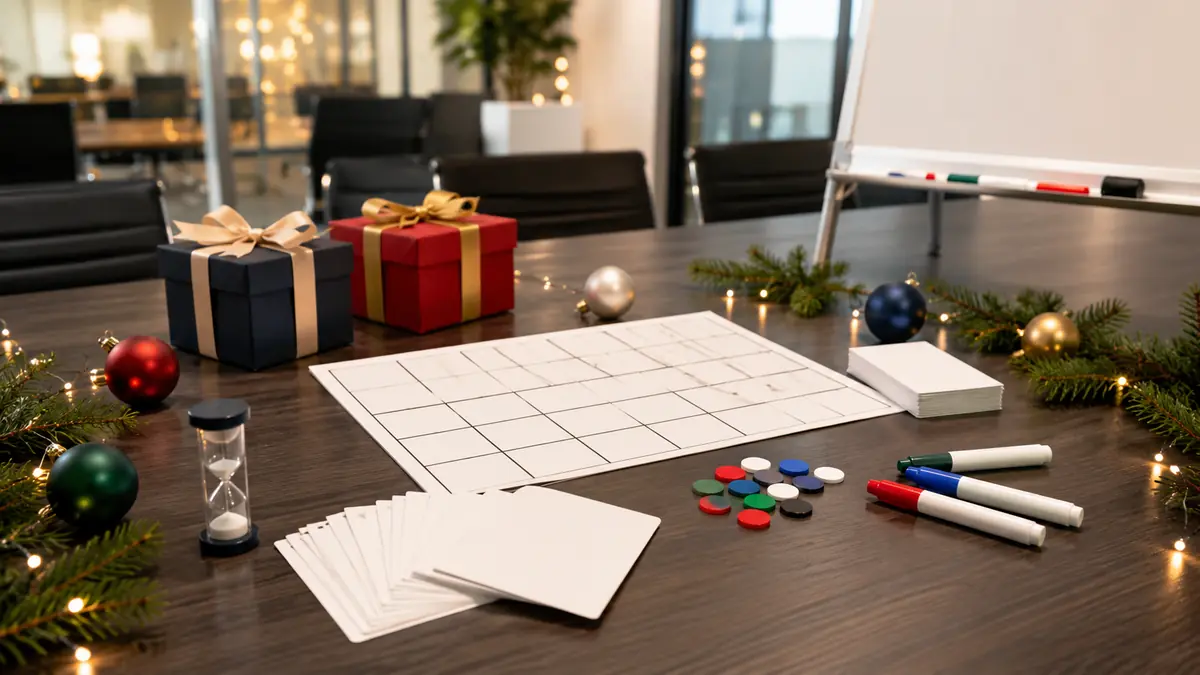
Direct Answer: The best Christmas party games for work are quick to explain, easy to join, and comfortable for different personalities. Strong choices include holiday trivia, Christmas bingo, an emoji quiz, Pictionary, a low-pressure scavenger hunt, a puzzle sprint, and remote-friendly caption contests. Choose two or three games that fit the team’s size, space, and energy.
By Gaming Station Editorial Team
Last reviewed: August 2026
Workplace party games succeed when employees understand the objective quickly and can participate without being singled out. The activity should fit the room, schedule, group size, and office culture—not simply look entertaining on a list.
This guide covers 25 Christmas party games for work, from five-minute table games to collaborative team challenges and remote activities. Each option includes a realistic time estimate, setup level, and workplace-fit note. Organizers planning other social events can also browse GamingStation’s Party Games guides for broader group-game ideas.
The suggestions use Christmas themes because that is the focus of the query. In a religiously diverse workplace, organizers can rename prompts “holiday” or “winter,” keep participation voluntary, and avoid questions that ask employees to explain personal beliefs.
Christmas Party Games for Work at a Glance
The quickest way to choose is to match the game to the team’s size, available time, and desired interaction level. “Low pressure” means no required performance or personal disclosure; “medium” means short drawing, acting, or presenting turns.
| # | Game | Best group | Time | Prep | Pressure | Remote-friendly |
| 1 | Christmas Trivia Sprint | 6–50+ | 15–25 min | Medium | Low | Yes |
| 2 | Holiday Bingo | 8–60+ | 15–25 min | Medium | Low | Yes |
| 3 | Christmas Emoji Quiz | 4–100+ | 10–15 min | Low | Low | Yes |
| 4 | Name That Holiday Tune | 6–60 | 10–20 min | Medium | Low | Yes |
| 5 | Guess What Is in the Stocking | 4–20 | 10–15 min | Low | Low | With adaptation |
| 6 | Festive Pictionary | 6–30 | 15–25 min | Low | Medium | Yes |
| 7 | Christmas Charades | 6–30 | 15–25 min | Low | Medium | Yes |
| 8 | Holiday Categories | 4–40 | 10–20 min | Low | Low | Yes |
| 9 | Christmas Movie Title Match | 4–50 | 10–15 min | Low | Low | Yes |
| 10 | Holiday Word Scramble | 4–100+ | 5–10 min | Low | Low | Yes |
| 11 | Office Scavenger Hunt | 8–60 | 20–30 min | Medium | Low | No |
| 12 | Holiday Survey Showdown | 8–50 | 20–30 min | Medium | Medium | Yes |
| 13 | Gift-Wrapping Challenge | 6–30 | 15–20 min | Medium | Medium | No |
| 14 | Ornament Tower | 6–30 | 10–15 min | Low | Low | No |
| 15 | Office-Supply Snowman | 6–40 | 20–30 min | Medium | Low | No |
| 16 | Paper Snowflake Design | 4–40 | 15–25 min | Low | Low | With kits |
| 17 | Gingerbread Design Contest | 4–30 | 30–45 min | High | Low | With kits |
| 18 | Festive Desk Decoration | 4–100+ | 20–45 min | Medium | Low | With adaptation |
| 19 | Holiday Puzzle Escape | 6–40 | 25–40 min | High | Low | Yes |
| 20 | Secret Santa Clue Guessing | 6–30 | 15–25 min | Medium | Low | Yes |
| 21 | Remote Desk Scavenger Hunt | 4–100+ | 10–15 min | Low | Low | Yes |
| 22 | Virtual Background Mystery | 4–40 | 10–15 min | Low | Low | Yes |
| 23 | Holiday Caption Contest | 4–100+ | 10–20 min | Low | Low | Yes |
| 24 | Holiday Fact or Fiction | 6–100+ | 15–25 min | Medium | Low | Yes |
| 25 | Cooperative Holiday Story | 4–25 | 10–20 min | Low | Medium | Yes |
How to Choose Office Christmas Party Games
Choose games by eliminating poor fits first. Group size matters, but participation pressure, physical access, room layout, noise, and cultural fit often matter more in a workplace than at a private gathering.
Use these five filters:
- Count active players. A game for eight people is not automatically suitable for a department of 40. Use teams, simultaneous answers, or rotating stations for larger groups.
- Set a time limit. For a one-hour party, two structured games plus social time usually work better than six rushed activities.
- Choose the interaction level. Trivia, bingo, and written quizzes are lower pressure. Charades, karaoke, and individual presentations demand more visible participation.
- Check the room and technology. Confirm seating, walking space, sound, screens, internet access, and whether remote employees can participate on equal terms.
- Prepare an equivalent alternative. Offer a seated role, clue-writing role, scorekeeping role, or non-food option rather than making one activity the only way to join.
GamingStation’s guide to the best party games for adults, families, and large groups explains the same core selection factors—group fit, teachability, pace, and interaction fit—in more detail.
Make participation inclusive and voluntary
An office celebration is still a workplace event. The U.S. Equal Employment Opportunity Commission explains that covered employers may need to provide reasonable religious accommodations and that an employee cannot be forced to participate in a religious activity as a condition of employment. Review the EEOC guidance on religious discrimination and applicable company policies when planning.
Accessibility also belongs in the game design, not in a last-minute exception. The U.S. Department of Justice notes that employment-related opportunities include social activities under the Americans with Disabilities Act. The ADA overview provides the federal context. In practice, organizers should offer seated alternatives, readable print, spoken and written instructions, and routes that do not depend on speed or mobility.
1. Christmas Trivia Sprint
Christmas trivia is a reliable choice for mixed teams because everyone can discuss answers without taking an individual performance turn. It also scales well when one host can use a screen, printed sheets, or an online form.
Best for: Mixed departments, large groups, and hybrid teams
You need: 20–30 questions, answer sheets or a digital form, a timer, and a score sheet
How to play
- Divide participants into teams of three to six.
- Run four short rounds, such as movies, music, food, and winter traditions.
- Give teams 30–45 seconds per question.
- Collect answers after each round and reveal the correct responses.
- Use a final tie-breaker that asks for a number; the closest answer wins.
Keep the question set broad enough that one specialist cannot dominate. Avoid religious doctrine questions, obscure dates, or prompts that assume everyone celebrates Christmas in the same way.
2. Holiday Bingo
Holiday bingo offers simple rules and continuous participation. It works especially well while food is being served or as a background activity that does not require everyone to stop talking.
Best for: Large groups and low-pressure events
You need: Randomized bingo cards, pens or markers, and a caller list
How to play
Create cards with seasonal objects, phrases, workplace moments, or picture icons. Call one item at a time until a player completes the announced pattern: one line, four corners, or a full card. Verify the marked squares before awarding a prize.
For a more social version, use squares such as “has worked here more than five years” or “prefers hot chocolate to coffee,” but keep every prompt harmless and easy to answer. Do not include health, religion, family status, or other sensitive personal information.
3. Christmas Emoji Quiz
A Christmas emoji quiz is one of the easiest Christmas holiday party games for the office because it needs little explanation and can be displayed on a screen or sent to remote participants.
Best for: Quick warm-ups, hybrid teams, and large rooms
You need: 10–15 emoji clues and answer sheets
How to play
Show emoji combinations representing seasonal movie titles, songs, objects, or familiar phrases. Teams write one answer per clue. Award one point for each correct title and use a final clue as a tie-breaker.
Build original clue combinations instead of copying a commercial quiz. Accept reasonable title variations, and include a text description if any icon is hard to see on the presentation screen.
4. Name That Holiday Tune
Name That Holiday Tune works when the group enjoys music but should not require anyone to sing. Short clips keep the game moving and allow teams to answer together.
Best for: Medium or large teams
You need: Legally accessed audio, a speaker, a playlist, and answer sheets
How to play
Play a short opening or instrumental section, pause it, and let teams write the title. Offer a bonus point for the performer only when the recording has one clear, recognizable artist. Fifteen clips are usually enough for a 15-minute round.
Check the venue’s audio setup beforehand and provide written alternative clues for anyone who cannot hear the clips clearly. Do not upload or distribute copyrighted recordings as part of a downloadable quiz pack.
5. Guess What Is in the Stocking
This tactile guessing game suits small offices and requires only familiar, clean objects. It can run as a station while other activities continue.
Best for: Small groups and casual drop-in parties
You need: An opaque stocking or bag and 8–12 safe objects
How to play
Place one object in the stocking at a time. Without looking inside, players feel the outside or reach in and write a guess. Use items with distinct shapes, such as ribbon, a pinecone, a tape dispenser, a sealed candy cane, or a small ornament.
Offer a visual clue version for anyone who does not want to touch unknown objects. Avoid sharp, breakable, messy, scented, or food-contact items.
6. Festive Pictionary
Festive Pictionary gives creative teams a clear objective without rewarding drawing skill. The entertainment comes from interpreting imperfect pictures under a short time limit.
Best for: Teams of six to 30
You need: A whiteboard or large paper, markers, prompt cards, and a timer
How to play
Divide the room into two or more teams. One player draws a seasonal word or phrase without writing letters, numbers, or spoken clues. The team has 60 seconds to guess. Rotate artists so participation is shared, but allow anyone to pass or become the prompt reader instead.
Use concrete prompts such as “snow globe,” “wrapping a present,” or “reindeer.” Abstract phrases can turn a quick game into a frustrating one.
7. Christmas Charades
Christmas charades is easy to set up, but it carries more participation pressure than a written game. It works best when acting is voluntary and teams can nominate willing performers.
Best for: Energetic, familiar teams
You need: Prompt cards and a timer
How to play
A player silently acts out a seasonal action, character, movie title, or object while teammates guess. Set a 60-second limit and award one point for a correct answer. Rotate teams after every prompt.
Do not penalize a player who passes. Include a clue-giver, timer, and scorekeeper role so employees can contribute without performing.
8. Holiday Categories
Holiday Categories is a seated word game that rewards quick thinking and works with almost no equipment. It is especially useful when the room cannot support movement.
Best for: Small and medium groups
You need: Paper, pens, a category list, and optional letter cards
How to play
Announce a category such as winter foods, seasonal movies, things found in a gift shop, or words associated with snow. Give players 60 seconds to list as many valid answers as possible. In the harder version, every answer must begin with one selected letter.
Score one point per unique accepted answer. Decide disputed answers by a quick majority vote rather than letting the discussion stall the round.
9. Christmas Movie Title Match
This matching game gives movie fans an advantage without requiring anyone to quote, sing, or act. Teams connect titles to short factual or descriptive clues.
Best for: Seated groups and quick team play
You need: A sheet with two mixed columns or a slide deck
How to play
Place 10–15 movie titles in one column and original clues in another. Teams draw lines or write matching letters. A clue might describe a broad premise, setting, object, or character role without copying dialogue.
Include older and newer titles, but avoid turning the round into a test of one generation’s movie knowledge. A few non-movie winter titles can be used when the workplace prefers a broader holiday theme.
10. Holiday Word Scramble
A holiday word scramble is a five-minute filler that works before the main activity or while organizers finish setup. It is easy to print and simple to run across a large room.
Best for: Any group size
You need: A list of 10–20 scrambled words and pens
How to play
Give everyone the same sheet and a fixed time limit. Players unscramble common words such as “ornament,” “mistletoe,” “snowflake,” or “gingerbread.” The highest total wins; a difficult final word can break a tie.
Keep the font large and the vocabulary familiar. For another low-cost backup that uses standard equipment, GamingStation’s guide to party games with playing cards offers options that can be screened for workplace fit.
11. Office Scavenger Hunt
An office scavenger hunt creates movement and teamwork without asking employees to perform in front of the room. The safest version rewards observation and problem-solving rather than speed.
Best for: Medium and large teams with access to a suitable venue
You need: A clue sheet, pencils, boundaries, a time limit, and a scoring guide
How to play
Divide participants into teams and give each team the same list. Challenges might include finding an object of a certain color, solving a location clue, photographing a permitted decoration, or identifying a detail from the office common area. Award different points based on difficulty.
Set clear boundaries before starting. Do not send players into private workspaces, storage areas, stairs, parking lots, or locations that disrupt employees who are still working. Make every clue solvable from an accessible route and score accuracy instead of finishing speed.
12. Holiday Survey Showdown
Holiday Survey Showdown turns harmless workplace preferences into a team guessing game. Because the answers come from an anonymous pre-event poll, the activity feels more relevant than generic trivia.
Best for: Teams that know one another and hybrid events
You need: An anonymous survey, the top answers, a display, and a score sheet
How to play
Before the party, ask optional questions such as “Which warm drink belongs at a winter party?” or “What is the hardest item to wrap?” Group similar responses and rank the most common answers. At the event, teams try to reveal the top responses and score more points for popular answers.
Avoid questions about religion, family plans, finances, health, dating, alcohol, or management. The host should review every response before displaying it so an inappropriate write-in answer never reaches the screen.
13. Gift-Wrapping Challenge
A gift-wrapping challenge works best as a quality-and-creativity contest rather than a race. Removing the speed requirement reduces mess and makes the activity easier to adapt.
Best for: Creative teams and station-based parties
You need: Empty boxes, paper, tape, ribbon, decorations, and blunt-tip scissors
How to play
Give each team the same box and materials. Allow 10–12 minutes to create a wrapped design. Score the results on neatness, creativity, material use, and adherence to a surprise theme revealed at the start.
Assign cutting and decorating roles based on comfort. Provide precut paper and tearable tape for a lower-dexterity option, and keep pathways clear of ribbon and paper scraps.
14. Ornament Tower
Ornament Tower is a compact building challenge that creates collaboration without requiring athletic ability. Teams must build the tallest freestanding structure from identical supplies.
Best for: Small spaces and table groups
You need: Plastic ornaments, paper cups, craft sticks, tape, and a measuring tape
How to play
Give each team an equal kit and 10 minutes. The structure must stand unsupported for at least five seconds. Measure from the table to the highest stable point. If two towers are the same height, the design using the least tape wins.
Use plastic or paper decorations, not glass. Limit materials to keep the challenge fair and stop teams from attaching a tower to furniture or walls.
15. Office-Supply Snowman
Office-Supply Snowman asks teams to turn ordinary materials into a recognizable winter character. It combines design, problem-solving, and a short presentation without requiring anyone to dress up.
Best for: Departments and mixed-skill groups
You need: Paper cups, cardboard, scrap paper, sticky notes, tape, markers, and reusable decorations
How to play
Give teams identical material sets and 20 minutes. The finished snowman must stand independently and include three specified features, such as a hat, nose, and name badge. Judges score structural stability, creativity, and use of materials.
Ask teams to build on a table rather than on a person. This avoids unwanted physical contact and keeps the activity comfortable for employees who do not want to become part of the display.
16. Paper Snowflake Design Challenge
The Paper Snowflake Design Challenge is quiet, inexpensive, and easy to run as a drop-in station. It also gives participants time to talk while working.
Best for: Low-key office parties and mixed-age family events
You need: Square paper, pencils, blunt-tip scissors, and display space
How to play
Allow 15 minutes for individual or paired designs. Display the finished snowflakes without names and let attendees vote for categories such as most intricate, most original, and best minimalist design.
Offer pre-folded paper, simple templates, and a no-cut drawing category. This keeps the activity available to people with different dexterity levels and avoids making artistic skill the only path to recognition.
17. Gingerbread Design Contest
A gingerbread design contest works as a longer centerpiece when the schedule, cleanup plan, and dietary needs are managed in advance. Teams can decorate preassembled houses or flat cookie shapes.
Best for: Small and medium groups with 30–45 minutes available
You need: Preassembled kits, icing, decorations, trays, labels, gloves, and cleanup supplies
How to play
Give each team the same materials and theme. Judge design rather than speed, using categories such as structural creativity, color, storytelling, and teamwork. Treat the finished pieces as displays unless the ingredients and handling process make eating appropriate.
Check ingredient labels and ask about dietary restrictions privately before the event. The U.S. Food and Drug Administration explains that major allergens must be identified on packaged foods and that allergen cross-contact can occur. Use the FDA food-allergy guidance when planning food-based activities, and provide a non-food craft using the same judging categories.
18. Festive Desk Decoration
A festive desk decoration contest can involve a large office without stopping work for one long game. It should reward creativity without pressuring employees to buy materials or reveal personal traditions.
Best for: Large offices and multi-day celebrations
You need: A small shared supply station, clear rules, and voting categories
How to play
Set a modest size limit and provide common materials. Allow individual or team entries, then schedule a short viewing period. Use several awards—such as best recycled-material design, best winter theme, and best use of color—rather than one “best Christmas” prize.
Make participation optional and prohibit candles, overloaded electrical outlets, blocked exits, flashing lights, strong scents, and decorations attached to safety equipment.
19. Holiday Puzzle Escape
A Holiday Puzzle Escape gives teams a common objective and avoids elimination. It can be built from paper clues, envelopes, number locks, or a shared digital form without creating a full physical escape room.
Best for: Problem-solving teams and hybrid events
You need: Four to six linked puzzles, answer sheets, hint cards, and a final code
How to play
Start every team with the same clue. Each correct answer unlocks the next envelope or form section. Mix puzzle types—word patterns, image matching, simple ciphers, sequencing, and logic—so one skill does not determine the whole result. The first team to submit the final code wins.
Test every puzzle with someone who did not write it. Provide two optional hints per team and large-print copies. The challenge should come from reasoning, not tiny text, color-only clues, or outside cultural knowledge.
20. Secret Santa Clue Guessing
Secret Santa Clue Guessing adds a short deduction round to an exchange that is already planned. It should not be used to require gifts or reveal who did not participate.
Best for: Small teams running an optional gift exchange
You need: Anonymous clue cards and the existing exchange list
How to play
Each participating giver submits three neutral clues about themselves, such as a preferred work snack, a hobby category, or a favorite type of movie. The recipient reads the clues and gets up to three guesses before the giver is revealed.
Keep the gift exchange and the guessing round opt-in. Set a low spending cap, avoid jokes at someone’s expense, and let employees join the party games even if they skip the exchange.
21. Remote Desk Scavenger Hunt
A remote desk scavenger hunt creates fast participation without requiring special software. Players find ordinary items in their immediate space and return to the camera or chat.
Best for: Remote and hybrid teams
You need: A video call, a prompt list, and a timer
How to play
Call prompts such as “something red,” “an object with a number,” or “something used every workday.” Give participants 30–45 seconds to find an item. Instead of awarding only the first return, give one point to every valid item and a bonus for the most creative interpretation.
Tell players to remain in a safe area, avoid stairs and outdoor spaces, and keep personal documents, medication, family photographs, and other private information off camera.
22. Virtual Background Mystery
Virtual Background Mystery turns a normal video-call feature into a visual guessing game. It works best with supplied images so employees do not need design skills or personal photos.
Best for: Remote teams and short hybrid warm-ups
You need: A folder of approved background images and a video platform that supports backgrounds
How to play
Privately assign each player or team a background representing a seasonal object, movie, place, or phrase. Other participants ask yes-or-no questions or submit guesses in chat. Limit each round to two minutes.
Provide a slide-based version for anyone whose device cannot use virtual backgrounds. Confirm that images are licensed or created for the activity rather than copied from copyrighted promotional artwork.
23. Holiday Caption Contest
A Holiday Caption Contest gives remote and in-person employees the same task. It produces humor through writing rather than putting one person onstage.
Best for: Hybrid teams and large groups
You need: Three or four original or licensed images and an anonymous submission form
How to play
Show one workplace-safe seasonal image at a time and allow two minutes for captions. The host screens submissions, then displays the finalists without names. Participants vote for the funniest, most creative, or most office-appropriate line.
Set clear content rules before collecting answers. Exclude captions about protected characteristics, appearance, religion, politics, coworkers’ private lives, or company disputes.
24. Holiday Fact or Fiction
Holiday Fact or Fiction combines trivia with team discussion. Players decide whether a short statement is accurate, then receive the explanation after voting.
Best for: Large, remote, or mixed-knowledge groups
You need: 12–15 verified statements, answer cards or a poll, and source notes
How to play
Present one statement at a time. Teams have 30 seconds to choose fact or fiction and may write a short reason for a bonus point. Reveal the answer and a concise explanation before moving on.
Use checkable topics such as winter weather, food history, language, or public-domain seasonal customs. Verify every claim from a reliable source and avoid presenting beliefs or religious traditions as universal facts.
25. Cooperative Holiday Story
The Cooperative Holiday Story is a flexible closer for a conversational group. Everyone adds one line to a shared story while trying to include assigned words.
Best for: Small teams and remote groups
You need: A starting sentence, a timer, and seasonal word cards
How to play
Start with a workplace-safe premise, such as “The office party began normally until a mysterious package arrived.” Each player adds one or two sentences and must use a word supplied by the host. After the final turn, the host reads the complete story.
Keep turns short and allow players to contribute in writing or pass. For a lower-pressure version, teams build one story privately and nominate a willing reader.
Best Christmas Party Games by Situation
The best choice depends on the event format. These shortlists reduce the 25 options to practical starting points.
| Situation | Best choices | Why they fit |
| Small office | Guess What Is in the Stocking, Holiday Categories, Paper Snowflake Design | Minimal equipment and easy conversation |
| Large group | Trivia Sprint, Holiday Bingo, Emoji Quiz | Simultaneous team or individual play |
| Remote team | Emoji Quiz, Caption Contest, Fact or Fiction | Works through slides, chat, or polls |
| Hybrid team | Trivia Sprint, Survey Showdown, Holiday Puzzle Escape | Both rooms can receive the same prompts and scoring |
| Quiet or seated event | Bingo, Movie Title Match, Word Scramble | Little movement and controlled noise |
| Creative team | Pictionary, Office-Supply Snowman, Paper Snowflakes | Visible output without personal questions |
| Five-minute filler | Emoji Quiz, Word Scramble, one Fact-or-Fiction round | Almost no rule explanation |
| Low budget | Categories, Charades, Word Scramble, Cooperative Story | Paper, pens, and prepared prompts are sufficient |
Ready-Made Work Party Game Plans
A short sequence works better than an overfilled schedule. Start with the easiest activity, use one substantial team game, and leave room for food and conversation.
45-minute plan for an in-person office
- Christmas Emoji Quiz — 8 minutes: A low-pressure start while people arrive.
- Christmas Trivia Sprint — 17 minutes: Three rounds plus answers.
- Ornament Tower — 15 minutes: A collaborative table challenge.
- Results and prizes — 5 minutes: Announce winners and recognize creative teams.
60-minute plan for a remote or hybrid team
- Christmas Emoji Quiz — 5 minutes: Use three quick visual clues without scoring.
- Holiday Fact or Fiction — 15 minutes: Everyone answers through the same poll.
- Holiday Puzzle Escape — 25 minutes: Small teams work in breakout rooms or at tables.
- Holiday Caption Contest — 10 minutes: End with anonymous submissions.
- Results — 5 minutes: Share the winning answers and close on time.
Common Office Christmas Party Game Mistakes
Most poor game experiences come from format problems rather than a bad idea. Avoid these mistakes before the event starts.
Making one person perform
Karaoke, charades, speeches, and talent contests may suit an enthusiastic group, but mandatory individual turns create unnecessary pressure. Use teams, volunteers, written responses, and pass options.
Treating speed as the only skill
Running, grabbing, and rapid unwrapping can exclude participants and create avoidable risk. Score accuracy, creativity, collaboration, or puzzle completion instead.
Asking sensitive questions
Do not build games around salaries, dating, family plans, health, religion, politics, alcohol use, embarrassing memories, or opinions about coworkers. “Funny” should never depend on someone feeling exposed.
Ignoring remote employees
A camera pointed at an office activity does not create equal participation. Hybrid teams need the same prompt, response method, time limit, and scoring opportunity.
Planning too many games
Two well-hosted activities usually create more engagement than a schedule that changes every five minutes. Prepare one backup, but do not force it into the event if conversation is already working.
Using food without an alternative
Food games require ingredient labels, handling controls, and a meaningful non-food version. A person should not lose the chance to participate because eating or touching the ingredients is unsafe.
Final Verdict
The strongest Christmas party games for work are easy to explain, team-based, and optional. For most offices, start with an emoji quiz or bingo, follow with trivia or a collaborative puzzle, and stop before the event feels overprogrammed. Match the activity to the group’s size, access needs, cultural mix, and willingness to perform—not just the Christmas theme.
Frequently Asked Questions
What are the best Christmas party games for work?
The best options are Christmas trivia, holiday bingo, an emoji quiz, Pictionary, a puzzle escape, and a caption contest. These games are easy to teach, work in teams, and can be adapted for different group sizes and comfort levels.
What office Christmas party games work for a large group?
Use games with simultaneous answers or team scoring, such as trivia, bingo, an emoji quiz, Fact or Fiction, or a survey showdown. Avoid formats that make 40 people wait while one employee takes a turn.
What are easy five-minute Christmas games for coworkers?
A short emoji quiz, word scramble, one round of Holiday Categories, or three Fact-or-Fiction statements can fit into five minutes. Prepare the prompts in advance and explain the objective in one sentence before starting.
How many games are needed for a one-hour office Christmas party?
Plan two structured games and one optional backup. A useful schedule includes a five- to ten-minute warm-up, one 15- to 25-minute team game, and enough unplanned time for food, conversation, and results.
How can office Christmas party games be more inclusive?
Keep participation voluntary, offer seated and written alternatives, avoid sensitive personal questions, use readable instructions, and provide non-food options. Broader “holiday” or “winter” wording may also suit a religiously diverse workplace better.
What Christmas party games work for remote employees?
Remote-friendly choices include an emoji quiz, online trivia, Holiday Fact or Fiction, a caption contest, a virtual background mystery, and a digital puzzle escape. Use one shared answer method so remote and office participants receive equal scoring opportunities.
What prizes are appropriate for workplace Christmas games?
Use modest, broadly useful prizes such as company-approved gift cards, snacks with clear allergen labels, desk accessories, or team recognition. Avoid alcohol, joke gifts aimed at individuals, expensive prizes that create tension, or items tied to one religion.
Should employees be required to join office holiday games?
No game should depend on forced participation. Offer a pass option and nonperforming roles such as scorekeeper, prompt reader, judge, or timer. Employers should also consider applicable accommodation duties and their own workplace policies.
Planning the Halloween edition first? These Halloween team building activities work great for office parties too.
