
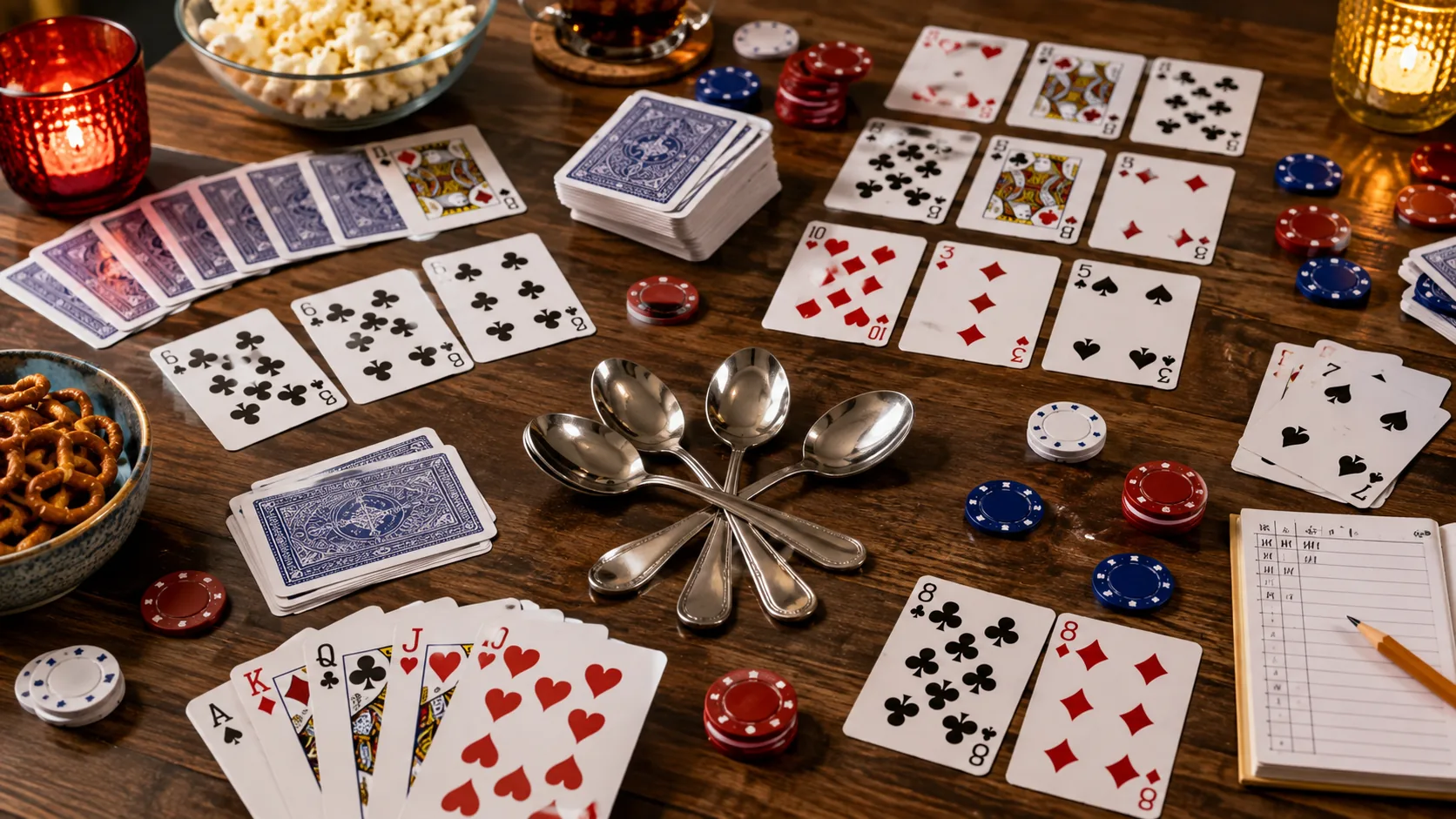
Direct Answer: The best party games with playing cards include Spoons, Kemps, Cheat/I Doubt It, Egyptian Rat Screw, Presidents, Crazy Eights, Pig, Six Card Golf, Slapjack, and Spades. Most need only a standard 52-card deck; Spoons adds one fewer spoon than players, while Kemps works especially well as a four-player team game.
By Gaming Station Editorial Team
Last reviewed: August 2026
You do not need a shelf full of boxed party games to run a good game night. A standard deck can support bluffing, teamwork, reaction games, card shedding, memory, strategy, and fast group competition.
The best party games with playing cards also solve a practical hosting problem: they are inexpensive, portable, quick to reset, and usually much easier to teach than a full board game.
For example, Spoons turns collecting four of a kind into a frantic race for spoons, Kemps has partners communicate through secret signals, I Doubt It—also commonly called Cheat or Bullshit—builds the entire game around bluffing, and Egyptian Rat Screw rewards fast reactions to specific card patterns. Bicycle publishes current rules for all four using standard playing cards.
This guide ranks ten of the best card games for parties, explains the essential rules, and shows which options work best for adults, families, small groups, and larger game nights.
Best Party Games With Playing Cards at a Glance
| Rank | Game | Best For | Recommended Group | Main Style | Extra Equipment |
|---|---|---|---|---|---|
| 1 | Spoons | Best overall party game | 3+ | Speed / four of a kind | Spoons |
| 2 | Kemps | Best team game | 4 with one deck | Teams / secret signals | None |
| 3 | Cheat / I Doubt It | Best bluffing game | 3–6 | Bluffing / shedding | None |
| 4 | Egyptian Rat Screw | Best reaction game | 2–6 | Speed / slapping | None |
| 5 | Presidents | Best adult social game | 3+ | Climbing / shedding | None |
| 6 | Crazy Eights | Best easy party card game | 2–5+ | Matching / shedding | None |
| 7 | Pig | Best simple large-group game | 5+ | Passing / observation | None |
| 8 | Six Card Golf | Best calmer party game | 2–4 | Memory / low-score strategy | Paper for scoring |
| 9 | Slapjack | Best easy reaction game | 2–5+ | Slapping / speed | None |
| 10 | Spades | Best strategic group game | Best with 4 | Trick-taking | Score sheet |
Most games here use one normal 52-card deck. Kemps uses one deck for four players but Bicycle recommends adding another deck for a larger group, while Spoons requires one fewer spoon than the number of players.
How We Chose the Best Party Games With Playing Cards
The Gaming Station Editorial Team prioritized games that meet most of these criteria:
- Work with a standard 52-card deck
- Support multiple people
- Have rules that can be explained relatively quickly
- Produce meaningful player interaction
- Require little setup
- Work well in a social environment
- Offer enough replay value for repeated game nights
- Do not depend on gambling or alcohol
- Cover different styles instead of repeating the same mechanic ten times
The ranking also favors games where the other people at the table matter. That distinguishes a good party card game from a multiplayer game where everybody quietly works on an individual puzzle.
1. Spoons — Best Party Game With Playing Cards Overall
Spoons is the strongest overall recommendation when the goal is laughter, speed, and immediate group interaction.
Bicycle lists Spoons for 3, 4, or 5+ players using a standard 52-card deck plus one fewer spoon than the number of players. Each player receives four cards and tries to collect four of a kind while cards circulate rapidly around the table.
Once somebody gets four matching ranks, that player quietly grabs a spoon.
Then chaos begins.
Everyone else can grab a spoon too, but because there is one fewer spoon than players, somebody is left empty-handed. Under Bicycle’s scoring system, that person receives a letter toward spelling S-P-O-O-N; spell the entire word and you are eliminated.
Why Spoons works at parties
The clever part is that the four-of-a-kind is only half the game.
Players also need to notice:
- Someone reaching toward the center
- A spoon disappearing quietly
- Other players suddenly reacting
That creates moments where half the table knows what is happening and the other half is still studying their cards.
Basic setup
If six people are playing:
- Use 1 standard 52-card deck
- Put 5 spoons in the center
- Deal 4 cards to each player
- Begin passing unwanted cards around the circle
Best for
- Family gatherings
- Mixed gaming experience
- Larger casual groups
- Fast openers
- Players who enjoy physical reaction games
Main caution
Clear drinks and fragile objects away from the spoons before starting. A fast grab across a crowded game-night table can knock over more than the intended spoon.
Gaming Station verdict: If a group wants one game that can change the energy in the room immediately, start with Spoons.
2. Kemps — Best Team Party Card Game
Kemps combines card collecting with secret communication between teammates.
Bicycle’s rules describe Kemps as a game played in pairs. Players try to collect four of a kind, then use a previously agreed non-verbal secret signal so their partner knows to call “Kemps!”
For a four-player game:
- Split into two teams.
- Partners sit across from one another.
- Deal four cards to each player.
- Put four face-up cards in the middle.
- Players exchange cards with the central display simultaneously.
- When somebody collects four of a kind, they secretly signal their partner.
- If the partner notices, they call “Kemps!”
Bicycle specifically describes the play as continuous rather than turn-based: players swap individual cards with the four face-up center cards while trying to complete a matching set.
The secret signal is the game
Before play, teammates choose something subtle such as:
- Touching an ear
- Winking
- Changing posture
- Scratching the chin
- Adjusting cards in a particular way
The signal needs to be visible to the teammate without being obvious to the other team.
Opponents can also attempt to detect a four-of-a-kind and call Kemps on the other team. Bicycle’s rules award a point for a correct call and penalize an incorrect one.
Why Kemps is one of the best group card games
It creates interaction on several levels:
Collect cards → watch partner → hide signal → watch opponents → intercept their signal
That is much more social than simply calculating the strongest hand.
Player-count note
Bicycle uses one standard 52-card deck for four players and notes that two decks can be used for larger groups. Therefore, for an article specifically focused on games with a 52-card deck, four players is the cleanest Kemps configuration.
Best for: Exactly four players who want teams and social deception.
3. Cheat / I Doubt It — Best Bluffing Party Card Game
Cheat is one of the best card games for parties because lying is an intentional game mechanic rather than a rules violation.
Bicycle publishes the game as I Doubt It and uses a standard 52-card deck. The goal is to become the first player to discard every card.
Ranks are claimed in sequence:
Aces → Twos → Threes → Fours → … → Queens → Kings → back to Aces
On a turn, a player puts one to four cards face down and claims that they match the current rank.
The cards may be genuine.
Or they may be complete lies.
Example
Required rank: Sixes
Player says:
“Three Sixes.”
The three face-down cards could actually be:
- 6♠
- K♦
- 2♥
Nobody knows unless someone challenges.
How challenges work
Any player may call “I doubt it” or, in common variations, “Cheat” or “BS.”
The latest cards are revealed.
- If the claim was false, the liar takes the entire discard pile.
- If the claim was truthful, the challenger takes the entire pile.
Why it works at parties
Cheat rewards:
- Bluffing
- Reading people
- Memory
- Probability
- Confident storytelling
- Knowing when not to challenge
The discard pile also creates escalating tension. A questionable claim when five cards are in the center is one thing; risking a challenge when 30 cards are waiting is much more dangerous.
Best group
Bicycle lists the game for 2, 3, 4, and 5+ players, but three to six is an especially practical social range because more opponents create more hidden information without making each round too long.
Best for: Adults and teens who like bluffing and calling each other out.
4. Egyptian Rat Screw — Best Fast Reaction Card Game
Egyptian Rat Screw combines card sequencing with sudden slap opportunities.
Bicycle lists the game for 2, 3, 4, or 5+ players, using a standard 52-card deck; Jokers can optionally be included. Players receive face-down piles and turn cards into a shared center without looking ahead.
Normal play continues until somebody turns over:
- Jack
- Queen
- King
- Ace
The next player then has a limited opportunity to produce another face card or Ace. If they fail, the previous face-card player takes the central pile.
Then come the slap rules.
Bicycle’s version includes patterns such as:
- Double: two equal ranks together
- Sandwich: equal ranks separated by one card
- Top Bottom: current card matches the first card in the pile
- Tens: selected combinations total 10
- Four in a row: four consecutive ranks
- Marriage: King and Queen adjacent
The first person to slap a valid pattern wins the central pile.
Why it gets intense
Players are simultaneously:
- Watching turn order
- Tracking face-card challenges
- Scanning for slap combinations
- Trying not to slap incorrectly
Bicycle penalizes an incorrect slap by requiring cards to be added to the bottom of the central pile.
Best way to teach it
Do not begin with every optional slap combination.
For a first party game, use only:
- Doubles
- Sandwiches
Once everyone understands the rhythm, add more patterns.
That is a house simplification, not a different core game.
Best for: Competitive groups with fast reactions.
5. Presidents — Best Party Card Game for Adults
Presidents is an excellent adult group game for people who want more strategy than Spoons but still want strong social interaction.
Bicycle lists Presidents for 3, 4, or 5+ players and labels its current ruleset for ages 18+.
The goal is to discard your hand before everyone else.
A player can lead:
- One card
- A pair
- Three equal cards
- Another set of equal ranks
The next player must either:
- Play the same number of cards at a higher rank, or
- Pass
For example:
Two Sixes can be beaten by:
- Two Sevens
- Two Queens
- Two Aces
but not by:
- One King
- Three Sevens
Bicycle specifies that matching sets must contain the same number of cards as the play they are beating.
Why it is social
The first player to empty their hand becomes President, while the last player remaining receives the lowest social rank under Bicycle’s rules.
The ranking creates an ongoing narrative across repeated hands.
Players remember:
- Who dominated the last round
- Who kept blocking whom
- Who is trying to move up the hierarchy
Strategy tip
Do not automatically burn your highest cards early.
Strong cards become especially useful when several opponents are close to emptying their hands and controlling a new lead matters.
Best for: Adult game nights where players want direct competition and multiple rounds.
6. Crazy Eights — Best Easy Party Card Game
Crazy Eights is one of the safest games to teach when several guests rarely play cards.
Bicycle lists it for 2, 3, 4, or 5+ players using a standard 52-card deck. The goal is simply to become the first person with no cards remaining.
Players place cards onto a discard pile by matching either:
- Suit, or
- Rank
For example, if the top card is:
Q♣
you can normally play:
- Any Club
- Any Queen
- Any Eight
Eights are wild. When playing one, the player chooses which suit must be followed next.
Why beginners understand it quickly
The core question on almost every turn is:
“Can I match the suit or number?”
There are not dozens of exceptions.
That makes Crazy Eights an ideal fallback when:
- People arrive unexpectedly
- The planned game has too many rules
- Children and adults are playing together
- You need something before the main event
Why it is useful at parties
It has low setup friction but still creates interaction through:
- Suit selection
- Holding wild Eights
- Watching opponents’ hand sizes
- Choosing when to change the active suit
Bicycle’s published version is suitable for ages 4+ and supports five or more players.
Best for: Mixed-skill groups and last-minute game nights.
7. Pig — Best Simple Game for a Larger Group
Pig is one of the simplest large-group card games in this guide.
Bicycle lists it for 5+ players using a standard 52-card deck. Each player receives four cards and repeatedly passes one unwanted card to the player on the left while receiving another from the right.
The objective is to collect four cards of the same rank.
But unlike Spoons, there is no spoon race.
When someone gets four of a kind, that person silently places a finger on their nose.
Everyone else who notices does the same.
The last person to notice is the Pig.
Why it works so well socially
The winner does not need to make an announcement.
The funniest moments occur when:
- Four people already have fingers on their noses
- One player is still frantically passing cards
- Nobody says anything
It is essentially observation disguised as a card-collecting game.
Pig vs. Spoons
Choose Spoons when you want physical chaos.
Choose Pig when you want a similar four-of-a-kind foundation with less grabbing across the table.
Best for: Five or more players, families, and easy party rounds.
8. Six Card Golf — Best Calmer Party Card Game
Not every party game needs shouting or slapping.
Six Card Golf provides a slower option for groups that want conversation while they play.
Bicycle lists it for 2–4 players, ages 8+, with one standard 52-card deck. Each player receives six face-down cards arranged in two rows of three and initially turns two cards face up.
Players draw from either the:
- Stock pile, or
- Discard pile
and use the drawn card to improve the six-card layout.
The objective is to finish with the lowest score, and a full game traditionally consists of nine deals or “holes.”
Key scoring
Under Bicycle’s rules:
- Ace = 1
- Two = -2
- 3 through 10 = face value
- Jack or Queen = 10
- King = 0
- Matching cards in the same column = 0 for that column
Why it works at a gathering
Six Card Golf creates enough decision-making to stay interesting without demanding constant attention.
Players can still:
- Talk
- Eat
- Take turns casually
- Follow the game without split-second reactions
That makes it a useful contrast to Spoons or Egyptian Rat Screw.
Best for: Four-person dinners, quieter gatherings, and mixed-age groups.
9. Slapjack — Best Simple Reaction Game
If Egyptian Rat Screw sounds fun but has too many special slap patterns, start with Slapjack.
Bicycle lists Slapjack for 2, 3, 4, or 5+ players with a standard 52-card deck. The objective is to win every card.
Players take turns revealing the top card of their face-down pile into the center.
When a Jack appears:
Everyone slaps.
The first player to place a hand directly on the Jack wins that card and all the cards beneath it.
Wrong slap penalty
If a player slaps a card that is not a Jack, Bicycle’s rules require that player to give a card to the person who played the incorrectly slapped card.
Why it is easy to teach
The entire reaction rule is:
See Jack → slap Jack
That means players can begin almost immediately.
Slapjack vs. Egyptian Rat Screw
| Choose Slapjack If… | Choose Egyptian Rat Screw If… |
|---|---|
| Players are beginners | Group wants more complexity |
| Children are playing | Players like pattern recognition |
| You want one slap rule | You want several slap triggers |
| Rules need to take 1 minute | Learning more rules is fine |
Best for: Easy reaction-game rounds with almost no teaching time.
10. Spades — Best Strategic Group Card Game
Spades is the strongest choice here when the group wants a traditional strategy game rather than pure party chaos.
Bicycle’s Spades rules use a standard 52-card pack. Spades are always trump, and players bid the number of tricks they expect to take before the hand begins.
A trick consists of one card played by each participant. Players normally follow the suit that was led if possible, and the highest card of that suit wins unless a Spade is played, in which case the highest Spade wins.
Why Spades belongs on a party list
It works especially well when four regular players want something with:
- Partnerships
- Table talk between hands
- Repeated rounds
- Bidding
- Risk management
- Long-term scoring
The core tension is not simply winning the maximum number of tricks.
Players first bid what they expect to win, so performance is measured against a declared target. Bicycle’s scoring awards contract points when players meet their bids and penalizes failing to make the contract.
Best for
- Adult groups
- Four-player game nights
- Regular card players
- Groups wanting more strategy
Skip it if: The group wants an immediate five-minute teach. Crazy Eights or Spoons will start much faster.
Best Card Games for Parties by Group Size
2 Players
A party normally implies a larger group, but if only two people are left:
- Crazy Eights
- Egyptian Rat Screw
- Slapjack
- Six Card Golf
All four are supported at two players in Bicycle’s current rules.
3 Players
Best options:
- Spoons
- Cheat / I Doubt It
- Presidents
- Crazy Eights
- Egyptian Rat Screw
- Six Card Golf
Spoons begins at three players, while Presidents and I Doubt It also officially support three-player play.
4 Players
This is the most flexible group.
Best picks:
- Kemps for teams
- Spades for strategy
- Spoons for chaos
- Cheat for bluffing
- Six Card Golf for something calmer
- Crazy Eights for beginners
Kemps is particularly suitable here because Bicycle specifies one 52-card deck for four players.
5+ Players
Best large-group choices:
- Spoons
- Pig
- Presidents
- Cheat
- Crazy Eights
- Slapjack
- Egyptian Rat Screw
Pig is explicitly listed for 5+ players, while Bicycle also supports larger groups for Spoons, Presidents, Crazy Eights, Slapjack, I Doubt It, and Egyptian Rat Screw.
Best Easy Party Card Games for Beginners
For players who do not regularly play cards, start with games whose objectives can be explained in one sentence.
Crazy Eights
Match suit or rank; Eights are wild; first player out wins.
Slapjack
Reveal cards and be first to slap a Jack.
Pig
Collect four of a kind, touch your nose, and don’t be last to notice.
Spoons
Collect four of a kind and grab a spoon before everyone else.
These four are easier first choices than teaching a completely new group Spades scoring or all the slap combinations in Egyptian Rat Screw.
Best Card Games for Adults
Adults do not necessarily need complicated games, but groups often want stronger bluffing, tactics, or social interaction.
Cheat / I Doubt It
Best for bluffing and reading opponents.
Presidents
Best for repeated social rounds and competitive card shedding. Bicycle currently labels its ruleset 18+.
Spades
Best for teams and long-term strategic play.
Kemps
Best for couples or pairs who want secret-team communication. Couples who prefer a question-based activity can also try these newlywed game questions.
Egyptian Rat Screw
Best for a competitive group that wants speed alongside more rules depth.
None requires turning the evening into a drinking or gambling game.
Fast Games vs. Strategic Games
Choose based on the atmosphere you want.
| If You Want… | Play |
|---|---|
| Maximum chaos | Spoons |
| Secret teams | Kemps |
| Bluffing | Cheat |
| Fast reflexes | Egyptian Rat Screw |
| Social hierarchy | Presidents |
| Very easy rules | Crazy Eights |
| Silent observation | Pig |
| Relaxed conversation | Six Card Golf |
| Simple slapping | Slapjack |
| Partnership strategy | Spades |
How to Turn One 52-Card Deck Into a Full Party Game Night
A single deck can cover an entire evening if you change the game style between rounds.
A practical sequence for six people is:
Round 1: Crazy Eights
Start with an easy game while everyone settles in.
Round 2: Cheat
Move into bluffing once the group is comfortable.
Round 3: Spoons
Increase the energy with a physical reaction game.
Round 4: Presidents
Finish with several competitive social rounds.
This creates variety without needing another boxed game.
For four players, try:
Kemps → Six Card Golf → Spades
That progression moves from fast social play to a calmer middle game and finishes with deeper strategy.
If your group prefers questions and team competition, explore these trivia board games for another game-night format.
Standard 52-Card Deck Setup Tips
Before game night:
- Remove Jokers unless the chosen rules specifically use them.
- Verify that all 52 cards are present.
- Shuffle thoroughly between different games.
- Keep a score pad and pen nearby.
- Clear enough space for central piles.
- Move drinks away before starting slap games.
- Keep spoons ready if Spoons is on the schedule.
Egyptian Rat Screw can optionally include Jokers, but Bicycle’s base equipment remains a standard 52-card deck.
Common Mistakes When Hosting Card Games for Parties
Choosing a Strategy Game for a Casual Group
Spades can be excellent, but not when everyone expected a five-minute party game.
Match the complexity to the room.
Teaching Every Variation
Many traditional card games have dozens of regional rules.
Teach one ruleset first.
House rules can come later.
Starting Spoons on a Crowded Table
Move glasses, plates, candles, and phones before placing the spoons in the center.
Using Too Many Slap Rules Immediately
Egyptian Rat Screw becomes difficult for beginners when seven trigger patterns are introduced before the first card is played.
Start small.
Changing Cheat Rules Midgame
Agree before dealing on:
- Rank order
- Whether passing is allowed
- When challenges can occur
- What happens on the final card
Bicycle’s published ascending version uses Aces, then Twos, Threes, and onward through Kings before returning to Aces.
Forgetting Player Count
Kemps needs pairs, while Pig is specifically designed for 5+ under Bicycle’s rules.
Quick Rules Cheat Sheet
| Game | Explain It in One Sentence |
|---|---|
| Spoons | Make four of a kind, then grab a spoon before someone else does. |
| Kemps | Get four of a kind and secretly signal your teammate. |
| Cheat | Play cards face down, claim a required rank, and decide who is lying. |
| Egyptian Rat Screw | Reveal cards and win the pile through face-card battles or correct slaps. |
| Presidents | Beat the previous equal-sized set with higher cards and empty your hand first. |
| Crazy Eights | Match rank or suit; Eights are wild. |
| Pig | Collect four matching cards and touch your nose without being last. |
| Six Card Golf | Replace hidden cards and finish with the lowest score. |
| Slapjack | Reveal cards and slap every Jack first. |
| Spades | Bid tricks, then try to win the number you promised with Spades as trump. |
Which Party Card Game Should You Choose?
Use this quick decision guide:
Choose Spoons if:
You want the room loud and active.
Choose Kemps if:
Four people want to play in teams.
Choose Cheat if:
Your group likes bluffing and accusing each other.
Choose Egyptian Rat Screw if:
Players enjoy speed and pattern recognition.
Choose Presidents if:
Adults want several competitive social rounds.
Choose Crazy Eights if:
You need something everyone can understand quickly.
Choose Pig if:
Five or more people want an extremely easy game.
Choose Six Card Golf if:
Everyone wants to talk while playing.
Choose Slapjack if:
You want a simpler alternative to Egyptian Rat Screw.
Choose Spades if:
Four regular players want strategy rather than party chaos.
Final Verdict
The best party games with playing cards demonstrate how much variety is hidden inside a single standard deck.
For most groups, Spoons is the strongest party starter because it combines simple four-of-a-kind collecting with a physical race for spoons. Bicycle supports it for three or more players with one fewer spoon than participants.
For four players, Kemps provides one of the most social team experiences by adding secret signals to real-time card collection.
If the group prefers psychological play, Cheat/I Doubt It turns every face-down card into a potential lie, while Egyptian Rat Screw and Slapjack serve groups who prefer speed and reaction.
Crazy Eights is the best fallback for inexperienced players, Pig scales well to larger casual groups, and Six Card Golf gives a party a slower game where conversation can continue between turns.
For adults who want more sustained competition, Presidents and Spades add considerably more tactical decision-making without requiring a specialty deck.
A good card-game night therefore does not need ten boxes. One complete 52-card deck, the right rules for the group, and a few spoons can cover most of the evening.
Frequently Asked Questions
What are the best party games with playing cards?
Spoons, Kemps, Cheat/I Doubt It, Egyptian Rat Screw, Presidents, Crazy Eights, Pig, Six Card Golf, Slapjack, and Spades are strong options. They cover speed, bluffing, teamwork, strategy, matching, memory, and reaction-based gameplay using standard playing cards.
What is the easiest card game for a party?
Crazy Eights is one of the easiest. Players match the current card by suit or rank, while Eights are wild and can change the active suit. Bicycle lists it for two through five or more players with a standard 52-card deck.
What card game is best for a large group?
Spoons and Pig are particularly well suited to larger casual groups. Spoons is listed for three or more players, while Pig is specifically listed for five or more. Both revolve around collecting four of a kind and reacting to other players.
What is a good four-player card game for a party?
Kemps is one of the best four-player options because two teams compete to collect four of a kind while communicating through secret non-verbal signals. Bicycle specifies one standard 52-card deck for four players.
What games can you play with a standard 52-card deck?
A single deck supports games including Crazy Eights, Cheat/I Doubt It, Slapjack, Egyptian Rat Screw, Pig, Six Card Golf, Presidents, Spades, and many others. Spoons also uses a standard deck but requires spoons as additional equipment.
What are good card games for adults?
Cheat is strong for bluffing, Presidents for social competition, Spades for partnership strategy, Kemps for team communication, and Egyptian Rat Screw for fast reaction play. Bicycle currently labels Presidents for ages 18+, while the other games have different published age ranges.
Is Spoons played with a normal deck of cards?
Yes. Bicycle’s published Spoons rules use one standard 52-card deck plus one fewer spoon than the number of players. Each player receives four cards and tries to collect four of a kind before the spoon race begins.
What is a good party card game that does not require fast reactions?
Six Card Golf is a good alternative. Players manage six-card layouts and try to achieve the lowest score through drawing, replacing, and pairing cards. Bicycle lists it for two to four players using a standard 52-card deck.
New to the classic? Learn how to play Cheat — setup, rules, and strategy for this bluffing card game.
