
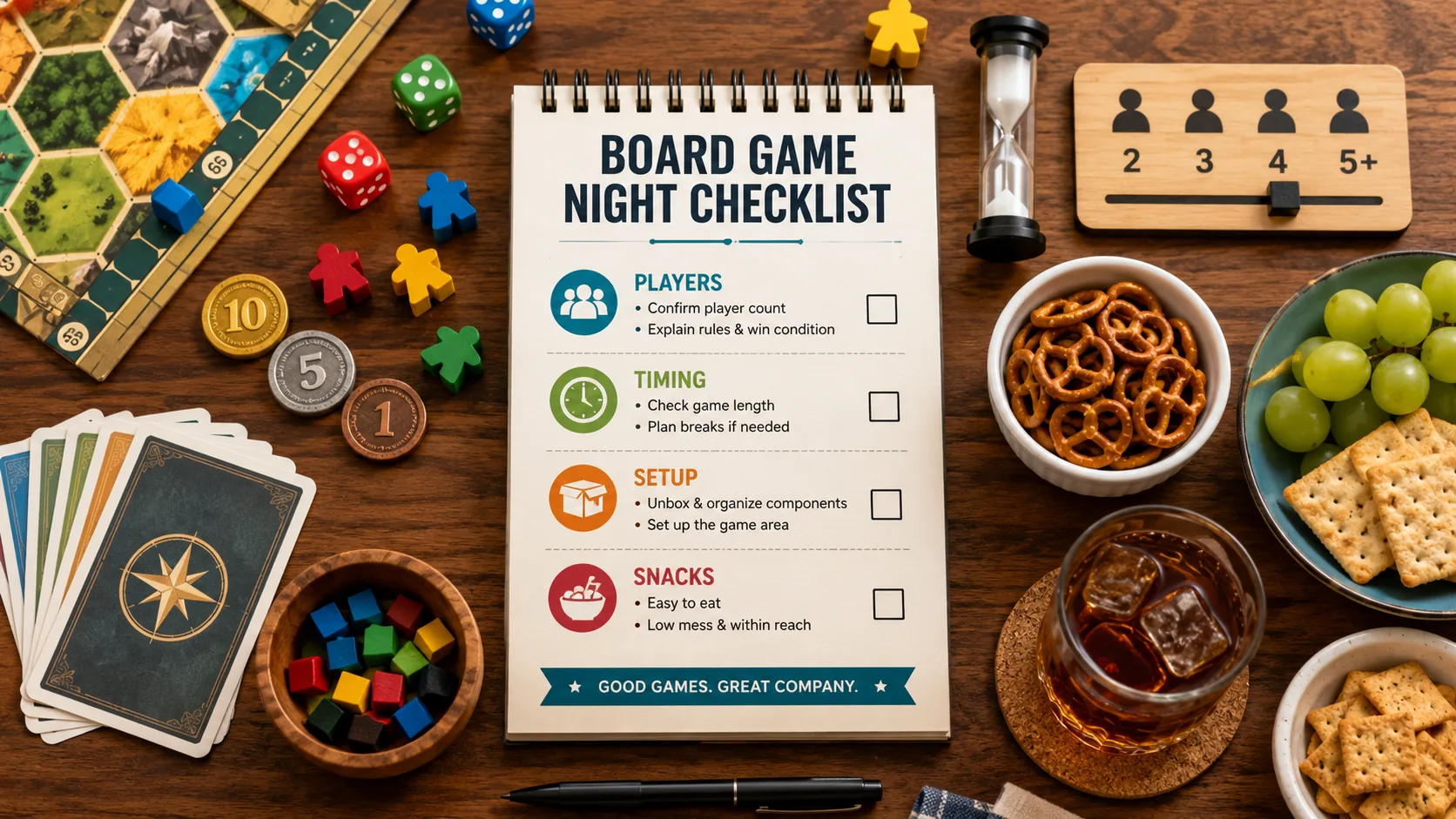
Direct Answer: A reliable board game night checklist starts with confirming the player count, choosing one main game plus a backup, checking the real play-and-teach time, preparing the table before guests arrive, and serving clean, low-mess snacks. Keep the first game easy to learn and save longer strategy games for groups that already know the rules.
By Gaming Station Editorial Team
Last reviewed: August 2026
A successful board game night depends on more than owning good games. Player count, arrival time, rules complexity, table space, food, breaks, and even where drinks are placed can determine whether the group completes three enjoyable games or spends half the evening deciding what to play.
The most useful board game night checklist therefore starts before anyone sits down.
A two-person evening can support a tightly designed cooperative game such as Sky Team, which is made exclusively for two players and takes about 20 minutes. A larger group may be better matched with Codenames, officially listed for 4–8+ players at about 15 minutes, or Just One, which supports 3–7 players and takes about 20 minutes.
This guide explains how to host a board game night from invitation to cleanup, including player-count planning, timing formulas, game selection, table setup, rules teaching, game night snacks, and ready-to-use checklists.
Board Game Night Checklist at a Glance
| Task | When to Do It | Priority |
|---|---|---|
| Confirm player count | 2–5 days before | Essential |
| Check experience levels | Before choosing games | Essential |
| Pick one main game | 1–2 days before | Essential |
| Pick one backup game | 1–2 days before | Highly recommended |
| Check official player count | Before game night | Essential |
| Check playtime | Before game night | Essential |
| Learn rules yourself | Before guests arrive | Essential |
| Organize components | 30–60 minutes before | Recommended |
| Clear adequate table space | Before arrival | Essential |
| Set up chairs and lighting | Before arrival | Essential |
| Put drinks away from game area | Before play | Recommended |
| Prepare low-mess snacks | Before play | Recommended |
| Explain the objective first | Before each new game | Essential |
| Schedule a break for long sessions | Between games | Recommended |
| Pack components carefully | End of night | Essential |
1. Confirm the Player Count First
The most important number for a game night is not the number of games on the shelf.
It is the number of people actually attending.
A game designed around two players can feel fundamentally different at four, while a large party game may not function at all with only two or three people.
Before choosing anything, confirm:
- Number of confirmed players
- Possible late arrivals
- Whether anyone may leave early
- Whether couples prefer playing together or separately
- Whether everyone is comfortable with competitive games
- Whether anyone is completely new to modern board games
Do this before selecting the headline game.
How to Choose a Board Game by Player Count
Use player count as your first filter.
2 Players
Dedicated two-player designs are usually preferable to forcing a large multiplayer game into its minimum player count.
Sky Team is explicitly designed for exactly two cooperative players, with the publisher describing a typical session at about 20 minutes.
Good formats include:
- Cooperative duels
- Abstract strategy
- Card games
- Two-player engine builders
- Head-to-head tactical games
Best setup: One main game plus one shorter backup.
3 Players
Three-player groups have access to many strategy games, but some team-based party games become awkward because teams cannot divide evenly.
Prioritize:
- Competitive strategy games
- Cooperative games
- Tableau builders
- Card games
- Games without fixed teams
If choosing a party game, verify that its rules genuinely support three rather than assuming it will work.
4–5 Players
This is one of the most flexible ranges.
Wingspan, for example, officially supports 1–5 players and has a listed game length of roughly 40–70 minutes on Stonemaier’s main game page.
Four or five players work particularly well for:
- Medium-weight strategy
- Cooperative games
- Social deduction
- Word games
- Drafting games
- Engine-building games
At this size, keep downtime in mind. A game with long individual turns can become significantly slower as more people are added.
6–7 Players
Start considering games designed around:
- Simultaneous actions
- Teams
- Fast turns
- Clue-giving
- Social interaction
Just One supports 3–7 players and is listed at approximately 20 minutes.
7 Wonders is another useful structural example: Repos Production says the game supports up to seven players while having everyone make choices simultaneously, which reduces dead time; the publisher lists a roughly 30-minute game.
8+ Players
At this size, traditional turn-by-turn strategy games become harder to manage.
Prioritize:
- Team games
- Party games
- Social deduction
- Simultaneous play
- Trivia
- Word games
The current edition of Codenames is officially listed for 4–8+ players and approximately 15 minutes.
For very large groups, teams are usually more practical than requiring every individual to have a separate turn.
Quick Player-Count Guide
| Group Size | Best Starting Format |
|---|---|
| 2 | Dedicated two-player or cooperative game |
| 3 | Strategy, cards, cooperative |
| 4–5 | Almost any standard board-game format |
| 6–7 | Party, drafting, simultaneous play |
| 8+ | Team, social, trivia, deduction |
This is an editorial planning guide rather than a universal rules table. Always use the publisher’s player count for the specific game being considered.
2. Decide What Kind of Night You Are Hosting
Do not ask only:
“What game should we play?”
Ask:
“What kind of evening are we trying to have?”
There are several common formats.
Casual Game Night
Best when people mainly want to talk and relax.
Choose:
- Short games
- Easy rules
- Low downtime
- 15–45 minute sessions
- Games that tolerate conversation
Avoid starting with a complex two-hour strategy game unless everyone specifically asked for it.
Strategy Night
Best for an experienced group that has deliberately gathered to play.
Choose:
- One substantial main game
- Optional short opener
- Minimal interruptions
- A rules reference ready
- More table space
Players should ideally know in advance what the main game is.
Party Game Night
Best for larger groups or mixed gaming experience.
Choose:
- Team games
- Trivia board games
- Drawing
- Word games
- Social deduction
- Simultaneous play
Codenames fits this type particularly well because its official player range starts at four and extends beyond eight.
Couples Game Night
For two players, alternate between:
- Cooperative play
- Competitive strategy
- Quick card games
- Puzzle games
If one person dislikes losing directly to the other, use cooperative games as the primary format.
Family Game Night
Prioritize:
- Suitable age rating
- Short teach
- Reasonable playtime
- Limited player elimination
- Simple turn sequence
The youngest or least experienced player should heavily influence the difficulty choice.
3. Pick One Main Game and One Backup
One of the easiest ways to waste a game night is to present guests with 25 boxes and ask:
“What does everyone feel like playing?”
Instead, prepare:
Main Game
The game you expect to play.
Backup Game
A shorter or easier alternative in case:
- Someone cancels.
- An extra person arrives.
- The main game looks too complex.
- People are tired.
- Time is running short.
Optional Filler
A 10–20 minute game for:
- Waiting for a late guest
- After dinner
- Between two larger games
- The end of the evening
A practical lineup might be:
20-minute opener → 60-minute main game → optional 15-minute closer
That feels much more organized than deciding from scratch every time a box closes.
4. Calculate the Real Time Available
The playtime printed on a box is not your entire game-night schedule.
You also need time for:
- Arrivals
- Greetings
- Food
- Setup
- Rules explanation
- Questions
- Breaks
- Cleanup
A useful planning formula is:
Total game-night time = Arrival/social time + Setup + Teach + Gameplay + Breaks + Cleanup
For example:
| Activity | Time |
|---|---|
| Guests arrive / chat | 20 min |
| Rules + setup | 20 min |
| Main game | 60 min |
| Break | 15 min |
| Second game | 30 min |
| Cleanup | 15 min |
| Total | 160 min |
That is 2 hours 40 minutes, even though the two games themselves total only 90 minutes.
Add a New-Player Time Buffer
If nobody has played the game before, use this practical estimate:
Planned slot = Published playtime × 1.25 to 1.5
This is an editorial planning rule, not an official industry formula.
A 60-minute game might therefore deserve:
75–90 minutes
on the schedule when several players are learning.
For complicated games, allow even more.
5. Match Game Complexity to the Group
The best game on the shelf can still be the wrong game tonight.
Ask:
- Has everyone played modern board games before?
- Does anyone dislike long rules explanations?
- Is the group tired after work?
- Are people primarily there to socialize?
- Do guests enjoy direct competition?
- Does anyone need to leave at a fixed time?
For New Players
Start with:
- Clear objectives
- Few actions per turn
- Limited text
- Short games
- Fast feedback
For Experienced Players
You can introduce:
- Asymmetric abilities
- Longer-term strategy
- Resource conversion
- Multi-step actions
- Hidden objectives
- Advanced scoring
Mixed Group
Choose the game according to the least experienced players—not the most experienced player at the table.
A skilled hobby gamer can usually enjoy a lighter game.
A new player may not enjoy being trapped in a complicated one.
6. Learn the Rules Before Guests Arrive
The host should not open a 40-page rulebook for the first time after everybody has sat down.
Before game night:
- Read the rules.
- Watch or review an official tutorial if useful.
- Set up a sample turn.
- Identify the win condition.
- Find the most commonly referenced rules.
- Mark the relevant page numbers.
- Understand endgame scoring.
You do not need to memorize every edge case.
You do need to know the game’s basic loop.
Best Order for Teaching a Board Game
Do not explain components randomly.
Use this sequence.
1. Theme
Give one sentence of context.
“We are competing cities trying to build the strongest economy.”
2. Objective
Tell players how they win.
“Most victory points at the end wins.”
3. End Condition
Explain what ends the game.
4. Turn Structure
Explain what players actually do.
5. Resources and Components
Now explain what the pieces represent.
6. Scoring
Explain how major points are earned.
7. Exceptions
Save unusual rules until the core system is understood.
This prevents players from memorizing tiny details without understanding why any of them matter.
7. Set Up the Game Before Everyone Arrives
For a medium or complex game, pre-setup can save 10–20 minutes of dead time.
Before guests arrive:
- Unfold the board.
- Sort tokens.
- Shuffle decks.
- Place shared resources.
- Set starting pieces.
- Prepare player aids.
- Leave hidden information hidden.
- Confirm that every required component is present.
For a first play, keep the rulebook within reach.
Board Game Night Setup Checklist
A good game night setup needs more than a board.
Table
Make sure the full game fits without cards hanging over edges.
Chairs
Everyone should be able to sit comfortably without constantly standing to see the board.
Lighting
Cards, iconography, and small text must be readable.
Temperature
A room that becomes uncomfortable after an hour will end the game night faster than the rules do.
Noise
Background music can work, but it should not compete with rule explanations or negotiation.
Phones
There is no universal need for a “no phones” rule.
A simpler guideline is:
Phones should not repeatedly stop the game.
Pets
Keep pets away from small components if they are likely to jump onto the table or swallow pieces.
8. Protect the Game From Drinks and Food
A drink does not need to be banned from game night.
It does need a sensible location.
Use:
- Coasters
- Side tables
- Cup holders
- A separate drink zone
Avoid placing open glasses directly beside:
- Card decks
- Player boards
- Paper money
- Rulebooks
- Cardboard tiles
One accidental spill can affect an entire game.
9. Choose Low-Mess Game Night Snacks
The best game night snacks can be eaten easily without leaving grease, powder, crumbs, or sticky residue on components.
Good Snack Options
- Pretzels
- Crackers
- Grapes
- Apple slices
- Small sandwiches
- Cheese cubes
- Nuts, where allergy-safe
- Dry popcorn with minimal seasoning
- Bite-size cookies
- Vegetable sticks
- Toothpick-served appetizers
Higher-Risk Snacks Around Games
Be more careful with:
- Powder-coated chips
- Greasy pizza slices
- Saucy wings
- Sticky candy
- Melted chocolate
- Frosted desserts
- Anything requiring two messy hands
These foods are not forbidden.
Serve them during a food break away from the active game rather than while people are handling cards.
The One-Hand Snack Rule
A simple planning test is:
Can the snack be eaten cleanly with one hand, a toothpick, or a napkin without touching the game afterward?
If yes, it is probably game-table friendly.
If not, put it on the break menu.
10. Check Allergies and Dietary Needs
Ask before buying food rather than guessing.
A short message is enough:
“Any allergies or food restrictions I should know about for game night?”
Keep ingredient packaging available when appropriate so guests can check something themselves.
For severe allergies, follow the guest’s specific requirements rather than assuming “probably safe” is sufficient.
11. Prepare Drinks Separately
A useful basic selection is:
- Water
- Sparkling water
- Soft drinks
- Tea
- Coffee
There is no need for a complicated drink menu unless hosting itself is part of the event.
The main practical rule remains:
Keep liquids farther from the game than snacks.
12. Start With an Easy Game
Even if the main event is a heavier strategy game, a short opener can improve the evening.
Why?
It gives people time to:
- Arrive
- Relax
- Start talking
- Shift into game mode
- Wait for anyone running late
Good opening games usually take under 20 minutes.
Codenames is officially listed at around 15 minutes, while Just One is about 20 minutes.
Do not use a complicated game as the “warm-up.”
13. Do Not Start the Longest Game Too Late
If someone needs to leave at 10:30 p.m., do not begin a 90-minute game at 9:45.
Work backward from the hard stop.
Use:
Latest start time = Required finish time − Expected gameplay − Teaching/setup buffer
Example:
Guests must finish by 10:30 p.m.
Expected game:
75 minutes
Teach/setup:
20 minutes
Therefore:
Latest sensible start = 8:55 p.m.
Add extra buffer if the group is new.
14. Schedule Breaks for Long Games
For games approaching 90 minutes or more, a short break can improve attention.
Good break points include:
- End of a round
- End of an age
- Scenario checkpoint
- Natural scoring phase
Avoid stopping in the middle of a complicated turn if possible.
A 10-minute break is usually easier to recover from than 30 minutes of continuous distraction at the table.
15. Handle Late Arrivals Before They Happen
Decide the rule in advance.
For example:
“We start the main game at 7:30. If you’re later than that, we’ll get you into the next one.”
That is better than making six people wait indefinitely.
For party games, late arrivals may be easy to integrate.
For fixed-player strategy games, they may not be.
16. Avoid Player Elimination Early in the Night
If a six-person game can eliminate somebody 45 minutes before everyone else finishes, consider whether it is appropriate for a social game night.
Early elimination can leave a guest sitting around with nothing to do.
Better alternatives for casual groups include games where:
- Everyone remains active
- Scores determine the winner
- Elimination occurs only near the end
- Players operate in teams
Save harsher elimination games for groups that specifically enjoy them.
17. Keep Rules Disputes Short
Do not let a minor rule question become a 20-minute legal case.
Use this order:
- Check the player aid.
- Check the rulebook.
- Check an official FAQ if readily available.
- If the answer still is not clear, agree on a temporary ruling.
- Verify the correct interpretation after the game.
For casual play, preserving the evening matters more than proving somebody wrong immediately.
18. Have a Backup Plan for a Changed Player Count
Suppose eight people were expected.
Only five arrive.
The game chosen for eight may no longer be the best option.
Prepare alternatives such as:
| Actual Players | Backup Style |
|---|---|
| 2 | Two-player / cooperative |
| 3 | Cards / strategy |
| 4–5 | Mainstream strategy |
| 6–7 | Party / simultaneous |
| 8+ | Teams / social |
Your backup does not need to be another large boxed game.
A deck of cards can solve many scheduling problems.
19. Know When to Stop
The best game night does not necessarily end after the maximum possible number of games.
If everyone has just completed an excellent 90-minute match at 11 p.m., forcing another complicated game may weaken the evening.
Ask:
“One quick game, or call it here?”
Give the group a genuine option.
Finishing while people are still enjoying themselves makes the next invitation easier.
20. Pack Components Before Socializing Takes Over
At the end of a game, spend two minutes restoring the box correctly.
Check:
- Cards
- Dice
- Tokens
- Miniatures
- Player boards
- Rulebooks
- Expansion pieces
Small components are easiest to lose when everyone starts clearing plates and moving chairs at the same time.
Use bags or inserts consistently.
Complete Board Game Night Checklist
Here is the full publish-and-save version.
2–5 Days Before
- Confirm guest list.
- Confirm player count.
- Ask about dietary needs.
- Identify gaming experience.
- Determine competitive vs. cooperative preference.
- Establish approximate start and finish times.
1–2 Days Before
- Choose main game.
- Confirm official player range.
- Check expected playtime.
- Choose backup game.
- Choose a short filler.
- Read the rules.
- Verify all components.
- Plan snacks and drinks.
30–60 Minutes Before
- Clear the table.
- Set up the main game where practical.
- Arrange chairs.
- Improve lighting.
- Chill drinks.
- Prepare snacks.
- Set coasters or a drink area.
- Put the rulebook nearby.
- Keep trash and napkins accessible.
When Guests Arrive
- Do not immediately launch into a 20-minute rules lecture.
- Give everyone a few minutes to settle.
- Confirm the final player count.
- Start with the planned opener if needed.
Before Starting a Game
- Explain theme.
- Explain objective.
- Explain end condition.
- Explain turn structure.
- Explain major scoring.
- Answer basic questions.
- Begin.
During Play
- Keep food away from components.
- Keep drinks controlled.
- Look up only important rules.
- Take breaks during long games.
- Avoid rushing new players.
- Watch the finish time.
At the End
- Confirm final scoring.
- Pack components.
- Clear the table.
- Ask which game people enjoyed most.
- Note good options for the next night.
Sample Three-Hour Board Game Night Schedule
For a casual 7:00–10:00 p.m. evening:
| Time | Activity |
|---|---|
| 7:00–7:20 | Arrival, drinks, snacks |
| 7:20–7:40 | Short opener |
| 7:40–7:50 | Break / main-game setup |
| 7:50–8:05 | Rules explanation |
| 8:05–9:15 | Main game |
| 9:15–9:30 | Food / break |
| 9:30–9:50 | Optional short closer |
| 9:50–10:00 | Cleanup |
This leaves enough flexibility that one slow round does not automatically push the evening an hour past its intended finish.
Board Game Night Ideas by Group Type
Couples
Format: One cooperative + one competitive game.
Example structure:
20-minute cooperative game → break → 30-minute competitive game
Sky Team is one current two-player cooperative option specifically designed around pilot and co-pilot teamwork.
Family
Format: Easy opener + one main family game.
Keep total playtime predictable, especially with younger children.
Friends Who Rarely Play Board Games
Format: Party game first.
Good mechanics:
- Words
- Drawing
- Trivia
- Teams
- Simultaneous choices
Just One’s current edition is designed for 3–7 players and around 20 minutes, making that type of game easy to fit into a social evening.
Experienced Strategy Group
Format: One major game.
Skip unnecessary filler if everyone specifically came to play the main event.
A game such as Wingspan currently supports 1–5 players with an official game-length estimate of 40–70 minutes, though learning groups should budget additional time.
Large Group
Format: Teams and simultaneous play.
Codenames currently supports 4–8+ players and is officially listed at around 15 minutes.
Common Board Game Night Mistakes
| Mistake | Why It Hurts | Better Approach |
|---|---|---|
| Choosing before knowing player count | Game may not work well | Confirm attendance first |
| Giving guests 20 choices | Creates decision paralysis | Pick main + backup |
| Reading rules at the table | Wastes prime game time | Learn beforehand |
| Trusting box time exactly | New groups often need longer | Add a learning buffer |
| Starting too late | Game may not finish | Calculate latest start |
| Greasy snacks at table | Damages components | Use low-mess food |
| Drinks beside cards | Spill risk | Use side area/coasters |
| Choosing for strongest gamer | Beginners may disengage | Match least experienced player |
| No backup game | Cancellation can derail plan | Prepare a flexible alternative |
| Forcing one more game | Ends evening on fatigue | Stop while energy is good |
Quick Hosting Formula
For an easy-to-remember how to host a board game night framework, use:
People → Time → Game → Teach → Table → Food → Play → Pack
People
Who is coming?
Time
How long is actually available?
Game
What matches player count and experience?
Teach
Can the rules be explained efficiently?
Table
Is the physical space ready?
Food
Can everyone snack without damaging components?
Play
Keep the evening moving without rushing.
Pack
Restore the game before cleanup becomes chaotic.
Final Verdict
A strong board game night checklist solves the predictable logistical problems before players arrive.
Start with the confirmed player count, then choose one main game and one backup rather than presenting the entire collection. Use the publisher’s player-count limits and playtime as the starting point, but add extra time when players are learning. Current examples show how much formats vary: Sky Team is exclusively for two, Wingspan supports 1–5, Just One supports 3–7, and Codenames reaches 4–8+ players.
Prepare the game night setup before guests arrive, teach the objective before explaining minor rules, keep drinks away from components, and favor clean game night snacks that do not cover cards in grease or seasoning.
Most importantly, match the game to the people rather than forcing the people to match the game.
A well-organized three-hour night with two enjoyable games is better than a six-hour event spent setting up, arguing over rules, waiting for late arrivals, and deciding what to play.
Frequently Asked Questions
What should be on a board game night checklist?
Confirm the player count, start and finish times, main game, backup game, rules, table space, seating, lighting, snacks, drinks, and cleanup plan. For longer games, also plan a break and add extra time when players are learning.
How do you host a board game night for beginners?
Choose an accessible game with a short teach, learn the rules before guests arrive, pre-set the table, explain the objective first, and avoid overwhelming players with every possible strategy. A short opening game can also make the group more comfortable before the main event.
How do I choose a board game by player count?
Check the publisher’s official range first. Dedicated two-player games work well for couples, 4–5 players support many strategy formats, and larger groups generally benefit from teams or simultaneous play. Sky Team, for example, is exclusively two-player, while Codenames supports 4–8+.
How many board games should I plan for one night?
For most 2–4 hour gatherings, one main game, one backup, and optionally one short filler are enough. Preparing too many choices can waste time deciding instead of playing.
What are the best game night snacks?
Choose foods that are easy to eat without leaving grease, powder, or sticky residue on cards and components. Pretzels, crackers, fruit, cheese cubes, nuts where allergy-safe, and toothpick-served snacks are practical options. Save messy foods for a separate break.
How much extra time should I allow for a new board game?
As an editorial planning rule, budget roughly 25–50% more than the expected gameplay time when several players are learning. Also add separate time for setup and the rules explanation.
What is a good board game night setup?
Use a table large enough for the complete game, comfortable seating, strong lighting, a separate drink area, accessible napkins and trash, and enough space around the board for every player to see and reach their components.
What should I do if the player count changes at the last minute?
Use the backup game. Keep at least one flexible option that works with a different group size, and do not force the originally planned game if its player count no longer suits the people who actually arrived.
Need game ideas for a class assignment? These board game ideas for a school project come with free printables.
