
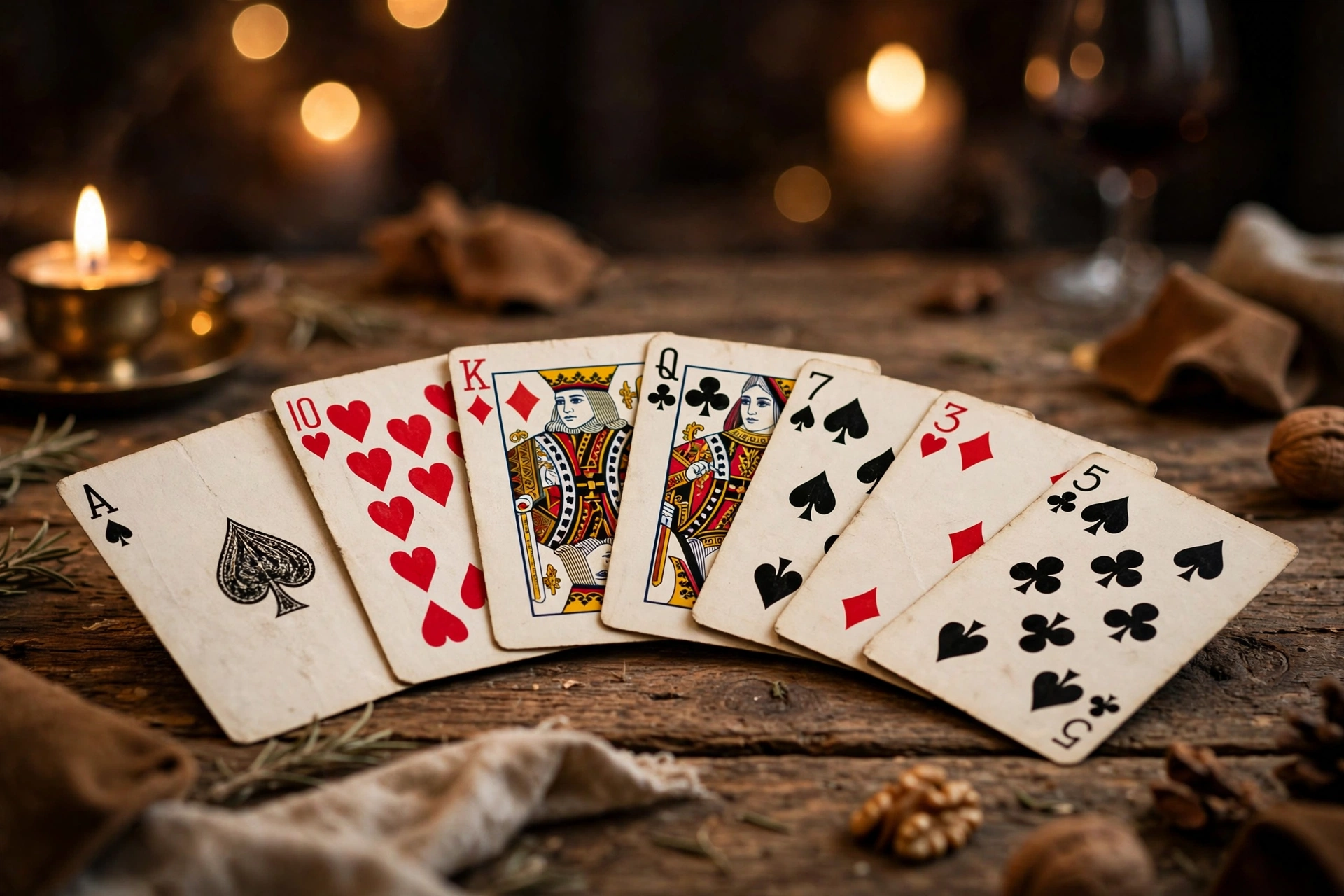
A standard deck of cards costs about two dollars and holds more games than any console ever will. This guide collects 51 of the best classic card games, every one playable with a regular 52-card deck, each summarized in a few lines so you can pick one in minutes instead of scrolling for an hour.
The games are grouped by family: trick-taking, shedding, rummy, bluffing and party, solitaire, kids and family, and two-player classics. If you’d rather not browse, the 30-second picker below will choose for you, and the comparison table near the end lines up the most-searched games side by side. Where we’ve written full rules guides, you’ll find links to them.
One note before we start: you won’t find poker strategy here. This guide sticks to non-gambling card games. And if you’re planning the evening around the game rather than the other way round, our guide to how to host a game night covers guests, timing, and setup.
Researched and written by the Gaming Station Editorial Team.
New to card games? Start with these 6
The easiest card games to learn are Go Fish, Crazy Eights, Spoons, Trash, Cheat, and Rummy. Each one takes less than 15 minutes to teach, needs nothing but a standard 52-card deck, and works the very first time you play it. Start with Go Fish or Crazy Eights for kids, and Spoons or Cheat for a rowdy group of adults.
Go Fish (2-6 players). Ask opponents for ranks, collect pairs, most pairs wins. Five minutes to teach, and it quietly trains the card sense every other game on this list assumes you have.
Crazy Eights (2-7 players). Match the rank or suit of the top discard; eights are wild and let you call the new suit. This is the direct ancestor of Uno, and with scoring added it is honestly the better game.
Spoons (3+ players). Pass cards around the circle, and the moment you hold four of a kind, grab a spoon from the middle. There is always one fewer spoon than players, so someone loses every round. Loud, physical, and over in fifteen minutes.
Trash (2+ players). Flip cards to fill a 1-through-10 layout in order; first to complete the row wins. Kids learn number sequencing while thinking it’s a race. Our full Trash card game rules settle the big regional argument: Jack-wild versus King-wild.
Cheat (3-8 players, also called Bullshit or I Doubt It). Discard face down and announce the rank, truthfully or not. Call out a liar and they eat the pile; accuse wrongly and the pile is yours. The only skill is a straight face. Full bluffing strategy in our Cheat card game rules.
Rummy (2-6 players). Form sets (same rank) and runs (sequences in one suit), lay them down, and go out first. The root of the whole meld family, easy to teach, and the “knock now or build bigger” tension never gets old.
Trick-taking games
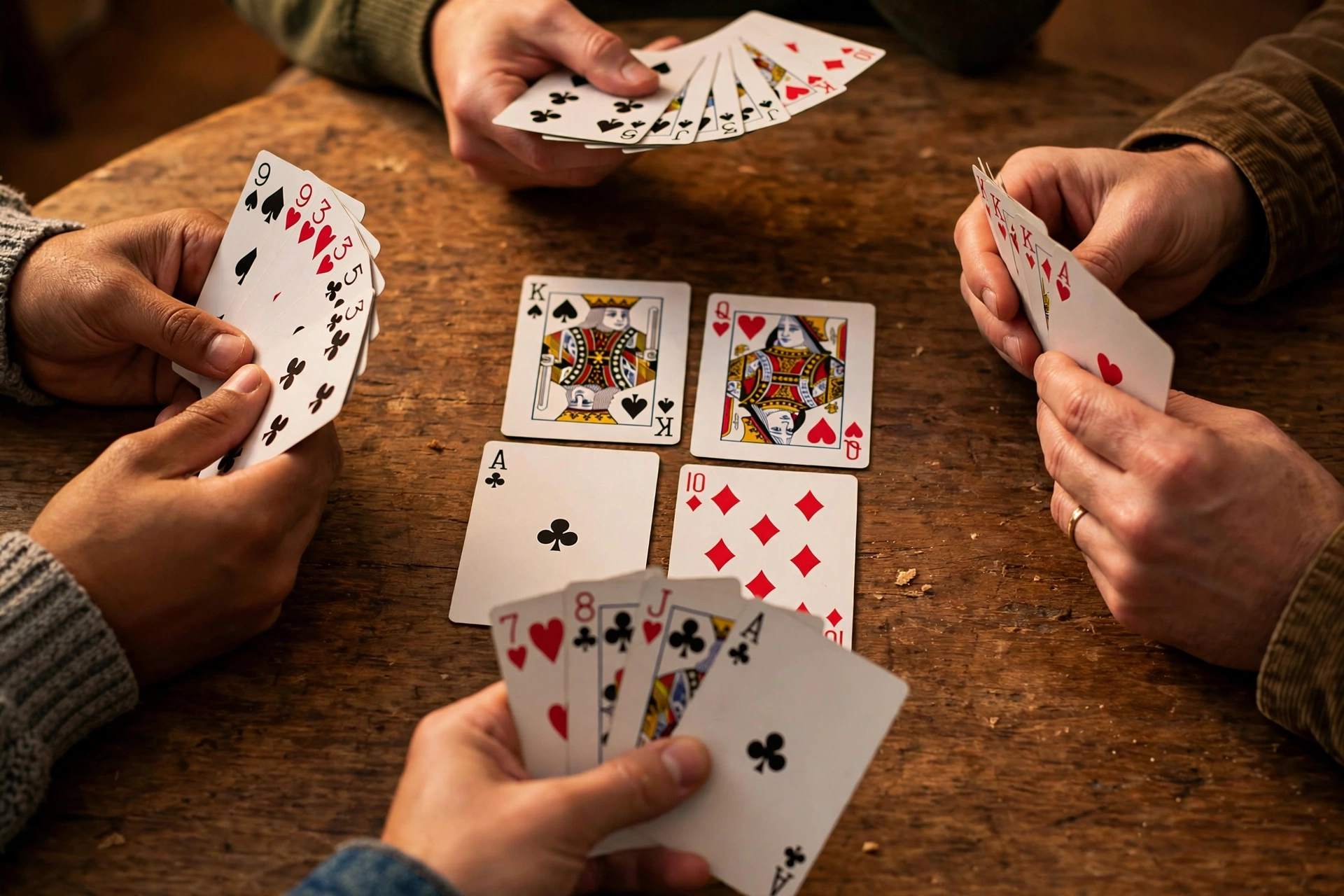
In trick-taking games, everyone plays one card per round (a trick) and the highest card, following rules about suits and trumps, wins it. Score over several hands. This is the oldest and deepest family here.
Hearts (3-6 players). Avoid taking hearts and the queen of spades; lowest score wins. The twist is shooting the moon: take every penalty card in one hand and all 26 points land on everyone else instead. Simple to learn, vicious to master. Full guide: how to play Hearts.
Spades (2-4 players). Partnerships bid how many tricks they’ll take, then must land on the number exactly. Spades are always trump. Bid too high and you bleed points; bid low and you leave points on the table.
Euchre (4 players). A fast partnership trick-taker using only 9s through aces (24 cards). The two jacks, called bowers, become the highest trumps, which confuses first-timers for exactly one hand. Huge in the US Midwest; a full game takes about 30 minutes.
Whist (4 players). The stripped-down ancestor of Bridge: no bidding, just take more tricks than the opposing pair. If Bridge sounds like homework, Whist delivers most of the thrill with none of it.
Bridge (4 players). The deepest card game ever designed, with a bidding language that takes weeks to learn and years to master. Honest warning: don’t start here unless everyone at the table is committed. Whist or Spades first.
Pinochle (2-4 players). Played with a 48-card double deck (two copies of 9 through ace), mixing meld scoring with trick-taking. Big in the US for a century; the doubled cards make for wild, high-scoring hands.
Oh Hell (3-7 players). Bid the exact number of tricks you’ll win, no more, no less. The deal size shrinks then grows every round, so no two hands play alike. Precision beats aggression here.
Knockout Whist (2-7 players). Win at least one trick per round or you’re knocked out; last player standing wins. Brutal, fast, and the single best card game for settling who does the dishes.
Ninety-Nine (3 players). Designed in 1967 by David Parlett specifically because good three-player trick games barely existed. You bid by secretly discarding three cards, then must win exactly that many tricks. The cleverest bidding system in this entire guide.
%
Shedding games
Shedding games have one goal: get rid of all your cards before anyone else does. Easy to teach, hard to put down.
President (4-7 players, also called Scum). Shed everything first to become President; the last player out is the Scum and deals the next hand. Ranks carry between rounds, so winners keep winning until the table rebels. House rules vary wildly, so agree them before dealing. Full guide: how to play President.
Crazy Eights (2-7 players). Match rank or suit, eights go wild. Listed above in the beginner six because it earns the spot twice: it is also the purest shedding game ever made.
Mau Mau (2-5 players). Europe’s answer to Crazy Eights, with penalty cards that skip players, reverse direction, or force draws. German kids learn it young; it plays meaner than it looks.
Switch (2+ players). The British pub version of the same family. Power cards change direction and punish the next player in line. Plays best loud and fast, ideally with a crowd that already knows the basics.
My Ship Sails (4-7 players). Everyone passes one card to the left at the same time, racing to collect seven cards of one suit. No turns, no downtime, just frantic swapping. Over in ten minutes and always demands a rematch.
Rummy and meld games
Meld games are about building sets (same rank) and runs (sequences in one suit) from your hand. Patient, satisfying, and the best family for mixed skill levels.
Rummy (2-6 players). The root of the family, covered above. If you only learn one meld game, this is it.
Gin Rummy (2 players). Ten cards each, race to 100 points, and the knocking decision (end the hand now or build bigger) is a genuine skill. Tighter and more tactical than classic Rummy.
Oklahoma Gin (2 players). Gin with one twist: the face-up card sets the knocking threshold for the hand. If that card is an ace, you can only knock by going gin. A small change that sharpens every decision.
Canasta (4 players). Two decks, partnerships, melds of seven cards. A 1940s craze that still has organized clubs today. Sessions run long, so this is a weekend game, not a weeknight one.
May I (3-5 players). Contract rummy: each round demands specific melds before you can go out, and you may “buy” discards out of turn. The contracts escalate beautifully from easy to brutal. Full contracts in our May I card game rules.
500 Rum (2-8 players). Like Rummy, but every meld scores the moment you lay it down, so even losing hands feel productive. The best meld game for a table with mixed skill levels.
Continental Rummy (2+ players). Twelve contracts, two decks, jokers wild. A marathon, not a sprint; bring players who already know basic Rummy or the first hour will drag.
Hand and Foot (4-6 players). Canasta’s rowdy cousin: huge hands and two meld piles per team, the “hand” and then the “foot.” Chaotic in the best possible way with six players.
Bluffing and party games
These games run on deception, reflexes, or pure chaos. Skill helps, but reading the table helps more.
Cheat (3-8 players). Covered in the beginner six above. The definitive bluffing game, and the one your group will ask for again.
Spoons (3+ players). Covered above. If your group has never played, start here; the spoon scramble converts skeptics fast.
Egyptian Rat Screw (2+ players). Slap the pile on doubles and sandwiches (a card, anything, the same card). Reflexes matter more than strategy, which is exactly why kids routinely destroy adults at it.
Palace (2-5 players). Shed all your cards, except you can’t see half of your own hand. Planning three moves ahead with imperfect information makes this deeper than it looks.
Pig (3-13 players). Collect four of a kind, then secretly touch your nose. The last player to notice loses. Silent, sneaky, and hilarious with a big group.
Kemps (4-6 players, even numbers). Partners use secret signals; collect four of a kind and signal without getting caught. Half the game happens before the first card is dealt, while you invent the signal.
Authors (2-6 players). Ask opponents for specific cards to complete four-of-a-kind “books,” Go Fish style but with the full deck and real memory work. Quieter than the rest of this section, and better for it.
Chase the Ace (3+ players). Everyone gets one card and three tokens. Pass your card left or keep it; lowest card loses a token, and three lost tokens means elimination. Teachable mid-party in two minutes.
Screw Your Neighbour (3+ players). One card each, one chance to swap with the player on your left, lowest card loses the round. Rounds take two minutes; the grudges last all night.
Solitaire games (1 player)
For one player, no opponents required. Every game below uses a single 52-card deck.
Klondike (1 player). The classic: seven tableau piles, build down in alternating colors, stack suits up to the aces. A good player wins roughly a third of games, which keeps it honest.
Spider (1 player). Ten piles, build same-suit sequences of thirteen to clear them. Harder than Klondike by a mile; try the two-suit version before attempting all four.
FreeCell (1 player). Every card is visible from the start, so this is pure logic with almost no luck. Nearly every deal is solvable, which somehow makes the losses sting more.
Pyramid (1 player). Pair exposed cards that total 13 to clear the pyramid. Quick, luck-heavy, and perfect for a coffee break.
TriPeaks (1 player). Clear three overlapping peaks by playing a card one rank up or down from the waste pile. The most relaxing game on this entire list.
Golf Solitaire (1 player). Nine rounds, lowest total score wins. Fast and swingy; a full game takes about five minutes.
Kids and family games
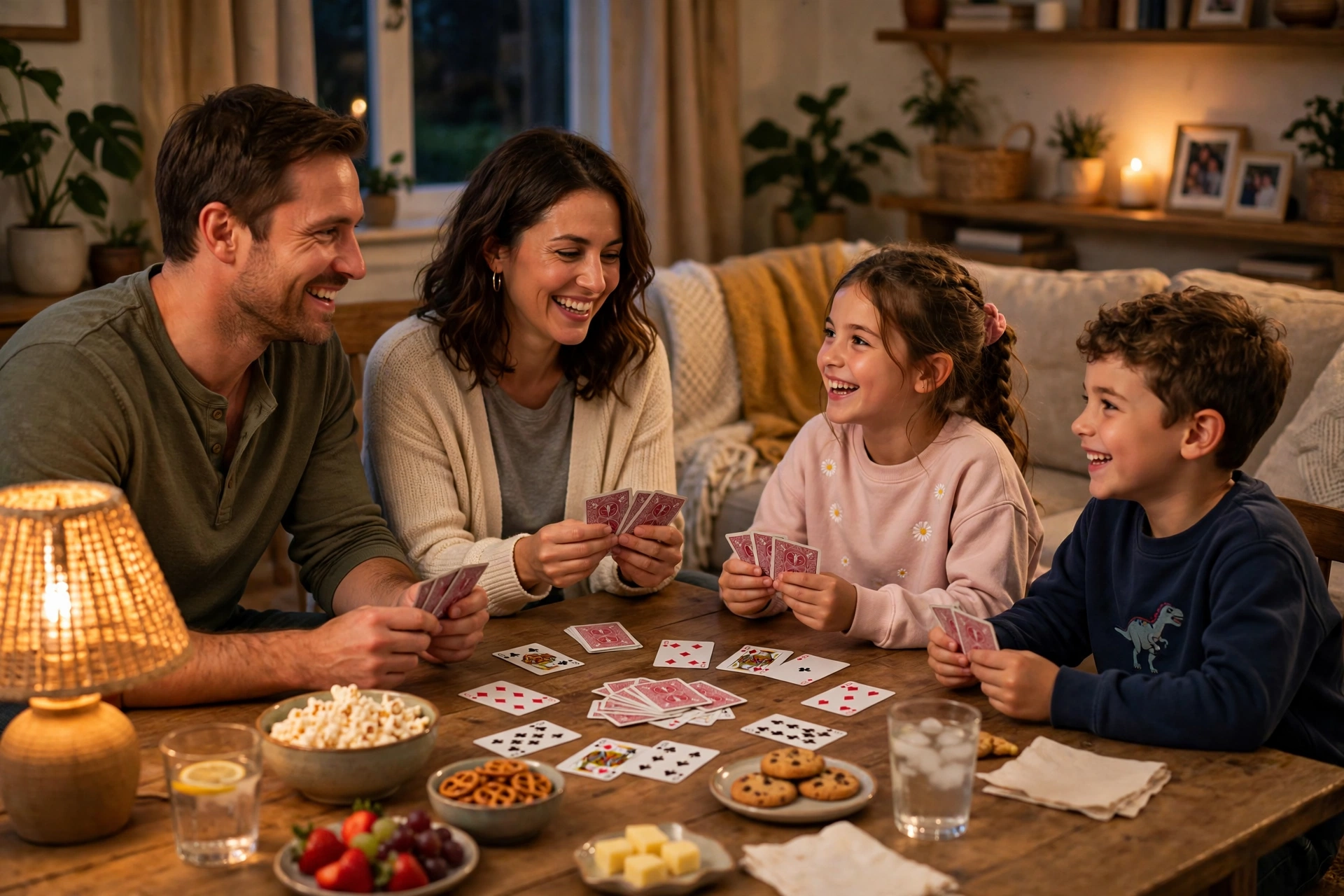
Simple rules, short rounds, and no reading required for most of these. The best entry point for young players.
%
Go Fish (2-6 players). Covered in the beginner six. Still the best first card game ever designed.
War (2 players). Higher card wins the battle; ties trigger a war with face-down stakes. Pure luck, zero decisions. Toddlers love it; be honest with yourself, adults will be bored in ten minutes.
Old Maid (2-8 players). Pass cards around, make pairs, and don’t get stuck holding the odd card out. Teaches bluffing to six-year-olds without anyone noticing.
Snap (2+ players). Flip cards onto a pile and slap it when two ranks match. The junior version of Egyptian Rat Screw; young reflexes beat adult reading every time.
Slapjack (2+ players). Slap only the jacks, nothing else. One rule, endless energy, playable from about age four.
Memory, also called Concentration (2+ players). Flip two cards from a face-down grid and keep the pairs. Genuinely good for kids’ concentration, and adults are always worse at it than they expect.
Trash (2+ players). Covered in the beginner six. The rare game that teaches number sequencing while feeling like a race.
Golf, the card game (2-6 players). Six cards face down per player, lowest score after nine “holes” wins. Memory plus light strategy; a genuine family staple, not just a kids’ game.
Fan Tan (4-8 players). Play cards in sequence outward from the sevens in the middle. Nobody gets stuck for long, which makes it ideal for big mixed-age groups.
Beggar My Neighbour (2+ players). Play low cards until someone drops a face card, then pay them cards as penalty. All luck, all drama, and kids adore the reversals.
Two-player classics
Dedicated two-player games, for when it’s just you and one opponent. Several reward real study.
Piquet (2 players). The oldest game on this list, from 16th-century France, played with 32 cards. Intricate scoring, genuine depth, and still respected by serious card players. Not a casual pick.
Ecarte (2 players). A 19th-century French dueling game: win three tricks out of five. Fast, sharp, and inexplicably out of fashion for a century.
Cribbage (2-4 players). The pegboard game: fifteens, pairs, runs, and “his nobs.” Takes one learning game, then it clicks forever. Best played with a proper wooden cribbage board, though any scoring method works.
Spit, also called Speed (2 players). Both players play simultaneously with no turns at all. The fastest game on this list; a full match takes five minutes and leaves both players slightly breathless.
Pick the right game in 30 seconds
Answer three questions and take the recommendation.
1. How many players? Alone: pick any solitaire game above; Spider if you want a challenge, TriPeaks if you want to relax. Two players: Gin Rummy, Cribbage, or Spit. Three or four: Hearts, Spades, or Euchre. Five or more: President, Spoons, or Cheat. Kids at the table: Go Fish, Trash, or Old Maid.
2. How much time do you have? Under 15 minutes: Spoons, My Ship Sails, Egyptian Rat Screw, or Spit. Thirty to sixty minutes: Hearts, Rummy, Cheat, or Cribbage. The whole evening: Bridge, Canasta, or Continental Rummy.
3. Serious or silly? Serious: Bridge, Pinochle, Ninety-Nine, or Gin Rummy. Silly: Cheat, Spoons, Pig, or Kemps. Somewhere in between: Hearts, Palace, or May I.
Card games compared: players, time, and difficulty
The twenty most-searched games from this guide, side by side.
| Game | Players | Time | Difficulty | Best for |
|---|---|---|---|---|
| Hearts | 3-6 | 30-60 min | Medium | Strategic groups |
| Spades | 2-4 | 45-60 min | Medium | Competitive partnerships |
| Euchre | 4 | 30 min | Easy-Medium | Quick team play |
| Bridge | 4 | 2+ hours | Hard | Serious strategists |
| President | 4-7 | 30-45 min | Easy | Parties, shifting alliances |
| Crazy Eights | 2-7 | 20 min | Easy | Families, Uno fans |
| Rummy | 2-6 | 30-60 min | Easy | Classic game nights |
| Gin Rummy | 2 | 30 min | Medium | Head-to-head tacticians |
| Canasta | 4 | 1-2 hours | Medium | Long sessions |
| May I | 3-5 | 60 min | Medium | Contract rummy fans |
| Cheat | 3-8 | 30 min | Easy | Bluffers and parties |
| Spoons | 3+ | 15 min | Easy | Loud groups |
| Egyptian Rat Screw | 2+ | 15-30 min | Easy | Fast reflexes |
| Klondike | 1 | 10-20 min | Easy | Solo downtime |
| Spider | 1 | 30-60 min | Hard | Solitaire veterans |
| Go Fish | 2-6 | 15 min | Easy | Young kids |
| War | 2 | 10 min | Easy | Toddlers (pure luck) |
| Old Maid | 2-8 | 15 min | Easy | Kids learning to bluff |
| Trash | 2+ | 15 min | Easy | Number-learning races |
| Cribbage | 2-4 | 30-45 min | Medium | Classic two-player |
Want the full rules? Start with these guides
Short summaries get you playing; these complete guides settle every argument:
- How to Play Hearts: passing strategy, shooting the moon, and scoring disputes settled.
- How to Play President: ranks, the revolution variant, and the house rules to agree before dealing.
- How to Play Trash: the Jack-wild versus King-wild regional split, explained.
- Cheat Card Game Rules: bluffing strategy and exactly how calling works.
- May I Card Game Rules: every contract round by round, plus buying discards.
- Party Games with Playing Cards: ten games that need nothing but a deck, picked for groups.
Card games FAQs
What is the easiest card game to learn?
Go Fish is the easiest card game to learn; most people pick it up in about five minutes. Crazy Eights and Spoons are close behind, and all three need nothing but a standard deck.
For young kids, Go Fish or Old Maid is the right call. For adults who want something with a little more bite after the first ten minutes, Crazy Eights with scoring, or Cheat, teaches faster than it looks.
What card games are good for 2 players?
Gin Rummy, Cribbage, Spit, and Piquet are the best card games built specifically for 2 players. Most standard-deck games also scale down well: Rummy, Crazy Eights, Egyptian Rat Screw, and Palace all play fine with two.
If you want strategy, learn Cribbage or Gin Rummy. If you want speed, Spit. If you want history with your game, Piquet has been played since the 1500s.
What card games work for large groups of 8 or more?
Spoons, Cheat, Pig, and Fan Tan handle 8 or more players well. Most deep strategy games top out at 6 or 7 players, so for very large groups the honest answer is to pick fast party-style games, or split into two tables.
Spoons is the safest pick for a big group: the rules take two minutes and the spoon scramble scales to any headcount. Cheat works because turns stay quick even with ten players.
What do you need to play card games?
All you need to play card games is a standard 52-card deck. A pen and paper for scoring helps in games like Rummy, Hearts, and May I, and Cribbage is traditionally played with a pegboard, though any scoring method works.
That is genuinely it. Every game in this guide was chosen because it needs nothing else: no chips, no boards, no special decks.
What is the difference between trick-taking and shedding games?
In trick-taking games like Hearts and Spades, every player plays one card per round (a trick), and the highest card wins it; you score across many tricks. In shedding games like Crazy Eights and President, there are no tricks at all: the goal is simply to get rid of all your cards before anyone else does.
Neither family is harder in general. Trick-taking rewards planning, shedding rewards speed and nerve.
Sources
- Wikipedia, “Ninety-nine (trick-taking card game)”: player count and the game’s 1967 origin with David Parlett.
- Wikipedia, “Card game”: definition and the family structure of traditional card games.
- David Parlett’s official site: Ninety-Nine rules, bidding system, and strategy notes.
- Fatherly, “The 21 Best Easy Card Games for Kids”: My Ship Sails player count (4-7) and rules.
- IcebreakerIdeas, “15 Fun & Easy Card Games for Kids”: My Ship Sails rules cross-check.
- Solitaired, “21 Easy Card Games for All Ages”: My Ship Sails rules cross-check.
- Wargamer, “The best playing card games using a standard deck”: competitor gap check for this hub.
- Apartment Therapy, “16 Popular Card Games with Friends”: competitor gap check for this hub.
