
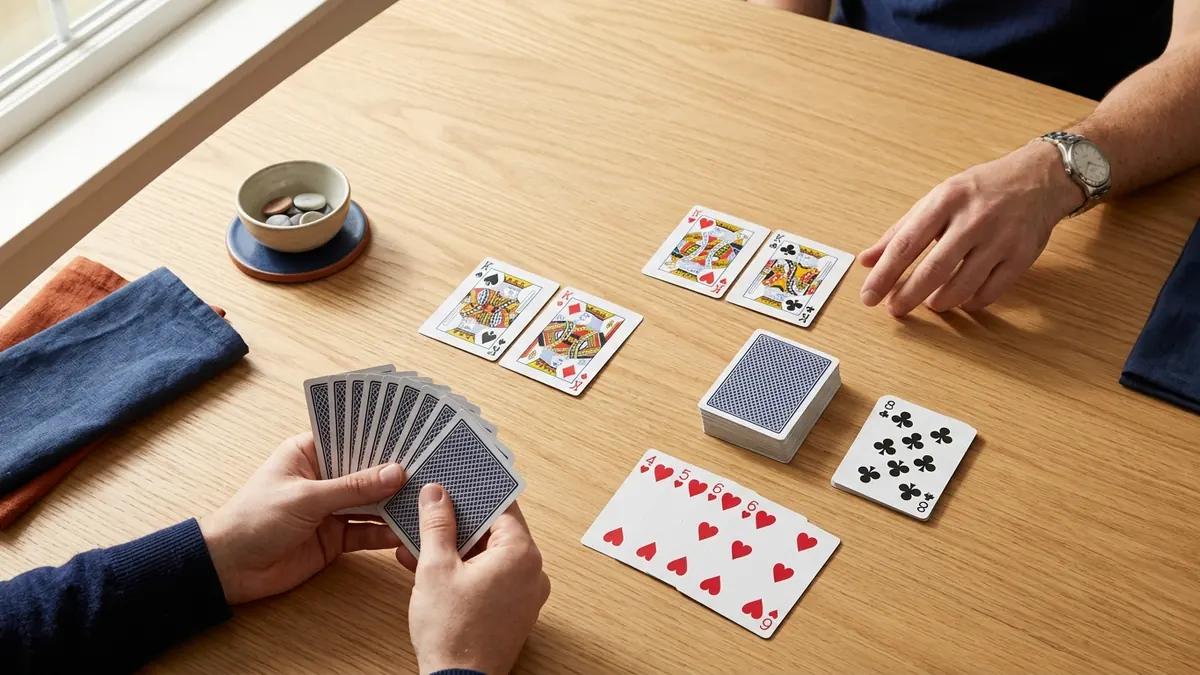
May I? looks complicated when someone explains all seven rounds at once. Once the cards are on the table, though, the game settles into a simple pattern: build the contract for the current round, get it down, then work on emptying your hand before everyone else. The twist is the rule that gives the game its name. If another player passes on the top discard, you may be able to ask “May I?” and take it out of turn – but you also pick up a penalty card from the stock.
If you are learning the game for the first time, keep the round chart nearby. Most of the confusion in May I? comes from remembering which combination you need next, not from the turn itself.
A quick note about the rules: May I? has been passed around families and card groups for years, so there are several legitimate versions. This guide follows the May I? variation documented by Pagat from Greg Petras. Where that variation does not change a rule, it uses the underlying Contract Rummy rules on the same page. A short house-rules section near the end explains why your family may play it differently.
May I card game rules at a glance
| Rule | This guide uses |
|---|---|
| Players | 3-5 works best |
| Rounds | 7 |
| Decks | 1 full 52-card deck + 2 Jokers for every 2 players |
| Cards dealt | 10 each in rounds 1-3; 12 each in rounds 4-7 |
| Set | 3 or more cards of the same rank |
| Run | 4 or more consecutive cards of the same suit |
| Wild cards | Jokers |
| May I cost | The wanted discard + 1 penalty card from the stock |
| Winner | Lowest total score after round 7 |
What you need before you deal
Use one complete deck, including both Jokers, for every two players. That means two decks for three or four players, and three decks for five players. Shuffle everything together.
Choose the first dealer at random. The deal then moves clockwise after each round. Deal 10 cards to each player in rounds 1, 2 and 3. In rounds 4 through 7, deal 12 cards each. Put the rest face down as the stock and turn one card face up beside it to start the discard pile.
Sets and runs, without the jargon
A set is three or more cards of the same rank. For example, 8 of clubs, 8 of diamonds and 8 of hearts make a set.
A run is four or more consecutive cards in the same suit. A 5, 6, 7 and 8 of spades make a run. Aces can sit low or high, so A-2-3-4 and J-Q-K-A are valid. You cannot wrap around the Ace, which means Q-K-A-2 is not a valid run.
The 7 May I rounds
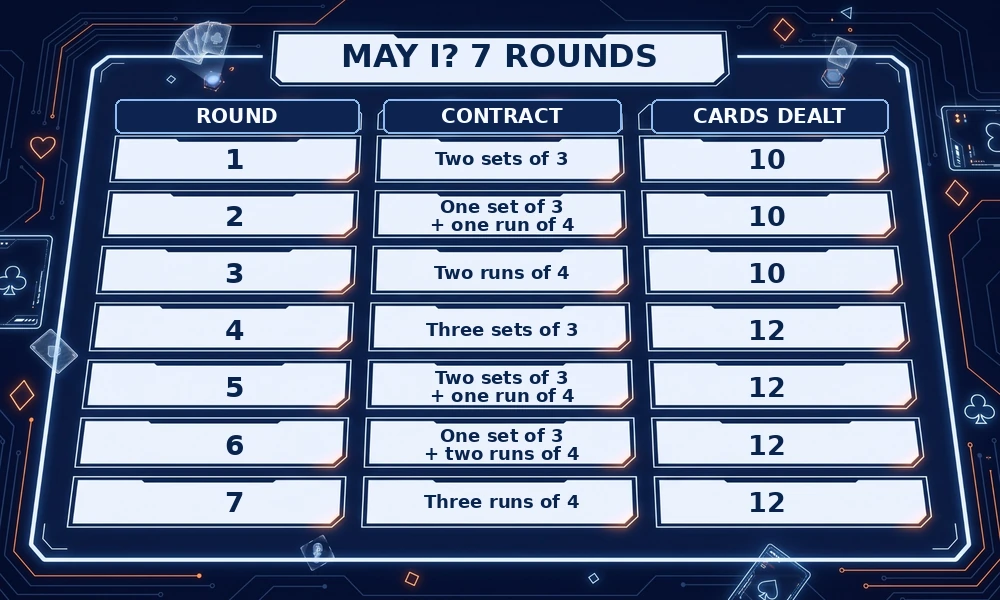
This is the part worth keeping open while you play. You must complete the whole contract for the current round before you can start laying off cards on later turns.
| Round | Contract | Cards dealt |
|---|---|---|
| 1 | Two sets of 3 | 10 |
| 2 | One set of 3 + one run of 4 | 10 |
| 3 | Two runs of 4 | 10 |
| 4 | Three sets of 3 | 12 |
| 5 | Two sets of 3 + one run of 4 | 12 |
| 6 | One set of 3 + two runs of 4 | 12 |
| 7 | Three runs of 4 | 12 |
One useful May I? rule is that your opening meld can be larger than the minimum. If Round 2 asks for a four-card run and you already have five consecutive cards in that suit, you can put all five down with your contract instead of holding the extra card for another turn.
How a normal turn works
A regular turn has four parts: draw, meld if you can, lay off if you are already eligible, then discard.
- Draw either the top card of the stock or the top card of the discard pile.
- If you have the complete contract for this round, you may put it down. You cannot put down half a contract and finish it later.
- Once you have melded on an earlier turn, you can lay matching cards onto melds already on the table, including other players’ melds.
- Finish your turn by discarding one card face up.
The round ends when a player gets rid of every card in their hand. Everyone else then counts the penalty value of the cards they are still holding.
So what does “May I?” actually mean?
Imagine it is Mia’s turn. The top discard is the 9 of hearts. Mia does not want it and is about to draw from the stock. You need that 9 to finish a run.
Before Mia draws, you can ask “May I?” If you have priority for that discard, you take the 9 of hearts and also take the top card of the stock as a penalty. Both cards go into your hand. You do not steal Mia’s turn; play returns to her and she continues from where she left off.
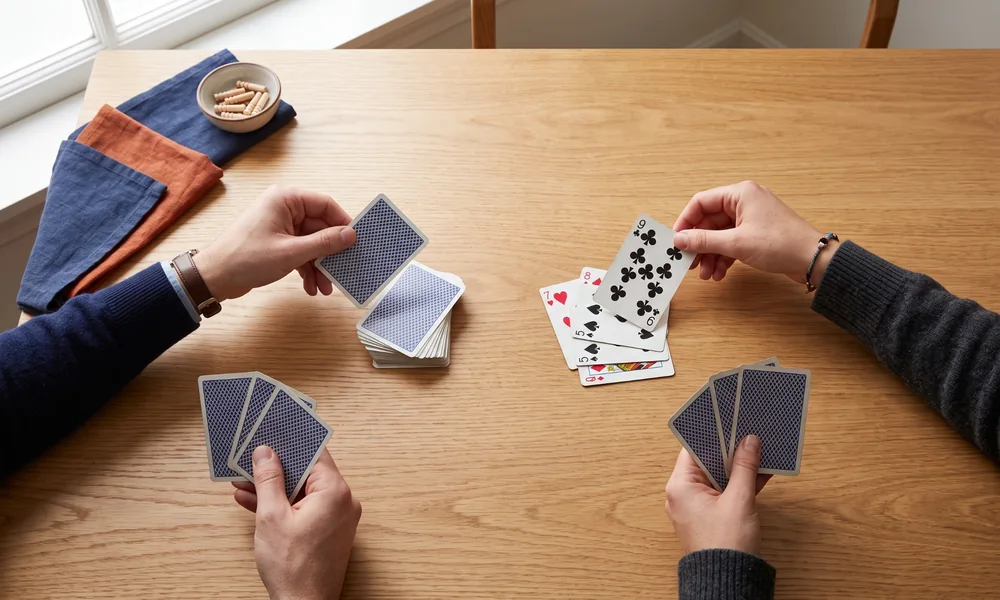
What if two players want the same discard?
It is not a race to shout first. The card goes to the player whose normal turn would come sooner after the active player. The active player still has first choice: if they decide to take the discard themselves, nobody else can May I that card.
Can more than one discard be taken?
Yes. After one player takes the top discard out of turn, the card underneath becomes exposed. A different player may take that card in the same way and also draw a penalty card. The same player cannot take two successive discards in this sequence.
In the Pagat version used here, there is no fixed limit on how many May I calls a player can make during a round. Some family versions do set a limit, which is one reason it is worth agreeing on the rules before the first deal.
Two examples that make the rules easier to see
Example 1: your contract is ready
You are in Round 2, so you need one set of three and one run of four. You have three 8s plus 4-5-6-7-8 of spades. That is enough to meld. Because this May I? variation allows an opening meld to exceed the minimum, you can put down the full five-card spade run instead of stopping at four.
That extra card matters. Every card you move out of your hand is one less card that can count against you if somebody else goes out first.
Example 2: buying the card you need
You are holding 6-7-8 of diamonds and waiting for either the 5 or the 9. Another player discards the 9 of diamonds, and the next player passes on it. You call “May I?”, take the 9, and then take one unseen card from the stock as your penalty.
You have completed the four-card run you wanted, but your hand also grew because of the penalty card. That is the trade-off: a May I can rescue a difficult contract, but too many of them can leave you holding a large hand when someone else goes out.
How Jokers work in May I
Jokers are wild. You can use one in a set or a run to stand in for a missing card. For example, 5-6-Joker-8 of hearts can work as a run with the Joker representing the 7 of hearts.
The May I? variation used here has an important restriction: once a Joker has been melded, it stays there. You cannot replace it with the natural card and move the Joker somewhere else later.
A Joker left in your hand is also expensive. It counts as 25 penalty points, so hanging onto one for too long can hurt if another player suddenly goes out.
Can two runs connect to each other?
Yes, in this May I? version. If a round requires two runs, 3-4-5-6 of hearts and 7-8-9-10 of hearts can count as two separate runs. That is different from the underlying Contract Rummy rule, which restricts contiguous runs in some rounds.
How to go out
After your contract is down, the job is to get rid of the rest of your cards by laying them off legally and eventually discarding your last card. The first player with no cards left ends the round and scores zero for that round.
Round 7 is a common source of arguments because standard Contract Rummy has a special “meld everything at once” rule. The May I? variation followed here specifically removes that restriction. You still need three runs, but if you have cards left after putting those runs down, play can continue normally.
May I card game scoring
Low score wins. When somebody goes out, add up only the cards still in your hand.
| Card | Penalty |
|---|---|
| 2-10 | Face value |
| Jack, Queen, King | 10 points each |
| Ace | 15 points |
| Joker | 25 points |
| Player who goes out | 0 points |
For example, if you are left with a 4, a 9, a Queen, an Ace and a Joker, your round score is 4 + 9 + 10 + 15 + 25 = 63. Add each round to your running total. After Round 7, the player with the lowest total wins.
Free printable PDF
Track all seven rounds
Print one copy and record each round’s score.
Download the printable May I score sheet (PDF)Why your family may play May I differently
If someone at your table says, “That is not how we play,” they may be completely right about the version they learned. May I? has several documented family and regional variations.
For example, a dMagy rules sheet uses Deuces as wild cards, starts with seven cards in Round 1 and increases the hand size each round. Another family version published at CardGameMayI.com deals 11 cards to most players, uses both Twos and Jokers as wild cards, and limits players to three May I calls per hand.
The easiest way to avoid a mid-game rules debate is to agree on four things before you shuffle:
- Which seven-round contract chart are you using?
- Which cards are wild?
- Is there a limit on May I calls?
- Does your final round have any special going-out rule?
For this guide and its printable score sheet, use the rules in the round chart above so the article and download stay consistent.
May I card game FAQs
The version in this guide has seven rounds. The contracts start with two sets of three and finish with three runs of four.
Deal 10 cards to each player in rounds 1-3 and 12 cards in rounds 4-7.
If the active player does not take the top discard and you have priority, you take that discard out of turn plus one penalty card from the stock. The original player then continues their turn.
The Pagat version used here does not set a fixed per-round limit. Other house versions do, so confirm this before play.
Yes. Jokers can stand in for missing cards in sets or runs. In this version, a Joker that has already been melded cannot be reclaimed and reused.
A Joker left in your hand is worth 25 penalty points in this ruleset.
Yes. A-2-3-4 and J-Q-K-A are valid runs. Q-K-A-2 is not.
No. The May I? variation used here removes the standard Contract Rummy final-round restriction. If you have cards left after laying down your three runs, play continues.
Rules sources
The article uses one ruleset consistently rather than combining incompatible house rules.
Primary ruleset: Pagat – Contract Rummy / May I?
Variant cross-check: dMagy – May I? Rules PDF
Family variation cross-check: CardGameMayI.com
