
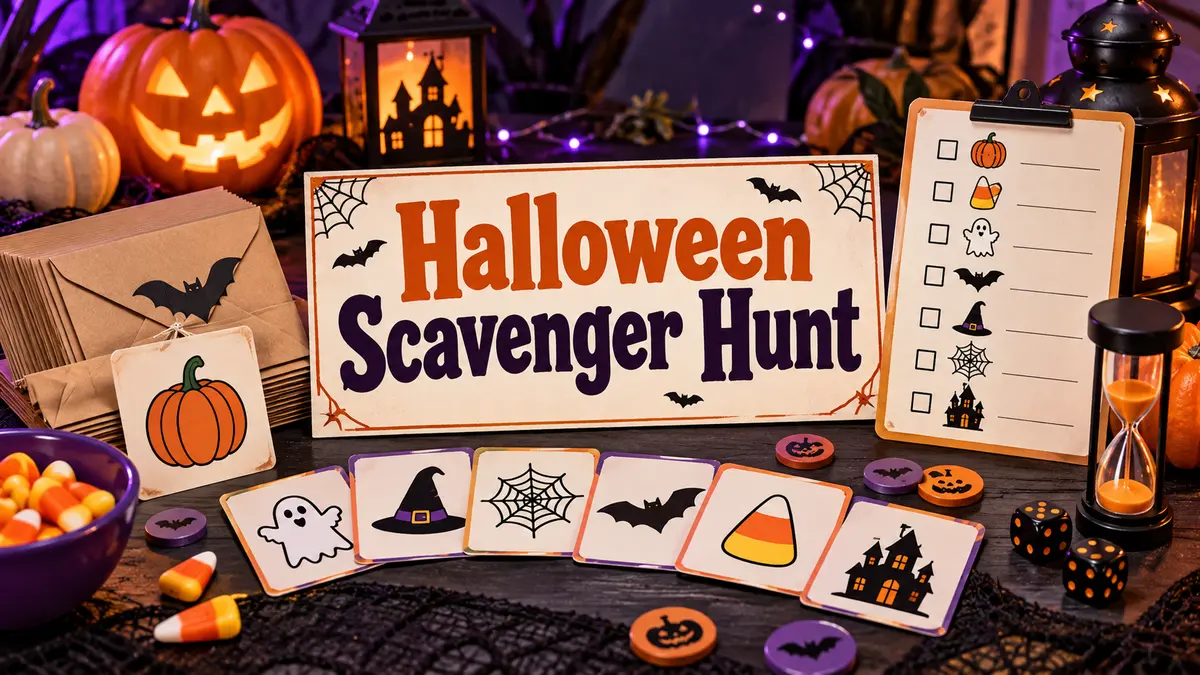
A good Halloween scavenger hunt should fit the place where it is being played. A clue that works perfectly inside a house may make no sense in a classroom or backyard, so this guide separates the ideas by location and age group. You can build a short indoor clue trail, an outdoor search, a photo challenge, or a longer team hunt without using all 60 clues at once.
A Halloween scavenger hunt gives guests a clear activity without requiring complicated equipment or a long rules explanation. To run one, the host simply selects clues that fit the location, sets a boundary, and sends individuals or teams searching for destinations, decorations, or photo opportunities.
This guide keeps several close variations on one page. Specifically, it includes an indoor clue trail, an outdoor spot-it hunt, a Halloween scavenger hunt for kids, harder options for teens and adults, and a printable card pack. As a result, hosts can use the full list as a menu rather than trying to complete all 60 clues in one session.
For a longer event, combine the hunt with other Halloween party games for adults, kids, and mixed groups. The hunt below remains focused on clues, setup, route planning, and safe participation, rather than repeating the broader game list.
More Halloween Game Ideas
If you are planning a full Halloween party, these related guides can help you add extra activities before or after the hunt:
- Halloween trivia questions and answers for a seated team game.
- Halloween charades and Pictionary ideas for acting and drawing rounds.
- Halloween would you rather questions for quick group discussion.
- Halloween party games for adults and kids for a broader list of game options.
Halloween Scavenger Hunt at a Glance
The figures below are flexible planning estimates for this GamingStation house version. They are not official limits or results from first-hand event testing.
| Planning detail | Practical recommendation |
|---|---|
| Best for | Families, classrooms, parties, teen groups, adult groups, and mixed ages |
| Players | 2-30 or more; use teams for larger groups |
| Suggested age | About 5 and older with reading help and age-appropriate clues |
| Teach time | About 2-3 minutes |
| Playing time | About 15-35 minutes |
| Setup time | About 10-30 minutes, depending on the route and number of cards |
| Supplies | Selected clues, answer sheet, pencils, and optional envelopes, timer, or prizes |
| Space | One room, a home, classroom, yard, or clearly defined neighborhood route |
| Interaction | Medium to high |
| Complexity | Low; adjustable through clue choice and time limits |
Scavenger Hunt vs. Treasure Hunt
A scavenger hunt usually asks players to find several objects, decorations, locations, or photo subjects in any order. A treasure hunt normally uses a chain: each solved clue leads to the next hidden clue, and the final clue leads to one prize.
This article supports both formats:
- Use indoor clues 1-30 as a treasure-hunt chain by placing the next card near each answer.
- Use outdoor clues 31-60 as a scavenger-hunt checklist, with players finding or photographing each answer in any order.
- Combine selected indoor and outdoor cards for a longer scavenger hunt for Halloween parties with access to a house and yard.
Players should find or photograph listed objects rather than collect anything that belongs to a neighbor, venue, or other guest.
How to Set Up a Halloween Scavenger Hunt
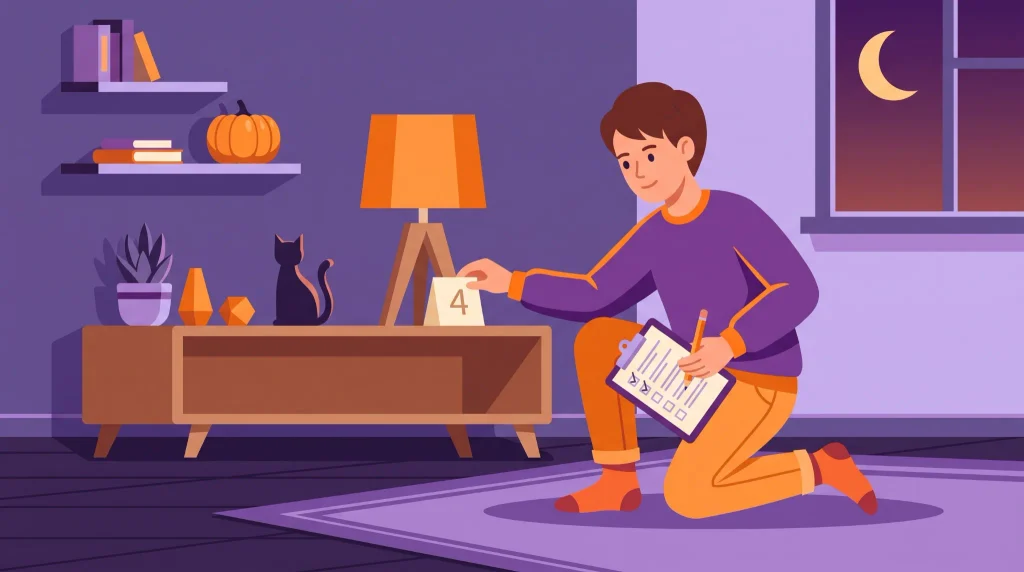
There is no universal publisher or official ruleset for a homemade scavenger hunt. The steps below are flexible house rules designed to keep the route clear and the stopping point easy to understand.
- Choose one format: indoor clue chain, outdoor checklist, photo hunt, team race, or cooperative search.
- Select 8-12 clues for young children, 12-18 for a mixed group, or 15-25 for teens and adults.
- Remove any clue whose answer is missing, unsafe, private, fragile, or outside the allowed area.
- For an indoor chain, place clue 2 near the answer to clue 1, clue 3 near the answer to clue 2, and continue until the final prize or finish card.
- For an outdoor checklist, give each team the selected clue cards and an answer sheet. Players may find the answers in any order.
- Explain boundaries, the time limit, whether photos are allowed, and whether teams must stay together.
- Start everyone with the same first clue or send teams in different directions to reduce crowding.
- Stop when the route is complete, the agreed number of answers has been found, or the timer ends.
Dry-run an indoor chain before guests arrive. One card placed at the wrong answer can break the entire route. Put clue cards near safe objects, never inside appliances, mailboxes, medicine cabinets, cleaning-supply areas, or anything a child should not open.
60 Original Halloween Scavenger Hunt Clues
The indoor riddles identify common household locations. The outdoor riddles describe decorations or yard features to spot. Hosts should choose only clues that match the actual venue.
Indoor clues 1-10: easy for kids and first rounds
I hum all day and keep food cold. Open my door and treats unfold.
Crackers and cans wait out of sight. Find the small room where snacks sit tight.
My cushions are soft, with room for a few. After a spooky movie, I am waiting for you.
When Halloween ends and tired heads slow, this is the place where sleepers go.
I rest under your head through every dream. Find me before the next ghostly scream.
I copy your face but never speak. Look for your reflection to find what you seek.
Stories stand together in a row. Find the shelves where book characters go.
Plates gather here when it is time to eat. Look for the table surrounded by seats.
Sneakers and boots wait side by side. Find where pairs of shoes like to hide.
Jackets hang here when outdoor trips end. Find the small space where coats spend the night.
Indoor clues 11-20: medium clues for families and classrooms
Socks and shirts land here in a heap. Find the basket where dirty clothes sleep.
Soap and water meet in this place. It helps clean your hands and freshen your face.
After hands are washed and water drips, find the place where a towel hangs or sits.
Movies and games glow on my screen. Find the biggest indoor picture machine.
Pencils and papers gather where work is done. Find the writing spot before you run.
I brighten a corner and chase shadows away. Find me glowing at the end of the day.
I have hands but cannot clap. I count every minute without taking a nap.
My numbered squares help plan the year. Find today’s month; the next clue is near.
Dice, cards, and game boxes wait on my shelf. Find where game night rests by itself.
Two straps help carry books on your back. Find this zippered traveling pack.
Indoor clues 21-30: harder clues for teens and adults
Rainy-day helpers stand tall and thin. Find where folded umbrellas wait to begin.
I rattle at breakfast when poured in a bowl. Find the box that makes morning crunch whole.
I have leaves but no forest and roots but no ground. Find the green guest growing indoors.
Guests knock here before coming inside. Find the entrance that opens wide.
Shoes pass over me beside the main door. Little bits from outside collect on me.
Many buttons cover me, though I wear no shirt. I change what appears on the screen from your chair.
I wear an orange grin but never take a bite. Find the pumpkin that glows or decorates the night.
I show the outdoors while keeping weather away. Find the clear view that brightens the day.
Blocks, dolls, and small surprises gather in me. Find the box where playthings wait patiently.
Music and voices come out of my face, though I have no mouth. Find the sound-making device.
Outdoor clues 31-40: easy objects for kids and neighborhood walks
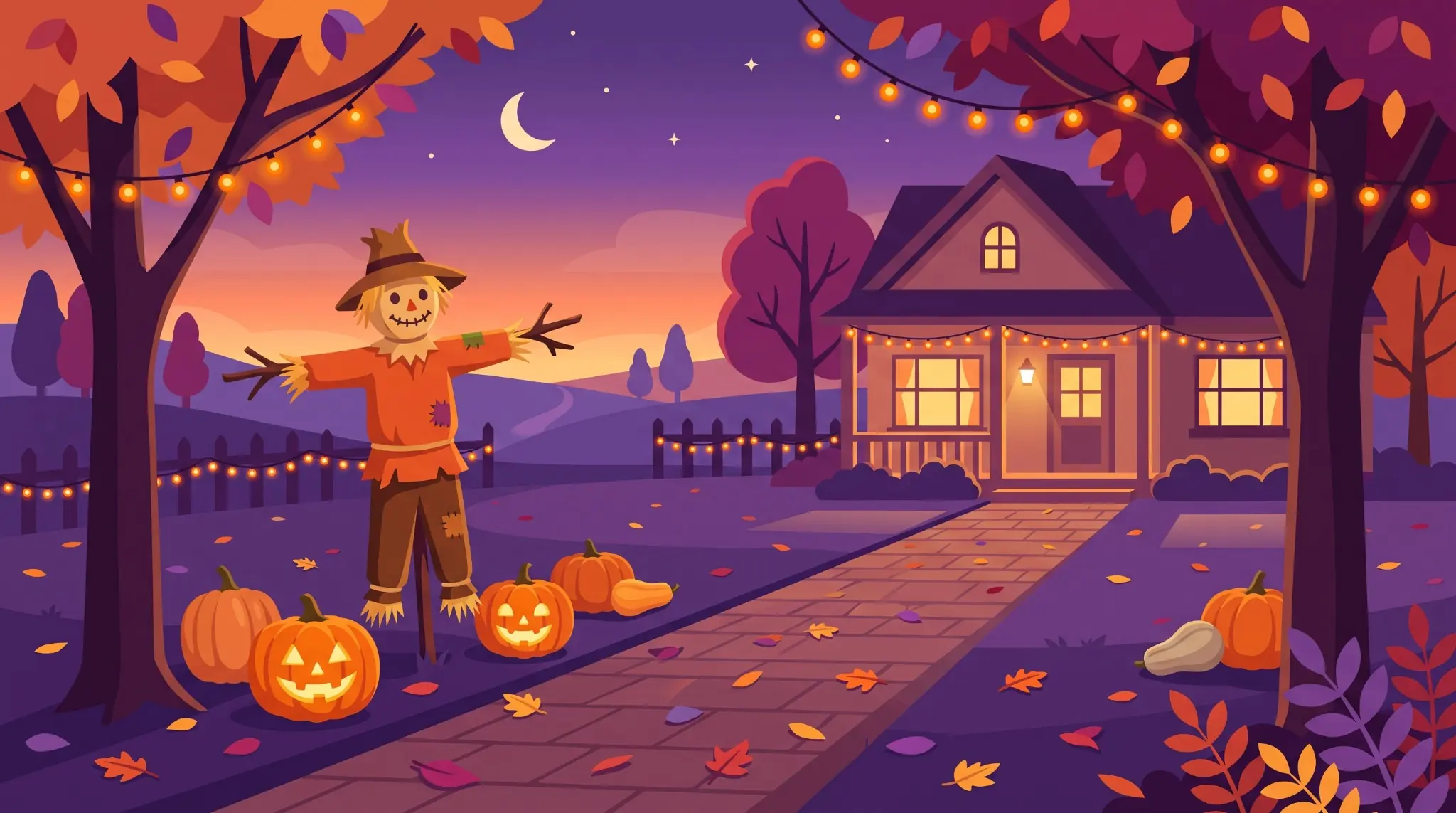
I sit outside a door, sometimes covered by a roof. Guests cross me before they enter.
I swing or latch to let people through. Find the outdoor barrier that opens for you.
My branches reach high while my roots stay low. Find the tall plant where leaves grow.
I grow below a tree and may be trimmed round. Find the leafy plant close to the ground.
Flowers or herbs may live in my space. Find the outdoor container that holds them in place.
I mark a boundary with panels or rails. Find the outdoor divider that follows a line.
Many feet travel over my flat little way. Find the path or sidewalk used every day.
Words stand outside for visitors to see. Find a sign in a yard, garden, or entry.
I have an orange face and a candle-like glow. Find the carved pumpkin putting on a show.
I crunch under shoes after falling down. Find autumn leaves scattered on the ground.
Outdoor clues 41-50: medium Halloween decorations
A stuffed shirt watches the garden all day. Find the straw-filled figure that scares birds away.
An eight-legged artist inspired this thread. Find the web decoration stretched overhead.
Tiny orange stars shine in a row. Find the Halloween lights with a warm little glow.
A pale shape floats without making a sound. Find the ghost decoration hanging around.
I have many bones but no skin at all. Find the skeleton standing, sitting, or pinned to a wall.
Two dark wings spread in the night. Find the bat decoration ready for flight.
A pointed top and a brim are the clue. Find the hat a storybook witch might use.
I show a name but no person lies below. Find the pretend tombstone made for a spooky show.
A midnight-colored cat watches the scene. Find the black-cat decoration dressed for Halloween.
Air makes me larger, but I am not a balloon. Find the big inflatable monster, ghost, or moon.
Outdoor clues 51-60: harder yard and porch features
I offer a seat where fresh air flows. Find the outdoor chair near a porch or patio.
I am the biggest door most houses display. Cars may pass through when I move away.
I look like a long green snake but bring water, not fright. Find the garden helper curled up tight.
One wheel and two handles help carry a load. Find the garden cart that does not need a road.
I am flat, firm, and placed in a line. Find the stones that help garden walkers stay dry.
I am a tiny house built high for a guest with feathers. Find the small home made for birds.
I hold or imitate a light near an outdoor seat. Find the lantern that makes the porch complete.
I have teeth but no mouth and gather leaves instead. Find the long-handled tool resting near a shed.
I am a little garden guest who never takes a step. Find the gnome or statue standing quietly.
My words welcome visitors before they come in. Find the outdoor banner or sign where greetings begin.
Indoor Clue Answer Key
- 1-10: 1. Refrigerator; 2. Pantry; 3. Couch or sofa; 4. Bed; 5. Pillow; 6. Mirror; 7. Bookshelf; 8. Dining table; 9. Shoe rack or shoe area; 10. Coat closet.
- 11-20: 11. Laundry basket; 12. Bathroom sink; 13. Towel rack or towel basket; 14. Television; 15. Desk; 16. Lamp; 17. Clock; 18. Calendar; 19. Board-game shelf; 20. Backpack.
- 21-30: 21. Umbrella stand or umbrella storage; 22. Cereal box; 23. Indoor plant; 24. Front door; 25. Entry mat; 26. Remote control; 27. Pumpkin decoration; 28. Window; 29. Toy box; 30. Speaker.
For a clue chain, the answer tells the host where to place the next numbered card. Place the card beside or near the answer rather than inside an appliance, container with chemicals, or private storage area.
Outdoor Clue Answer Key
- 31-40: 31. Porch or entry; 32. Gate; 33. Tree; 34. Bush or shrub; 35. Flowerpot or planter; 36. Fence; 37. Path or sidewalk; 38. Yard or entry sign; 39. Jack-o’-lantern; 40. Fallen leaves.
- 41-50: 41. Scarecrow; 42. Spiderweb decoration; 43. Orange lights; 44. Ghost decoration; 45. Skeleton decoration; 46. Bat decoration; 47. Witch hat; 48. Tombstone prop; 49. Black-cat decoration; 50. Inflatable decoration.
- 51-60: 51. Porch or patio chair; 52. Garage door; 53. Garden hose; 54. Wheelbarrow; 55. Stepping stones; 56. Birdhouse; 57. Lantern; 58. Rake; 59. Garden gnome or statue; 60. Welcome sign or banner.
Outdoor answers are observation targets, not invitations to enter private property, open containers, or move decorations. Replace any answer that is not visible from the permitted route.
Choose Clues for Kids, Teens, or Adults
- Halloween scavenger hunt for kids: Use indoor clues 1-10 or outdoor clues 31-40. Choose 8-12 cards, read riddles aloud when needed, and let children work with an adult or older partner. A shared finish prize keeps the group together.
- Mixed-age families: Combine easy and medium cards. Give each team at least one reader, allow one free hint, and avoid a route that repeatedly sends players up and down stairs.
- Halloween scavenger hunt for teens: Use clues 11-30 and 41-60, add a 20-minute limit, and require a photo of each outdoor answer rather than collecting it. Award a bonus for the clearest or funniest staged team photo.
- Halloween scavenger hunt for adults: Use 15-25 medium and harder cards, stagger team starts, and add a final code made from selected answer initials. Keep drinking separate from scoring, penalties, and time pressure.
- Classrooms or community groups: Use one floor or a marked outdoor zone. Play cooperatively, assign a clue reader and answer recorder, and replace household locations with objects actually available at the venue.
- Who should skip or adapt the route: Anyone who cannot comfortably use the planned path should be offered a seated clue-solving, map-marking, photo-review, scorekeeping, or host role with equal importance.
For a crowd larger than one household group, the team and staggered-start ideas in Halloween party games for large groups can help prevent everyone from reaching the same clue at once.
Five Ways to Run the Hunt
- Indoor clue chain: Hide each next card near the previous answer and finish at a shared prize. This is the clearest format for a small home party.
- Outdoor spot-it hunt: Give teams the same clue set and let them record answers in any order. Do not require players to collect or touch the objects.
- Photo challenge: Teams photograph visible answers and add a few staged prompts, such as making a group shadow monster. Keep photos on the host’s device or private group unless every person pictured has agreed to sharing.
- Cooperative countdown: The entire group tries to solve a chosen number of clues before time ends. Hints cost time rather than eliminating a player.
- Remote or group-text hunt: Send one clue at a time and ask households to reply with a fresh photo from their own space. State whether creative substitutes count before the first clue is sent.
If guests need a seated activity after the hunt, use Halloween Would You Rather questions or the drawing option in Halloween charades instead of extending the route until players are tired.
Hosting, Timing, and Cleanup
Select the cards before the event and keep the unused pack out of sight. For an indoor chain, number the backs lightly in pencil so the host can rebuild the route if cards are moved. Keep a private answer sheet and one master copy of the printable.
Announce the following before play:
- The allowed rooms, yard, or neighborhood boundary
- Whether teams must remain together
- Whether walking, photos, hints, and phones are allowed
- The finish condition and time limit
- Objects and areas that must not be touched
- Where players should return if they become unsure of the route
For most groups, 12-18 clues provide enough variety for one session. End when teams complete the selected set or the timer expires; the full 60-card bank is intended for choice and replay value.
Collect indoor cards after the hunt and remove tape or reusable putty from walls and furniture. For an outdoor hunt, count teams back at the meeting point and confirm that no props, cards, or prizes were left along the route.
Safety, Accessibility, and Privacy
Keep indoor routes away from candles, stairs, medicine, cleaning products, knives, glass, pet food, locked rooms, and working appliances. Place cards at waist or eye level when possible so players do not need to climb, crawl under furniture, or reach behind heavy objects.
For a neighborhood hunt, use sidewalks and designated crossings. The National Highway Traffic Safety Administration’s pedestrian guidance recommends crossing at intersections or crosswalks, watching driveways and backing vehicles, and using an adult walking buddy for younger children. The game should never reward rushing across a road.
Check the forecast before an outdoor session and identify an indoor backup. The National Weather Service’s outdoor-event guidance advises organizers to have a lightning safety plan and move people to appropriate shelter when thunderstorms threaten. Stop the hunt when thunder is heard rather than trying to finish the remaining clues.
Plan alternative ways to participate from the beginning. The Section508.gov accessible-meetings guide emphasizes accessible materials and equivalent access to activities. For this hunt, that can mean large-print clues, spoken clue reading, a step-free route, seated puzzle solving, extra time, or a navigator and recorder role.
Do not ask players to photograph strangers, license plates, house interiors, or children outside their own group. Stay on the approved route, respect private property, and keep location-tagged images off public social feeds unless the people involved have knowingly agreed.
Common Halloween Scavenger Hunt Mistakes
- Using every clue without checking the venue: A missing answer stops an indoor chain and frustrates outdoor teams. Select only cards that match the location.
- Hiding cards in unsafe or private places: Do not use appliances, mailboxes, medicine storage, chemical cabinets, vehicles, or neighbors’ property. A clever clue is not worth an unsafe search.
- Making the route depend on speed: Running creates collisions and disadvantages players with different mobility needs. Score correct answers, teamwork, or creative photos instead.
- Mixing age levels without hints: A hard riddle can hold up an entire young group. Mark two optional hints on the host’s answer sheet and allow help without embarrassment.
- Skipping the finish rule: State whether the winner is the first correct team, the team with the most answers at time, or the whole group completing a shared target.
Free Printable Halloween Scavenger Hunt Cards
Printable Halloween scavenger hunt cards with indoor riddles, outdoor clues, and a separate answer key.
Want to play without reading clues from a screen? Download the Halloween scavenger hunt printable with all 60 clues in cut-apart card format. Print the selected pages, keep the answer sheet with the host, and choose only cards that match the location and players.
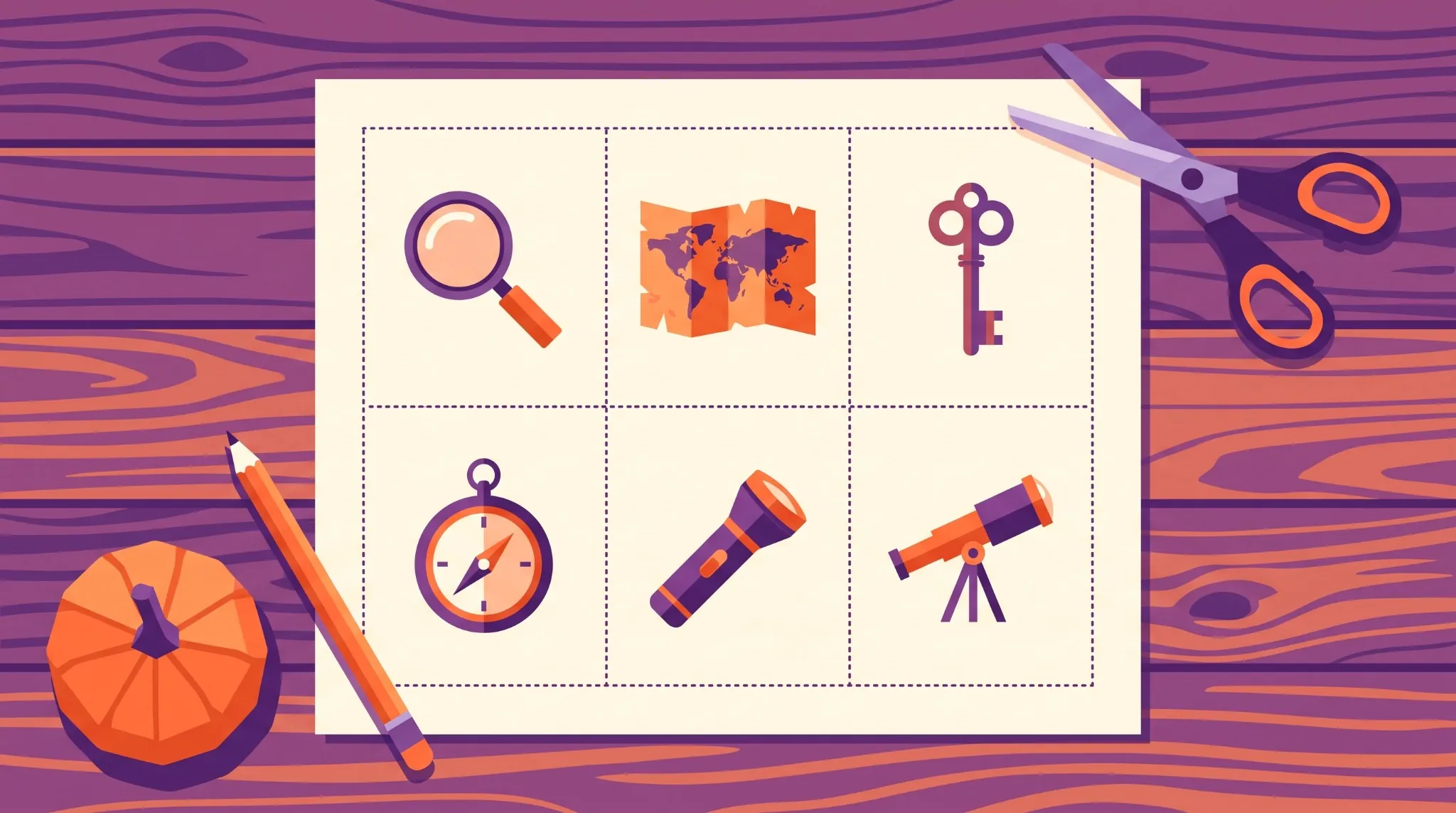
Free PDF • 60 clue cards + answer key • Print at 100% scale
Sources and Editorial Method
This guide was created as an original prompt bank for homes, classrooms, yards, and clearly defined neighborhood routes. The clue sets were organized by location and approximate difficulty so hosts can build a shorter game without using every card.
Scavenger hunts do not have one universal publisher or official ruleset. Player counts, suggested ages, timing, scoring, clue quantities, and stopping points are flexible GamingStation house rules and editorial planning estimates. They are not results from first-hand game testing.
Safety and accessibility guidance was informed by the National Highway Traffic Safety Administration’s pedestrian-safety resources, the National Weather Service’s lightning guidance for organized outdoor activities, and the U.S. General Services Administration’s accessible-meetings guidance.
Final Verdict
For most groups, choose 12-18 clues that actually exist at the venue, set one clear boundary, and use teams instead of a speed-only race. Run the indoor cards as a clue chain or the outdoor cards as a spot-it hunt. Keep the answer sheet with the host and save the remaining cards for another round.
Explore more low-prep group activities, printable games, and hosting guides in GamingStation’s Party Games collection.
Frequently Asked Questions
Choose one play area, select age-appropriate clues, and set clear boundaries. Decide whether players will solve riddles, spot listed objects, take photos, or complete team challenges before placing the clues and explaining the rules.
Use familiar locations, picture-supported clues, and recognizable objects such as pumpkins, bats, orange decorations, or costume pieces. Keep the route short, supervise younger players, and avoid frightening or unsafe hiding places.
Add team competition, photo missions, coded clues, and a firm time limit, using harder riddles within the approved play area.
Build a Halloween scavenger hunt for adults around layered riddles, themed trivia, photo challenges, or a mystery storyline. Use teams and a scoring system, and keep every task respectful, legal, and appropriate for the venue.
Yes. The Halloween scavenger hunt printable includes 60 ready-to-use clue cards and an answer key. Print it at 100% scale, select cards that match your location, and remove any clue that does not suit your players.
Set boundaries before playing, keep children with an adult, and avoid roads, flames, unstable decorations, dark isolated areas, and private property. Check weather and visibility for outdoor games, and move the hunt indoors if conditions become unsafe.
