
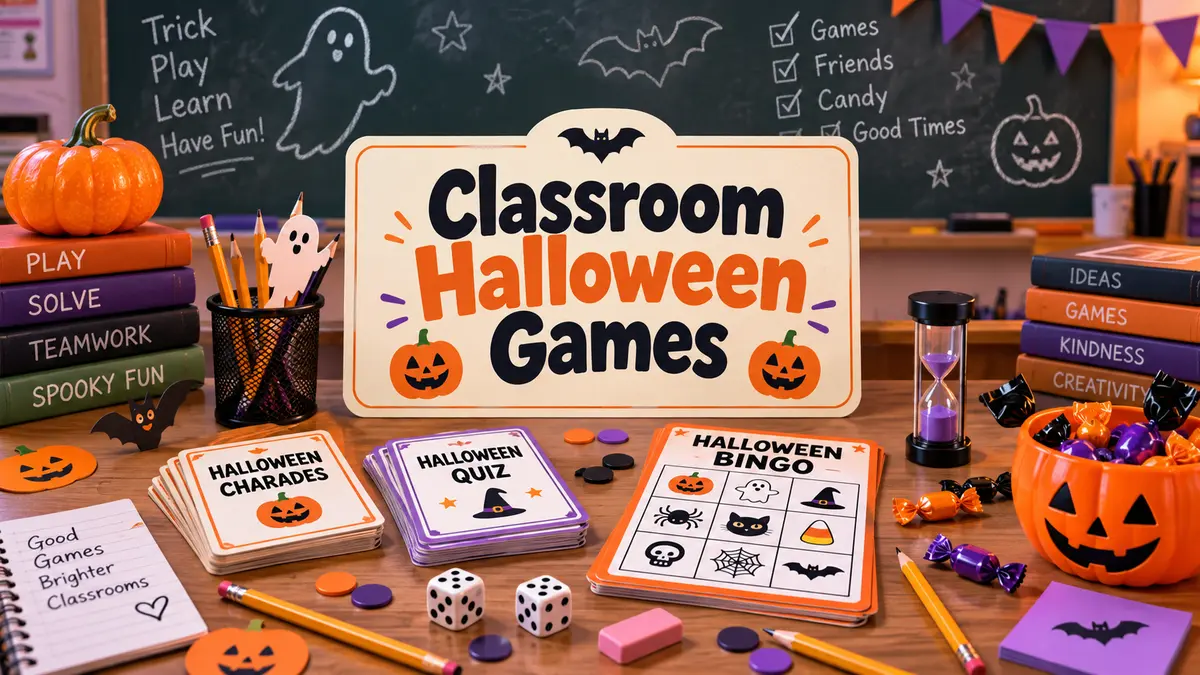
Direct Answer: The best classroom Halloween games use short rules, ordinary school supplies, and flexible team formats. Quiet choices include trivia, drawing, bingo, and memory games, while cleared classrooms can add cup stacking, ring toss, or a walking scavenger hunt. Choose three or four activities that match students’ grade level, space, and comfort.
Last reviewed: September 2026
Classroom Halloween games should feel special without taking over the school day. The strongest choices are quick to teach, easy to reset, and flexible enough for students who prefer drawing, solving, acting, or simply keeping score.
This guide covers 20 games for school-age students, mainly grades 1-8. It does not include preschool activities, costume judging, snacks, or decorating projects. Instead, every idea has a clear play method, a practical stopping point, and an adaptation for different classroom needs.
Teachers planning a larger celebration can also use the Halloween party games guide to compare broader group formats. For more year-round group ideas, browse the Party Games category.
Classroom Halloween Games at a Glance
Use this short table to narrow the options before reading the full rules. Grade bands, times, and player ranges are flexible GamingStation planning estimates rather than official limits.
| Game | Suggested grades | Energy | Approx. time |
| Halloween This-or-That Vote | 1-8 | Quiet | 5-10 min |
| Two-Sentence Spooky Story | 3-8 | Quiet | 10-15 min |
| Halloween Team Trivia | 3-8 | Quiet | 15-25 min |
| Mystery Category Challenge | 2-8 | Quiet | 10-15 min |
| Halloween Charades | 2-8 | Medium | 15-20 min |
| Monster Drawing Relay | 1-8 | Medium | 10-15 min |
| Pumpkin Pattern Memory | 1-5 | Quiet | 8-12 min |
| Halloween Bingo | 1-8 | Quiet | 15-20 min |
| Ghost Cup Stack | 2-8 | Medium | 8-12 min |
| Paper Skeleton Build | 2-8 | Medium | 12-18 min |
| Pumpkin Patch Sort | 1-5 | Quiet | 8-12 min |
| Spooky Sequence Build | 3-8 | Quiet | 10-15 min |
| Witch Hat Ring Toss | 1-8 | Medium | 10-15 min |
| Feed the Monster Toss | 1-6 | Medium | 10-15 min |
| Desk-Safe Scavenger Hunt | 2-8 | Medium | 12-20 min |
| Four-Corner Clue Challenge | 3-8 | Active | 10-15 min |
| Haunted House Map Puzzle | 3-8 | Quiet | 15-20 min |
| Monster Blueprint | 2-8 | Quiet | 12-18 min |
| Costume Concept Challenge | 4-8 | Medium | 15-20 min |
| Classroom Mystery Relay | 4-8 | Medium | 15-25 min |
On a phone, each row still answers the main decision: which game, which grade band, how much energy, and how much time. The detailed sections add supplies, player formats, and adaptations.
How to Choose Games for the Class
Begin with the room and schedule, not the theme. A lively relay may sound exciting, but it is a poor fit when desks cannot move or another class shares the wall.
- Grades 1-2: Favor picture clues, simple matching, large props, demonstrations, and cooperative goals.
- Grades 3-5: Mix trivia, drawing, building, and one controlled movement game.
- Grades 6-8: Add strategy, harder clues, design constraints, and team roles.
- Quiet classroom: Choose bingo, trivia, story writing, memory, or map puzzles.
- Limited preparation: Use This-or-That, charades, drawing, categories, or the printable pack.
- Mixed abilities: Build teams with several useful roles, including reader, writer, artist, materials manager, and speaker.
Usually, three varied games work better than one long competition. For example, combine a five-minute warm-up, a 15-minute team challenge, and a calm closing activity.
Supplies and Setup Before Students Arrive
Most classroom Halloween party ideas become easier when supplies are grouped by station. Place each game’s materials in a labeled tray, envelope, or reusable bin. Then add one instruction card and a sample finished task.
Common supplies include paper cups, index cards, printer paper, pencils, markers, tape, soft rings, large craft shapes, and a visible timer. Food is unnecessary for every game in this guide.
Before class:
- Select activities that match school policy and available space.
- Print one rule card for each station and one score sheet for the teacher.
- Test the walking route, throwing line, and cleanup plan in the actual room.
- Remove fragile objects, cords, backpacks, and loose decorations from play areas.
- Prepare a seated or nonperforming role before students request one.
- Decide whether the class is earning points, completing a cooperative goal, or simply rotating for fun.
Finally, place the quietest station nearest any shared wall or hallway. That small decision can make the entire rotation easier to manage.
Quiet Warm-Up Games
1. Halloween This-or-That Vote
Best for: Grades 1-8; any class size
Time: 5-10 minutes
Supplies: Prompt list and two response cards per student
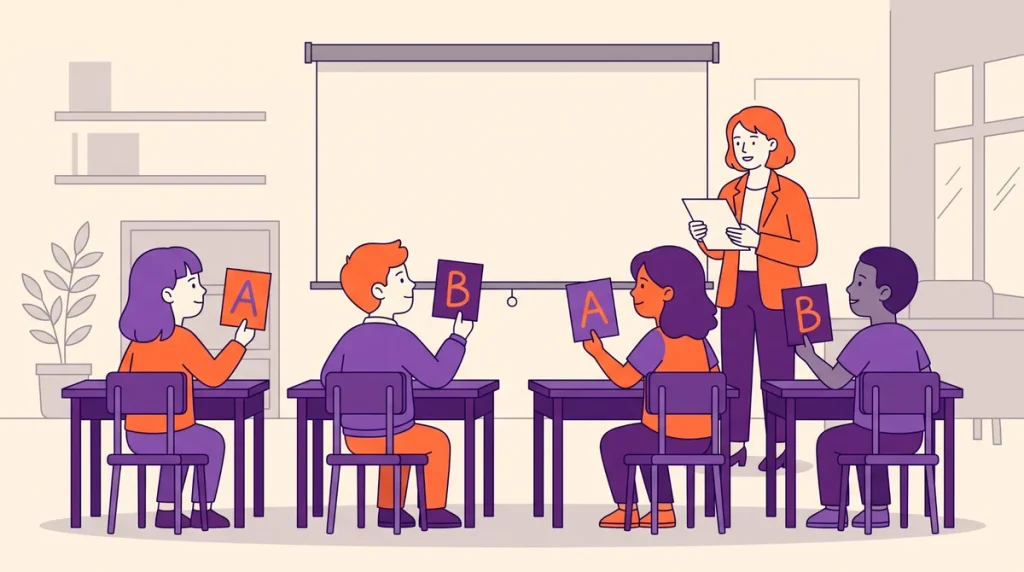
Read a choice such as “explore a pumpkin patch or a friendly haunted house?” Students raise an A or B card, point to one side of a desk mat, or show a hand signal. Invite two volunteers to explain their choices, then move to the next prompt.
Keep the activity noncompetitive so no opinion is treated as wrong. For a ready-made question bank, select school-appropriate prompts from Halloween Would You Rather questions.
2. Two-Sentence Spooky Story
Best for: Grades 3-8; pairs or groups of four
Time: 10-15 minutes
Supplies: Paper, pencils, and optional story starters
Give each group a harmless opening such as “The classroom clock began counting backward.” One student writes two sentences and passes the page. Each teammate adds two more, keeping the story understandable. After two rounds, a volunteer reads the finished story.
Set the scare level as funny, mysterious, or mildly spooky. Students may contribute sound effects, a title, or an illustration instead of reading aloud.
Team Question Games

3. Halloween Team Trivia
Best for: Grades 3-8; teams of three to six
Time: 15-25 minutes
Supplies: Questions, answer sheets, pencils, and optional timer
Choose two or three age-appropriate rounds. Read each question aloud, give teams quiet discussion time, and collect one written answer. Award one point for a correct response, while accepting reasonable spelling variations when the intended answer is clear.
History, animals, books, and family movies create a useful mix. The full Halloween trivia questions and answers collection provides verified questions, an answer key, and round options.
4. Mystery Category Challenge
Best for: Grades 2-8; pairs or table teams
Time: 10-15 minutes
Supplies: Category cards, paper, and pencils
Reveal a category such as “things seen in October,” “friendly monsters,” or “objects in a mystery story.” Teams have 60 seconds to list suitable answers. One point goes to every valid response; disputed answers are decided by the teacher before the next round.
Younger students can draw three answers instead of writing a long list. Older students can work with a required starting letter, although the teacher should preview letters to ensure enough possible responses.
Drawing and Acting Games
5. Halloween Charades
Best for: Grades 2-8; teams of four to eight
Time: 15-20 minutes
Supplies: Prompt cards, bowl, and timer
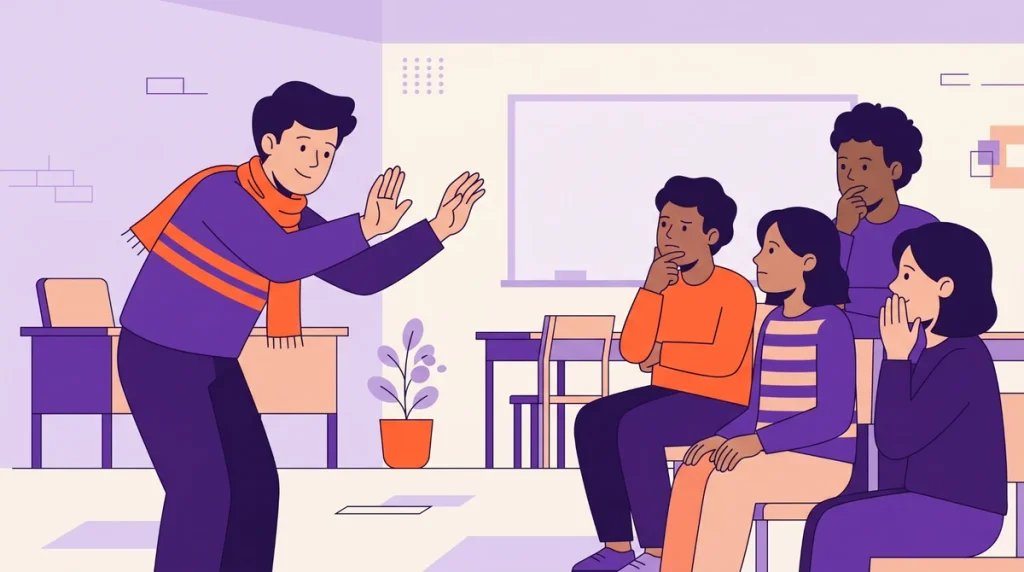
One player silently acts out a classroom-safe prompt while teammates guess. Allow 45-60 seconds, then rotate actors even when the team does not solve the card. Actions such as “a bat learning to dance” are often easier and funnier than abstract single words.
Performance should always be optional. Students may act with a partner, draw instead, manage the timer, or select prompts from the Halloween charades ideas guide.
6. Monster Drawing Relay
Best for: Grades 1-8; teams of four to six
Time: 10-15 minutes
Supplies: One sheet and marker per team
Seat each team in a line or around a table. The first artist draws a head, folds the paper to hide most of it, and passes it on. Later players add a body, arms, legs, and accessories. Unfold every monster together at the end.
This relay measures teamwork rather than drawing skill, so judging is optional. If points are needed, award simple categories such as clearest teamwork, funniest detail, and most unexpected creature.
Memory and Matching Games
7. Pumpkin Pattern Memory
Best for: Grades 1-5; individuals or pairs
Time: 8-12 minutes
Supplies: Pattern card, colored paper shapes, and cover sheet
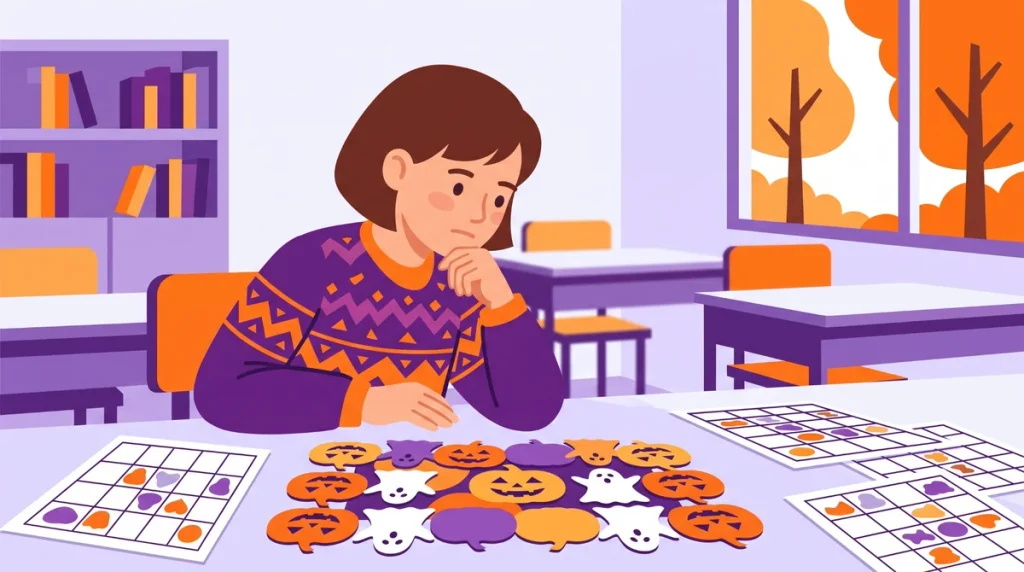
Display an arrangement of six to twelve paper pumpkins, ghosts, or stars for 20 seconds. Cover it, and ask students to rebuild the pattern from their own pieces. Reveal the original and let pairs check placement, color, and order.
Begin with fewer pieces for early grades. Meanwhile, older students can reproduce a longer pattern after completing a short distraction question.
8. Halloween Bingo
Best for: Grades 1-8; any class size
Time: 15-20 minutes
Supplies: Bingo cards, calling cards, and reusable markers
Give each student a card containing school-safe Halloween words or pictures. Draw one calling card at a time and display it as well as saying it. A player who completes the announced pattern quietly signals the teacher for verification.
Avoid food markers; paper squares or dry-erase sleeves reset faster. To prevent early winners from sitting out, continue toward a second pattern or let confirmed winners help display calling cards.
Building and Sorting Stations
9. Ghost Cup Stack
Best for: Grades 2-8; individuals or pairs
Time: 8-12 minutes
Supplies: Paper or reusable plastic cups with simple ghost faces
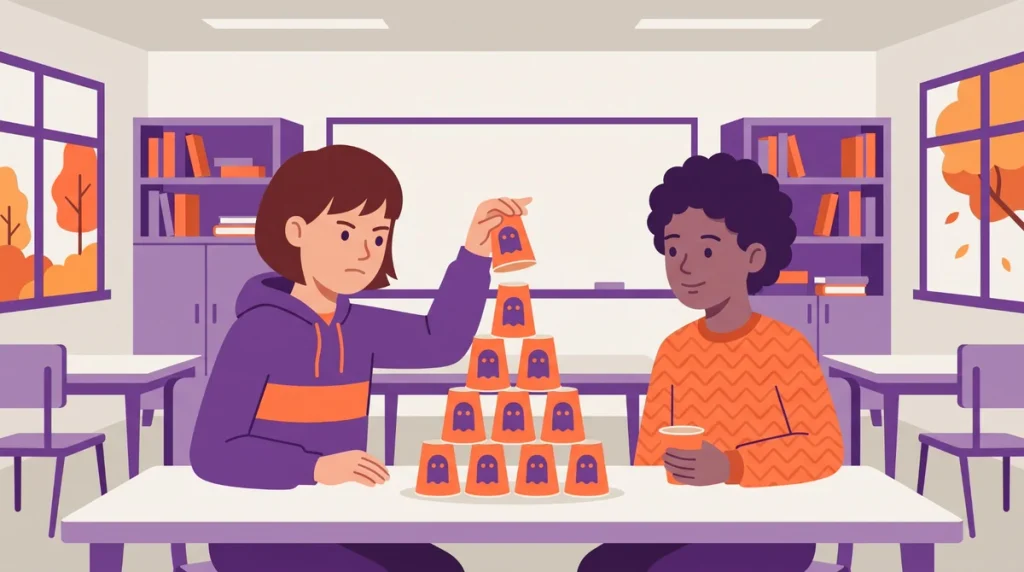
Players copy a displayed tower using an identical cup set. The structure must stand unsupported for three seconds. After one practice attempt, either time each pair or give the whole class a shared two-minute building window.
Use unweighted cups and keep stacks below face height. For a cooperative version, challenge the class to complete five different tower cards before time ends.
10. Paper Skeleton Build
Best for: Grades 2-8; pairs or teams of four
Time: 12-18 minutes
Supplies: Large paper bone shapes, reference card, and table space
Mix a set of paper bones in an envelope. Teams assemble a complete skeleton on the table without glue. Accuracy can earn one point per correctly placed major section, while a separate creativity round lets students build an imaginary creature.
This is a simplified picture puzzle, not an anatomy assessment. Therefore, use a clear reference image and avoid marking students down for medical terminology that has not been taught.
More Building and Sorting Stations
11. Pumpkin Patch Sort
Best for: Grades 1-5; pairs or small groups
Time: 8-12 minutes
Supplies: Large orange paper shapes and sorting cards
Students sort pumpkins by size, pattern, number, letter, or another visible feature. Next, they explain the rule used. Older students can receive one “mystery patch” and infer how the teacher sorted it.
Large laminated pieces are easier to collect than tiny counters. In addition, assigning one materials manager per team speeds up the reset.
12. Spooky Sequence Build
Best for: Grades 3-8; teams of three to five
Time: 10-15 minutes
Supplies: Event cards or illustrated sequence cards
Give each team a shuffled set showing steps in a harmless Halloween scene, such as preparing a jack-o’-lantern display or guiding a friendly ghost home. Players place the cards in a logical order and explain their reasoning.
Some sequences can have more than one sensible answer. Award the point when a team gives a clear explanation supported by every card rather than insisting on a hidden exact order.
Tossing Games for a Cleared Space
13. Witch Hat Ring Toss
Best for: Grades 1-8; station groups of two to six
Time: 10-15 minutes
Supplies: Stable cone, soft rings, tape, and score card
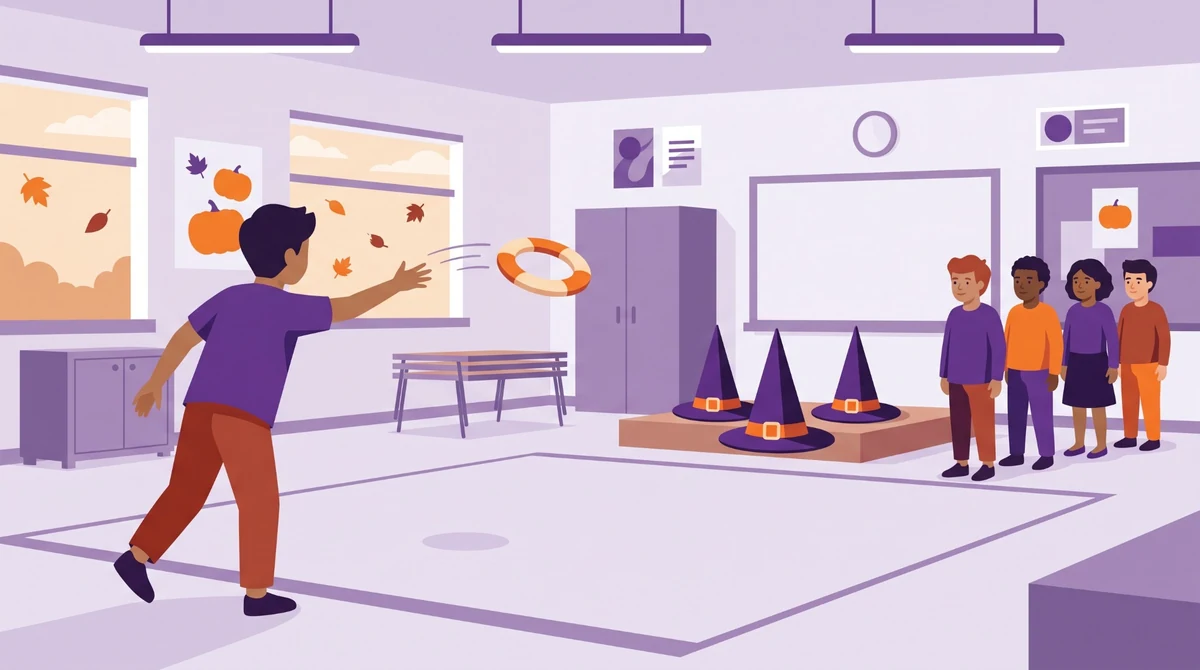
Mark one or more throwing lines. Each student gets three underhand tosses toward a cone decorated as a witch hat. Score one point per ring, then collect all rings before the next player begins.
Move the line rather than changing the equipment for different difficulty levels. A seated toss, larger target, or partner total provides an equivalent option without singling anyone out.
14. Feed the Monster Toss
Best for: Grades 1-6; individuals or teams
Time: 10-15 minutes
Supplies: Cardboard target and soft, securely closed beanbags
Cut or draw a wide monster mouth on a sturdy box. Students toss three beanbags from behind a line, and each successful throw adds one point to the class total. Stop when everyone has taken a turn or the class reaches its goal.
Keep waiting students behind a second line. Also, place the target against a clear wall so missed throws cannot hit displays, devices, or other players.
Whole-Class Movement Games
15. Desk-Safe Scavenger Hunt
Best for: Grades 2-8; pairs or table teams
Time: 12-20 minutes
Supplies: Clue sheet and permitted classroom objects
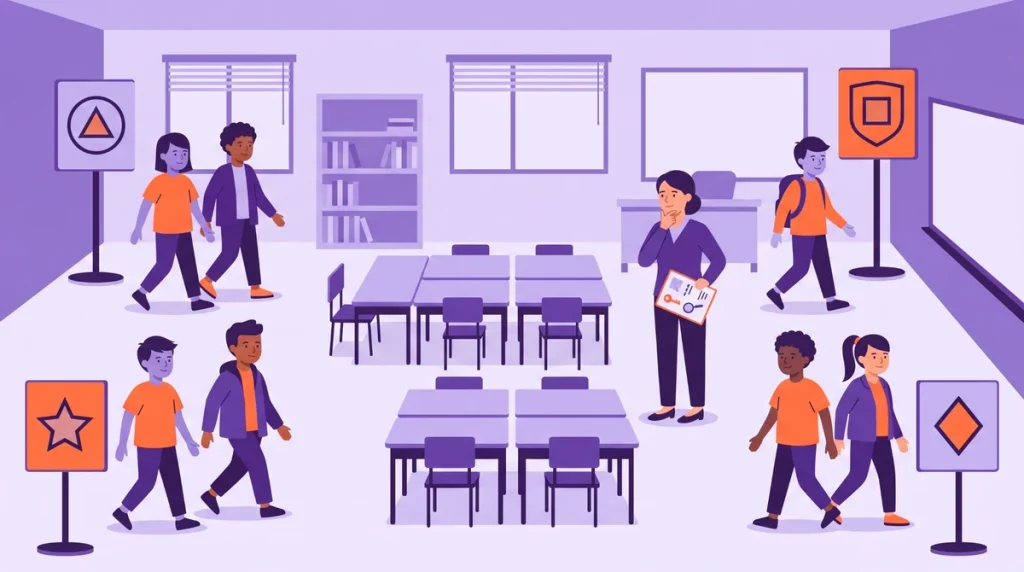
Create clues that point to visible, teacher-approved places: the class calendar, reading corner, pencil bin, or a numbered paper ghost. Teams record answers instead of collecting objects. Everyone walks; no running or opening drawers is allowed.
Stagger team starts when aisles are narrow. Unlike a building-wide hunt, this version stays inside one supervised room and keeps private desks, bags, and cabinets off-limits.
16. Four-Corner Clue Challenge
Best for: Grades 3-8; whole class
Time: 10-15 minutes
Supplies: Four large answer signs and question cards
Label the room corners A, B, C, and D. Read a multiple-choice clue, then students move at walking speed to the matching answer. Reveal the solution and invite a brief explanation before the next question.
Nobody is eliminated after a wrong answer. Students who prefer not to move can display an answer card from their seats, while a classmate or teacher records the response.
Cooperative Puzzle Games
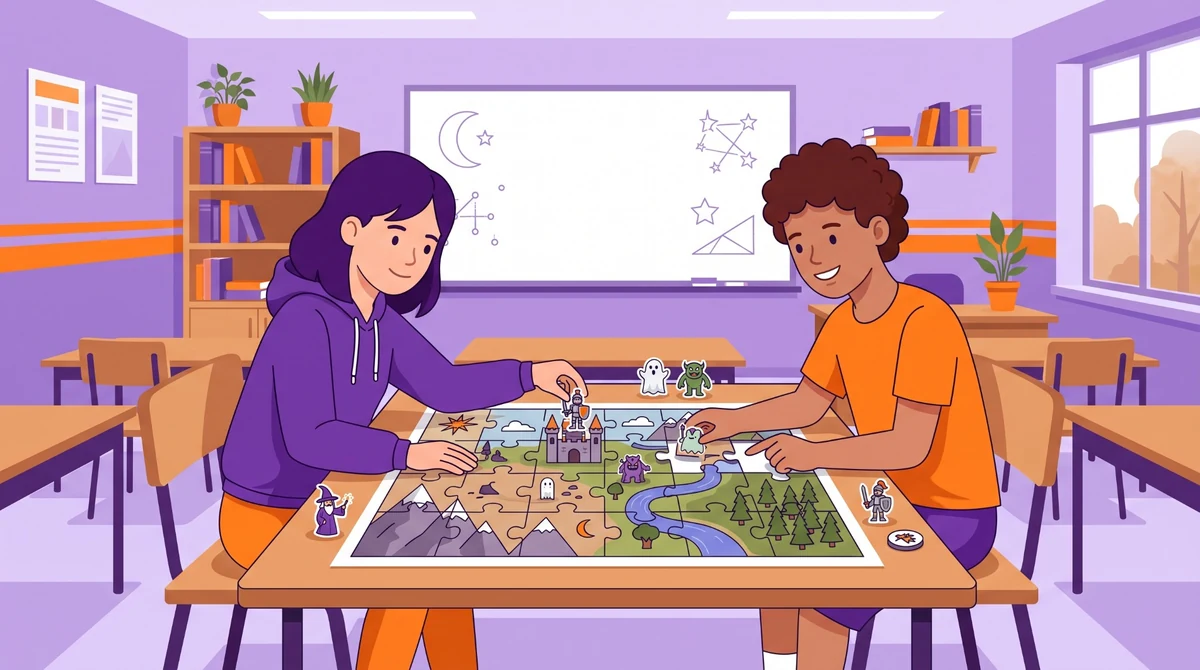
17. Haunted House Map Puzzle
Best for: Grades 3-8; teams of three to five
Time: 15-20 minutes
Supplies: Printed map, clue cards, pencils, and optional tokens
Teams use location clues to place friendly characters or objects in rooms on a fictional map. For example, “The black cat is not beside the library” becomes one piece of a simple logic puzzle. Every clue must be visible to the group.
Start with a teacher demonstration using two rooms and two characters. If the full puzzle stalls, allow teams to exchange one point for a hint instead of ending the activity.
18. Monster Blueprint
Best for: Grades 2-8; pairs
Time: 12-18 minutes
Supplies: Paper, pencils, and feature cards
Partners sit back-to-back or use a folder as a screen. One student describes a monster picture without naming the creature; the other draws from those instructions. Then they compare the two images and switch roles.
Scoring is unnecessary because the comparison creates the payoff. However, teachers can highlight clear directional language, careful listening, and useful follow-up questions.
Creative Team Challenges
19. Costume Concept Challenge
Best for: Grades 4-8; teams of three to five
Time: 15-20 minutes
Supplies: Character cards, setting cards, paper, and markers
Each team draws one character and one setting, such as “vampire” and “space station.” Students design a costume on paper, label three materials, and give a 30-second pitch. No student has to wear, model, or purchase anything.
Judge the concept against announced criteria: clarity, creativity, and whether the design answers both cards. Keep comments focused on the drawing rather than students’ bodies, clothing, or family budgets.
20. Classroom Mystery Relay
Best for: Grades 4-8; teams of four to six
Time: 15-25 minutes
Supplies: Four clue envelopes, answer sheet, and pencils
Teams solve one short puzzle at a time, show the answer to the teacher, and receive the next envelope. Use codes, word scrambles, picture clues, and simple logic rather than physical racing. The first accurate finish can win, or every team can work toward a shared deadline.
Assign rotating roles for reading, recording, checking, and reporting. As a result, the “relay” moves information instead of students, which suits a crowded classroom.
A 30-Minute Classroom Halloween Party Plan
A short party needs fewer transitions than a station event. This schedule fits one warm-up, one main team game, and one calm finish.
- 0-5 minutes: Explain expectations and play Halloween This-or-That.
- 5-20 minutes: Run Halloween Team Trivia, Monster Drawing Relay, or the Haunted House Map Puzzle.
- 20-27 minutes: Play one fast round of charades or Mystery Category Challenge.
- 27-30 minutes: Announce the class total, collect supplies, and use the cleanup checklist.
Choose the main game before printing materials. Then keep a no-supplies prompt list ready in case the class finishes early or the room setup changes.
A 45-Minute Station Rotation Plan
Four short stations provide variety without requiring every student to move at once. Groups stay at each station for eight minutes, with two minutes reserved for directions and transitions.
- 0-5 minutes: Introduce station rules, groups, roles, and movement direction.
- 5-13 minutes: Begin at the assigned station.
- 15-23 minutes: Move to the second activity.
- 25-33 minutes: Continue with the third challenge.
- 35-43 minutes: Finish at the fourth station.
- 43-45 minutes: Return materials and close the activity.
A balanced set could include Ghost Cup Stack, Pumpkin Pattern Memory, Monster Drawing Relay, and Mystery Category Challenge. If throwing is permitted, replace one table activity with Witch Hat Ring Toss in a separately marked area.
Fair Scoring and Classroom Management
Scoring should help the activity move, not become the main source of conflict. Announce the rule before each game and keep it visible on the station card.
- Give every team the same supplies, time limit, and explanation.
- Demonstrate one sample turn before starting the timer.
- Award points for objective results whenever possible: correct answers, completed patterns, or successful tosses.
- Use a simple three-part rubric for creative games: followed the prompt, explained the idea, and shared team roles.
- Record scores only after checking the result.
- Let absent or late-arriving students join a team without resetting earlier rounds.
For younger classes, a cooperative target often works better than ranked winners. For instance, the class can aim for 40 correct answers or 25 successful tosses. Older students may enjoy team standings, although no group should lose points for choosing a seated or nonperforming adaptation.
Safety, Accessibility, Allergies, and Comfort
Review every activity in the actual classroom because desk spacing, school policy, student needs, and available supervision vary.
- Keep aisles, exits, and throwing zones clear.
- Use walking-only rules and soft props for movement games.
- Avoid blindfolds, open flames, sharp decorations, body wrapping, and surprise touching.
- Offer seated play, partner performance, drawing, reading, timing, scoring, or materials management as real participation roles.
- Read prompts aloud and display them when possible.
- Preview references for age suitability, cultural context, and the class’s expected scare level.
- Ask students to keep personal desks, backpacks, and devices out of scavenger hunts.
- Follow school rules before photographing, recording, or posting any activity.
These games do not require candy or snacks. If food is added separately, follow the school’s allergy plan rather than assuming a treat is safe; the CDC guidelines for managing food allergies in schools support schoolwide prevention and response planning.
Finally, use classroom or consumer products that match their labeled age range, and remove damaged pieces before play. The U.S. Consumer Product Safety Commission’s toy safety guidance explains why small objects, hazardous edges, points, and certain materials require particular care in children’s products.
Common Classroom Halloween Game Mistakes
Planning more games than the schedule can hold. Directions, questions, and resets take time. Three complete activities are more useful than six rushed ones.
Making every station loud or active. Instead, alternate movement with drawing, memory, or puzzle work so the room has a natural reset.
Eliminating students after one mistake. Use team points, repeated rounds, helper roles, or cooperative totals to keep the full class involved.
Hiding rules until a dispute happens. Display the time limit, scoring method, permitted clues, and stopping point before play begins.
Treating adaptations as an advantage. A seated toss, partner actor, larger print card, or reader role should offer equivalent participation without a scoring penalty.
Free Printable Classroom Halloween Games Teacher Pack
Want to run the activities without building every sheet from scratch? Download the ink-friendly teacher pack with a preparation checklist, classroom-safe prompts, station rules, rotation schedules, a team score sheet, and a cleanup checklist.
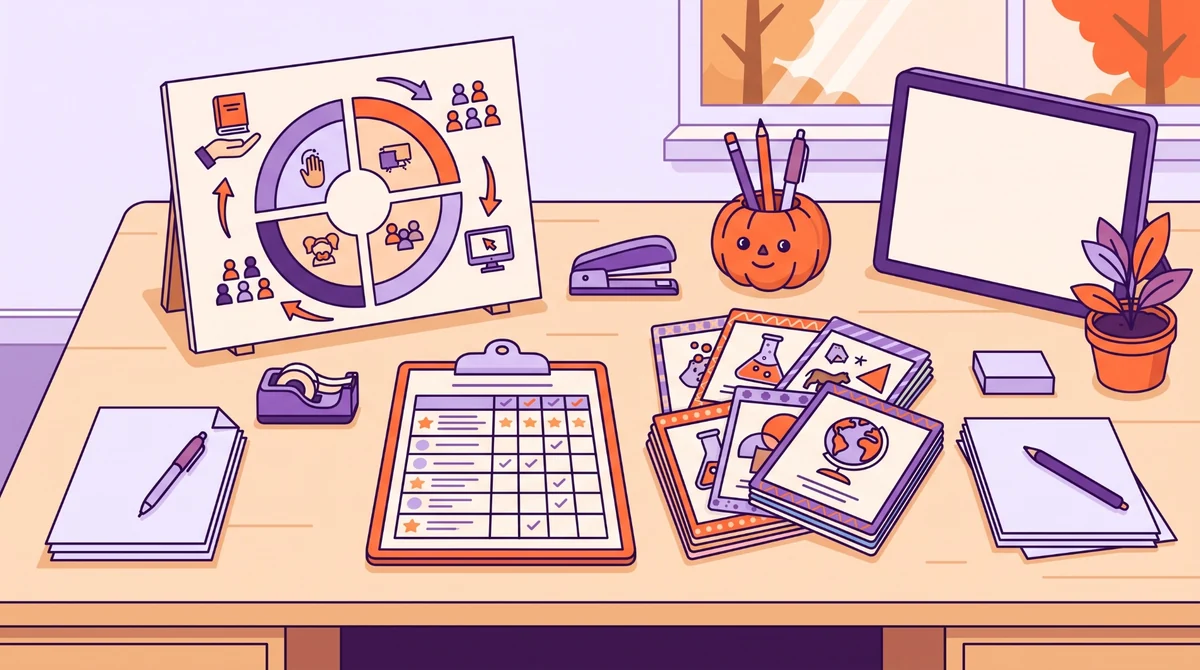
Free PDF • Teacher-ready rules • Classroom-safe prompts • Rotation chart • Score sheet
Print the host pages at 100% scale. Place each station card with its matching supply bin, and keep the master score sheet with the teacher rather than moving it between groups.
Sources and Editorial Method
This article treats each activity as a flexible classroom party format rather than a game with one universal publisher or official rulebook. Consequently, the grade bands, player ranges, timing, scoring, station schedules, and stopping points are GamingStation editorial planning estimates. Teachers should adjust them to the class, room, school rules, and available supervision.
The article does not claim first-hand classroom testing, event attendance, or measured outcomes. Safety and allergy guidance was checked against the following authoritative sources:
- CDC: Voluntary Guidelines for Managing Food Allergies in Schools and Early Care and Education Programs
- U.S. Consumer Product Safety Commission: Toy Safety Business Guidance
Final Verdict
The best classroom Halloween games are the ones a teacher can explain quickly, supervise comfortably, and adapt without excluding students. For most classes, combine one quiet question game, one creative team challenge, and one controlled movement option.
Start with Halloween This-or-That, Team Trivia, and Monster Drawing Relay when preparation time is limited. If the room supports stations, add Ghost Cup Stack or Witch Hat Ring Toss and use the printable rotation chart to keep transitions predictable.
Frequently Asked Questions
Low-prep options include Halloween This-or-That, Mystery Category Challenge, charades, and Monster Drawing Relay. They use basic paper, pencils, prompt cards, or a timer, and teachers can explain each game quickly without rearranging the entire classroom.
Quiet classroom Halloween games include team trivia, bingo, Pumpkin Pattern Memory, Haunted House Map Puzzle, and Two-Sentence Spooky Story. These activities keep students seated or working at tables while still encouraging teamwork, creativity, and discussion.
For grades 1-2, choose picture matching, simple voting, and large props. Grades 3-5 can handle trivia and building stations, while grades 6-8 often enjoy logic puzzles, design challenges, and harder clues.
Choose three or four classroom Halloween party ideas with different energy levels. Start with a quick warm-up, move into a team challenge, and finish quietly. Clear rules, labeled supply bins, and planned transitions keep the celebration manageable.
Use Halloween This-or-That for five minutes, Pumpkin Pattern Memory for eight to twelve minutes, or a short Mystery Category round. These options need little setup and can fill a brief break without disrupting the lesson schedule.
Divide students into table teams and assign roles such as reader, writer, artist, timer, and materials manager. Team trivia, bingo, charades, and four-corner clues scale well because several students can participate during each turn.
Offer seated play, partner acting, drawing, reading, scoring, or materials roles. Avoid forced performance and early elimination. Students using an adapted role should receive equal scoring opportunities rather than being treated as if they have an advantage.
The printable teacher pack includes classroom-safe prompts, station rule cards, a trivia answer key, 30- and 45-minute schedules, a rotation chart, a team score sheet, and a cleanup checklist for easier classroom planning.
