
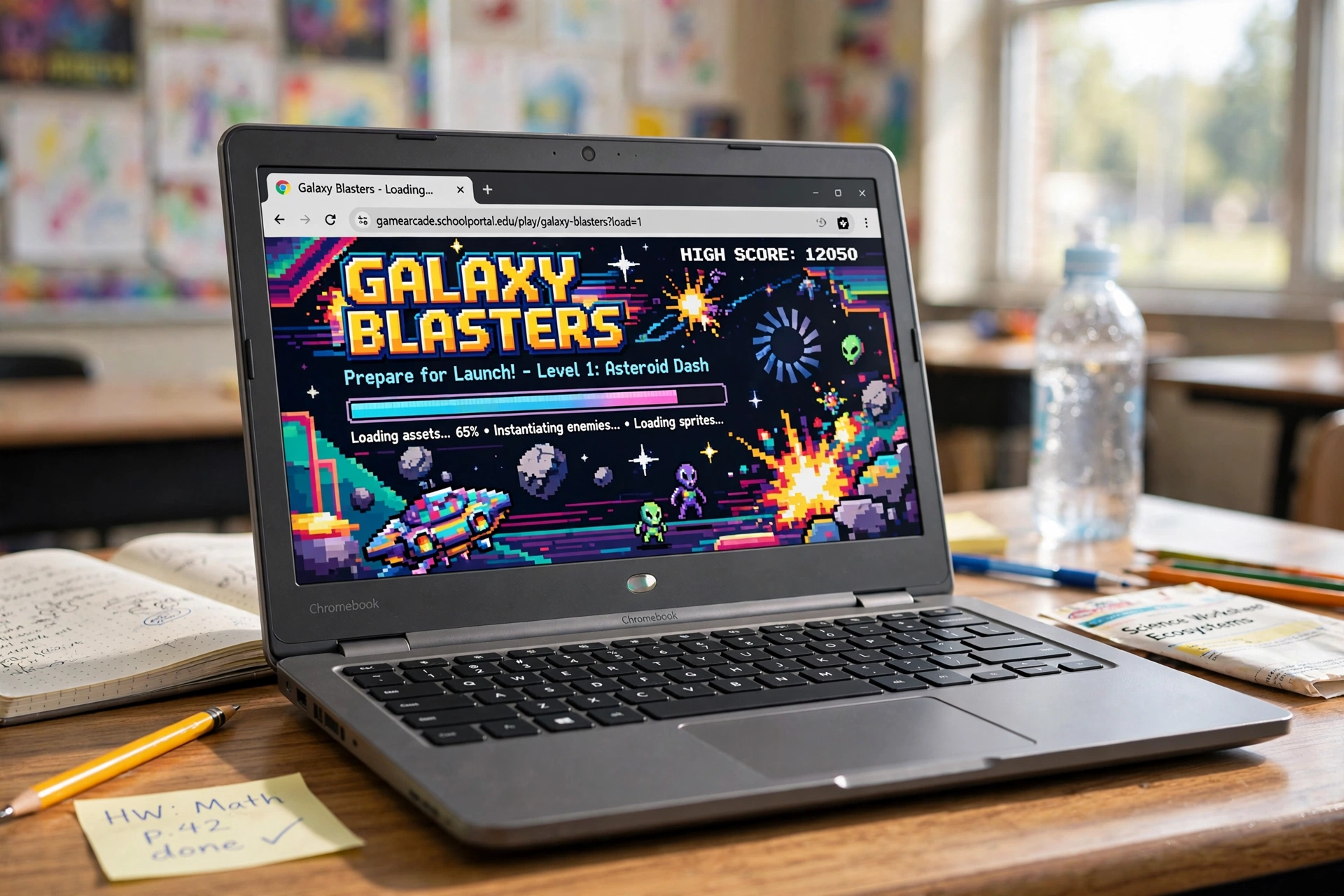
Unblocked Games 67 is not a single official website. It is a label for a loose family of browser game pages, mostly hosted on Google Sites and GitLab, that stay reachable on school networks because filters rarely block those platforms. There is no verified official domain and no company behind it. Stranger still, most of the top search results for the term are not game sites at all.
Why the search results look broken
Search “unblocked games 67” and look at what actually ranks. You will find auto-generated PDF files sitting on a home-automation company’s API domain, the official website of the city of Aracaju in Brazil, and a car dealership’s internal dashboard. You will find a Q&A thread on GoodNovel, a fiction reading app. The PDFs all repeat the same template text with the domain names swapped, down to identical FAQ tables answering “Is 67 Games Unblocked safe to use?” with the same sentences. None of them is a real game site, and none of them is official anything. Even the safety advice on those pages is template filler, not anything anyone tested.
This is what happens when 95,000 people a month search a term that has no official owner. Spammers fill the vacuum with machine-made pages, and the few real pages, plain Google Sites mirrors with embedded games, get buried under the junk. Understanding this matters because it tells you the single most important fact about “67”: there is nobody official to trust, so every page has to earn trust on its own.

What “67” actually is
Strip away the spam and the pattern is simple. “Unblocked Games 67” describes browser game pages that live on infrastructure school filters do not block: Google Sites pages and GitLab project pages, embedding free HTML5 games with no downloads and no accounts. We traced the same mirror pattern with Unblocked Games G+, a sibling label from the same world.
The one live example you can verify right now is a Google Sites page titled “unblockedgames67.io” (sites.google.com/view/unblockedgames67io/). It is exactly what the label describes: a plain page claiming 1000+ games, organized into action (SAS Zombie Assault), sports (Head Arena Soccer, Basketball Stars), arcade (Space Invaders, Slope, UNO), and .io games (Agar.io, Slither.io, Surviv.io, Mope.io). Minimalist interface, instant play, no accounts, no branding, no company. That plainness is the signature of a genuine mirror: there is nothing to sell you, so there is nothing dressed up.
The same label also shows up on GitLab, the developer platform, where “Unblocked Games 67” project pages host games the same way: static pages, embedded HTML5, no downloads. The trust logic is identical. Filters do not block developer infrastructure, and developer platforms scan what they host.
Why do these pages slip through school filters at all? Because the filters cannot afford to block the platforms. Schools run on Google Workspace: assignments live in Classroom, documents in Drive, sites in Google Sites. Blocking sites.google.com outright would break actual schoolwork, so filters allowlist it and try to block individual game pages instead, which is a losing game of whack-a-mole as mirrors rotate addresses. GitLab survives for the same reason: it is infrastructure, not a “game site” in any filter’s category list.
So why “67”? Nobody official has ever explained it, because there is nobody official. The going explanation is that the numbers are mirror batch labels: 66, 67, and 76 are sibling labels for the same pattern, and when one batch of addresses gets blocked, the next number takes over. One of the spam PDFs accidentally supports this, noting that “the number 67 often refers to specific unblocked proxy servers or mirrors.” Treat it as informed guesswork, not history, but it fits everything observable: the numbers behave like batches, not brands.
67 vs 66 vs 76: are they different?
Not really. They are sibling labels for the same mirror pattern, and there is no verified relationship between them beyond the naming. If your school blocks the 67 mirrors, a 66 or 76 page might still load, and vice versa, because school filters usually block exact addresses rather than ideas. Some “76” pages are visibly just renamed 67 mirrors with the same game lists. Judge each page on its own: check the address bar, check what platform hosts it, and never assume one number is safer than another. A Google Sites 67 page and a random-domain 76 page are completely different animals despite the family resemblance in name.
Is Unblocked Games 67 safe? Myths vs facts
Myth: the official site is unblockedgames67.com.
Fact: no official domain can be verified. Auto-generated spam pages name that domain, but they are template text mirrored across random websites, not evidence. Notice the inconsistency: different spam templates name different “official” homes (unblockedgames67.com here, unblockedgames67.io there, a Google Sites page elsewhere). A real official site has one address. The only verifiable live pages under this label are the Google Sites and GitLab mirrors described above.
Myth: the games themselves can infect your computer.
Fact: browser-based HTML5 games cannot install anything on your computer without your explicit action. The real risks are everything around the game: fake download buttons, pop-ups claiming your Flash player is out of date (Flash died in 2020, so that message is always a lie), prompts to install “unblock” extensions, and redirects. Extensions deserve special caution: a browser extension can read everything you do in the browser, which makes a shady “unblocker” far more dangerous than any game. If a page asks you to download, install, enable, or allow anything, leave.
Myth: playing unblocked games is illegal.
Fact: opening a web page breaks no law. What it can break is your school’s acceptable use policy, which is a school discipline issue, not a legal one. More on that below.
Myth: you need an account, or a VPN, or special software.
Fact: real mirrors need none of that. No accounts, no downloads, no extensions, no sign-ups. The genuine pages work the moment they load; anything demanding setup before you can play is either an ad trap or something worse. Our Unblocked Games 1024 safety review walks through the same red flags on another mirror network, step by step.
8 safer ways to play
If hunting mirrors feels like work, these are established options with real reputations. Each one gets an honest trade-off.
| Option | Why it is safer | Trade-off |
|---|---|---|
| Google Sites 67 mirrors | Google scans hosted content; nothing to download | Addresses rotate as filters catch up; no support |
| GitLab-hosted 67 mirrors | Developer platform, same no-download model | Even less polished; harder to find |
| Scratch (MIT) | School-whitelisted; you can make games too | A kids’ coding platform, not an arcade |
| Lagged | Built for unblocked play, curated library | Ads are part of the deal |
| Y8 | Huge catalog, long-running portal | Dated interface in places; ads |
| Newgrounds | Genuine curation, indie classics | Some content skews older; check first |
| Unblocked Games 66 / 76 | Sibling labels, same mirror pattern | Same verification problem as 67 |
| Coolmath Games | The school-safe veteran since the 90s | Covered in depth in our Unblocked Games G+ guide; tame catalog |
How to pick: on a school Chromebook, start with Scratch or a Google Sites 67 mirror, since both are the least likely to be blocked and neither asks for anything. At home where filters are not the issue, Newgrounds and Y8 have the deepest catalogs. If you want zero ads, Scratch is the cleanest mainstream option; our G+ guide also covers Classroom 6x, a newer portal built with no ads at all.
Two more from our own reviews, if you want the full background: the Selenite Games review covers another portal’s safety record, and the 1024 review linked above covers a second mirror network’s red flags.
Games worth playing
These are the titles that show up again and again on 67 mirrors and the safe portals above. All run in the browser, most load in seconds on a Chromebook, and none needs an account.

- Slope. The endless downhill reflex game. One button to steer, speed that keeps climbing, runs that last two minutes. The unofficial mascot of unblocked gaming, and it loads instantly on weak hardware.
- Run 3. An endless runner through collapsing space tunnels with a genuinely clever gravity mechanic. Dozens of levels, so it lasts longer than most break-time games.
- Retro Bowl. Simplified American football management with real depth. Plays like the Tecmo Bowl era: draft, manage, and call plays in short sessions.
- 1v1.LOL. Fast build-and-shoot duels, the closest thing browsers have to Fortnite’s core loop without the download. Needs a stable connection more than the others here.
- Moto X3M. Physics bike trials with forgiving checkpoints. Easy to learn, hard to put down, and each level is a natural stopping point.
- 2048. The number puzzle that ate a thousand study halls. One puzzle per run, easy to quit mid-game, zero learning curve.
- Tank Trouble. Maze tank battles where your own shots bounce back at you. Best with a friend on the same keyboard, which is half the fun.
- Fireboy and Watergirl. Two-player co-op puzzles built for pairs sharing one keyboard. Made for the kid sitting next to you.
- Subway Surfers. The endless runner everyone knows, playable in the browser. See our Subway Surfers unblocked guide for the verified safe version and the copycats to avoid.
When your mirror stops working
It will happen. A mirror that loads today can be blocked tomorrow, because that is the entire lifecycle of this pattern: addresses rotate as filters catch up. When it happens, work through this list in order.
First, try a sibling number. If the 67 mirror is blocked, a 66 or 76 page with the same games often still loads, since filters block exact addresses. Second, try the other platform: if Google Sites mirrors are blocked, look for the GitLab-hosted ones, and vice versa. Third, check whether the page simply moved; mirrors sometimes reappear under a slightly different address within days.
What not to do: do not install a VPN or an “unblocker” extension to get around it. On a school-managed device that can violate the acceptable use policy more seriously than the gaming itself, and shady extensions can read everything in your browser. And do not go hunting through random domains wearing the “67” name; that is exactly where the copycats and ad traps live. If no mirror works, the safer portals in the table above are the better move.
A quick, factual note on school rules
Playing browser games is not illegal. It can violate your school’s acceptable use policy, which may mean detention or losing device privileges, but that is school discipline, not law. One practical fact: many schools run monitoring software like GoGuardian on school-managed Chromebooks, which shows teachers open tabs in real time. Assume activity on a school device is visible. That is the actual situation, so you can make your own call with real information.
FAQs
What is Unblocked Games 67?
Unblocked Games 67 is a label for browser game pages, usually hosted on Google Sites or GitLab, that stay accessible on restricted school and work networks. There is no single official website or company behind it. The name describes a pattern: pages embedding free HTML5 games on platforms that school filters rarely block, because blocking those platforms would break classroom tools.
What is the real Unblocked Games 67 website?
There is no verified official website. The only live pages you can actually check are mirrors like the Google Sites page titled “unblockedgames67.io” and GitLab-hosted pages under the same label. Any page claiming to be the one official homepage is misrepresenting itself, and auto-generated pages naming an official domain are spam templates, not evidence. When in doubt, the address bar test from the safety section settles it in seconds.
Is Unblocked Games 67 safe?
Pages genuinely hosted on Google Sites or GitLab are low risk, since those platforms scan hosted content and the games are static HTML5 embeds with nothing to download. The danger comes from copycat sites on other domains borrowing the “67” name, and from ad traps: fake download buttons, pop-ups, and prompts to install extensions. Check the address bar, never download anything, and leave any page that asks for permissions or personal information.
Why is it called 67?
Nobody knows for certain, because there is no official source to ask. The most plausible explanation is that the numbers are mirror batch labels: 66, 67, and 76 are sibling labels for the same pattern, and new numbers appear as old addresses get blocked. One spam result even describes 67 as referring to “specific unblocked proxy servers or mirrors,” which fits the batch theory. Treat it as informed guesswork.
What is the difference between Unblocked Games 66, 67, and 76?
Very little. They are sibling labels for the same mirror pattern with no verified official connection between them. If one is blocked on your network, another might still load, since filters block exact addresses. Judge each page individually by its hosting platform and address bar, not by its number. A Google Sites 67 page is a different animal from a random-domain 76 page.
Do I need to download anything to play Unblocked Games 67?
No. Real mirrors run entirely in the browser with no downloads, installs, accounts, or extensions. If any page tells you to download a player, an extension, or an app to play, that is a red flag. Close the page. The same goes for “enable notifications” or “allow location” prompts: a browser game has no legitimate use for either.
Can I play Unblocked Games 67 on a Chromebook or phone?
Yes. The games are HTML5 and browser-based, so they run on Chromebooks, phones, and tablets through any modern browser. That is exactly why the pattern spread through schools: no install step means it works on locked-down devices. On a phone, stick to simpler games; fast 3D titles like Slope play better on a Chromebook keyboard.
Sources
- Google Sites, “unblockedgames67.io”: live example of a genuine 67-pattern page, game catalog and categories.
- Skool, “Unblocked Games 67” (Kids and Games community): Google Sites hosting, safety notes, and the 66/76 sibling labels.
- Beast Hunger, “Unblocked Games 67”: UG67 branding, genre breakdown, and game list.
- Sinovision, “Unblocked Games 67 Gitlab”: GitLab-hosted mirrors under the same label.
- Google search results for “unblocked games 67” (observed October 2026): SERP composition, auto-generated PDF spam, and GoodNovel Q&A.
