
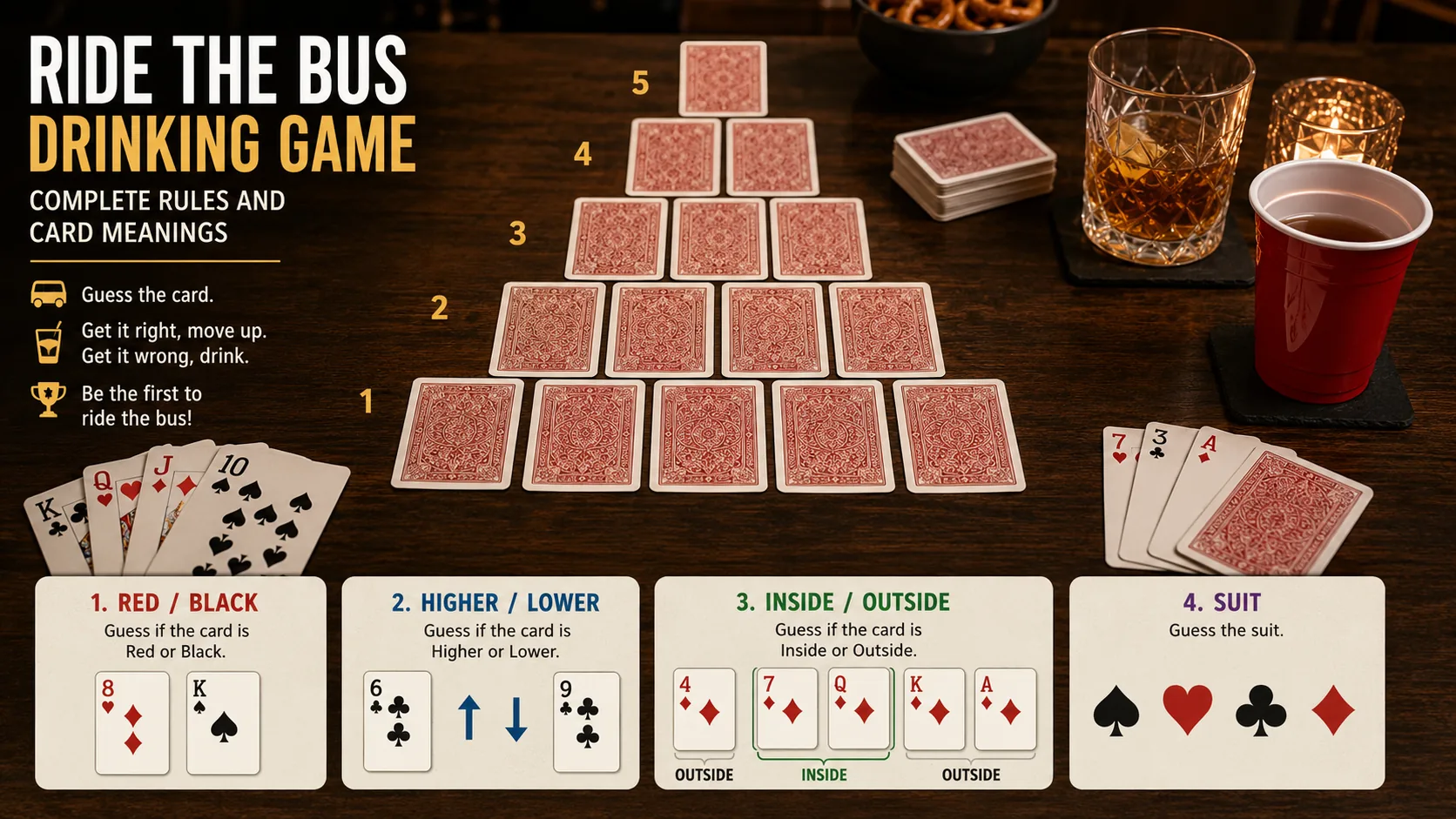
Direct Answer: The Ride the Bus drinking game is a three-phase card game built around prediction, matching, and a final “bus” round. Players first answer four card questions—red or black, higher or lower, inside or outside, and suit—then play through a five-row pyramid. Because house rules vary widely, agree on penalties and the final bus format before starting.
By Gaming Station Editorial Team
Last reviewed: August 2026
The Ride the Bus drinking game looks complicated when its rules are written as one long sequence, but the structure is easier to understand when separated into three stages:
If your group wants a lighter card activity after this, these party games with playing cards are easier to teach with the same standard deck.
Four prediction cards → Pyramid → Ride the Bus
A standard 52-card deck is enough for the card game itself. Widely published versions begin by giving each player four cards through a sequence of prediction questions, then use those cards against a five-row pyramid. The player left with the most cards usually becomes the person who has to “ride the bus.”
There is one important complication: Ride the Bus has no universal official ruleset. Published versions disagree about ties, pyramid penalties, and especially what happens during the final bus. This guide therefore uses a clearly defined common version and identifies major variations separately rather than silently mixing different rules.
For a safer and more inclusive game night, every drinking penalty in the rules below can—and preferably should—be replaced with a point, token, challenge card, water sip, or another non-alcoholic consequence. Drinking too much too quickly can cause serious impairment and alcohol overdose, and alcohol content can vary substantially between beverages.
Ride the Bus Card Game Rules at a Glance
| Feature | Common Rule |
|---|---|
| Deck | Standard 52-card deck |
| Players | Commonly 2+ |
| Main phases | 3 |
| Phase 1 | Four prediction questions |
| Question 1 | Red or Black |
| Question 2 | Higher or Lower |
| Question 3 | Inside or Outside |
| Question 4 | Guess the Suit |
| Phase 2 | Five-row pyramid |
| Pyramid layout | 5–4–3–2–1 cards |
| Who rides the bus? | Usually player with most cards left |
| Alcohol required? | No |
| Best alternative | Points or penalty tokens |
Both Thrillist’s published rules and a current TOZ rules guide use a standard deck, four prediction rounds, a five-row pyramid, and a final Ride the Bus phase.
What Is the Ride the Bus Drinking Game?
Ride the Bus is a prediction-and-matching card game in which players accumulate four personal cards, use those cards against a central pyramid, and then determine which player must complete a final card challenge.
Its three parts test different skills:
- Phase 1: Probability and guessing
- Phase 2: Card matching and timing
- Phase 3: Luck, memory, or prediction depending on the chosen variation
The alcohol component is not mechanically necessary. Replacing every drinking instruction with penalty points leaves the underlying card structure intact.
Ride the Bus Setup
What You Need
For the basic game:
- 1 standard 52-card deck
- 2 or more players
- Table space for a 15-card pyramid
- Optional score or penalty tokens
- One dealer
A current TOZ ruleset specifies a standard 52-card deck and 2+ players.
Recommended Gaming Station Setup
For a smoother game, also prepare:
- 15–20 small tokens
- A simple rules card
- A clear discard area
- Water and non-alcoholic drinks
- A written agreement on tie rules
The last point matters because several Ride the Bus traditions use different final-round rules.
Ride the Bus Card Meanings
There are no special printed cards in Ride the Bus. Instead, each of the first four cards has a specific question or meaning based on the order in which it is dealt.
| Card | Question | What You Predict |
|---|---|---|
| Card 1 | Red or Black? | Card color |
| Card 2 | Higher or Lower? | Rank compared with Card 1 |
| Card 3 | Inside or Outside? | Whether rank falls between Cards 1 and 2 |
| Card 4 | What Suit? | Hearts, Diamonds, Clubs, or Spades |
This four-question sequence is consistent across multiple published Ride the Bus rulesets.
Phase 1: The Four Ride the Bus Questions
Each player receives four cards total, one during each question round.
Keep those cards. They will be needed during the pyramid phase.
Round 1: Red or Black?
The dealer asks:
“Red or black?”
The player predicts the color of the next card.
Red
- ♥ Hearts
- ♦ Diamonds
Black
- ♣ Clubs
- ♠ Spades
The dealer reveals one card.
If the prediction is correct, the player keeps the card and proceeds.
If incorrect, apply the agreed penalty.
Published drinking versions commonly assign a drinking penalty for a wrong guess, but a point or token works exactly as well mechanically.
Probability
At the beginning of a full standard deck:
26 red cards + 26 black cards = 52 cards
So the initial red-or-black prediction is essentially a 50/50 choice before any cards are known.
Round 2: Higher or Lower?
Now compare the next card with the player’s first card.
The dealer asks:
“Higher or lower?”
Example:
First card:
6♣
The player says:
“Higher.”
Possible winning cards include:
- 7
- 8
- 9
- 10
- Jack
- Queen
- King
- Ace
In the published Thrillist and TOZ versions reviewed here, Ace is high.
What Happens on a Tie?
This is one rule worth defining before starting.
Two published versions we reviewed treat an equal-ranked second card by replacing or redealing it rather than counting it as either higher or lower.
Recommended rule
Same rank = redraw
Example:
First card: 8♠
Next card: 8♦
Return or discard the second Eight according to your house procedure and draw again.
This keeps the question genuinely binary.
Round 3: Inside or Outside?
The player now has two cards.
The dealer asks:
“Inside or outside?”
The player predicts whether Card 3 will fall:
- Inside the values of the first two cards
- Outside those values
Example
First cards:
4♣ and 10♥
Inside cards include:
5, 6, 7, 8, 9
Outside cards include:
2, 3, Jack, Queen, King, Ace
The Thrillist rules give the same basic interpretation: if the boundaries are Four and Nine, Five is inside while Queen is outside.
What If Card 3 Matches a Boundary?
Published versions again vary slightly.
Thrillist’s rules replace a card equal to either boundary rather than counting it as inside or outside.
Recommended beginner rule
Equal to either boundary = redraw
This eliminates arguments over whether “inside” includes the endpoints.
Round 4: Guess the Suit
The final prediction is:
“Which suit?”
The player chooses:
- Hearts ♥
- Diamonds ♦
- Clubs ♣
- Spades ♠
The dealer reveals Card 4.
With no useful card-counting information, there are four possible suits, making this the narrowest basic prediction of the opening phase.
Thrillist and TOZ both use suit as the fourth question.
After everyone completes this round, each player should have:
4 personal cards
Keep them visible only to yourself unless your chosen house rules say otherwise.
Phase 1 Card Meanings Cheat Sheet
| Round | Call | Example |
|---|---|---|
| 1 | Red / Black | “Red” |
| 2 | Higher / Lower | “Higher than 7” |
| 3 | Inside / Outside | “Inside 4 and Queen” |
| 4 | Suit | “Spades” |
For a non-alcoholic game, a wrong guess can simply equal:
1 penalty point
That is cleaner than escalating consequences and keeps the card game moving.
Phase 2: Ride the Bus Pyramid Setup
After all players have four cards, build the pyramid.
Lay 15 cards face down:
        [1]

      [2] [2]

    [3] [3] [3]

  [4] [4] [4] [4]

[5] [5] [5] [5] [5]
More simply:
- Bottom row: 5 cards
- Next row: 4
- Next: 3
- Next: 2
- Top: 1
Both current rulesets reviewed use this five-row structure.
How the Pyramid Works
Starting at the bottom row, flip one pyramid card at a time.
Suppose the revealed card is:
Queen of Diamonds
Any player holding any Queen can play that Queen onto the pyramid card.
The rank matters, not the suit.
So all of these match:
- Q♥
- Q♦
- Q♣
- Q♠
Published Ride the Bus pyramid rules use matching rank as the condition for playing a card from your hand.
Once played, that card is no longer in the player’s hand.
The strategic goal is therefore simple:
Get rid of as many of your four cards as possible before the pyramid ends.
What Do the Pyramid Rows Mean?
Traditional drinking versions increase the penalty or assignment as the pyramid moves upward.
| Row | Cards | Traditional Weight |
|---|---|---|
| Bottom | 5 | 1 |
| Row 2 | 4 | 2 |
| Row 3 | 3 | 3 |
| Row 4 | 2 | 4 |
| Top | 1 | 5 |
Both Thrillist and TOZ describe escalating row values from one at the bottom to five at the top.
Safer Gaming Station version
Use the numbers as points, not quantities of alcohol:
- Bottom = assign 1 penalty point
- Row 2 = 2 points
- Row 3 = 3 points
- Row 4 = 4 points
- Top = 5 points
This preserves the escalating value of holding a matching card without creating an incentive for rapid alcohol consumption.
Example Pyramid Turn
The dealer reveals:
9♣
It is on Row 3.
Jordan has:
9♥
Jordan plays the Nine and assigns:
3 penalty points
to another player.
The pyramid continues.
Later another Nine appears on a higher row. If Jordan already used the only Nine in hand, Jordan cannot play again.
Should You Play a Matching Card Immediately?
Not necessarily.
Some Ride the Bus versions allow players to hold a matching card in hopes that the same rank appears later on a higher-value row. Thrillist explicitly describes this choice as a risk because the player with the most cards remaining after the pyramid must ride the bus.
Example:
You hold a King.
A King appears on the bottom row.
You could:
Play now
Remove the King safely.
Save it
Hope another King appears near the top for a larger scoring opportunity.
The risk:
If no King appears again, that card stays in your hand.
That may cause you to ride the bus.
Who Has to Ride the Bus?
After all 15 pyramid cards have been revealed, everyone counts their remaining personal cards.
In the common ruleset:
The player with the most cards remaining rides the bus.
Example:
| Player | Cards Left |
|---|---|
| Alex | 0 |
| Sam | 2 |
| Jordan | 1 |
| Taylor | 3 |
Taylor rides the bus.
What Happens If Players Tie?
This is another area where house rules differ.
Thrillist’s version breaks the tie using the highest-valued remaining card, then the next-highest if necessary.
Another common house rule sends every tied player onto the bus.
Recommended rule
Use the high-card tiebreaker:
- Compare highest remaining rank.
- Higher rank rides.
- If tied, compare next-highest card.
- Continue until the tie breaks.
It avoids turning a one-player finale into an unexpectedly large group round.
Phase 3: Riding the Bus
This is the least standardized part of the game.
Two widely published versions currently describe different bus mechanics. Thrillist uses ten face-down cards with penalties triggered by face cards and Aces, while TOZ describes a sequence of predictions that resets after a wrong answer.
For clarity, Gaming Station recommends the following 10-card bus version because it is straightforward and requires no ambiguous prediction sequence.
Recommended Ride the Bus Final Round
The dealer places:
10 cards face down in a row.
The bus rider turns them over one at a time.
Number Cards
2 through 10
No special effect.
Continue.
Jack
Traditional value: 1
Queen
Traditional value: 2
King
Traditional value: 3
Ace
Traditional value: 4
Thrillist’s published Ride the Bus rules use this exact increasing J-Q-K-A structure in its final 10-card bus.
For a non-alcoholic version, simply convert those numbers to penalty points.
Ride the Bus Face Card Meanings
| Card | Bus Value |
|---|---|
| 2–10 | 0 |
| Jack | 1 |
| Queen | 2 |
| King | 3 |
| Ace | 4 |
These are final-bus values, not universal card values throughout the entire game.
During the prediction and pyramid stages, Jack, Queen, King, and Ace generally function primarily as ranks.
Alternative Final Round: Consecutive Predictions
Another widely circulated version makes the rider repeatedly predict cards rather than simply revealing a 10-card line.
A current TOZ ruleset describes the rider making prediction calls such as red/black or higher/lower and restarting after a wrong guess.
Example house format
Require the rider to get:
5 correct predictions in a row
using:
- Red or black
- Higher or lower
- Another agreed prediction rule
A miss resets the streak.
Important
Do not combine this reset mechanic with escalating alcohol penalties. Repeated forced consumption can quickly become unsafe, particularly because the duration is controlled by random card outcomes rather than by the participant. NIAAA warns that drinking too much too quickly can impair judgment and coordination and can lead to potentially fatal alcohol overdose.
Using penalty tokens makes this version work just as well as a card challenge.
Complete Ride the Bus Example
Four players:
- Alex
- Casey
- Morgan
- Taylor
Phase 1
Alex predicts:
Red
Card:
8♥
Correct.
Next:
Higher
Card:
King♣
Correct.
Next:
Inside
With boundaries 8 and King, the new card is:
10♦
Correct.
Final prediction:
Spades
Card:
4♠
Correct.
Alex’s hand:
8♥, K♣, 10♦, 4♠
Phase 2
The dealer creates:
5–4–3–2–1 pyramid
A Ten appears.
Alex plays:
10♦
Later a Four appears.
Alex plays:
4♠
No Eight or King appears.
Alex finishes with:
2 cards
If every other player has fewer than two, Alex rides the bus.
Non-Alcoholic Ride the Bus
The non-alcoholic Ride the Bus version uses exactly the same card rules. For mixed groups, you can also use these party games for adults when some players do not want drinking penalties.
Replace drinking instructions with one of these systems:
Penalty Points
Wrong prediction:
+1 point
Lowest total score wins after several games.
Tokens
Players collect penalty tokens.
Most tokens at the end loses.
Candy or Coin Counters
Use small objects instead of drinking penalties.
Mini Challenges
A wrong answer triggers something simple:
- Tell a joke
- Name a movie beginning with a chosen letter
- Answer a trivia question
- Do a harmless impression
- Draw a quick doodle
Water Version
Use optional small sips of water while avoiding any competitive pressure to consume excessive liquid.
Best option
Penalty tokens are the cleanest because they preserve scoring without interrupting gameplay.
Ride the Bus Without Alcohol: Recommended Rules
For a completely game-first version:
Phase 1
Wrong prediction:
Take 1 penalty token
Pyramid
Matching card lets you assign penalty points equal to the row value.
Final Bus
- Jack = 1 point
- Queen = 2
- King = 3
- Ace = 4
Winner
After one or several full games:
Fewest penalty points wins.
This turns Ride the Bus into a legitimate prediction-and-memory party card game rather than making alcohol the actual objective.
Ride the Bus Strategy
Ride the Bus contains substantial randomness, but a few decisions matter.
1. Use Known Cards
As more cards appear, the remaining deck changes.
If many red cards have already been revealed, black becomes somewhat more likely among the unknown cards.
The same principle applies to suits and ranks.
2. Higher or Lower: Use the Position of the First Card
An extremely low card provides more higher possibilities.
An extremely high card provides more lower possibilities.
For example:
First card:
3
“Higher” is usually a more favorable direction than “Lower.”
First card:
King
“Lower” is usually the obvious choice.
Exact probabilities change as cards leave the deck.
3. Inside or Outside: Look at the Gap
Suppose your first two cards are:
2 and King
There are many ranks between them.
Inside is attractive.
If your cards are:
7 and 9
Very few ranks fall strictly between them.
Outside becomes more attractive.
4. Do Not Overvalue Pyramid Points
If your goal is avoiding the bus, getting rid of cards is often more important than saving them for a higher pyramid row.
Holding three cards for potential top-row matches and missing all three can send you directly to the final round.
5. Track Frequently Appearing Ranks
If three Kings have already appeared during the game and you are holding the fourth, the probability of another King appearing from the remaining deck depends on whether previously played cards are recycled.
Know your group’s deck procedure before attempting serious card tracking.
Ride the Bus Rules That Must Be Agreed Before Starting
Because this is a folk party game rather than a standardized commercial product, write down these decisions:
| Rule | Choose Before Playing |
|---|---|
| Ace | High only? |
| Higher/lower tie | Redraw or loss? |
| Inside/outside boundaries | Redraw or outside? |
| Pyramid | Can cards be saved? |
| Tie for most cards | High-card tiebreak or multiple riders? |
| Final bus | 10-card face-card version or prediction version? |
| Penalties | Points, tokens, or optional adult drinking? |
| Alcohol quantities | Never escalate automatically |
Agreeing on these points prevents most arguments.
Safer Alcohol Rules for Adults
If your group prefers a cup-based party game instead of a card game, these beer pong rules are easier to run with clear scoring. If adults of legal drinking age choose to include alcohol, the game should not determine how much someone must consume.
NIAAA notes that a U.S. standard drink contains about 14 grams of pure alcohol, but beverage strength varies substantially; for example, the same 12-ounce serving can represent different numbers of standard drinks depending on alcohol percentage.
Use these modifications:
- Replace multiple “drinks” with points.
- Do not use shots as card penalties.
- Never require someone to finish a beverage.
- Let anyone switch to water or a soft drink at any time.
- Do not pressure anyone who declines alcohol.
- Do not combine alcohol with driving.
- Stop the drinking component entirely if anyone shows significant impairment.
Drinking large quantities rapidly can impair coordination and judgment and can lead to alcohol overdose. Warning signs include confusion, difficulty staying conscious, vomiting, seizures, trouble breathing, slow or irregular breathing, and clammy or unusually pale/bluish skin. Suspected alcohol overdose requires urgent medical help. For adult players, the CDC explains that drinking less is better for health than drinking more.
Common Ride the Bus Mistakes
| Mistake | Problem | Better Rule |
|---|---|---|
| Mixing two rule versions | Causes disputes | Pick one finale before starting |
| Forgetting each player’s four cards | Breaks pyramid stage | Keep cards separate |
| Matching by suit in pyramid | Usually wrong mechanic | Match rank |
| Not defining Ace | Higher/lower becomes ambiguous | Use Ace high |
| No tie rule | Finale stalls | Use highest remaining card |
| Saving every matching pyramid card | Increases bus risk | Balance value vs. card removal |
| Escalating alcohol by pyramid row | Can encourage rapid consumption | Use penalty points |
| Using shots for face cards | Unnecessary risk | Use points/tokens |
| Pressuring non-drinkers | Excludes players | Use non-alcoholic penalties |
Ride the Bus Quick Rules
Need the game explained in under a minute?
- Shuffle a standard 52-card deck.
- Each player gets four cards through four predictions: red/black, higher/lower, inside/outside, suit.
- Build a face-down pyramid with rows of 5, 4, 3, 2, 1 cards.
- Reveal cards from the bottom upward.
- Players discard personal cards matching the revealed rank.
- Higher pyramid rows are worth more penalty points.
- Player with the most cards remaining rides the bus.
- For the recommended final round, reveal 10 cards: number cards are neutral; Jack = 1, Queen = 2, King = 3, Ace = 4 penalty points.
- Lowest penalty total wins.
The first two phases follow the broad structure found across published Ride the Bus rules; the final format is explicitly one of several common versions.
Final Verdict
The Ride the Bus drinking game is easiest to understand as three separate card games joined together:
Predict four cards → clear cards through the pyramid → survive the bus.
The four basic Ride the Bus card meanings are consistent across widely published versions: Card 1 asks red or black, Card 2 higher or lower, Card 3 inside or outside, and Card 4 asks for the suit.
The pyramid is normally built with 15 cards in five rows—5, 4, 3, 2, 1—and players try to remove personal cards whose ranks match cards revealed from the pyramid. The player with the most cards remaining generally rides the bus.
The final bus is where published versions diverge, so groups should explicitly choose either a face-card-value finale or a prediction-based version before playing. For another fast adult party game with simple setup, see these Rage Cage drinking game rules.
For Gaming Station’s recommended version, use penalty points or tokens instead of escalating alcohol quantities. It keeps every strategic and social part of Ride the Bus while making the game accessible to drinkers and non-drinkers alike.
Frequently Asked Questions
What are the basic Ride the Bus card game rules?
Players first receive four cards by predicting red or black, higher or lower, inside or outside, and suit. They then use those cards against a 5–4–3–2–1 pyramid. The player with the most cards remaining typically completes the final Ride the Bus challenge.
What are the Ride the Bus card meanings?
Card 1 means red or black, Card 2 means higher or lower, Card 3 means inside or outside, and Card 4 means guess the suit. In one common final bus version, Jack through Ace carry increasing values of 1 through 4.
How do you set up Ride the Bus?
Use a standard 52-card deck and choose a dealer. During the opening phase every player receives four cards. For the pyramid, place 15 additional cards face down in rows of five, four, three, two, and one.
Is Ace high or low in Ride the Bus?
The published versions reviewed for this guide use Ace as the highest rank during higher-or-lower play. Because Ride the Bus has many house-rule variations, announce this before starting.
What does inside or outside mean in Ride the Bus?
“Inside” means the new card’s rank falls strictly between the first two cards. “Outside” means it falls above the higher card or below the lower card. One published version redraws when the third card exactly matches either boundary.
Who has to ride the bus?
Under a common ruleset, the player with the most personal cards remaining after the pyramid rides the bus. Thrillist’s version breaks ties using the highest remaining card.
Can you play Ride the Bus without alcohol?
Yes. The entire game works with penalty points, tokens, trivia challenges, or other non-alcoholic consequences. Alcohol does not affect the card mechanics, so a non-alcoholic Ride the Bus follows the same predictions, pyramid, matching, and bus structure.
Are there different Ride the Bus rules?
Yes. Published versions agree on much of the opening and pyramid structure but can differ significantly during the final bus. One uses a 10-card line where face cards and Aces trigger penalties, while another uses repeated prediction challenges and resets.
