
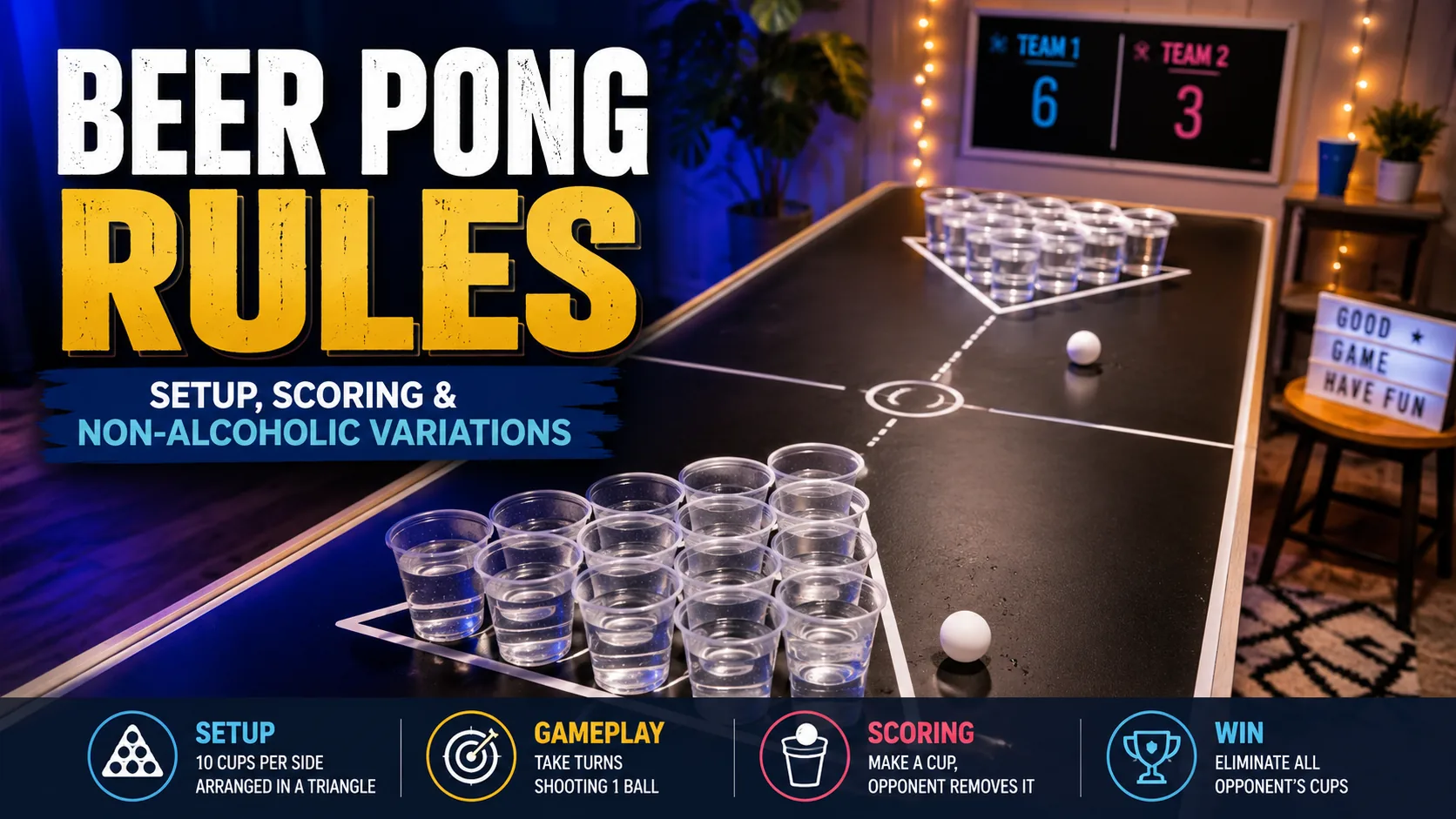
Direct Answer: Standard beer pong rules use 10 cups per team in a tight triangle and two ping-pong balls. Teams alternate shots, removing a cup when a ball lands inside. House rules vary for bounce shots, re-racks, redemption, and rollbacks. For safer play, use water in the game cups and keep drinking completely separate from scoring.
By Gaming Station Editorial Team
Last reviewed: August 2026
Beer pong has thousands of house-rule variations, which is why two groups can both say they know the “official” rules and still disagree about bounce shots, re-racks, balls back, or what happens after the final cup.
The clearest way to establish consistent beer pong rules is to separate standard tournament-style rules from optional party rules.
The World Series of Beer Pong rules provide a useful standardized reference: 10 cups per team, arranged in a tight triangle; two 40 mm balls; an 8-foot table; automatic re-formations at six, three, and one cups; and redemption after the last cup is hit. Importantly, official tournament rules use water in the cups and explicitly state that nobody should be required or encouraged to drink because of the game.
For casual game nights, you can simplify those rules considerably. This guide covers the setup, beer pong cup formation, shot rules, scoring, re-racks, bounce shots, redemption, common house rules, and a fully non-alcoholic beer pong format.
If your group wants another adult party game after beer pong, these Ride the Bus drinking game rules are useful for a card-based option.
Beer Pong Rules at a Glance
| Rule | Recommended Format |
|---|---|
| Teams | 2 players per team |
| Cups | 10 per team |
| Starting formation | 4–3–2–1 triangle |
| Balls | 2 ping-pong balls |
| Shots per normal turn | 2 total, one per teammate |
| Direct shot | Removes 1 cup |
| Bounce shot | House-dependent; tournament format can remove 2 |
| Re-racks | Standardized tournament format at 6, 3, and 1 |
| Both teammates score | Tournament format gives 1 rollback shot |
| Final cup | Opponent may receive redemption |
| Successful redemption | 3-cup overtime |
| Recommended cup contents | Water |
| Alcohol required? | No |
These standardized details are based on current World Series-style tournament rules published by the Japan Beer Pong Association, which links back to BPONG’s official rules.
What Is Beer Pong?
Beer pong is a target-throwing party game in which opposing teams attempt to land ping-pong balls inside cups arranged at opposite ends of a table.
When a shot lands successfully, the corresponding cup is removed.
The basic objective is therefore:
Eliminate all of the opposing team’s cups before they eliminate yours.
Traditional house-party versions may connect successful shots with drinking penalties, but drinking is not required for the game mechanics. In fact, official World Series-style competition uses water in the playing cups and says the water is not for consumption.
For GamingStation.org, the recommended format is:
Water in the game cups + optional separate beverages + no forced consumption.
That keeps the skill game intact while avoiding a system where random results determine alcohol intake.
Beer Pong Setup
What You Need
A practical home beer pong setup requires:
- 20 cups
- 2 ping-pong balls
- A long rectangular table
- Water
- 2 teams
- Enough clear space around the table
For formal World Series-style competition, the published equipment specification uses an 8-foot by 2-foot table, two 40 mm tournament balls, and 16-ounce cups.
You do not need regulation equipment for a casual game.
The important factors are:
- Both teams use identical cups.
- Both ends are equally spaced.
- The table is stable.
- Nobody has an unfair shooting distance.
Beer Pong Cup Formation
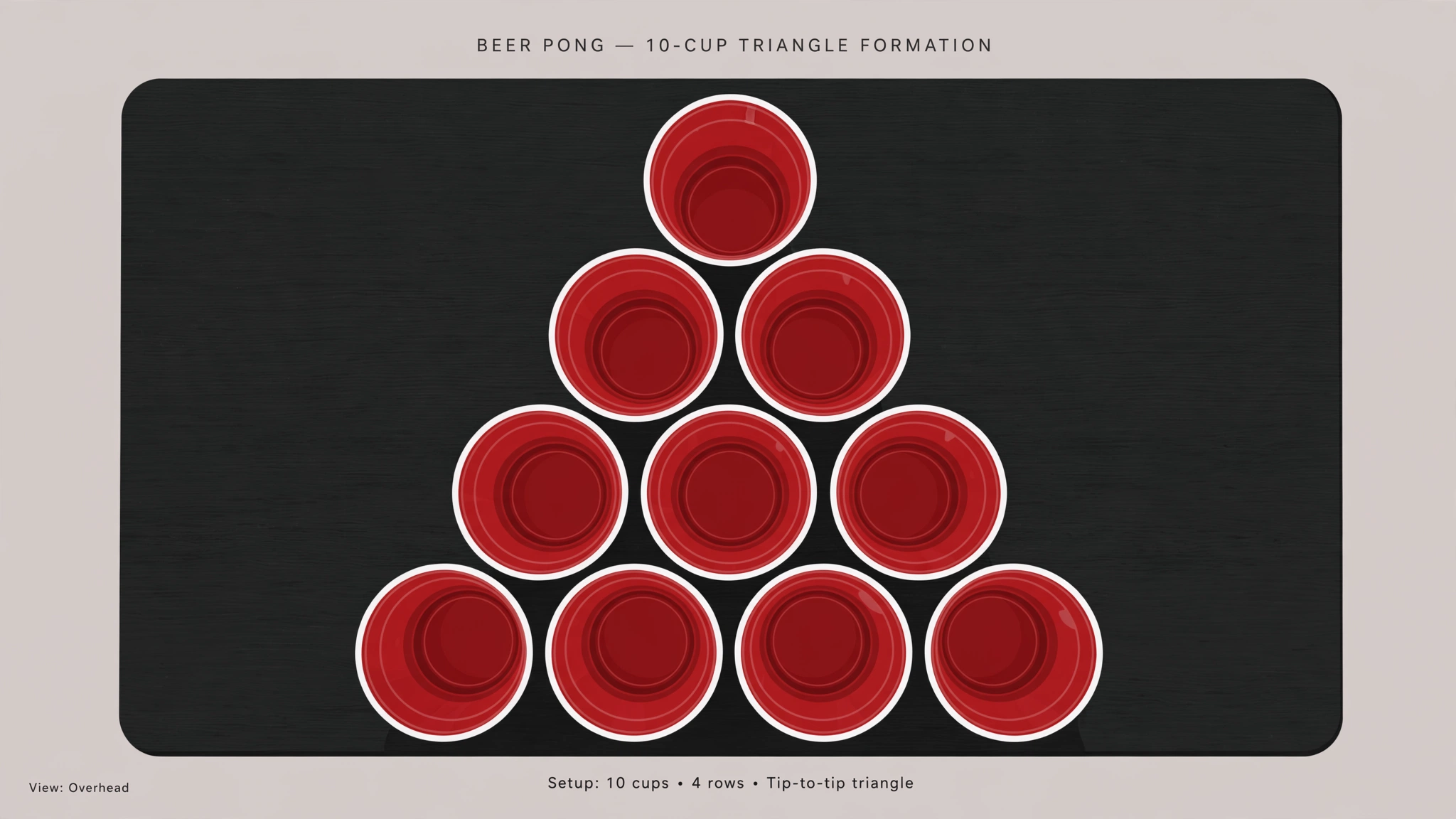
The standard beer pong cup formation starts with 10 cups per team.
Arrange them as:
        O
      O   O
    O   O   O
  O   O   O   O
From the shooter’s perspective:
- Front row: 1
- Second row: 2
- Third row: 3
- Back row: 4
Total:
1 + 2 + 3 + 4 = 10 cups
In the tournament rules, the triangle is described as tight, meaning the cup rims touch. The triangle points toward the opposing team and is centered at the end of the table.
What Goes in Beer Pong Cups?
For the cleanest modern setup:
Use water.
Official tournament rules specify that each cup is filled roughly one-third to one-half with water, and the rules explicitly state that this water is not consumed.
This setup has several advantages:
- Alcohol consumption is not controlled by game outcomes.
- Players can choose their own beverage separately.
- Non-drinkers participate equally.
- Cups can be filled consistently.
- Spills are easier to manage.
A separate drinking glass or bottle should remain away from the playing cups.
How to Decide Which Team Goes First
For casual play, use any neutral method:
- Coin toss
- Rock-paper-scissors
- Random draw
- One-shot challenge
The official tournament rules allow teams to use an agreed method such as a coin flip or rock-paper-scissors; if teams cannot agree, rock-paper-scissors is used.
Once first possession is determined, begin shooting.
How to Play Beer Pong
The typical format uses two players on each team.
During a normal turn:
- Player 1 takes one shot.
- Player 2 takes one shot.
- Any successfully hit cups are removed.
- Possession switches to the other team.
Official World Series-style rules give the opening team one shot on its first possession, then normally give each team two shots per turn—one per teammate.
For a simpler house game, many groups simply use two shots from the beginning.
Agree before starting.
What Counts as a Made Shot?
A normal shot scores when:
The ping-pong ball enters and remains in a live opponent cup.
That cup is removed.
If the ball merely:
- Hits the rim
- Strikes the side
- Lands on top of the cups
- Bounces away
it normally does not score.
Tournament rules specifically state that a ball that somehow lands and remains on top of the cups counts as a miss.
Beer Pong Scoring
Beer pong is normally scored by cup elimination rather than numerical points.
Standard Direct Shot
Made shot = remove 1 cup
Miss
Remove 0 cups
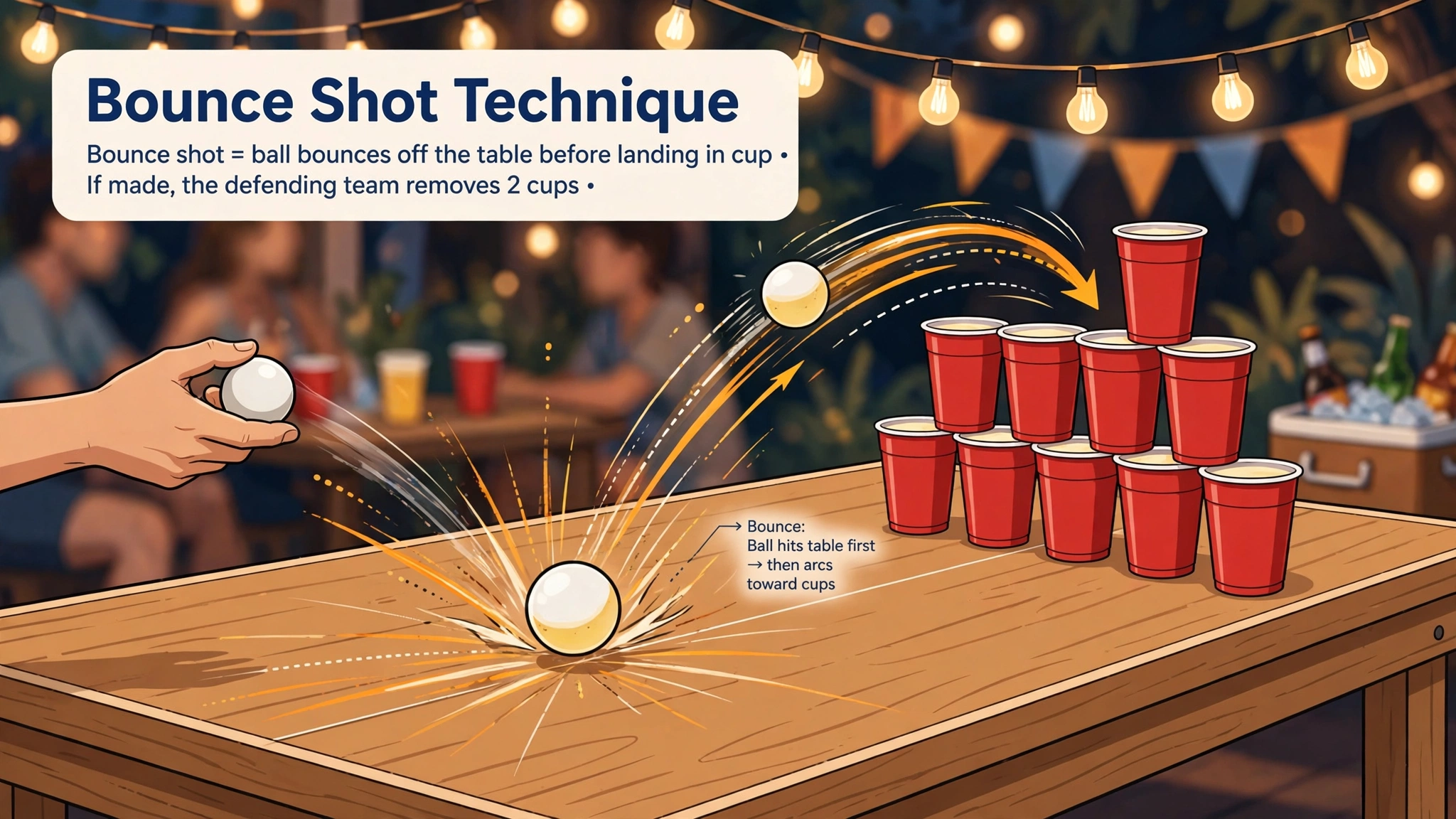
Bounce Shot
Rules vary.
Under World Series-style rules:
Successful bounce = 2 cups removed
The cup containing the ball is removed, and the defending team chooses the second cup. However, once the ball has bounced on the table, defenders may swat or catch it.
Quick Scoring Table
| Shot | Result |
|---|---|
| Direct shot made | Remove 1 cup |
| Direct shot missed | No cup |
| Tournament-style bounce made | Remove 2 cups |
| Bounce intercepted after table contact | No cup |
| Both teammates score | Additional rollback may apply |
Should Bounce Shots Count Double?
This is one of the most common house-rule disputes.
A straightforward option is:
Simple Beginner Rules
Bounce shot = 1 cup
No extra value.
This keeps the game easier to explain.
Tournament-Inspired Rules
Bounce shot = 2 cups
But the defending team may swat the ball after it has touched the table.
The risk/reward balance is therefore:
Potentially worth twice as much → but much easier to defend.
Whatever rule you choose, announce it before the first shot.
Can You Swat a Beer Pong Ball?
For a normal airborne shot:
No—do not interfere before it reaches the cups.
World Series-style rules allow a ball to be grabbed or swatted only after it has already contacted a cup, with a specific exception for bounce shots. A bounce shot may be swatted or caught after it makes contact with the table.
So:
| Shot Status | Can Defender Swat? |
|---|---|
| Normal shot still flying | No |
| Bounce has touched table | Yes |
| Ball has contacted cup | Rules permit interaction in defined situations |
| Ball is inside cup | No |
For casual play, the simplest rule is:
Never interfere with a direct shot; bounce shots can be blocked after the bounce.
What Is a Re-Rack in Beer Pong?
As cups disappear, the formation becomes spread out.
A re-rack or reformation moves the remaining cups back into a compact arrangement.
This improves consistency and removes awkward drifting formations.
Official Beer Pong Re-Racks
The World Series-style rules automatically reform cups when:
- 6 cups remain
- 3 cups remain
- 1 cup remains
The rules specify that reformation occurs as soon as the relevant count is reached, including in the middle of a turn.
Simple Formations
Six cups are commonly compacted into a triangle:
      O
    O   O
  O   O   O
Three cups:
    O
  O   O
One cup:
OFor casual play, automatic re-racks are easier than arguing over how many requests each team gets.
Can Players Request a Re-Rack?
Under tournament-style rules, cups that drift out of position can be reformed at the shooter’s request, while the principal 6-, 3-, and 1-cup formations happen automatically.
House games frequently use different policies such as:
- One re-rack per game
- Two re-racks
- Re-rack whenever requested
- Fixed re-racks only
Any can work.
The important thing is consistency between teams.
What Happens If Both Teammates Make Their Shots?
One popular rule is usually called:
Balls Back
or
Rollback
Under current World Series-style rules, when both teammates sink their shots during the same turn, their team receives one additional rollback shot. Either teammate may take it, subject to limits on repeated consecutive rollbacks by the same person.
Example
Team A:
Player 1 → Makes shot
Player 2 → Makes shot
Result:
- Both hit cups are removed.
- Team A receives one extra shot.
This differs from some house rules where both players receive another shot.
Decide which format you are using.
What If Both Balls Land in the Same Cup?
House rules vary significantly.
For casual play, the cleanest rule is:
Each ball counts normally if the cup is still live when the shot occurs.
Tournament rules instruct players to wait until hit cups are removed before taking the next shot; shooting into a cup that has already been hit counts as a miss.
This eliminates arguments about “same cup” bonuses.
Can You Lean Over the Table?
Some form of leaning is allowed under World Series rules, but players cannot use the table for additional support or move it while shooting. Players must begin with both feet on the ground and cannot use prohibited contact with the table to gain extra reach.
For casual parties, use the simpler version:
You may lean naturally, but you cannot support yourself on the table or move the table while shooting.
This is easier to enforce than arguing about an imaginary elbow line.
What Happens If You Knock Over Your Own Cup?
Under tournament rules, if a team knocks over one of its own live cups, that cup generally counts as hit and is removed.
For casual play:
Your team knocks over its own cup → your team loses that cup.
That encourages players to keep:
- Phones
- Drinks
- Bags
- Sleeves
- Spectators
away from the active cup formation.
How Does Beer Pong End?
The simplest rule is:
The first team to eliminate all 10 opponent cups wins.
However, many beer pong rules add a final chance known as:
Redemption
or
Rebuttal
What Is Redemption in Beer Pong?
When one team makes the opponent’s final cup, the losing team gets an opportunity to stay in the game.
Under formal World Series-style rules, redemption depends on how many cups remain on the winning team’s side and how the final shot occurred. Broadly, the defending team attempts to make its remaining opponent cups without missing.
If redemption succeeds:
The game goes to overtime.
Simple Redemption Rule for Home Games
The official system contains several detailed scenarios, so a casual game can use a simpler rule.
Recommended Beginner Rule
After the final cup is made:
- Each player on the losing team gets one redemption shot.
- If both miss, the game ends.
- If enough shots are made to clear the opponent’s remaining cups, go to overtime.
Or use an even simpler format:
No redemption—the final cup ends the game immediately.
That version is ideal for short game nights.
Beer Pong Overtime
In World Series-style rules, successful redemption leads to a three-cup overtime.
The three cups form a tight triangle. The team that originally hit the last cup gets first possession in overtime.
Formation:
    O
  O   O
Play continues with the normal shooting and redemption structure.
Common Beer Pong House Rules
Beer pong has an unusually large number of unofficial variations.
For groups that like fast house-rule games, these Rage Cage drinking game rules are another simple party option.
Common examples include:
- Bounce shots worth two
- Balls back when both teammates hit
- Limited re-racks
- Redemption
- Overtime
- Trick-shot bonuses
- “Heating up” or “on fire”
- Special final-cup rules
- Different cup counts
Not all of these belong to formal tournament play.
For a good party game, fewer rules are often better.
House Rules vs. Tournament Rules
| Rule | Simple House Format | WSOBP-Style Format |
|---|---|---|
| Starting cups | 10 | 10 |
| Water in cups | Recommended | Required |
| Normal make | Remove 1 | Remove 1 |
| Bounce | Optional | Worth 2 |
| Bounce defense | Optional | Can swat after bounce |
| Re-racks | Decide beforehand | 6, 3, 1 |
| Both teammates hit | Optional balls back | 1 rollback |
| Final cup | Can end game | Redemption follows |
| Overtime | Optional | 3 cups |
| Drinking required | No | No |
The official tournament framework is notably not a forced-drinking format: water is used in all game cups, and participants are not required or encouraged to drink because of gameplay.
Recommended Beer Pong Rules for a Casual Party
For the easiest version to teach, use these:
- Two teams of two.
- Ten water-filled cups per team.
- Arrange cups in a 4–3–2–1 triangle.
- Each teammate shoots once per turn.
- Direct make removes one cup.
- Bounce make removes two cups but can be swatted after the bounce.
- Automatic re-rack at six, three, and one.
- If both teammates score, team gets one bonus shot.
- Final cup triggers one redemption opportunity.
- Successful redemption creates three-cup overtime.
- Alcohol is never required.
That keeps most recognizable beer pong mechanics without loading the game with obscure house rules.
Beer Pong Scoring Explained
Unlike basketball or darts, beer pong usually does not need a point score.
Think of each team as having:
10 health points = 10 cups
Every direct made shot normally reduces the opponent by:
1 cup
So:
Cups remaining = 10 − valid cups hit
Example:
Team A has made six valid direct shots:
10 − 6 = 4 cups remaining
If using a tournament-style successful bounce worth two cups:
Cups remaining = Previous cups − 2
The winner is normally the team that successfully eliminates the opponent’s final cup and survives any applicable redemption round.
Beer Pong Cup Formation by Remaining Cups
For an easy visual guide:
10 Cups
        O
      O O
    O O O
  O O O O
6 Cups
      O
    O O
  O O O
3 Cups
    O
  O O
1 Cup
OFormal rules require the racks to remain centered and re-form at six, three, and one cups.
Non-Alcoholic Beer Pong
Non-alcoholic beer pong uses exactly the same throwing, scoring, re-rack, and victory rules.
For mixed groups, these party games for adults can also work when not everyone wants a drinking-style game.
Nothing about the core game requires beer.
In fact, this closely resembles competitive beer pong: official tournament rules already put water in the game cups and prohibit requiring or encouraging drinking as part of play.
Best Non-Alcoholic Beer Pong Variations
1. Water Pong
Fill the playing cups with water.
Do not drink from them.
This is the simplest option.
2. Point Pong
Instead of associating cups with beverages:
Every removed cup = 1 point
First team to 10 wins.
Or play multiple rounds:
- Win = 3 match points
- Overtime win = 2
- Loss = 0
This works well for tournaments.
3. Soda Pong
Keep water in the actual game cups for cleanliness and use optional soda separately.
Do not require a player to consume anything when a cup is hit.
4. Challenge Pong
Assign harmless challenges to selected cups.
Examples:
- Answer a trivia question
- Name five movies in 15 seconds
- Perform a short impression
- Draw something in 20 seconds
- Complete a word puzzle
The challenge affects the social game, not consumption.
5. Team Tournament Pong
Create a bracket:
Semifinal 1 ─┐
             ├─ Final
Semifinal 2 ─┘
Use standardized water-pong rules for every match.
This is often more competitive than adding drinking penalties.
Why Water in the Cups Is the Better Setup
Beyond being alcohol-free, water cups separate the target from the beverage.
That matters because ping-pong balls can:
- Hit the floor
- Roll under furniture
- Touch players’ hands
- Contact the table repeatedly
Official competitive rules already use water-filled cups that are not consumed.
For home play, use:
Game cups = water
Personal beverages = separate cups
Beer Pong Strategy for Beginners
Beer pong is primarily an accuracy game, but several basic decisions can improve consistency.
1. Use the Same Shooting Motion
Constantly changing technique makes it harder to understand why a shot missed.
Keep your:
- Starting position
- Grip
- Release
- Arc
reasonably consistent.
2. Aim at a Specific Cup
Do not simply aim at the entire triangle.
Pick one target.
A clear target gives better feedback on whether the shot missed:
- Left
- Right
- Short
- Long
3. Prefer Direct Shots Until Comfortable
Bounce shots can have greater value under some rules, but defenders may swat them after the bounce under tournament-style play.
Beginners will usually find direct shots easier to evaluate.
4. Watch the Rack
As cups are removed, your preferred target changes.
A six-cup triangle provides a different visual target from a single isolated cup.
Adjust aim rather than continuing to use the center of the original 10-cup formation.
5. Know the Rules Before Taking Risky Shots
A double-value bounce is attractive only if your rule set actually awards two cups.
Many beer pong disagreements come from players assuming their own house rules are universal.
Common Beer Pong Mistakes
| Mistake | Why It Causes Problems | Better Approach |
|---|---|---|
| Not agreeing on house rules | Creates arguments mid-game | Set rules first |
| Drinking from game cups | Unnecessary sanitation issue | Put water in cups |
| Different cup spacing | Gives one team easier targets | Use matching racks |
| Shooting during re-rack | Creates disputed shots | Wait until setup is finished |
| Blocking direct shots | Usually illegal | Interfere only when rules allow |
| Moving cups randomly | Changes difficulty | Use fixed re-racks |
| Not defining redemption | Final cup becomes disputed | Decide before starting |
| Treating every bounce differently | Scoring inconsistency | Pick one bounce rule |
| Putting personal drinks near rack | Causes spills/interference | Keep table clear |
Formal rules specifically require players to wait while cups are being removed or reformed and keep the playing area clear of unnecessary objects.
Beer Pong Safety for Adults Who Choose to Drink
Beer pong’s game mechanics should not determine how much alcohol someone consumes.
Official competitive beer pong already demonstrates that separation by using water and stating that players should not be required or encouraged to drink during gameplay.
If adults of legal drinking age independently choose to consume alcohol, avoid rules such as:
- Finish the cup
- Take a shot for a miss
- Double consumption for bounce shots
- Drink until the next turn
- Mandatory drinking for losing
- Drinking races
These can encourage consumption faster than a person intends.
The U.S. National Institute on Alcohol Abuse and Alcoholism warns that drinking too much too quickly can impair motor coordination, judgment, and impulse control and can lead to potentially fatal alcohol overdose. Risk depends on factors including speed of consumption, medications, age, sensitivity, and food intake.
Signs of possible alcohol overdose include confusion, inability to remain conscious or wake up, vomiting, seizures, slow or irregular breathing, slow heart rate, clammy skin, and unusually pale or bluish skin. NIAAA advises seeking emergency medical help immediately when an overdose is suspected rather than assuming an unconscious person can simply “sleep it off.”
The CDC also explains that drinking less is better for health than drinking more.
Quick Beer Pong Rules
Need to explain the game in under a minute?
- Set up 10 water-filled cups at each end in a 4–3–2–1 triangle.
- Split into two teams.
- Players alternate turns shooting ping-pong balls at the opposing rack.
- Each normal made shot removes one cup.
- Each teammate normally takes one shot per turn.
- If using bounce rules, a successful bounce can remove two cups but may be swatted after hitting the table.
- Re-rack at six, three, and one cup if using tournament-style formations.
- If both teammates score, award one rollback shot.
- Eliminate the final opponent cup.
- Apply your agreed redemption rule.
- Successful redemption creates a three-cup overtime.
- No alcohol is required.
Final Verdict
The essential beer pong rules are straightforward:
10 cups → two teams → shoot → remove made cups → eliminate the opponent’s rack.
The standardized World Series-style setup uses a tight 10-cup triangle, two 40 mm balls, two shots during normal possessions, re-racks at six, three, and one cups, double-value defendable bounce shots, a one-shot rollback when both teammates score, redemption, and three-cup overtime.
House games do not need every tournament detail. For most parties, the best approach is to establish the bounce rule, re-racks, balls-back rule, and redemption rule before the first shot. If you want an easier no-table option, these party games with playing cards only need a standard deck.
More importantly, beer pong does not need beer. Official tournament rules themselves use water in the cups and explicitly separate gameplay from required consumption.
For GamingStation.org’s recommended format:
Use water in every game cup, keep personal drinks separate, and let shooting accuracy—not alcohol consumption—determine the winner.
Frequently Asked Questions
What are the basic beer pong rules?
Set up 10 cups in a triangle at each end of the table. Teams alternate shots, and a valid made shot removes a cup. The first team to eliminate the opposing rack wins, subject to any agreed redemption rule. Official tournament-style play adds fixed re-racks and overtime procedures.
How many cups do you use in beer pong?
The standard tournament setup uses 10 cups per team, arranged as a tight triangular rack pointing toward the opposing side.
What is the standard beer pong cup formation?
The standard 10-cup formation contains rows of 4, 3, 2, and 1 cups forming a triangle. Tournament rules require the cups to remain tightly grouped and centered at the end of the table.
How many shots does each team get?
Under World Series-style rules, after the initial possession, teams normally receive two shots per turn—one shot for each teammate.
Does a bounce shot count as two cups?
Under tournament-style rules, yes. A made bounce removes the hit cup plus another cup selected by the defending team. However, defenders may swat or catch a bounce after the ball contacts the table. House rules can instead make all shots worth one cup.
When do you re-rack in beer pong?
The World Series-style rules automatically reform the remaining cups when six, three, and one cup remain. Casual games often use different house rules, so agree on re-racks before starting.
What is redemption in beer pong?
Redemption, sometimes called rebuttal, is a final opportunity for the team whose last cup was made to eliminate the opponent’s remaining cups. Under tournament rules, successful redemption sends the game into a three-cup overtime.
Can you play beer pong without alcohol?
Yes. Official World Series-style tournament rules already use water in every game cup and state that no participant should be required or encouraged to drink because of the game. Water pong, point pong, and challenge pong therefore preserve the full skill game without alcohol.
