

Hosting a game night is simple: pick a date, invite four to eight people, choose one main game that fits the group, and keep the food easy. But the difference between a game night people talk about for weeks and one where half the group ends up scrolling their phones comes down to three things: the right games for your specific group, food that doesn’t interrupt play, and a host who keeps the evening moving.
This guide walks you through all of it — planning, a minute-by-minute timeline for the evening, game picks matched to your group size, and honest fixes for the five problems that kill most game nights. By the end, you’ll have a plan you can run this weekend.
TL;DR — the short version:
- Invite 4–8 people and send the invite a week ahead.
- Pick games by group size, not by what you personally love most.
- One main game plus one easy backup. Learn the rules before guests arrive.
- Finger food only — nothing that needs a fork while holding cards.
- Start with something quick and loud; save the long strategy game for the middle.
- End while the energy is still high. Never let the night fizzle out.
What’s in This Guide
- What makes a game night actually work
- How to host a game night, step by step
- The game night timeline that keeps things moving
- Best games by group size
- Food and drinks that don’t interrupt play
- 5 ways game nights die (and how to fix each one)
- How to turn one night into a regular thing
- Game night FAQs
What Makes a Game Night Actually Work
The best game night we ever hosted had seven people and a fifteen-dollar card game. The worst had twelve people, three unopened board games, and a forty-minute rules explanation while everyone stared at the ceiling. The difference wasn’t the games. It was the hosting.
Every good game night we’ve seen runs on the same three things:
1. Games matched to the group, not to the host. Your favorite heavy strategy game is the wrong pick for a group of casual players, and a party game falls flat with two serious board gamers. Match the game to the people in the room.
2. Momentum. Dead air kills game nights faster than a bad game does. The host’s real job isn’t winning — it’s keeping things moving: starting the next round, cutting a game short when energy dips, and filling the gaps between games before anyone reaches for their phone.
3. Comfort. Enough seating, food within reach, drinks that don’t require a trip to the kitchen mid-turn. When people are physically comfortable, they relax — and relaxed people have more fun.
Get those three right and the specific games almost don’t matter. Get them wrong and even the best game on the shelf won’t save the evening.
How to Host a Game Night, Step by Step
1. Pick a date and send invites early
Send the invite a full week ahead — a group chat message is fine, it doesn’t need to be formal. Friday or Saturday evening works for most adults. Include three things in the invite: the date and start time, the end time (so people can plan), and one line about food (“I’ll have snacks, bring a drink if you want”). Ask about food allergies now, not when someone’s already at your table.
2. Lock the guest list at the right size
Four to eight people is the sweet spot. Here’s why: most of the best party games cap out around eight players, and with fewer than four you lose the energy that makes group games fun. More than eight and you’re running two tables — which is fine if you plan for it, but don’t let it happen by accident.
3. Choose your games by group size
This is the step most hosts skip, and it’s the one that matters most. Don’t bring your whole shelf — pick one main game and one easy backup, both suited to your headcount. We’ve put together a full breakdown by group size further down, and if you want a longer list of ideas, our roundup of the best party games for adults is a good place to browse.
4. Plan food and drinks around the games
The rule is simple: if it needs two hands or a fork, it doesn’t belong on the game table. Finger foods — popcorn, pretzels, sliders, veggie cups — keep the game moving. Set up a small drink station off to the side so nobody has to pause the game for a refill. More on food below.
5. Set up before anyone arrives
Open the boxes. Punch out any new components. Set out dice, pens, and score sheets. Arrange seating so everyone can reach the middle of the table. Doing this in advance means the night starts with playing, not with twenty minutes of setup while your guests watch. We keep a full board game night checklist for the nitty-gritty if you want to be thorough.
6. Learn the rules before guests arrive
This is the single biggest favor you can do your guests. Watch a ten-minute how-to-play video the day before, play a practice round solo if you can, and plan to teach the game in under five minutes. Nobody — nobody — enjoys a forty-minute rules lecture. Teach the goal, teach one turn, and start playing. You’ll pick up the edge cases as you go.
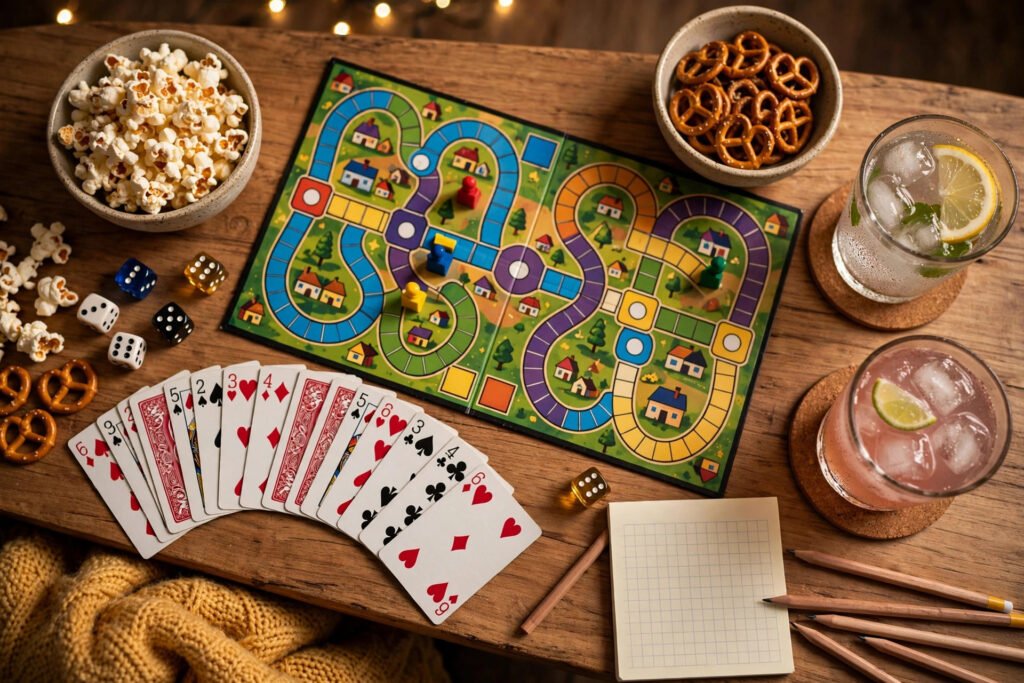
The Game Night Timeline That Keeps Things Moving
A loose run-of-show is the difference between a night that flows and one that stalls. You don’t need to announce it — just follow it yourself as the host:
- 7:00 — Doors open. Snacks out, music on, drinks ready. No game yet. Let people arrive, settle, and chat. Starting a game while half the group is still parking is how you lose the room.
- 7:30 — The icebreaker. Something quick, loud, and easy — a round of charades, 5 Second Rule, or a fast card game. The goal isn’t the game itself; it’s getting everyone laughing and talking within the first half hour.
- 8:00 — The main game. This is your headliner. Everyone’s warmed up, nobody’s tired yet. This is where the longer or meatier game goes.
- 9:15 — Break. Dessert, stretch, bathroom, phones. Announce it: “ten-minute break, then one more game.” Breaks feel generous when they’re planned and awkward when they’re not.
- 9:30 — The second game. Lighter than the first. Energy is dipping, so pick something with laughs built in rather than something that demands deep thought.
- 10:30 — Wind down. End while the energy is still good. The nights people remember fondly are the ones that ended with everyone wanting more — not the ones that dragged until people started inventing excuses to leave.
Adjust the times to your crowd, but keep the shape: warm-up, headliner, break, closer, clean ending.
Best Games for Game Night by Group Size
Player count is the fastest way to narrow the shelf. Here’s what we’d actually pull out for each group size:
| Group size | Our picks | Why they work |
|---|---|---|
| 2–4 players | Ticket to Ride, Catan, Jaipur, Patchwork | Real strategy without the downtime — turns stay snappy with a small group. |
| 4–6 players | Codenames, Wavelength, Just One | The golden zone. Team play keeps everyone involved on every turn — Codenames is the safest pick we’ve found for mixed groups of gamers and non-gamers. |
| 6–10 players | Wits & Wagers, Telestrations, Time’s Up! Title Recall | Built for crowds: simultaneous play, no elimination, and the funny answers are the entertainment. |
| 10+ players | Fishbowl (the hat game), team trivia, charades | Split into teams and keep it loud. Our best trivia board games roundup has ready-made options if you want structure. |
| No-prep option | A standard deck of cards | Zero setup, zero cost. Our guide to party games with playing cards covers the best ones for groups. |
| Couples’ night | The Newlywed Game (homemade version) | Four couples, one set of questions, endless arguments about who knows whom better. Grab questions from our Newlywed Game questions list. |
One tip that saves more nights than any specific game: when you’re choosing between two options, pick the shorter one. You can always play again. You can’t un-play an hour that dragged.
And if you’re building a collection from scratch, BoardGameGeek’s party game browse page lets you filter thousands of party games by player count and rating — it’s the fastest way to check whether a game actually fits your group before you buy it.

Food and Drinks That Don’t Interrupt Play
Food is part of the hosting, not a side quest. The principle is the one-hand rule: if a guest can’t eat it with one hand while holding cards in the other, serve it before or after the games — not during.
What works: popcorn, pretzels, chips and dip, sliders, pizza bites, veggie cups, cookies, a bowl of candy. What doesn’t: anything with a sauce that stains (RIP, one memorable game of Codenames and a plate of wings), anything needing a knife and fork, anything served in a communal bowl that requires reaching across the board mid-turn.
For drinks, set up a small station off to the side — a pitcher of something, a few sodas, water, and whatever else fits your crowd. The point is that refills don’t pause the game. And that allergy question from the invite? Actually remember the answers. Nothing kills a vibe like a guest quietly not eating.
5 Ways Game Nights Die (and How to Fix Each One)
1. The forty-minute rules lecture. The host reads the rulebook aloud while everyone else mentally checks out. Fix: learn it the day before, teach the goal and one turn, start playing. Edge cases can wait.
2. The phone zombies. Two people drift to their phones during downtime and never fully come back. Fix: keep downtime near zero — simultaneous-play games, quick turns — and make the first game of the night phone-free by example, not by announcement. A phone basket feels like school; momentum feels like fun.
3. The runaway game. A “quick” game hits the two-hour mark and half the table is done. Fix: check the real play time before the night (the box lies — add 50%), and give yourself permission to call it: “last round, then we switch.” Nobody minds a game ending early. Everybody minds one that won’t end.
4. The ultra-competitive friend. Every group has one, and they’re fine until the winning matters more than the laughing. Fix: lean on team games and cooperative games for mixed groups — they redirect the competitive energy at the game instead of at each other.
5. The slow fizzle. No planned ending, so people start peeling off one by one and the last hour is awkward. Fix: put the end time in the invite and honor it. Ending at 10:30 with everyone laughing beats midnight with three people left.
How to Turn One Night Into a Regular Thing
The first game night is an event. The fourth one is a tradition — and traditions are what get people to actually show up. If the night goes well, strike while it’s warm:
- Set the next date before people leave. “Same time next month?” takes ten seconds and beats a group chat that slowly dies.
- Rotate the hosting. The fastest way to burn out is hosting every time. Take turns — different houses keep it fresh, and everyone appreciates the work more once they’ve done it.
- Keep a shared wishlist. A note in the group chat where anyone can drop games they want to try. It solves the “what should we play?” debate permanently.
- Let the games rotate with the hosts. Whoever hosts picks the main game. It keeps things varied and takes the decision pressure off one person.
Game Night FAQs
How many people should I invite to a game night?
Four to eight is the sweet spot for most game nights. Fewer than four and you lose group energy; more than eight and you’ll need to split into two tables or stick to big party games.
How long should a game night last?
Three to four hours is ideal — long enough for two games plus food and chatting, short enough that nobody’s watching the clock. Put the end time in the invite.
What food should I serve at a game night?
Finger foods that can be eaten with one hand: popcorn, pretzels, sliders, pizza bites, cookies. Avoid anything saucy, anything needing a fork, and anything that stains game components.
What if someone doesn’t like board games?
They probably don’t like long, complicated board games. Start them on a party game — Codenames, Wits & Wagers, or a round of trivia — where the social part carries the fun. Almost nobody dislikes laughing with friends for twenty minutes.
Can I host a virtual game night?
Yes. Jackbox Party Packs (one person shares their screen, everyone plays on their phone), online Codenames, and Board Game Arena all work well over a video call. It’s not the same as a table full of snacks, but it’s far better than no game night.
How often should we host game night?
Monthly is the cadence that actually sticks. Weekly burns hosts out; quarterly and people forget. Set the next date before everyone leaves the current one.
The Short Version
Hosting a game night isn’t about owning the most games — it’s about matching the games to the group, keeping the evening moving, and feeding people without pausing the fun. Pick your date, invite four to eight people, learn one game’s rules in advance, and follow the timeline. Do that, and you’ll host the kind of night people ask to repeat.
Ready for game ideas? Start with our best party games for adults, grab the detailed setup from our board game night checklist, and if trivia’s on the menu, our best trivia board games roundup has you covered.
