
Direct Answer: Minute to win it Halloween games are 60-second party challenges built around simple tasks such as stacking cups, tossing soft props, sorting objects, or completing a team goal. Choose four to eight games, give everyone equal supplies, explain scoring before the timer starts, and offer seated or easier versions for mixed groups.
Last reviewed: September 2026
Minute to win it Halloween games turn ordinary party supplies into short challenges that are easy to rotate, score, and reset. They can work at home, in a classroom, at a youth event, or during a casual office party because the host chooses the number of rounds.
This guide contains 24 original GamingStation house-rule versions for kids, teens, adults, and mixed groups. Each game includes a clear objective, suggested materials, a scoring method, and a practical adaptation. For activities that are not limited to one minute, start with the broader guide to Halloween party games for adults, kids, and mixed groups.
The full list is a menu, not a single party schedule. In most cases, four to eight challenges provide enough variety. Player ranges, age guidance, timing, and scoring are editorial planning suggestions rather than official limits or results from first-hand event testing. More group activities are available in the Party Games collection.
Minute to Win It Halloween Games at a Glance
Use these planning ranges as a starting point, then adjust them for the room, participants, and available helpers.
| Game detail | Suggested format |
|---|---|
| Best for | Family parties, classrooms, youth groups, teen events, and casual workplace gatherings |
| Players | 2-12 at one station; use parallel stations for larger groups |
| Suggested age | About 6 and older for direct play; simplify materials and rules for younger children |
| Games per event | 4-8 challenges |
| Active challenge | 60 seconds; 90 seconds is a useful access or beginner option |
| Total event time | About 30-75 minutes, including instructions and resets |
| Setup time | About 20-45 minutes, depending on the selected games |
| Typical supplies | Cups, paper, soft balls, beanbags, tongs, pom-poms, cards, tape, and a timer |
| Space | A table for quiet games or a clearly marked area for active games |
| Interaction | Low to high, depending on individual or team format |
| Complexity | Low |
| Cleanup | Low to medium |
For a balanced party, choose two tabletop challenges, one target game, one team activity, and one quiet backup. Meanwhile, a classroom or large event works better with duplicate supply kits so several players can participate at once.
How the One-Minute Format Works
A minute-to-win-it challenge gives a player or team 60 seconds to complete a specific task or record the highest valid result. The timer creates urgency, but every rule should remain simple enough to explain and demonstrate before the scored attempt begins.
Three formats cover most parties:
| Format | How it works | Best use |
|---|---|---|
| Beat the clock | Complete one defined goal within 60 seconds | Small groups and simple skill challenges |
| Highest score | Count valid objects, points, or completed actions at the buzzer | Stations and team tournaments |
| Head-to-head | Two players use identical setups at the same time | Short parties with duplicate supplies |
Use one format consistently within a game. For example, Ghost Cup Stack can reward the fastest completed stack or the tallest standing stack at the buzzer, but switching between those goals during play creates disputes.
Choose the Timer and Scoring Rules First
Before setting out the props, decide how every attempt begins, ends, and earns a result. A visible phone timer works, although a host can also use a stopwatch and call the final ten seconds aloud.
- Give players a clear “ready, set, go” signal.
- Start hands behind a marked line or resting flat on the table.
- Stop all movement at the buzzer; an item released afterward does not count.
- Count only objects that remain in the target or structure when time ends.
- Allow one restart after an equipment failure, but not after an ordinary mistake.
- Use identical materials, distances, and starting arrangements for scored opponents.
- Announce whether ties share the place or trigger one short tiebreaker.
For younger children, first attempts can be practice rounds. Alternatively, use 90 seconds for the entire group rather than quietly giving different players different limits.
Master Supply List
Only gather materials for the selected games. Labeling one container per station keeps setup and reset supplies together.
| Supply group | Useful items | Safer or reusable option |
|---|---|---|
| Containers | Paper cups, bowls, buckets, trays | Lightweight, stable, nonbreakable containers |
| Game pieces | Large pom-poms, beanbags, cards, clothespins, paper shapes | Pieces too large for young children to swallow |
| Targets | Painter’s tape, cardboard boxes, paper plates, floor markers | Removable tape tested on the surface first |
| Building materials | Index cards, craft sticks, paper cups, cardboard shapes | Clean reusable pieces stored by game |
| Host supplies | Timer, pencils, printed rules, score sheets, station labels | A visible digital timer and reusable clipboards |
| Optional theme items | Plastic pumpkins, large spiders, witch hats, skeleton cutouts | Flat printed icons when dimensional props are unavailable |
Avoid glass containers, sharp decorations, lit candles, hard projectiles, and props that require shared mouth contact. Candy is optional throughout this guide; colored pom-poms or paper shapes can replace it.
Easy Tabletop Halloween Games
These three games fit on a table, reset quickly, and need little movement. Place each setup far enough from the table edge that falling pieces do not create a floor hazard.
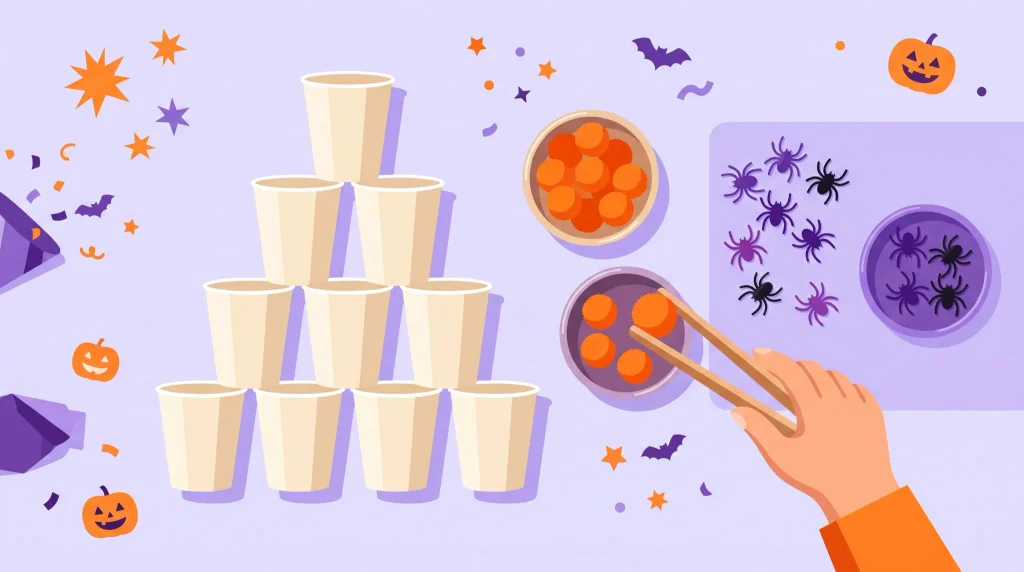
- 1. Ghost Cup Stack
- Best for: Ages 6+, individual or head-to-head play.
- Supplies: Ten white paper or plastic cups per player and a black marker for faces.
- Play and score: Start with nested cups. First, build a four-level pyramid; then return every cup to one stack before 60 seconds expires. A complete up-and-down cycle earns one point, so continue if time remains.
- Adaptation: Build only the pyramid, or use six cups for a younger group.
- 2. Pumpkin Pom-Pom Transfer
- Best for: Kids, classrooms, and seated stations.
- Supplies: Two bowls, large orange pom-poms, and child-safe tongs per player.
- Play and score: Next, move one “pumpkin” at a time from the full bowl to the empty bowl without using the free hand. Count pom-poms resting in the second bowl at the buzzer.
- Adaptation: Move the bowls closer or let beginners use a large spoon.
- 3. Spider Sorting Sprint
- Best for: Visual sorting and mixed-age play.
- Supplies: Large plastic spiders or paper spider cards in three colors, plus three labeled cups.
- Play and score: Mix the spiders in one tray. Then, sort them into matching cups one at a time, correcting mistakes before time ends. Each correctly placed spider earns one point.
- Adaptation: Use two colors or let partners alternate pieces.
Tossing and Target Games
Set one throwing line for each age or ability group before play. Players should retrieve objects only after the host closes the round.
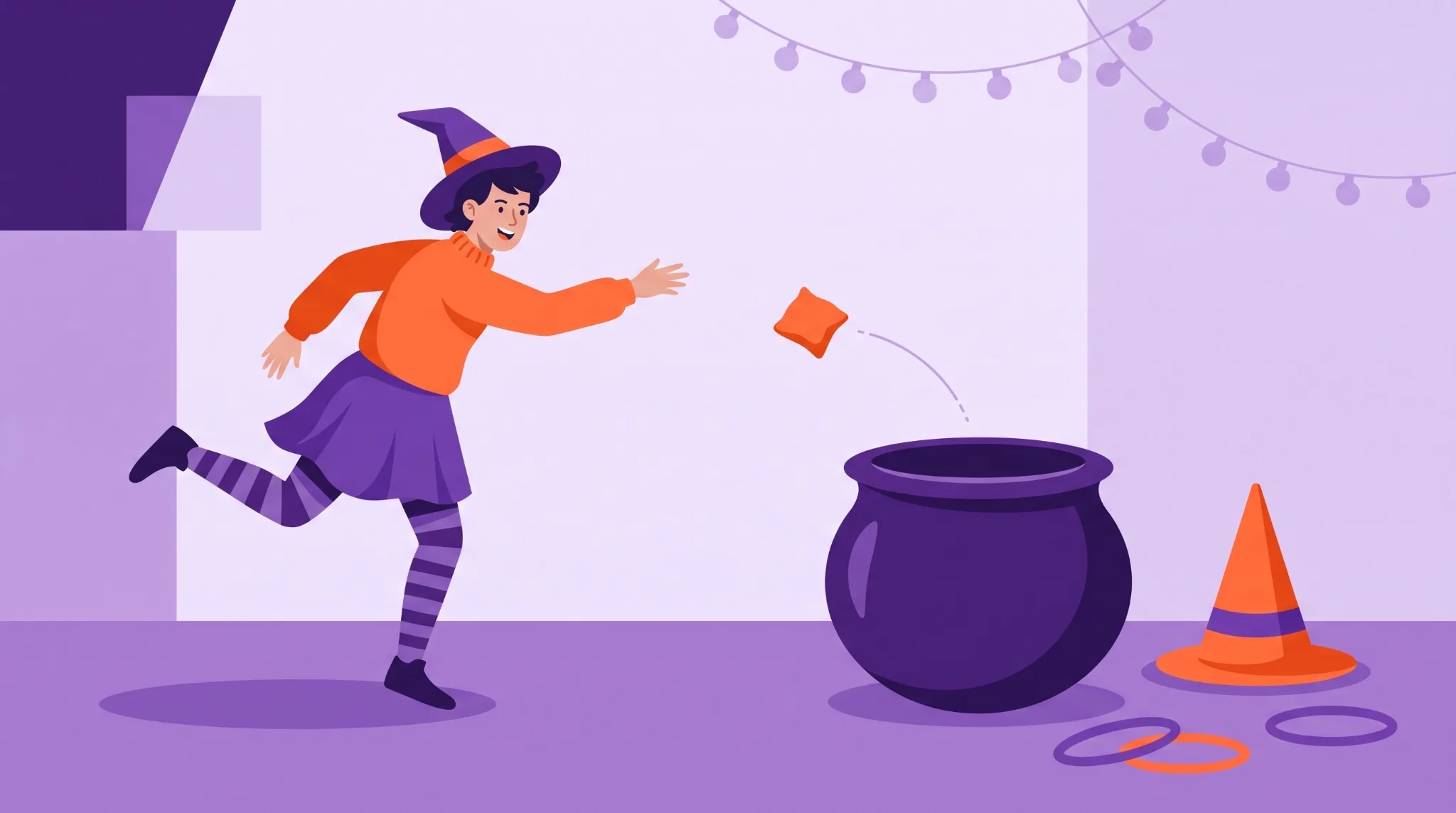
- 4. Cauldron Beanbag Toss
- Best for: Families, school parties, and team stations.
- Supplies: Three stable buckets or boxes, soft beanbags, and floor tape.
- Play and score: First, place targets at increasing distances worth one, two, and three points. Players toss one beanbag at a time for 60 seconds. Finally, add points only for bags that finish inside a target.
- Adaptation: Move the line closer or use one wide container as the target.
- 5. Witch Hat Ring Toss
- Best for: Younger children and mixed-age groups.
- Supplies: A stable cone or witch hat and five soft rope or foam rings.
- Play and score: Toss all five rings. Afterward, collect them and repeat until time ends. Every ring resting fully around the cone scores one point.
- Adaptation: Change the throwing distance instead of changing the ring size, so every player still uses the same equipment.
- 6. Ghost Cup Knockdown
- Best for: Indoor parties with a clear floor.
- Supplies: Six lightweight ghost cups, one soft foam ball, and a marked rolling line.
- Play and score: Arrange the cups in a pyramid. Next, roll the ball, count fallen cups, reset, and continue. The total number of cups knocked down across all valid rolls becomes the score.
- Adaptation: Use a larger ball or reduce the distance; keep the ball on the floor.
Stacking and Building Games
Building games reward control instead of speed alone. At the buzzer, require each structure to stand without support for a three-second host count.
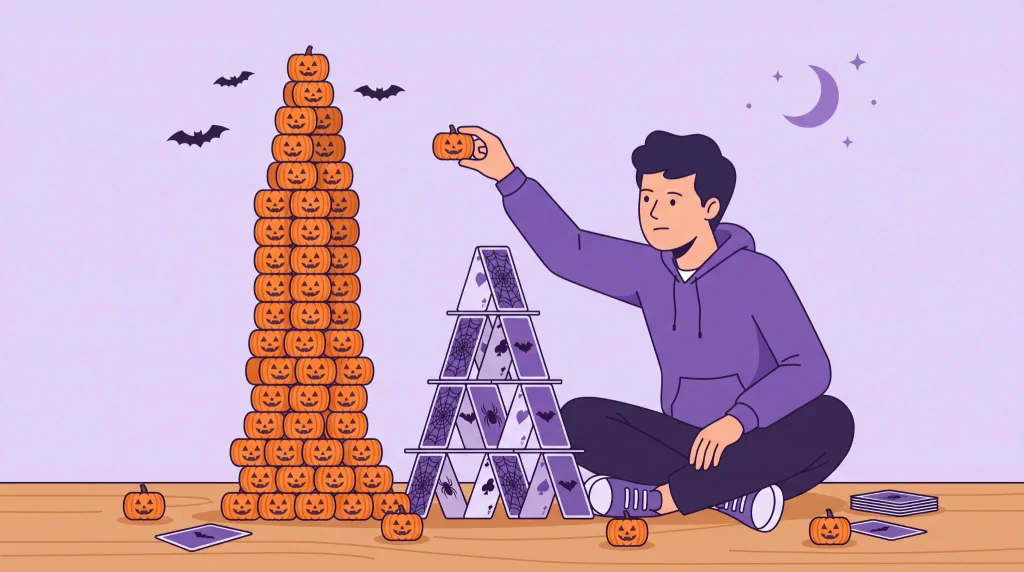
- 7. Pumpkin Patch Tower
- Best for: Tabletop stations and small groups.
- Supplies: Twelve lightweight mini pumpkins, orange cups, or wooden blocks.
- Play and score: First, build the tallest freestanding tower possible within 60 seconds. Then, measure the result by complete pieces from base to top; a hand-supported tower scores zero until the player releases it.
- Adaptation: Build a wide pyramid or allow pairs to share one tower.
- 8. Haunted House Card Build
- Best for: Teens, adults, and patient builders.
- Supplies: Twenty index cards per player or team.
- Play and score: Next, create a freestanding house containing a base, two walls, and a roof. A complete house earns five points; otherwise, award one point for each stable required part.
- Adaptation: Pre-fold four cards for beginners or extend the common timer to 90 seconds.
- 9. Skeleton Bridge
- Best for: Classrooms and cooperative pairs.
- Supplies: Fifteen wide craft sticks, two paper cups, and one large pom-pom.
- Play and score: Place the cups a short distance apart. Then, build a bridge that supports the “skull” pom-pom for three seconds. Score one point per successful bridge, rebuilding after each result.
- Adaptation: Move the cups closer or provide a sample bridge before the round.
Halloween Team Challenges
Team games work best when every person has a defined job. Rotate the builder, runner, sorter, or recorder between rounds so one confident player does not control the station.
- 10. One-Minute Mummy Wrap
- Best for: Willing mixed-age teams in a clear area.
- Supplies: Equal toilet-paper or paper-streamer rolls and one cleanup bag per team.
- Play and score: First, wrap one consenting teammate loosely from the shoulders down for 60 seconds. Afterward, judge design, coverage, and teamwork only if the face, neck, hands, feet, and separate legs remain clear.
- Adaptation: Use a cardboard figure. See the complete Halloween mummy wrap game rules and safety guide before hosting the body-wrapping version.
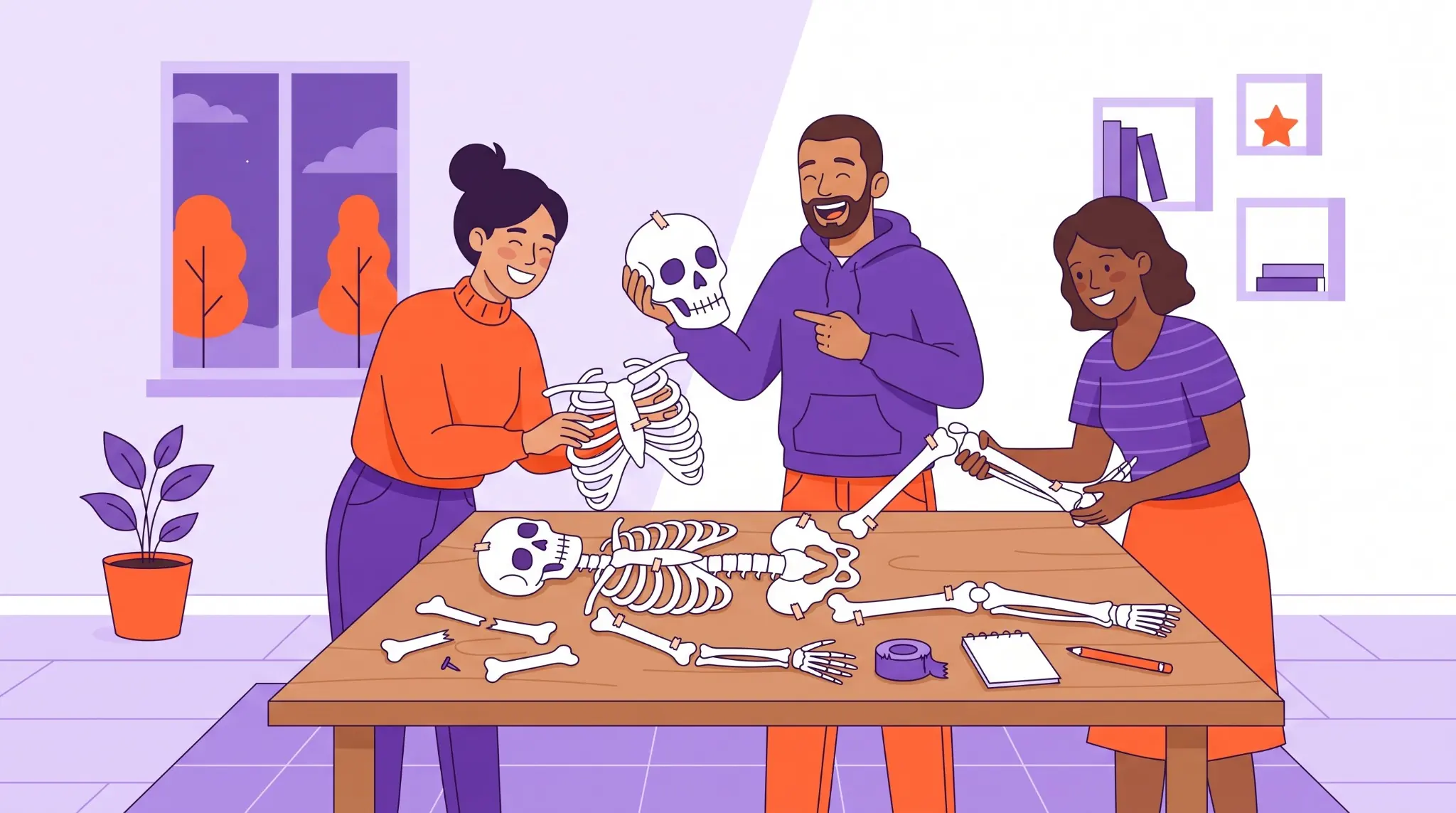
- 11. Build-a-Skeleton Relay
- Best for: Teams of three to six at separate tables.
- Supplies: One identical 12-piece paper skeleton puzzle per team.
- Play and score: Next, players take turns adding or correcting one piece, then move behind the team line. The first correctly assembled skeleton wins; otherwise, count correctly placed pieces at the buzzer.
- Adaptation: Pass a turn card around a seated table instead of using a movement line.
- 12. Pumpkin Patch Pattern Relay
- Best for: Communication and cooperative play.
- Supplies: Matching sets of orange, green, and black cards plus one hidden pattern card per team.
- Play and score: Meanwhile, one viewer studies the pattern and describes it without touching the pieces. Teammates recreate the order. Each correctly placed card earns one point when time ends.
- Adaptation: Show a four-card pattern to beginners and an eight-card pattern to older players.
Active Games for an Open Space
Mark separate lanes and make every challenge walking-only. If the space cannot support clear lanes, use the seated games instead.
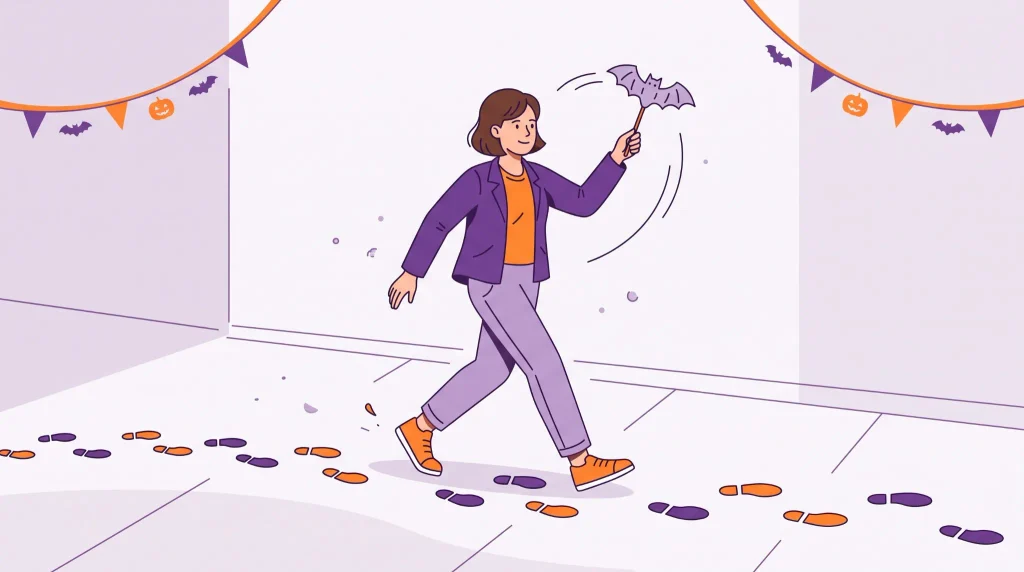
- 13. Bat Fan Race
- Best for: Kids, teens, and parallel team lanes.
- Supplies: One paper bat and one piece of cardboard per player.
- Play and score: First, fan the bat along the floor without touching it. Then, cross as many marked lane sections as possible in 60 seconds, returning to the start after each completed trip.
- Adaptation: Shorten the lane or move the bat across a tabletop.
- 14. Monster Footstep Course
- Best for: Players who enjoy controlled movement.
- Supplies: Large paper footprints secured flat to the floor and a start marker.
- Play and score: Next, walk the path, placing one foot on each print; afterward, return and repeat. Count completed paths rather than speed between individual markers.
- Adaptation: Arrange prints closer together or tap matching footprint cards while seated.
- 15. Eyeball Tray Shuttle
- Best for: Teams with a short, uncluttered lane.
- Supplies: A lightweight tray, large decorated foam ball, and two markers.
- Play and score: Then, carry the “eyeball” to the far marker and back while walking. A completed return earns one point. If it falls, replace it where it landed before continuing.
- Adaptation: Carry the tray with two hands or pass it along a seated row.
Quiet and Seated Halloween Games
Quiet stations help balance an energetic schedule. They also give players meaningful options that do not depend on throwing, running, or standing.

- 16. Monster Face Drawing Challenge
- Best for: Any group that can use pencils or markers.
- Supplies: Paper, drawing tools, and a six-feature prompt card.
- Play and score: First, draw a monster containing the announced features, such as three eyes, two horns, square teeth, wings, spots, and a hat. Finally, award one point per recognizable feature.
- Adaptation: Use stickers or pre-cut paper shapes instead of drawing.
- 17. Haunted Tray Memory
- Best for: Families, classrooms, and workplace teams.
- Supplies: A tray, cloth, 12 large Halloween objects or picture cards, paper, and pencils.
- Play and score: Show the tray for 30 seconds. Afterward, cover it and allow 60 seconds for players to list remembered items. Each accurate item earns one point.
- Adaptation: Use eight objects or let a team submit one shared answer sheet.
- 18. Spooky Pattern Copy
- Best for: Seated individual or paired play.
- Supplies: Colored blocks or symbol cards and several model patterns.
- Play and score: Next, reveal one pattern at a time. Recreate it, call for a check, and then move to the next card. Each exact pattern completed before the buzzer earns one point.
- Adaptation: Keep the model visible or reduce the number of pieces.
Classroom and Mixed-Age Games
These games use simple turns and visible results. Prepare duplicate kits for each table so students do not spend most of the activity waiting.
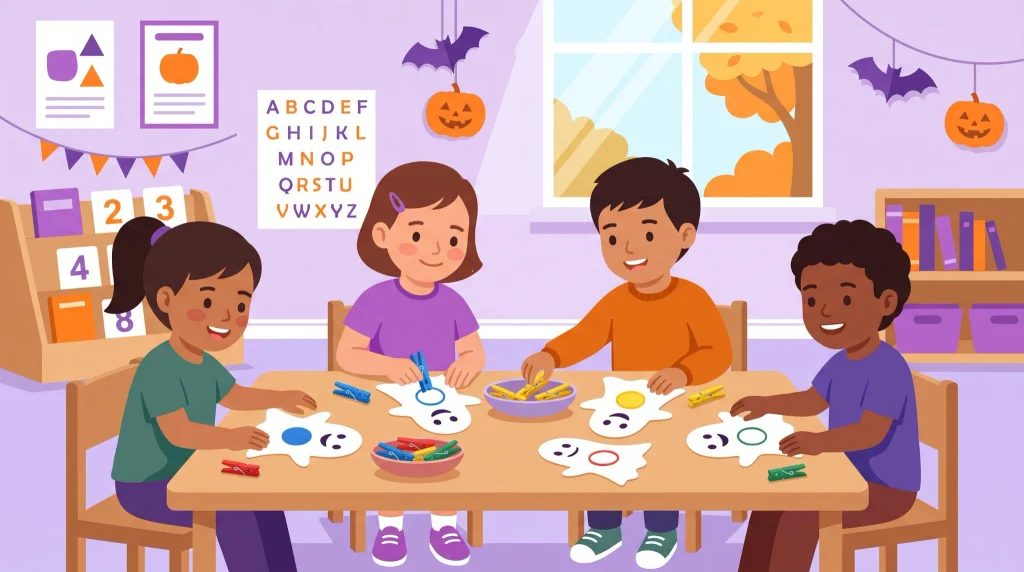
- 19. Ghost Clothespin Match
- Best for: Fine-motor play at classroom tables.
- Supplies: Paper ghosts with colored borders and matching colored clothespins.
- Play and score: First, attach every clothespin to a ghost with the same color, using one hand. At the buzzer, count correct matches and remove mismatched clips from the score.
- Adaptation: Use larger clips, two hands, or fewer colors.
- 20. Pumpkin Scoop and Count
- Best for: Younger players and cooperative tables.
- Supplies: Large orange pom-poms, a scoop, two bowls, and number cards.
- Play and score: Then, turn over a number card, scoop exactly that many pumpkins into the second bowl, and repeat. As a result, each correctly completed card earns one point.
- Adaptation: Use numbers one through five or let partners count aloud together.
- 21. Costume Closet Sort
- Best for: Early readers, families, and classroom teams.
- Supplies: Large picture cards showing hats, masks, capes, shoes, and props, plus labeled sorting mats.
- Play and score: Next, sort one card at a time into the matching clothing or prop group. Finally, count correct cards after 60 seconds.
- Adaptation: Use two broad groups—things to wear and things to carry.
Harder Games for Teens and Adults
Harder does not need to mean riskier. These challenges add memory, precision, or limited-hand rules while keeping the physical setup controlled and non-alcoholic.

- 22. One-Handed Monster Stack
- Best for: Teens, adults, and office parties.
- Supplies: Twelve paper cups in three colors.
- Play and score: First, use one hand to copy a displayed three-level color pattern. Then, return the cups to one stack and repeat. Each correct completed cycle earns one point.
- Adaptation: Remove the color pattern or allow both hands.
- 23. Mystery Mitt Transfer
- Best for: Players who enjoy awkward dexterity challenges.
- Supplies: Clean oven mitts, two bowls, and large soft game pieces.
- Play and score: Meanwhile, move pieces between bowls one at a time while wearing both mitts. At the buzzer, count pieces in the destination bowl; dropped pieces stay out until the round ends.
- Adaptation: Wear one mitt or use larger objects.
- 24. Witch’s Brew Sequence
- Best for: Memory-focused teams and quieter adult groups.
- Supplies: Eight large ingredient cards and several hidden recipe cards.
- Play and score: First, study a recipe for ten seconds and then hide it. Next, arrange the ingredient cards in order, check the sequence, and continue with a new recipe. Each exact recipe earns one point.
- Adaptation: Keep the recipe visible or reduce it to four ingredients.
Choose Games for the Group
Age alone does not determine whether a game fits. Consider reading level, reach, coordination, comfort with competition, noise, available space, and whether each player can take a meaningful role.
| Group or situation | Strong starting choices | Useful adjustment |
|---|---|---|
| Younger children | Pumpkin Scoop, Costume Closet Sort, Witch Hat Ring Toss | Larger pieces, shorter distances, and a practice round |
| Mixed-age family | Ghost Cup Stack, Cauldron Toss, Monster Drawing | Team children with adults and use shared targets |
| Classroom | Spider Sort, Skeleton Relay, Haunted Tray Memory | Duplicate table kits and use no-elimination scoring |
| Teens | Haunted House Build, Bat Fan Race, Witch’s Brew Sequence | Harder patterns and team standings |
| Adults or workplace | One-Handed Stack, Mystery Mitt Transfer, Memory Tray | Keep the tone social and the games non-alcoholic |
| Small room | Tabletop, building, drawing, and memory games | Remove all throwing and lane-based activities |
| Large group | Parallel target stations and team challenges | Use timed rotations and identical supply kits |
| Low-movement option | Drawing, pattern copy, memory, and seated transfers | Bring all materials within comfortable reach |
For more than 20 guests, separate the party into stations rather than asking everyone to watch one player. GamingStation’s guide to Halloween party games for large groups explains additional team and crowd-management formats.
If supplies become unavailable at the last minute, keep a verbal backup ready. These Halloween games with no supplies can fill a gap without delaying the schedule.
Run a Halloween Game Station Party
Stations allow several challenges to run at once. Four stations usually provide enough variety without requiring a large number of helpers.
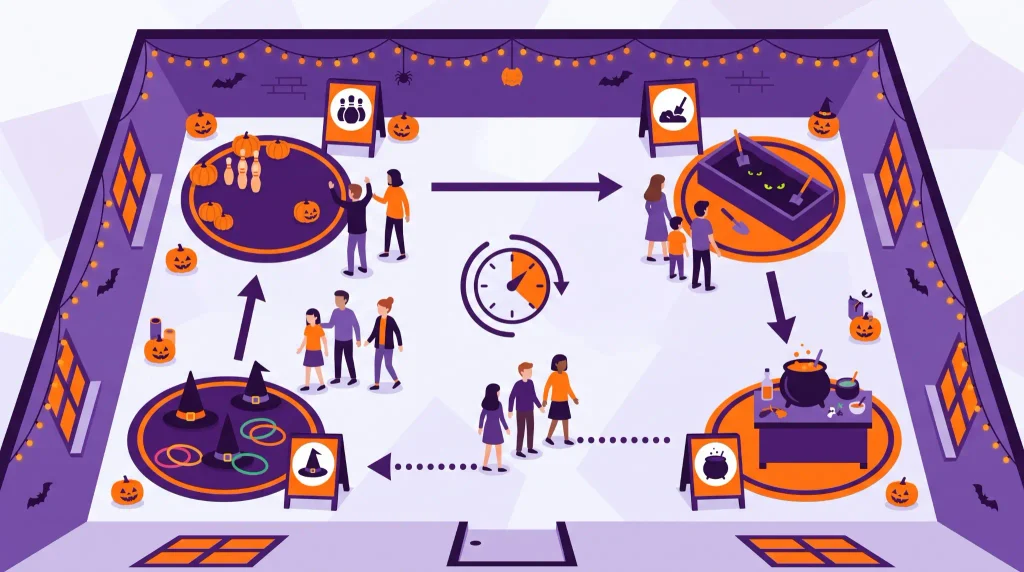
- Choose four games that use different skills, such as stacking, tossing, memory, and teamwork.
- Create one labeled supply container and one printed rule card for each station.
- Divide guests into equal teams and assign a different starting station.
- Demonstrate every challenge before teams separate, or place a trained helper at each station.
- Allow one practice attempt, one scored 60-second attempt, and about two minutes for resetting.
- Rotate every team in the same direction when the host gives the signal.
- Record raw results first, then convert them to placement points after all teams finish.
Do not add raw results from unrelated games. Twelve transferred pom-poms are not directly comparable with four successful ring tosses. Instead, rank teams within each station and award three points for first, two for second, and one for third. Tied teams can receive the same placement points.
A 60-Minute Halloween Game Schedule
This example uses four teams and five challenges. It leaves more time for instructions and resets than the one-minute label might suggest.
| Time | Activity | Host action |
|---|---|---|
| 0-8 minutes | Welcome, teams, safety, and demonstration | Explain one attempt at each station |
| 8-16 minutes | Challenge 1 | Run practice, score, and reset |
| 16-24 minutes | Challenge 2 | Check equal starting materials |
| 24-32 minutes | Challenge 3 | Record raw results before rotating |
| 32-40 minutes | Short break and floor check | Clear dropped pieces and refill kits |
| 40-48 minutes | Challenge 4 | Confirm every player has a role |
| 48-56 minutes | Challenge 5 | Collect score sheets after the round |
| 56-60 minutes | Results and cleanup | Convert placements and allow shared winners |
Five games are enough for a complete session. However, hosts can keep two additional rule cards ready in case the group moves faster than expected or one setup does not suit the venue.
Safety, Accessibility, and Comfort
A short timer should never turn a simple party game into a rushed physical risk. Before play, clear cords, bags, decorations, drinks, and loose game pieces from every lane. Use stable containers and soft props, and never aim thrown objects toward another participant.
Keep paper, costumes, and decorations away from open flames. The U.S. Consumer Product Safety Commission’s Halloween safety guidance recommends flameless lighting where children can reach decorations and keeping burning candles away from combustible materials.
Use the following pregame check:
- Offer a seated or low-movement version of every active station.
- Let players skip a game or change roles without losing their team place.
- Avoid blindfolds, rapid spinning, shared mouth-contact props, and body-contact rules.
- Keep small pieces away from young children and supervise all game stations.
- Test removable tape on the venue surface and keep exits unobstructed.
- Stop immediately when a player signals discomfort or equipment enters another lane.
- Ask permission before photographing or posting images of participants.
If candy or other food appears in a challenge, keep it wrapped, do not require anyone to eat it, and provide a nonfood substitute. The FDA’s food-allergy guidance advises people with food allergies to read labels and avoid foods containing their allergens. Therefore, the simplest inclusive option is to use pom-poms, cards, or blocks as game pieces.
Common Hosting Mistakes
- Trying to play all 24 games: A smaller, varied set keeps the pace manageable. Choose four to eight and save the rest for another event.
- Explaining rules after the timer starts: Demonstrate one complete example first. Otherwise, players lose time because the host is still clarifying the objective.
- Making one kit serve a large crowd: Duplicate inexpensive supplies or create stations. A long line removes the main benefit of a short challenge.
- Changing distances between opponents: Mark the starting line and reset every object in the same position before the next attempt.
- Adding unrelated raw scores: Rank results within each game, then award placement points. Different tasks do not share one meaningful unit.
- Using only active games: Balance movement with drawing, memory, or building so more guests have a comfortable way to contribute.
- Treating difficulty as a surprise: Announce whether dropped pieces, unfinished structures, or late releases count before the first scored round.
Free Printable Halloween Minute-to-Win-It Host Pack
Want to host without reopening the article between every round? The printable pack contains all 24 game cards, a master supply checklist, timer and scoring rules, a station rotation planner, and a reusable team score sheet.
Print the host pages on U.S. Letter paper at 100% scale. Next, select only the game-card pages needed for the party and place one card beside each supply kit. Keep the timer rules and master score sheet with the host.
Download Free Halloween Game Host PackFree PDF • Printable host pack • Print at 100% scale
Sources and Editorial Method
This is an original GamingStation challenge collection using consistent house rules. The suggested ages, player ranges, distances, timing adjustments, station formats, and scoring systems are editorial planning recommendations rather than universal official limits. No first-hand game testing or event-performance result is claimed.
- U.S. Consumer Product Safety Commission: Halloween Safety Tips
- U.S. Food and Drug Administration: Food Allergies
Final Verdict
The best minute to win it Halloween games use one clear objective, equal supplies, a visible timer, and a scoring rule announced before play. Most parties need only four to eight challenges, ideally mixing tabletop skill, targets, teamwork, and one quiet option.
Choose the games that fit the actual room and participants, then print only the required cards. If an activity needs unsafe props, forced contact, or more space than the venue provides, replace it with a seated challenge rather than trying to force the setup.
Frequently Asked Questions
Give each player identical supplies, explain one clear goal, and start a 60-second timer. When time ends, record only valid items, points, or completed tasks.
Ghost Cup Stack, Pumpkin Scoop, Spider Sorting Sprint, and Witch Hat Ring Toss work well for kids. Use larger pieces, closer targets, and one practice round.
Teens and adults may prefer Haunted House Card Build, Mystery Mitt Transfer, One-Handed Monster Stack, and Witch’s Brew Sequence because they add precision and memory.
Choose quiet, fast-reset games such as Haunted Tray Memory, Ghost Clothespin Match, and Spooky Pattern Copy. Prepare duplicate kits and rotate small classroom teams together.
Yes. Paper cups, bowls, index cards, tape, and homemade paper shapes can replace themed props. The free printable host pack also provides rules, checklists, and score sheets.
Pumpkin Pom-Pom Transfer, Pumpkin Patch Tower, and Pumpkin Scoop and Count are easy minute-to-win-it pumpkin games. Use orange pom-poms, cups, or reusable blocks instead of real pumpkins when weight, mess, or rolling could cause problems.
Each scored attempt normally lasts 60 seconds, but the full activity takes longer because instructions, practice, scoring, and resets need time. Allow about six to eight minutes per station, or combine several challenges into a 15-minute mini tournament.
Use identical supplies, marked starting lines, one scoring rule, and the same timer for every opponent. For mixed abilities, offer equivalent seated versions or give the entire group 90 seconds, rather than changing rules privately for one player.
Running these at school? Our classroom Halloween games are picked specifically for students, with low-mess options.
