
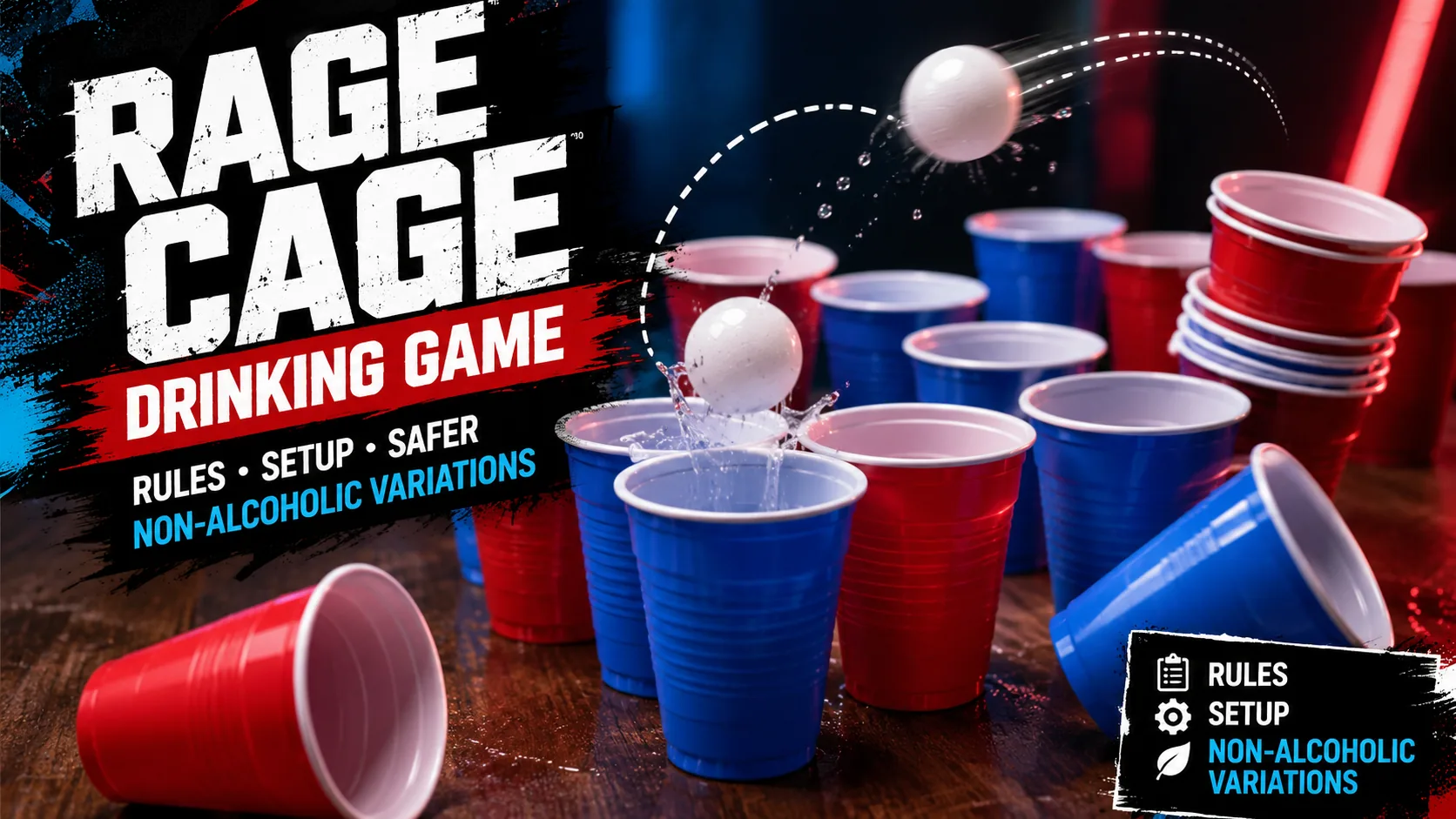
Direct Answer: The Rage Cage drinking game is a fast group game where two cups and ping-pong balls move clockwise around a table. Players bounce a ball into their cup and pass it on; if one player catches the person ahead, the cups are stacked and the caught player takes another center cup. Rules vary, so agree on first-shot bonuses and the final cup before starting.
By Gaming Station Editorial Team
Last reviewed: August 2026
The Rage Cage drinking game—also commonly called Stack Cup or Rage Cup—combines ping-pong accuracy with a constantly moving race around the table. If your group prefers a more structured cup game, these beer pong rules are easier to follow for beginners.
Unlike beer pong, players do not take turns aiming at an opponent’s fixed rack. Two people are shooting simultaneously, and the cups keep circulating as players catch one another.
Published Rage Cage rules are not completely standardized. One current guide specifies 3+ players and 10 or more cups, while another recommends at least four players and roughly three cups per participant. Both agree on the core loop: two separated players start, bounce balls into individual cups, pass completed cups onward, and stack a cup onto the player directly ahead when they catch them.
Traditional versions connect the center cups with alcohol consumption. That creates a particular concern with Rage Cage because the game can make consumption rapid and repeated. NIAAA warns that drinking too much too quickly can impair coordination, judgment, and impulse control and can lead to potentially fatal alcohol overdose.
For that reason, Gaming Station recommends treating Rage Cage primarily as a bounce-and-stack party game: use empty cups, penalty tokens, or another non-alcoholic system while keeping the competitive mechanics intact.
Rage Cage Rules at a Glance
| Rule | Common Format |
|---|---|
| Players | 3+; 4+ works better for the full racing effect |
| Ping-pong balls | 2 |
| Cups | 10+; larger groups can use more |
| Cup layout | Loose central cluster |
| Starting shooters | 2 players separated around the table |
| Main action | Bounce ball into your cup |
| Normal successful shot | Pass cup and ball clockwise |
| First-try make | May allow passing to another eligible player |
| Catch the player ahead | Stack your cup into/on their cup |
| Caught player | Takes another center cup and continues |
| Ball lands in center cup | Common rules assign that cup to the shooter |
| End condition | Center supply eventually runs out |
| Alcohol required? | No |
| Gaming Station recommendation | Empty cups + penalty tokens |
The traditional structure above is documented across multiple Rage Cage rules guides, though details such as player minimums and center-cup quantities vary.
What Is the Rage Cage Drinking Game?
Rage Cage is a simultaneous-action cup game in which players try to bounce ping-pong balls into cups faster than the player ahead of them.
The game revolves around one repeating sequence:
Bounce → make → pass → catch → stack → repeat
Two cups are active at once.
If both cups continue moving at roughly the same speed, they circulate around the group.
But when one shooter makes the ball quickly and the person immediately ahead is still struggling, the faster player catches them.
The faster player then stacks their cup onto the slower player’s cup, forcing the caught player to take another cup from the central supply and continue with a larger or replacement target, depending on the house version.
That catching mechanic is what creates the “rage” in Rage Cage: a player who falls behind can suddenly have the second active cup racing toward them again.
Rage Cage vs. Stack Cup: Are They the Same Game?
Often, yes.
The names Rage Cage, Stack Cup, Rage Cup, and sometimes Slam Cup are used for closely related versions of the same bounce-and-stack party game. A current Stack Cup rules guide explicitly identifies Stack Cup as also being known as Slam Cup or Rage Cage.
However, house rules can differ.
One group may use:
- One central “King’s Cup”
- First-shot passing privileges
- Different cup quantities
- Different final-cup rules
while another may omit those elements entirely.
For publication and game-night clarity, it is better to define the rules being used instead of claiming there is one universally official Rage Cage ruleset.
Rage Cage Setup
What You Need
A common Rage Cage setup uses:
- 2 ping-pong balls
- 10 or more plastic cups
- 1 table
- 3 or more players
- Enough room for everyone to stand around the table
One published ruleset uses exactly those minimums, while another recommends four or more players and approximately three cups per player.
Gaming Station Recommended Setup
For a smoother party game:
- 4–8 players
- 2 ping-pong balls
- 15–24 empty cups
- 2 dedicated shooting cups
- Penalty tokens or counters
- Large table
- Drinks kept off the active play surface
This recommendation preserves the racing mechanic while separating it from forced consumption.
Rage Cage Cup Layout
Unlike beer pong, there is no fixed 10-cup triangle.
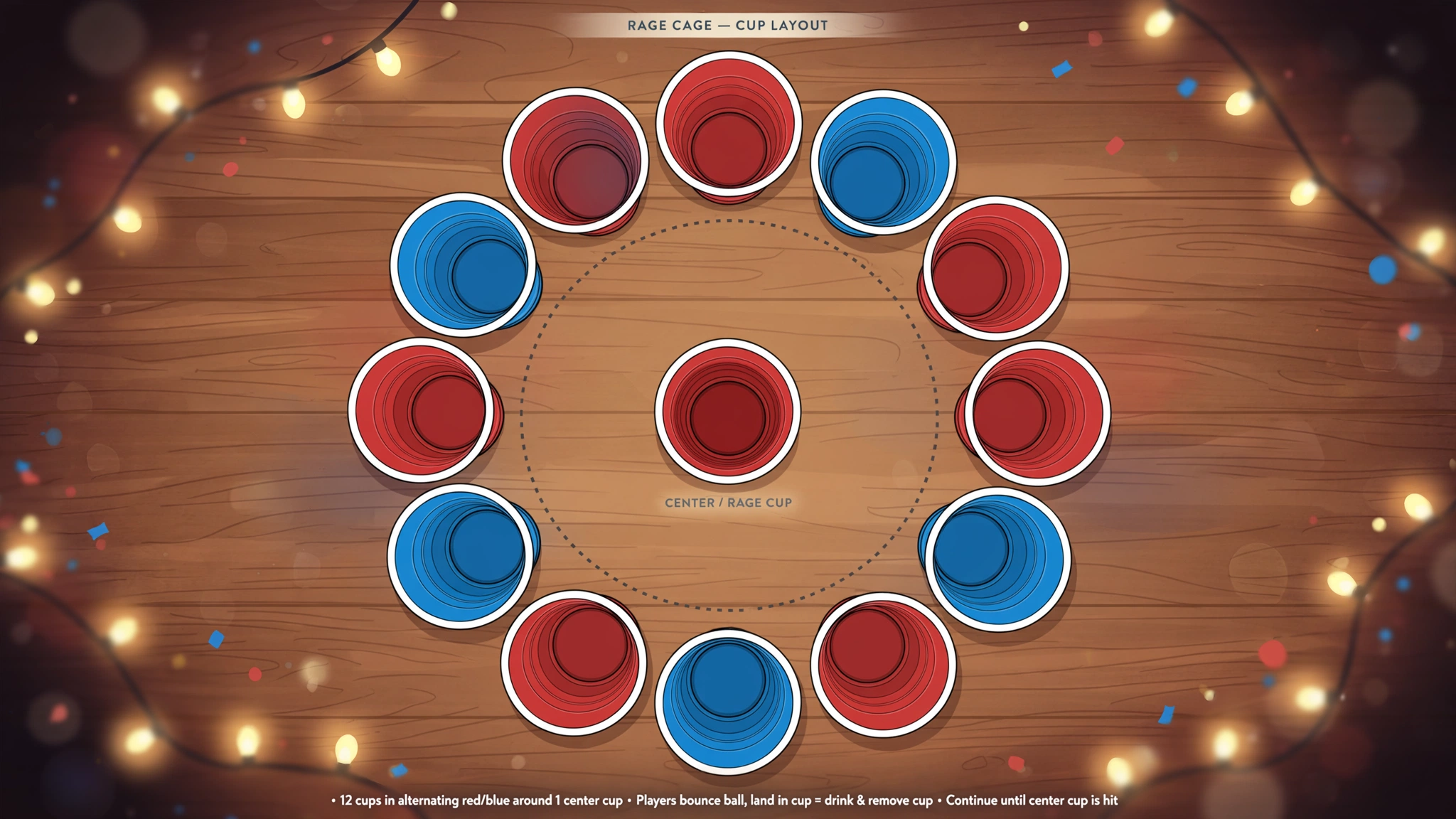
The standard Rage Cage cup layout places the reserve cups together in a cluster near the center of the table, while all players stand around the outside. Published guides describe the cups as grouped in the middle rather than arranged in a formal geometric rack.
A simple layout looks like this:
          Player
             |
      Player   Player

         O O O O
       O O O O O O
         O O O O
           O O
       CENTER CUPS

      Player   Player
             |
          Player
You do not need perfect spacing.
The important requirements are:
- Everyone can reach the central cups.
- The two starting shooters are separated.
- Cups do not block the bouncing area.
- Drinks and breakable objects are away from the game.
What Is the Center Cup or King’s Cup?
Some Rage Cage variations designate one special cup in the center.
BeerBaller’s current rules describe a central “King’s Cup” that remains until the end of the game.
Another published Rage Cage version simply describes the center cup as fuller than the surrounding cups without giving the entire layout a fixed pyramid structure.
Recommended safer rule
Instead of filling a special final cup with alcohol:
Put a distinctive token inside it.
Whoever receives the final cup gets:
- 3 penalty points,
- a harmless party challenge, or
- responsibility for starting the next round.
The game retains its dramatic final cup without turning it into a consumption challenge.
How to Play Rage Cage
Once the table is prepared, select two starting players.
They should be positioned across from or well separated from one another, rather than standing side by side. Published versions use this separation to give both active cups time to begin moving before they collide.
Give each starter:
- One cup
- One ping-pong ball
Then count down:
3… 2… 1… Go.
Step 1: Bounce the Ball Into Your Cup
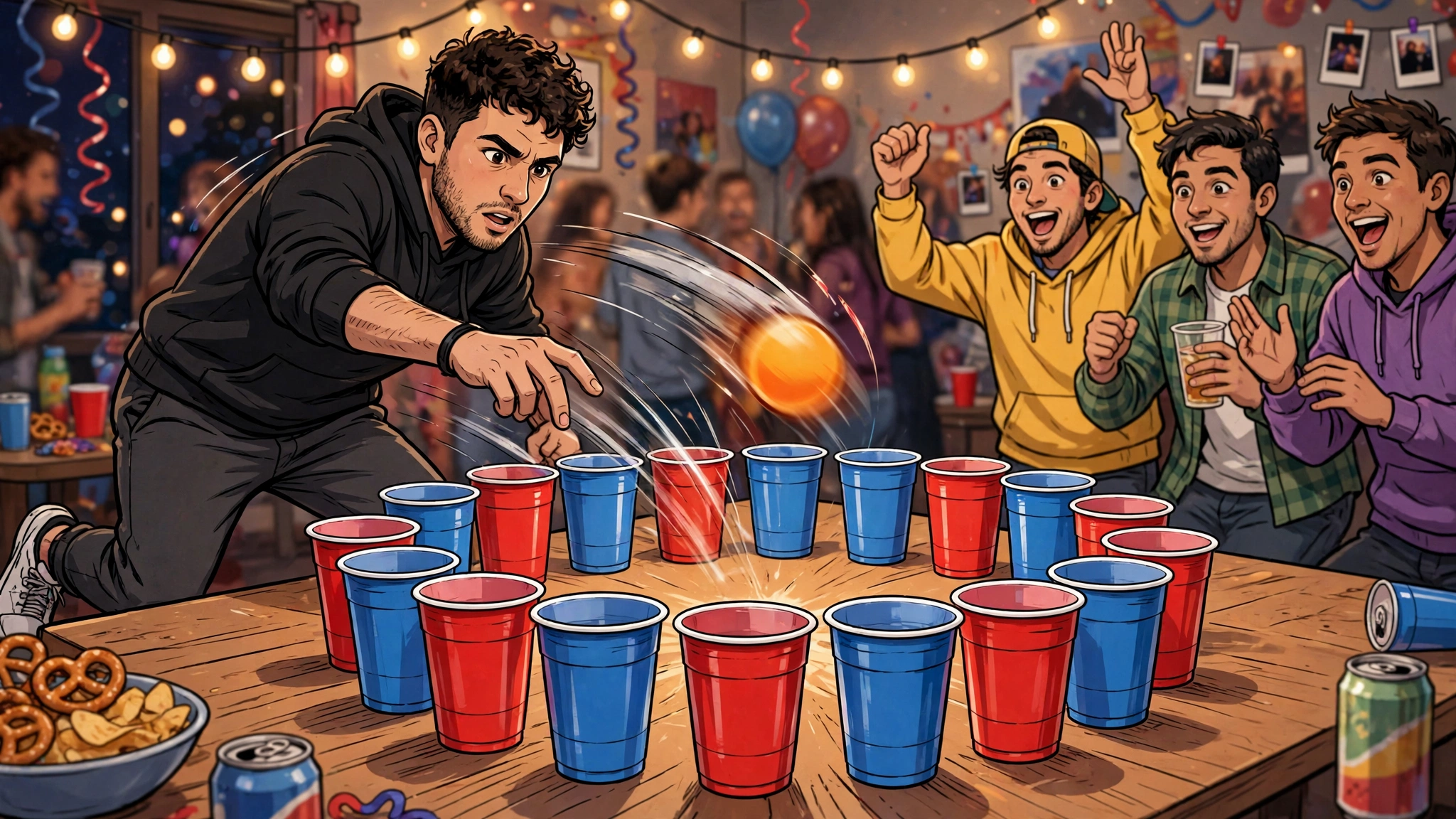
Each active player tries to bounce their ping-pong ball off the table and into their own cup.
A successful attempt looks like:
Ball → table → cup
It is a bounce shot, not a direct toss.
Once the ball lands in the cup, that player is finished with the current attempt.
Step 2: Pass the Cup Clockwise
Under the common rules, if the player makes the ball after more than one attempt, the cup and ball move to the next player clockwise.
The new player immediately starts bouncing.
There is no need to wait for the other active cup.
That means two separate bounce attempts are usually happening at different locations around the same table.
Step 3: Use the First-Try Rule
A common Rage Cage rule gives a bonus for making the bounce on the first attempt.
One published version allows the player to pass the cup to any player who is not currently still bouncing rather than automatically passing it clockwise.
Another Stack Cup guide similarly notes that a first-try make allows passing to almost anyone except the player actively trying to finish the other cup.
Why this matters
The first-shot rule creates strategy.
Instead of sending the cup harmlessly to the next person, you can direct it toward someone who may soon be caught by the other active cup.
Beginner alternative
For the first round, skip the first-shot bonus entirely:
Every make → pass clockwise
Add the redirect rule once everybody understands stacking.
Step 4: Catch the Player Ahead
This is the defining Rage Cage rule.
Suppose:
- Alex is bouncing.
- Jordan is directly clockwise from Alex and also bouncing.
- Alex makes the shot first.
Because Jordan is still trying, Alex has caught Jordan.
Alex stacks their cup onto Jordan’s active cup. Published versions describe the faster player putting their cup onto or into the slower player’s cup when the two active stations meet.
Jordan is now the caught player.
Step 5: Caught Player Takes a New Center Cup
The caught player takes another cup from the middle.
Traditional versions then tie that new cup to drinking before the player resumes bouncing.
Gaming Station safer rule
Use an empty center cup instead.
When caught:
- Take one center cup.
- Add 1 penalty token.
- Use that cup as the new active cup.
- Continue bouncing.
No drinking race is needed.
The gameplay remains identical:
Getting caught still costs you something and keeps the cup moving.
Rage Cage Example Round
Six players stand clockwise:
Alex → Blake → Casey → Drew → Emma → Finn
Alex and Drew begin with the active balls.
Alex makes in three attempts
Alex passes normally to:
Blake
Drew makes on the first attempt
The house rules allow a first-shot redirect.
Drew passes to:
Casey
Now Blake and Casey are bouncing.
Blake makes quickly
Casey is immediately clockwise from Blake and is still shooting.
Blake catches Casey.
Blake stacks the cup onto Casey’s.
Casey:
- Takes a new center cup
- Receives one penalty token
- Continues bouncing
The other active cup keeps circulating at the same time.
That asynchronous movement is what distinguishes Rage Cage from most turn-based party games.
What Happens If the Ball Goes Into a Center Cup?
This is another commonly published Rage Cage rule.
If a player’s bounce accidentally lands in one of the unused central cups, traditional versions require that player to take that cup and incorporate it into their stack before continuing.
Safer version
If the ball lands in a center cup:
- Remove that cup from the center.
- Add it to your active stack.
- Take 1 penalty point.
- Continue bouncing.
The accident still has a consequence without requiring any beverage consumption.
How Cup Stacking Works
The terminology can be confusing because groups use slightly different physical techniques.
A “stack” may mean:
- Placing one cup inside another cup
- Placing one cup on top of the caught cup
- Creating a nested cup stack that becomes the next target
The published rules agree on the important mechanical point:
The faster cup overtakes the slower cup, and the caught player has to restart with another center cup.
For consistency, choose one method before starting.
Recommended method
Use nested cups.
They are:
- Easier to control
- Less likely to fall over
- Easier to bounce into
- Easier to separate at the end
Does the Cup Stack Keep Getting Bigger?
House rules differ.
In some versions, the caught player receives the nested stack and then adds another cup.
In others, the stacked pair simply marks the catch while the loser takes a fresh center cup.
Recommended rule for beginners
Do not force players to bounce into increasingly tall towers.
Instead:
- Remove the completed stack from active play.
- Caught player takes one fresh cup.
- Add one penalty token.
This keeps the target consistent and makes skill more important than cup instability.
Rage Cage First-Try Rule Explained
The first-try mechanic is one of the most strategic parts of the game.
More than one attempt
Pass clockwise.
First attempt
Pass to any eligible player, depending on your chosen house rules.
You can use that freedom to place pressure on another part of the table.
Imagine the other active cup is one player away from Casey.
You make your ball on the first try.
Rather than passing normally, you send your cup toward Casey’s side of the table.
Now Casey may face another stack threat quickly.
Can You Pass to Someone Who Is Already Shooting?
Under the common first-shot variation, no.
The published rules exclude the person who is still actively trying to make the other ball.
That restriction prevents two active cups from being handed directly to the same player before a legitimate catch occurs.
How Does Rage Cage End?
Published traditional versions end when the center supply is exhausted, sometimes leaving a designated final King’s Cup for last.
There is not always a conventional winner.
One guide explicitly describes the game as ending after all center cups have been consumed rather than identifying a winner through points.
Better competitive scoring
For a structured game night, track catches.
Each time you are caught:
+1 penalty point
If your bounce lands in a center cup:
+1 penalty point
Final special cup:
+3 penalty points
When no center cups remain:
Lowest score wins.
This gives Rage Cage a clear winner without making consumption the scorekeeping mechanism.
Complete Rage Cage Rules: Recommended Gaming Station Version
If you want one consistent ruleset, use this.
Setup
- 4+ players
- 2 ping-pong balls
- 15+ empty cups
- Place reserve cups loosely in the center
- Everyone stands around the table
- Give cups and balls to two separated players
Gameplay
- Both players begin bouncing simultaneously.
- Ball must bounce once on the table before entering the cup.
- Make after 2+ attempts → pass clockwise.
- Make on first attempt → pass to any player except the other active shooter.
- If your completed cup catches the active shooter immediately clockwise, stack the cups.
- Caught player takes a fresh center cup.
- Caught player receives 1 penalty point.
- If your ball lands in a center cup, remove it and take 1 penalty point.
- Continue until the center cups are gone.
- Fewest penalty points wins.
This is based on common published Rage Cage mechanics but replaces the consumption component with scoring.
Rage Cage Cup Layout for Different Group Sizes
There is no fixed regulation cup count, but the center supply should last long enough for several catches.
| Players | Practical Cup Supply |
|---|---|
| 3–4 | 10–12 |
| 5–6 | 15–18 |
| 7–8 | 18–24 |
| 9+ | 24+ |
These are Gaming Station planning recommendations, not standardized Rage Cage rules.
One published source uses 10+ cups regardless of group size, while another suggests roughly three cups per player, illustrating how flexible the setup traditionally is.
Rage Cage Rules vs. Beer Pong
Despite using ping-pong balls and party cups, the games operate very differently. For a full comparison-style option, you can also review these beer pong rules before choosing the better game for your group.
| Rage Cage | Beer Pong |
|---|---|
| Players stand around one table | Teams stand at opposite ends |
| Two shooters act simultaneously | Teams normally alternate turns |
| Bounce into your own cup | Shoot toward opponent cups |
| Cups circulate | Cups stay in fixed racks |
| Catching/stacking drives play | Cup elimination drives play |
| Central reserve cups | Triangle formations |
| Strong reaction/speed element | Strong accuracy element |
Rage Cage is therefore closer to a continuous racing game than a conventional target-elimination game.
Rage Cage vs. Flip Cup
Rage Cage and Flip Cup both:
- Work well in groups
- Use cups
- Reward speed
- Can be played without alcohol
But the physical skill is different.
Rage Cage
Bounce ball into cup
Flip Cup
Flip cup from table edge
Rage Cage also has two active competitors circulating continuously rather than fixed teams progressing down a line.
Non-Alcoholic Rage Cage
A non-alcoholic Rage Cage version requires almost no mechanical changes. For mixed adult groups, these party games for adults also give you options that do not depend on drinking penalties.
The easiest approach is:
Use empty cups.
There is no rule requiring liquid for the ball to bounce into the cup.
Non-Alcoholic Variation 1: Penalty Token Rage Cage
This is Gaming Station’s preferred format.
When caught:
Take 1 token.
Ball lands in center cup:
Take 1 token.
Receive final King cup:
Take 3 tokens.
Winner:
Fewest tokens
This preserves:
- Speed
- Stacking
- First-shot strategy
- Pressure
- A final winner
without forcing anyone to consume anything.
Non-Alcoholic Variation 2: Water Cup Rage Cage
If players prefer the traditional visual setup, cups can contain water.
However, do not make drinking or quickly emptying water a requirement.
Instead:
- Use a small amount of water for weight.
- When a cup is assigned, pour it into a discard container.
- Resume play.
This keeps cups stable without introducing competitive drinking.
Non-Alcoholic Variation 3: Challenge Rage Cage
Put folded challenge cards beneath selected central cups.
Examples:
- Name five video games in 10 seconds.
- Answer a trivia question.
- Do a five-second victory dance.
- Name three movies beginning with “S.”
- Draw a cat with your non-dominant hand.
- Tell one terrible joke.
If you get caught and draw a marked cup, complete the challenge before the next round.
Keep challenges harmless and fast so they do not stop the game for several minutes.
Non-Alcoholic Variation 4: Team Rage Cage
Split players into two teams while everybody remains around the table.
Each time a player on Team A catches someone on Team B:
Team A scores 1 point.
First team to:
10 points
wins.
This creates a clear strategic competition instead of relying on beverage penalties.
Non-Alcoholic Variation 5: Elimination-Free Tournament
Run three short rounds.
Score each round:
- Catch someone: +1 point
- Get caught: 0
- First-try make: +1 bonus
- Center-cup accident: −1
Highest total score after three rounds wins.
This format works better for a gaming publication because performance—not consumption—determines the result.
How to Make Rage Cage Easier for Beginners
Remove the First-Try Redirect
For Round 1:
Every make passes clockwise.
Add redirecting later.
Use Wide Cups
A larger target shortens frustrating bounce streaks.
Keep Stacks at One Cup
Use the stack only to signal the catch, then replace it with one clean active cup.
Start With Four Players
Four provides enough movement to understand the catching mechanic without making the table too chaotic.
Use More Center Cups
A longer supply means players have time to learn before the round abruptly ends.
Rage Cage Strategy
Rage Cage looks like pure chaos, but several skills matter.
1. Use a Repeatable Bounce
Do not throw harder after every miss.
Try to keep:
- Ball height
- Bounce location
- Hand position
- Release force
consistent.
The goal is repeatability.
2. Watch the Other Active Cup
You are not only trying to make your own shot.
You should know:
Where is the other cup?
If it is one player behind you, speed matters immediately.
If it is across the table, you have more time.
3. Use First-Try Passes Strategically
If your rules allow redirects after a first-attempt make, do not choose a player randomly.
Send the cup where it increases the chance of a catch.
4. Reset Mentally After a Stack
Missing five times usually causes players to rush the sixth attempt.
That often makes accuracy worse.
Use the same controlled bounce rather than escalating force.
5. Keep the Table Clear
A bounce game becomes inconsistent when balls hit:
- Phones
- Coasters
- Bottles
- Plates
- Loose cups
Clear the active table before starting.
Why Traditional Rage Cage Can Escalate Alcohol Quickly
Traditional published Rage Cage rules connect several events directly with consuming cup contents:
- Starting a turn
- Being caught
- Accidentally landing in a center cup
- Receiving the final cup
Because catches can happen rapidly and repeatedly, the game does not give every participant consistent control over pacing.
NIAAA states that drinking too much and too quickly can impair motor coordination, decision-making, and impulse control. Continuing to drink despite significant impairment can result in alcohol overdose.
That risk is particularly relevant to a game that simultaneously demands:
- Hand-eye coordination
- Fast reactions
- Standing around a table
- Repeated bouncing movements
For those reasons, Gaming Station recommends keeping game penalties separate from alcohol.
If Adults Choose to Drink Separately
Adults who are legally permitted to drink can still keep beverages at a Rage Cage party without tying them to the rules. The CDC also explains that drinking less is better for health than drinking more.
Use:
Game = cups, balls, points
Beverages = individual choice
Do not use rules such as:
- Finish a cup before shooting
- Take a shot when caught
- Double drinks for consecutive catches
- Drink until the ball is made
- Mandatory “King’s Cup”
- Speed-drinking races
These mechanics directly reward or compel rapid consumption.
NIAAA notes that alcohol concentration varies substantially between beverages. In the United States, one standard drink contains about 14 grams of pure alcohol; for reference, that is approximately 12 ounces of 5% beer, 5 ounces of 12% wine, or 1.5 ounces of 40% distilled spirits.
Alcohol Overdose Warning Signs
If alcohol is present at any party, participants should recognize signs that require urgent medical attention.
NIAAA identifies warning signs including:
- Mental confusion
- Difficulty remaining conscious or inability to wake
- Vomiting
- Seizures
- Slow breathing
- Irregular breathing
- Slow heart rate
- Clammy skin
- Dulled responses
- Extremely low body temperature
- Pale or bluish skin
NIAAA advises calling emergency medical services immediately if alcohol overdose is suspected and warns against assuming an unconscious person can simply “sleep it off.”
Common Rage Cage House Rules
Because Rage Cage has no single standardized governing ruleset, groups commonly vary several details.
Number of Center Cups
One source says 10 or more. Another recommends roughly three cups per player.
Starting Players
Usually opposite or widely separated.
First-Try Bonus
Often allows passing to another eligible player.
Center-Cup Accident
Typically adds that center cup to the player’s burden.
King’s Cup
Present in some variants but not required universally.
Ending
Often occurs when the central cup supply is exhausted.
Rules to Agree On Before Starting
| Question | Recommended Rule |
|---|---|
| Minimum players | 4 |
| Center cups | 3 per player or ~15–20 |
| Cups contain | Nothing |
| Starting shooters | Opposite/separated |
| Bounce required | Yes |
| First-try bonus | Pass to any non-active player |
| Normal make | Pass clockwise |
| Catch | Stack slower player’s cup |
| Caught penalty | 1 point/token |
| Center-cup hit | 1 penalty point |
| Growing stacks | No; reset to fresh cup |
| Final cup | 3 penalty points |
| Winner | Lowest penalty score |
This version is simple enough to explain in approximately two minutes.
Rage Cage Quick Rules
Need the entire game summarized fast?
- Put 10+ empty cups in the center of the table.
- Everyone stands in a circle.
- Give one cup and ping-pong ball to two separated players.
- Both begin bouncing simultaneously.
- Bounce the ball off the table and into your cup.
- Make after multiple attempts → pass clockwise.
- Make on your first attempt → optionally pass to any non-active player.
- If you catch the person immediately ahead while they are still bouncing, stack your cup onto theirs.
- The caught player takes another center cup and one penalty point.
- If your ball lands in a center cup, take that cup and a penalty point.
- Continue until the center cups are gone.
- Fewest penalty points wins.
The bounce, pass, first-attempt bonus, catch, and stacking mechanics correspond to published Rage Cage/Stack Cup rules; the point system is Gaming Station’s non-alcoholic replacement.
Common Rage Cage Mistakes
| Mistake | Why It Causes Problems | Better Approach |
|---|---|---|
| Starting players beside each other | Immediate collision | Separate them |
| Not defining first-try rule | Creates disputes | Agree beforehand |
| Passing against direction | Breaks catch logic | Keep clockwise movement |
| Passing to active shooter | Creates two balls at one station | Exclude active player |
| Tall unstable stacks | Makes shots random | Reset after catch |
| Too few center cups | Game ends immediately | Scale to group |
| Drinks on playing table | Balls and cups collide with them | Clear surface |
| Forced drinking penalties | Removes control over pacing | Use points/tokens |
| No end scoring | Nobody knows who won | Track penalties |
Best Rage Cage Setup by Group Type
4 Players
Use:
- 12 center cups
- Two balls
- No first-shot redirect for the first round
Good for learning.
5–6 Players
Use:
- 15–18 center cups
- Full first-shot rule
- Penalty tokens
This is the most balanced social setup.
7–8 Players
Use:
- 20–24 cups
- Large table
- Clear pass direction
- Separate scorekeeper if needed
More players make the location of the second active cup harder to track, which increases the game’s chaos.
Is Rage Cage a Skill Game or Luck Game?
Rage Cage contains both.
Skill matters in:
- Bounce accuracy
- Consistency
- Speed
- Awareness
- First-shot redirect choices
Luck matters in:
- Who receives the cup next
- Whether another player suddenly catches up
- Accidental center-cup bounces
- How quickly nearby players complete their shots
Because the cups circulate continuously, one excellent shooter cannot fully control the entire round.
That social unpredictability is a major reason the format works as a party game.
Final Verdict
The Rage Cage drinking game is best understood as a fast bounce-and-stack racing game rather than as a complicated drinking ritual.
Two separated players begin with cups and ping-pong balls. Each tries to bounce the ball into the cup, then passes the completed cup clockwise. A first-attempt make commonly allows a strategic redirect, and when a faster cup catches the shooter immediately ahead, the faster player stacks the cups and the caught player takes another central cup.
The precise Rage Cage setup is flexible. Published versions range from 10+ cups for three or more players to larger layouts using roughly three cups per participant, so there is no single regulation Rage Cage cup layout.
For most groups, the cleaner version is also the safer one:
Use empty cups, award penalty tokens when somebody is caught, and let bounce accuracy determine the game. If you want a card-based follow-up game, these Ride the Bus drinking game rules work well for the same adult party audience.
That keeps everything that makes Rage Cage entertaining—speed, pressure, stacking, first-shot decisions, and constant movement—without using random game outcomes to dictate alcohol intake. For a lighter option without cups or ping-pong balls, these party games with playing cards only need a standard deck.
Frequently Asked Questions
What are the basic Rage Cage rules?
Two separated players simultaneously bounce ping-pong balls into individual cups. After making the shot, the cup normally passes clockwise. If a player catches the active shooter immediately ahead, the faster player’s cup is stacked onto the slower player’s cup and the caught player takes another central cup.
How do you set up Rage Cage?
Place 10 or more cups in a loose cluster in the center of a table, stand the players around the outside, and give cups and balls to two separated starting players. Published versions differ on exact player and cup counts.
What is the Rage Cage cup layout?
Unlike beer pong, Rage Cage normally does not use a fixed triangle. Reserve cups are grouped together near the center of the table while players stand around them. Some variants designate one central cup as a special final or “King’s Cup.”
What happens if you make the ball on your first try?
A common Rage Cage rule allows a first-try shooter to pass the cup to another eligible player rather than automatically sending it clockwise. The other active shooter is generally excluded from receiving that pass.
What happens when you catch someone in Rage Cage?
When your completed cup reaches the person immediately ahead while they are still attempting their shot, you stack your cup with theirs. Traditional versions then make the caught player take another center cup and continue.
How many cups do you need for Rage Cage?
There is no universal standard. One published ruleset requires 10 or more cups, while another recommends roughly three cups per player. For a casual 5–6 player game, 15–18 cups provides a practical starting point.
Can Rage Cage be played without alcohol?
Yes. Non-alcoholic Rage Cage works with empty cups and penalty points or tokens. The bouncing, passing, catching, stacking, and first-shot mechanics do not require alcohol.
Is Rage Cage the same as Stack Cup?
The names are frequently used for the same or closely related bounce-and-stack game. A current Stack Cup guide explicitly identifies Stack Cup as also being known as Rage Cage or Slam Cup, although individual house rules can differ.
