
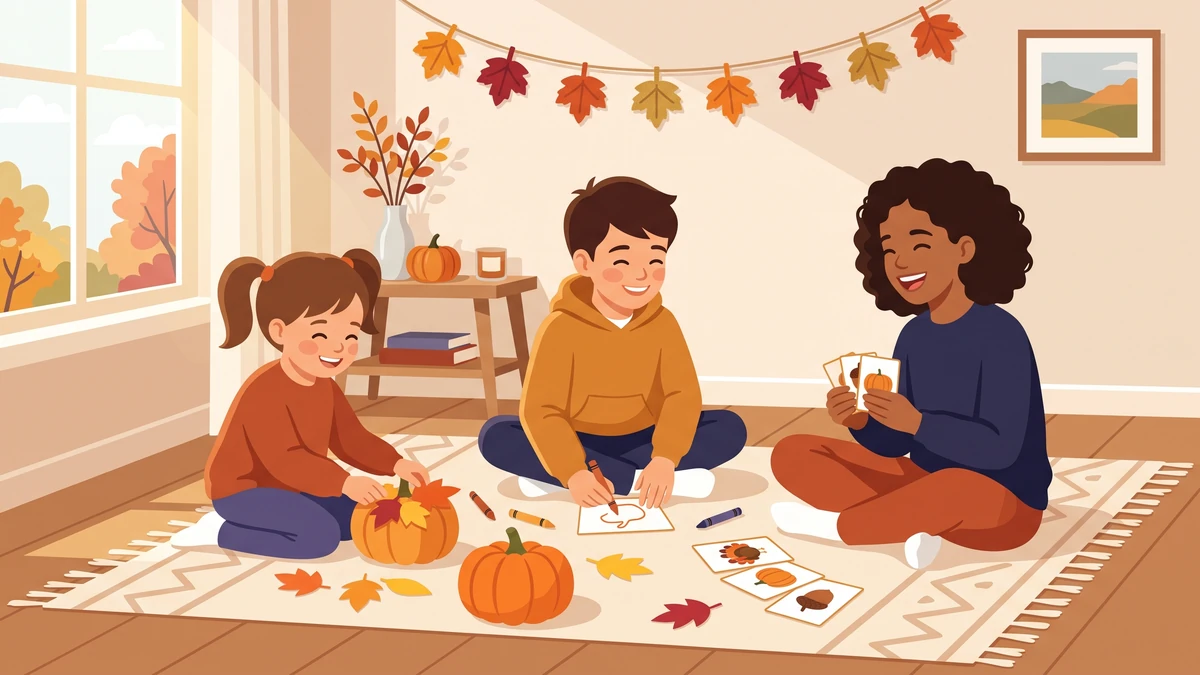
These Thanksgiving games for kids are arranged by age, so you can move from one-rule preschool play to puzzles and team missions for older children without comparing one giant mixed list. Every idea works indoors, most use paper or soft household supplies, and three sample schedules make it easy to plan a short or full activity session.
Last reviewed: September 2026
The age bands below are starting points, not fixed ratings. A confident five-year-old may enjoy a game from the next section, while an older child may prefer a quieter picture activity. Reading comfort, movement needs, noise level, available space, and adult help all matter more than a birthday alone.
This is a children-only guide. For a gathering where adults and grandparents will also play, use the broader Thanksgiving games for family gatherings hub instead.
Ages 4-5: One Rule, Short Turns, Plenty of Repeats
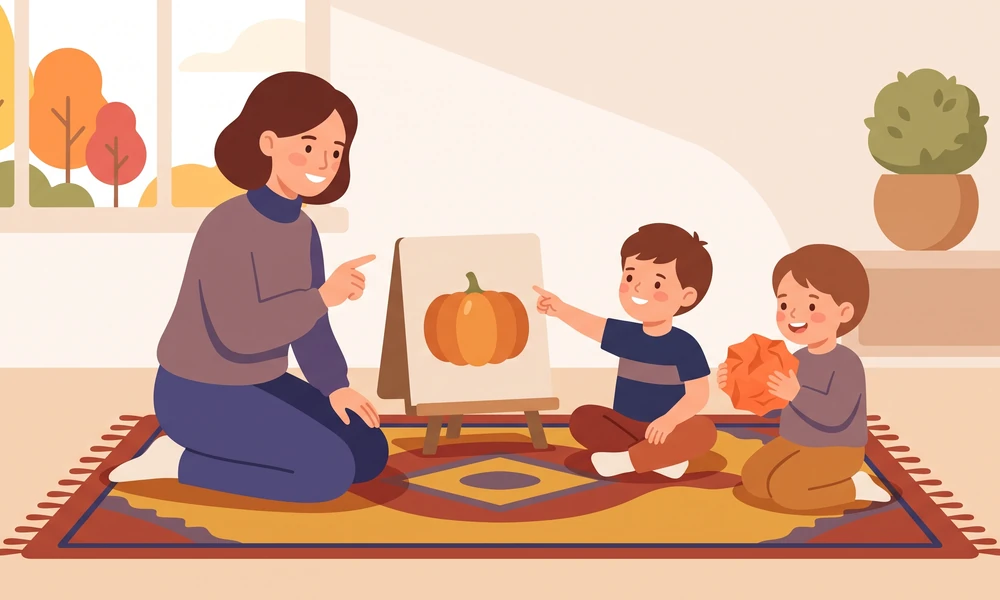
At this age, the clearest games use one action at a time and let children copy an adult before the first turn. Keep each round short, repeat favorite games, and treat every age as a flexible starting point rather than a test.
1. Turkey Says
Good fit: Ages 4-8; 3+ players; 5-8 minutes; no supplies.
The host gives actions such as “Turkey says flap twice,” “Turkey says tap your knees,” or “Turn around.” Children only copy an action that begins with “Turkey says.” Instead of sending a mistaken player out, let that child stay in and help spot the next command.
For a seated version, use hand, face, and shoulder movements. For older children, combine two instructions in one turn.
2. Feather Color Hunt
Good fit: Ages 4-7; 2+ players; 5 minutes; no supplies.
Call a fall color, then ask every child to find something in the room with that color and point to it from where they are. This keeps the game indoors and prevents a rush toward one object. Try orange, brown, gold, green, and red before adding clues such as “something soft” or “something square.”
If a child is color-blind, use shape, texture, or object clues instead.
3. Pass the Paper Pumpkin
Good fit: Ages 4-12; 3+ players; 7 minutes; supplies: orange paper and tape.
Crumple orange paper into a loose ball, add a paper stem, and pass it around the circle while the host claps a steady beat. When the clapping stops, the player holding the pumpkin chooses a group action: everyone makes a turkey pose, names a fall color, or claps a short rhythm.
Keep the pumpkin moving hand to hand rather than throwing it. As a result, the game also works around a table.
4. Harvest Freeze Poses
Good fit: Ages 4-9; 3+ players; 8 minutes; supplies: music or hand claps.
Children move gently while music plays or the host claps. When the sound stops, call a pose: tall scarecrow, tiny acorn, floating leaf, proud turkey, or parade balloon. Every pose counts, so there is no “wrong” shape and no player leaves the game.
In a small room, replace dancing with slow marching in place. A seated player can create each pose with arms and facial expressions.
5. Picture Clue Match
Good fit: Ages 4-7; 1+ players; 8 minutes; supplies: six large picture cards and six clue cards.
Draw or print six large pictures, such as a leaf, hat, pie, pumpkin, acorn, and star. Read a clue – “I am round and have a stem” – and let the child point to the matching card. Then invite the child to invent the next clue.
Use pictures alone for early readers. Older children can match each picture to a written clue without hearing it first.
6. Quiet Pattern Builder
Good fit: Ages 4-10; 1+ players; 10 minutes; supplies: large colored paper shapes.
Start a pattern with large paper shapes – leaf, leaf, pumpkin, leaf, leaf, pumpkin – and ask the child to place or point to what comes next. Once the pattern is complete, the child creates a new challenge for someone else.
Preschoolers can use two repeating shapes, while older children can build an AAB, ABB, or growing pattern. Store the pieces when play ends, especially if toddlers are present.
<a id=”ages-6-8-movement-matching-and-make-believe”></a>
Ages 6-8: Movement, Matching, and Make-Believe
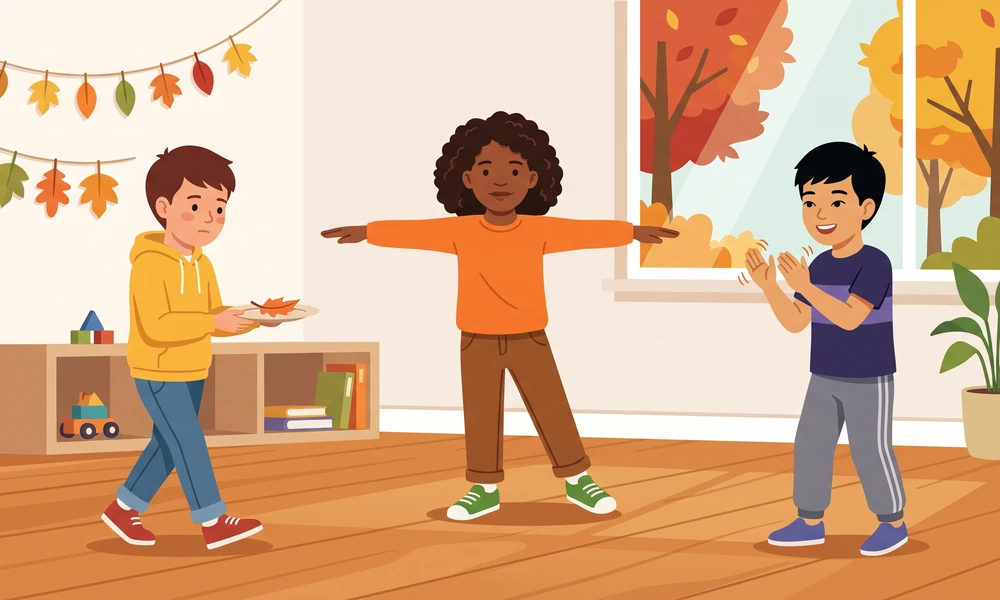
Children in this range can usually manage a short sequence, a simple score, or a partner role. Alternate movement with a seated challenge so the group does not spend the whole session either waiting or racing.
7. Harvest Sound Echo
Good fit: Ages 5-10; 4+ players; 7 minutes; no supplies.
Make a two-sound pattern using claps, knee taps, table taps, or a spoken “gobble.” The group repeats it exactly. Next, add one sound at a time until the pattern reaches five actions, then let a child become the sound leader.
For a quieter round, replace sounds with visible gestures. This variation also helps children who prefer not to make animal noises.
8. Turkey Step Trail
Good fit: Ages 4-8; 2+ players; 10 minutes; supplies: large paper action cards and painter’s tape.
Place six large cards in a short path. Each card shows one action: step, clap, turn, reach, pause, or pose. A player follows the trail in order while the group reads the actions aloud. Tape every corner flat and test the path before play.
To raise the difficulty, rearrange the cards after each round. A seated version uses the same sequence with hand and upper-body actions.
9. Waddle-and-Deliver Relay
Good fit: Ages 5-10; 4+ players; 12 minutes; supplies: paper plates, crumpled paper balls, two baskets.
Each player carries a paper “pumpkin” on a paper-plate tray to the basket and walks back before the next teammate starts. If the pumpkin falls, the player picks it up and continues from that spot. The goal is to deliver every pumpkin, not to sprint.
For mixed ages, shorten the lane for younger players and give older children two paper pumpkins to balance.
10. Soft Sock Harvest Toss
Good fit: Ages 5-12; 2+ players; 10 minutes; supplies: clean rolled socks and laundry baskets.
Set baskets at two or three distances and give each child five rolled socks. Near baskets earn one point, while farther baskets earn two or three. Players toss only toward the baskets, and everyone waits behind the same line until the round ends.
Younger children can stand closer. Alternatively, skip points and challenge the group to land 15 socks together.
11. Leaf Balance Lane
Good fit: Ages 4-9; 2+ players; 8 minutes; supplies: large paper leaves and paper plates.
Put a large paper leaf on a plate, then walk it down a short clear lane and back. If the leaf slides off, stop, replace it, and continue. Because the object is light, a drop does not create a hard projectile or a messy cleanup.
For an easier game, hold the plate with two hands. For a level-up, add one slow turn at the halfway mark.
12. Stuff the Nest
Good fit: Ages 4-10; 4+ players; 10 minutes; supplies: crumpled paper and two baskets.
Fill one basket with crumpled paper “feathers” and leave the other empty across the room. Players take turns walking one feather to the nest. Can the group move the whole harvest before a two-minute timer ends?
Rather than racing teams against one another, replay the same cooperative challenge and try to improve the group total. Keep all loose paper outside the walking lane.
13. Parade Route Traffic Lights
Good fit: Ages 4-10; 3+ players; 8 minutes; no supplies.
The host calls “green” for marching in place, “gold” for slow motion, and “red” for a parade pose. Add “blue” for a wave and “orange” for two claps once everyone knows the first three commands.
Nobody is eliminated for moving on red; the group simply resets. Therefore, children can focus on listening instead of worrying about being out.
14. Missing Feast Memory Board
Good fit: Ages 5-10; 2+ players; 8 minutes; supplies: six large picture cards and a towel.
Display six Thanksgiving picture cards for 20 seconds. Children close their eyes while the host covers the board and removes one card. When the board returns, everyone guesses which picture is missing.
Start with four cards for younger children and build up to eight. Use printed pictures rather than real food, cutlery, or breakable decorations.
<a id=”ages-9-12-and-up-puzzles-design-and-team-strategy”></a>
Ages 9-12 (and Up): Puzzles, Design, and Team Strategy
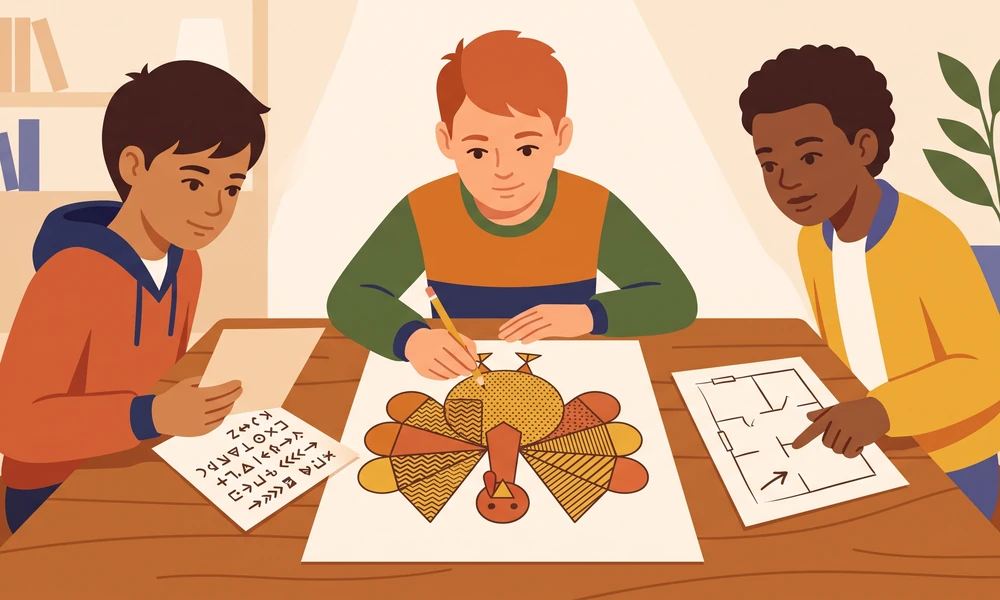
Older children often stay interested when a game gives them something to solve, design, or explain. These options add decisions and teamwork without turning the activity into a school worksheet.
15. Thanksgiving Codebreaker
Good fit: Ages 7-12; 1+ players; 10-15 minutes; supplies: printed quest pack and pencils.
Use the A-to-Z number key in the printable pack to decode four short mission messages. Younger readers can call out letters while an older partner writes, so the puzzle still feels shared rather than simplified.
If children finish early, ask them to create a five-word coded message for another team. Keep the answer-key page with the host until the end.
16. Turkey Blueprint Challenge
Good fit: Ages 6-12; 1+ players; 15 minutes; supplies: paper and crayons or pencils.
Design a parade turkey that includes at least three shapes, two patterns, one silly feature, and one labeled moving part. The printable pack provides a large drawing space, but plain paper works too.
There is no single winning design. Instead, give lighthearted badges such as Clever Mechanism, Boldest Pattern, or Best Tiny Detail so several ideas can be recognized.
17. Three-Card Story Quest
Good fit: Ages 6-12; 2+ players; 15 minutes; supplies: prompt cards or the printed quest pack.
Choose one hero, one place, and one problem. For example, a tiny scarecrow might enter a leaf maze because the map is upside down. Players take turns adding one sentence until the story has a beginning, middle, and ending.
A child who does not want to speak can draw the next scene or hold up a prompt choice. That role still changes the story.
18. Thanksgiving Charades: Kids Mode
Good fit: Ages 5-12; 4+ players; 10-15 minutes; supplies: prompt slips or a phone for the host.
Use easy prompts such as raking leaves, stirring a bowl, marching in a parade, or a turkey stretching its wings. One child acts while the group guesses, but passing is always allowed. Keep every round to about 30 seconds so waiting stays short.
For ready-made prompts, open the free Charades Generator and select Kids plus Easy. The host can hold the screen, so children do not need their own devices.
19. Harvest Map Quest
Good fit: Ages 7-12; 3+ players; 15-20 minutes; supplies: four paper clues and a simple room map.
Mark four safe clue stations on a hand-drawn map. At each station, the team solves one small task: match two pictures, finish a pattern, decode a word, or copy a clap sequence. The final letters spell a message such as TEAMWORK.
Keep every clue in shared rooms, away from stairs, cooking areas, doors, and breakables. In addition, let one child hold the map while another reads.
20. Cousin Communication Build
Good fit: Ages 7-12; 4+ players; 12 minutes; supplies: two matching sets of large paper shapes and a folder.
Partners sit across from each other with a folder standing between them. One partner arranges five large shapes and describes the design without naming colors alone; the other tries to copy it. Remove the folder, compare the layouts, then switch roles.
For an easier round, allow directional words and one question per shape. Avoid tiny counters when younger siblings are nearby.
21. Save the Parade Float
Good fit: Ages 6-12; 3+ players; 15 minutes; supplies: ten index cards, tape, and one paper pumpkin.
The parade float needs a stand. Teams use only ten index cards and 30 centimeters of tape to build a platform that holds a crumpled-paper pumpkin for ten seconds. Folding, rolling, and layering are allowed.
If a platform falls, the team gets a repair minute rather than losing. Afterwards, ask which shape made the structure steadier.
Mixed-Age Siblings: Give Each Child a Different Job
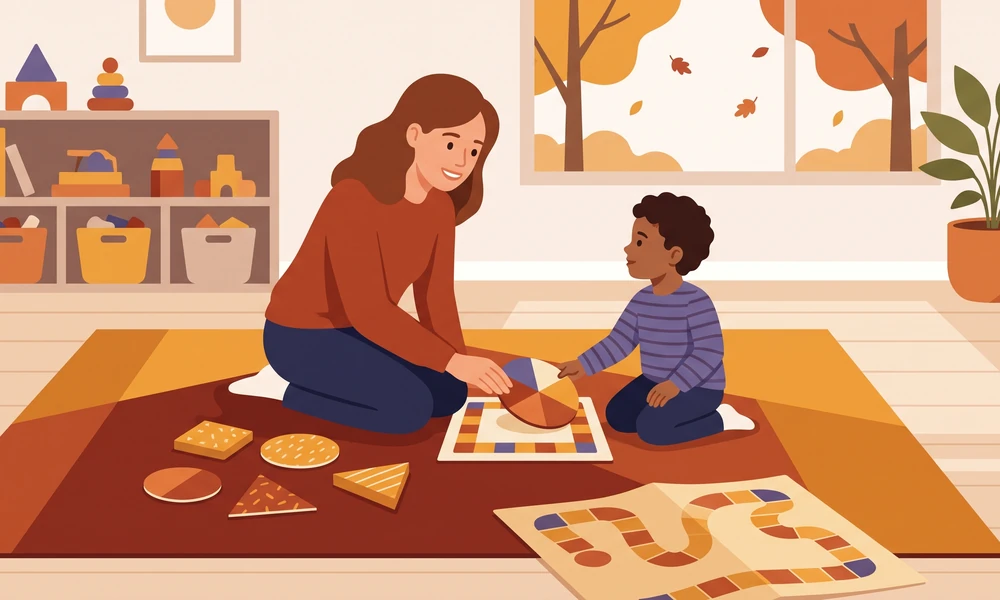
A mixed-age game works when children do not all need the same reading, drawing, or movement skill. Give older players the longer clues and younger players the picture, sorting, pointing, or materials roles.
22. Team Table-Setting Puzzle
Good fit: Ages 5-10; 2+ players; 10 minutes; supplies: large paper plate, cup, napkin, and utensil pictures.
Show a simple picture model for ten seconds, cover it, and ask the team to arrange matching paper pieces in the same positions. Reveal the model, make one correction together, and try a new layout.
This is a memory puzzle, not an etiquette test. Use paper pictures instead of actual glasses, plates, or sharp utensils.
23. Thanksgiving Mission Chain
Good fit: Ages 6-12 with an older reader; 4+ players; 20 minutes; supplies: four envelopes, paper puzzles, and pencils.
Put one task in each envelope: decode a message, copy a sound pattern, match picture clues, and draw the final symbol. Completing one task reveals which envelope comes next. The whole group wins when it reaches the final message.
Keep the chain to four steps and give each player a role – reader, writer, materials keeper, or checker. Consequently, the puzzle stays collaborative instead of becoming one child’s solo solve.
24. Indoor Thanksgiving I Spy
Good fit: Ages 4-9; 1+ players; 10 minutes; supplies: printed quest pack and pencil.
Children count pumpkins, leaves, hats, pies, acorns, and stars in the printable grid. They record each total and then answer two bonus questions: which symbol appears most often, and which symbols are tied?
Pair a beginning counter with an older helper. For a reusable version, slide the page into a dry-erase pocket and supervise the marker.
25. Which Card Changed?
Good fit: Ages 5-10; 2+ players; 7 minutes; supplies: six large picture cards.
Arrange six cards in a row and give players 15 seconds to study them. Children close their eyes while the host swaps two cards or turns one card over. The first player to explain the change becomes the next host.
Do not use blindfolds. For younger children, begin with four cards and change only one position at a time.
<a id=”three-ready-to-run-kids-activity-schedules”></a>
Three Ready-to-Run Kids’ Activity Schedules
Choose a schedule by the time you actually have. The games can stop cleanly when dinner is ready, and each plan moves from an easy opener toward a calmer finish.
| Plan | Game order | Play time | Best use |
|---|---|---|---|
| Quick and calm | Turkey Says → Picture Clue Match → Which Card Changed? | About 20 min | A small group or a short wait before dinner |
| Balanced indoor session | Feather Color Hunt → Soft Sock Harvest Toss → Three-Card Story Quest | About 30 min | Movement followed by a seated creative game |
| Full team quest | Harvest Sound Echo → Turkey Step Trail → Harvest Map Quest → Thanksgiving Codebreaker | About 50 min | A planned kids’ activity during a longer gathering |
Add only one backup instead of preparing another full schedule. The same one-main-game principle is useful in the board game night checklist, although the age bands on this page should guide the final choice.
Download the Thanksgiving Kids Game Quest Pack
The six-page printable supports the article without repeating all 25 games. It includes a three-game planner, team roles, a scoreboard, codebreaker, I Spy grid, story prompts, turkey blueprint, answer key, and notes for next year.
Free 6-page printable
Thanksgiving Kids Game Quest Pack
Plan three games, assign team roles, track scores, solve a codebreaker, complete an I Spy grid, and finish with two creative quests.
Download the Free Kids Game Quest Pack (PDF)Before the First Round: A One-Minute Host Check
Clear one short play area and keep all games away from stairs, doorways, hot dishes, and the cooking zone.
Demonstrate one turn before adding a timer, score, or harder variation.
Keep eating separate from play. The American Academy of Pediatrics advises that young children should sit while eating rather than walk or play with food in their mouths in its choking-prevention guidance.
If a child under 3 is nearby, remove small loose objects. The U.S. Consumer Product Safety Commission’s small-parts guidance explains the hazard for this age group.
Offer a seated, drawing, reading, scorekeeping, or materials role instead of requiring every child to move or perform.
Let a child pass without explaining why, and reset mistakes instead of removing players.
Choose the First Three Games
Start with one game from the closest age band, add one movement option if the room allows it, and keep one quiet activity ready for the final ten minutes. For a mixed group, Turkey Says, Soft Sock Harvest Toss, and Indoor Thanksgiving I Spy create a simple active-to-calm sequence.
For more nonseasonal choices, browse the Party Games collection. The age route on this page should remain the main decision guide, while the family pillar handles mixed generations and larger gatherings.
