
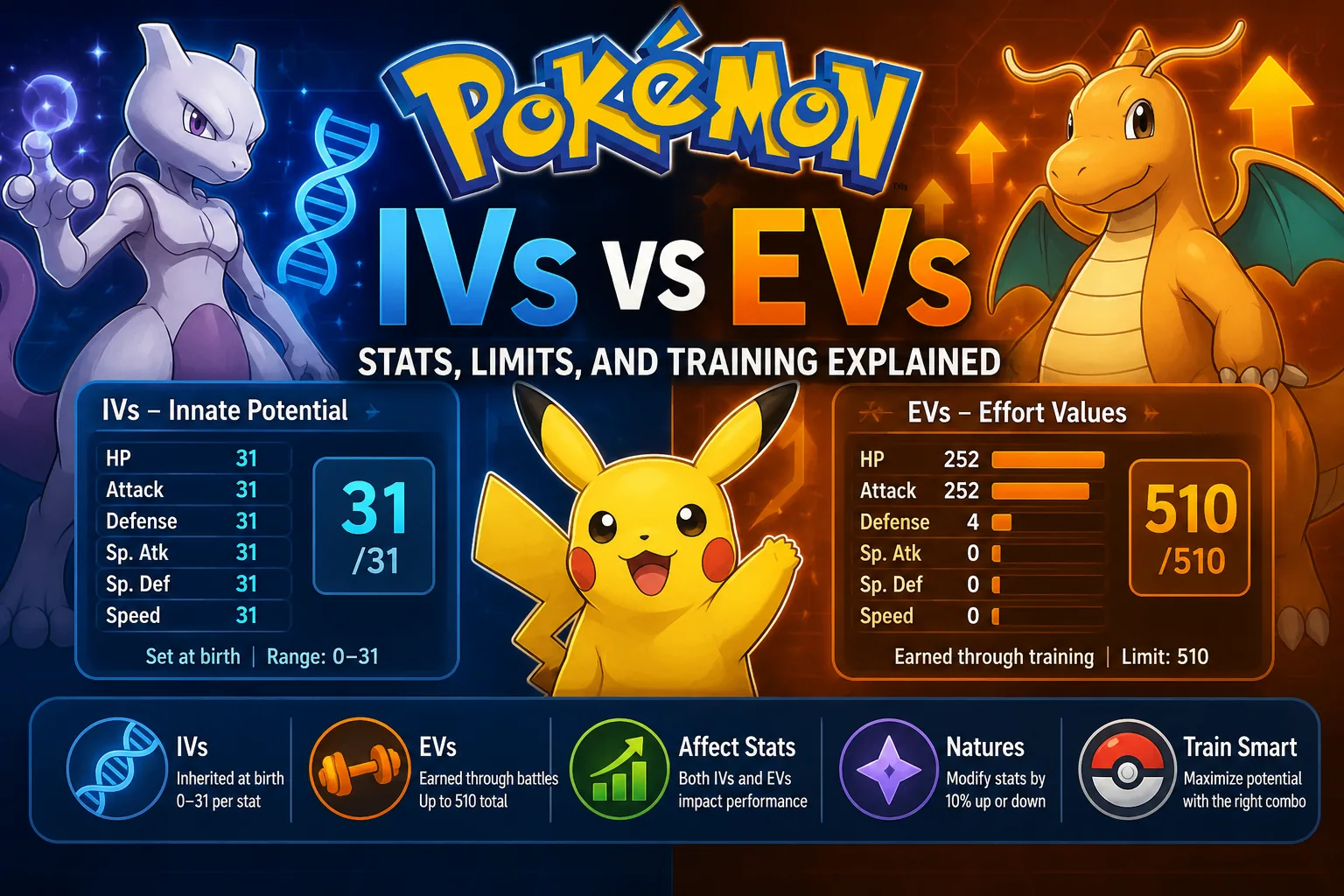
Direct Answer: In Pokemon IVs vs EVs, IVs are innate values that determine a Pokémon’s natural potential in each stat, while EVs are training points you deliberately distribute through battles or items. In modern main-series games, IVs are represented from 0–31 per stat, while EVs allow up to 252 per stat and 510 total.
By Gaming Station Editorial Team
Last reviewed: August 2026
Two Pokémon of the same species, level, and Nature can still finish with noticeably different stats. The reason is that the displayed HP, Attack, Defense, Sp. Atk, Sp. Def, and Speed are influenced by several underlying systems—not simply the Pokémon’s species and level.
Two of the most important are IVs and EVs.
The Pokémon Company generally calls IVs individual strengths and EVs base points in its modern player-facing Scarlet and Violet training material. Competitive players continue to use the familiar terms Individual Values (IVs) and Effort Values (EVs). Pokémon’s official Scarlet/Violet training guide confirms that individual strengths affect a Pokémon’s stat potential, while base points can be deliberately accumulated and redistributed through training.
The distinction is straightforward:
IVs = what the individual Pokémon starts with
EVs = how you train that Pokémon
Nature then modifies how particular stats develop, creating the third major piece of competitive stat optimization. Pokémon’s official Scarlet/Violet guidance explains that Mints can change a Pokémon’s effective stat growth without changing the Nature displayed in its summary.
This guide focuses on the traditional main-series stat system used in games such as Pokémon Scarlet and Pokémon Violet. If you want to check a build quickly, use our Pokemon IV/EV calculator while reading the stat examples below.
Pokémon Champions, released in 2026, uses its own visible Stat Points and Stat Alignment terminology, so its team-building interface should not be treated as a direct EV-training screen.
Pokemon IVs vs EVs at a Glance
| Feature | IVs | EVs |
|---|---|---|
| Full name | Individual Values | Effort Values |
| Official modern wording | Individual strengths | Base points |
| What they represent | Natural stat potential | Trained stat investment |
| Applied to | All six stats individually | All six stats individually |
| Common range | 0–31 per stat | 0–252 per stat |
| Overall limit | No shared IV budget | 510 total EVs |
| Can you train them normally? | No | Yes |
| Can they be improved artificially? | Yes, through Hyper Training | Yes, through battles/items |
| Can they be reduced? | Not normally through Hyper Training | Yes |
| Main competitive purpose | Maximize or deliberately minimize specific stats | Build the Pokémon for a role |
| Example | 31 Attack IV | 252 Attack EVs |
Pokémon’s Scarlet/Violet guide describes individual strengths as innate differences between individual Pokémon and explains that base points have both per-stat and overall limits, allowing two stats to be maximized with a small amount left for another.
What Are Pokemon IVs?
IVs are hidden values assigned independently to a Pokémon’s six stats that influence how high those stats can become.
The six IV categories are:
- HP
- Attack
- Defense
- Sp. Atk
- Sp. Def
- Speed
In the conventional competitive representation used by modern main-series Pokémon games, each IV ranges from:
0 to 31
A value of:
31 = maximum potential
0 = minimum potential
Pokémon’s own Scarlet/Violet interface does not normally show players the raw number. Instead, the Judge function displays labels such as “No Good” and “Best.” The official training guide describes these values as individual strengths and confirms that higher individual strength allows a stat to reach a higher maximum.
IV Example
Imagine two otherwise identical Garchomp.
Both are:
- Level 50
- Jolly Nature
- Same EV spread
- Same species
- Same moves
But:
Garchomp A
Speed IV:
31
Garchomp B
Speed IV:
10
Garchomp A can reach a higher Speed stat because its individual strength in Speed is better.
This is why competitive players frequently look for 31 IVs in the stats that matter to a Pokémon’s intended role.
Does Every Pokemon Need Perfect IVs?
No.
A common beginner assumption is:
Competitive Pokémon = 31 IVs in all six stats
That is often unnecessary.
Pokémon’s own Scarlet/Violet training guide specifically notes that not every Pokémon needs every individual strength maximized.
For example:
Physical attacker
Usually wants:
- 31 HP
- 31 Attack
- 31 Defense
- 31 Sp. Def
- 31 Speed when applicable
Its Sp. Atk IV may be irrelevant if it never uses special attacks.
Special attacker
Often does not need a maximum Attack IV.
In some competitive situations, players deliberately prefer:
0 Attack IV
because reducing unnecessary physical Attack can reduce damage from mechanics that use the target’s Attack stat.
Trick Room Pokémon
May intentionally prefer:
0 Speed IV
because Trick Room rewards slower Pokémon by reversing normal move order.
So a lower IV is not automatically “bad.”
The correct IV depends on the build.
What Does “Best” Mean for IVs?
In modern main-series Judge terminology:
Best indicates the highest natural individual-strength category.
Pokémon Scarlet and Violet also display:
Hyper Trained!
when a stat has been improved through Hyper Training.
The official training guide states that a Hyper Trained stat is functionally equivalent to “Best” for stat calculation, even though the Pokémon’s underlying individual strength is not simply presented as a naturally obtained Best value.
How to Check IVs in Pokemon Scarlet and Violet
Pokémon Scarlet and Violet unlock the Judge function after completing the Pokémon League and the Victory Road storyline.
Once available:
- Open your Boxes.
- Highlight a Pokémon.
- Press the + Button.
- View the individual-strength labels beside each stat.
Pokémon’s official Scarlet/Violet training guide documents this Judge-function workflow.
Common labels include values such as:
- No Good
- Decent
- Pretty Good
- Very Good
- Fantastic
- Best
- Hyper Trained!
For most players, the two strategically important endpoints are:
No Good → minimum
Best → maximum
Can You Change IVs?
You cannot normally train natural IVs upward through ordinary battles the way you train EVs.
Modern games instead provide Hyper Training.
In Pokémon Scarlet and Violet, Pokémon at Lv. 50 or higher can be Hyper Trained in Montenevera by exchanging Bottle Caps.
Bottle Cap
Hyper Trains:
1 stat
Gold Bottle Cap
Hyper Trains:
all applicable stats
The official guide states that Hyper Trained stats function as if their individual strength were at the maximum for battle-stat purposes.
Important: Hyper Training Does Not Mean “Change the IV to Any Number”
Hyper Training is primarily a maximization tool.
It is excellent when you want:
31-equivalent performance
It is not the tool you use when you want:
- 0 Speed
- 0 Attack
- A specific intermediate IV
That distinction matters for specialized competitive builds.
If a Pokémon needs deliberately low Speed or Attack, obtaining the appropriate natural stat configuration remains important.
What Are Pokemon EVs?
EVs are points you intentionally accumulate to increase specific stats through training.
Pokémon officially refers to them as base points in its Scarlet and Violet strategy material.
Unlike IVs, EVs are not primarily about what your Pokémon was born or caught with.
They represent:
Where you invested its training.
Pokémon begin with no base-point investment and can gain it through eligible battles or consumable training items.
Pokemon EV Limits
In the modern traditional EV system:
Maximum in one stat: 252 EVs
Maximum across all six stats: 510 EVs
That means you cannot maximize all six stats.
The familiar beginner spread:
252 / 252 / 4
uses almost the entire available budget.
For example:
Physical sweeper
252 Attack / 252 Speed / 4 HP
Special attacker
252 Sp. Atk / 252 Speed / 4 Sp. Def
Defensive Pokémon
252 HP / 252 Defense / 4 Sp. Def
Pokémon’s official Scarlet/Violet guide explains the same restriction conceptually: base-point limits permit a Trainer to maximize two stats with only a small amount of capacity remaining for a third. It also notes that 252 feathers are enough to take a stat from zero base points to its maximum, confirming the practical single-stat cap used in modern EV spreads.
Why Do Competitive Builds Usually Use 252 EVs?
The EV system works in effective increments.
Only complete groups of EV investment contribute to the underlying stat calculation, which is why competitive spreads are conventionally written in multiples of four.
A maxed stat therefore uses:
252 EVs
rather than wasting points above the effective cap.
The familiar allocation:
252 + 252 + 4 = 508
leaves two EVs that cannot produce another useful increment under the traditional system.
That is why many published competitive sets appear as:
252 / 252 / 4
rather than using all six stats.
Does 4 EVs Always Mean +1 Displayed Stat?
This point needs nuance.
Players often hear:
4 EVs = 1 stat point
That is a useful shorthand, but it is most directly true at Level 100.
The game first converts EV investment into an internal contribution and then applies level scaling and rounding.
At competitive Level 50, adding four more EVs does not necessarily make the visible stat increase by exactly one every time.
The practical takeaway is:
Allocate EVs in effective four-point increments, but calculate exact Level 50 stat targets when building optimized competitive spreads.
This is why advanced VGC spreads can look like:
196 Speed
instead of simply:
252 Speed
The Trainer may only need enough Speed to beat a specific opposing Pokémon and can invest the remaining EVs elsewhere.
How Do Pokemon Gain EVs?
In Pokémon Scarlet and Violet, Pokémon gain base points from battles that award Exp. Points.
The specific stat trained depends on the species defeated.
The official Scarlet/Violet training guide gives examples such as targeting particular wild Pokémon when training a desired stat and notes that Pokémon receiving Exp. Points also receive the corresponding base points. Auto Battles are specifically excluded from this normal base-point training process.
For example, a Trainer may deliberately battle species associated with:
- HP
- Attack
- Defense
- Sp. Atk
- Sp. Def
- Speed
until the required spread is reached.
Power Items and EV Training
Pokémon Scarlet and Violet include six Power Items designed to accelerate training in specific stats. The official guide identifies these items as a major method for increasing the growth rate of a chosen stat when opposing Pokémon are defeated.
| Stat | Power Item |
|---|---|
| HP | Power Weight |
| Attack | Power Bracer |
| Defense | Power Belt |
| Sp. Atk | Power Lens |
| Sp. Def | Power Band |
| Speed | Power Anklet |
This makes targeted battle training significantly faster than defeating Pokémon without a relevant Power Item.
EV Training With Vitamins
You do not have to grind wild encounters.
Pokémon Scarlet and Violet allow base points to be increased with vitamins.
| Stat | Vitamin |
|---|---|
| HP | HP Up |
| Attack | Protein |
| Defense | Iron |
| Sp. Atk | Calcium |
| Sp. Def | Zinc |
| Speed | Carbos |
The official Scarlet/Violet guide states that:
26 vitamins
can take one stat from zero base points to its maximum.
This is one of the simplest ways to create a standard competitive spread if you have enough in-game currency.
EV Training With Feathers
Feathers provide finer control than vitamins.
Scarlet and Violet include:
| Stat | Feather |
|---|---|
| HP | Health Feather |
| Attack | Muscle Feather |
| Defense | Resist Feather |
| Sp. Atk | Genius Feather |
| Sp. Def | Clever Feather |
| Speed | Swift Feather |
Pokémon’s official training guide states that 252 feathers are enough to take a stat from zero base points to the maximum.
That makes feathers particularly useful when an optimized spread requires a smaller, precise amount rather than a full 252-point investment.
EV Training With Mochi
The Hidden Treasure of Area Zero introduced additional stat-training items in Pokémon Scarlet and Violet.
Specific Mochi can increase individual stat base points, while Fresh-Start Mochi can reset them. The official Scarlet/Violet training guide documents these items and notes that they are associated with Ogre Oustin’ in Kitakami.
Examples include:
- Health Mochi
- Muscle Mochi
- Resist Mochi
- Genius Mochi
- Clever Mochi
- Swift Mochi
For players with DLC access, Mochi offers another direct training path.
Can You Reset EVs?
Yes.
Unlike natural IVs, EV allocation is designed to be trainable and correctable.
Pokémon Scarlet and Violet provide stat-specific Berries that reduce base points.
| Stat | EV-Reducing Berry |
|---|---|
| HP | Pomeg Berry |
| Attack | Kelpsy Berry |
| Defense | Qualot Berry |
| Sp. Atk | Hondew Berry |
| Sp. Def | Grepa Berry |
| Speed | Tamato Berry |
The Teal Mask’s Fresh-Start Mochi can instead reset the Pokémon’s base points broadly, making complete retraining much easier.
IV and EV Difference Explained With One Example
Consider two Level 50 Dragonite.
They are the same:
- Species
- Level
- Nature
- Ability
- Moves
But their training differs.
Dragonite A
Attack IV:
31
Attack EVs:
252
Dragonite B
Attack IV:
15
Attack EVs:
0
Dragonite A benefits from both:
better natural Attack potential + maximum deliberate Attack investment
Dragonite B has:
lower natural potential + no Attack training
The resulting Attack values will therefore differ substantially.
That illustrates the core IV and EV difference:
IV = potential
EV = investment
Where Base Stats Fit In
IVs and EVs do not replace a Pokémon species’ natural stat distribution.
Every species already has its own underlying strengths.
For example, some Pokémon are naturally:
- Fast
- Physically bulky
- Specially offensive
- High-HP
- Slow but powerful
IVs and EVs modify that foundation rather than making every species statistically identical.
A useful mental model is:
Final stat = Species potential + IV contribution + EV training + Level scaling + Nature effect
That is why putting maximum Attack EVs on a naturally weak physical attacker usually does not transform it into the same kind of attacker as a species built around high physical offense.
Pokémon’s official training advice similarly recommends leaning into a Pokémon’s existing strengths in many cases rather than trying to repair every weak stat.
Pokemon Nature Stats Explained
A Pokémon’s Nature is another major part of stat optimization.
Most strategically relevant Natures favor one non-HP stat while hindering another, while several neutral Natures do not create an increase/decrease pairing.
Pokémon’s official Scarlet/Violet guide gives examples such as:
Adamant
Increases the development of:
Attack
Reduces:
Sp. Atk
Modest
Increases:
Sp. Atk
Reduces:
Attack
Jolly
Increases:
Speed
Reduces:
Sp. Atk
Timid
Increases:
Speed
Reduces:
Attack
The official guide provides the Nature/stat pairings and explains why different offensive builds may prefer different Natures.
IVs vs EVs vs Nature
| Mechanic | Main Question |
|---|---|
| Base stats | What is this species naturally good at? |
| IVs | How strong is this individual Pokémon’s potential in each stat? |
| EVs | Where have you deliberately invested its training? |
| Nature | Which stat direction is being favored or reduced? |
| Level | How much of the stat formula is currently realized? |
Competitive training means getting these systems to work together.
Example: Physical Sweeper Build
Suppose you are building a Pokémon whose job is to:
hit physically and move quickly
A basic beginner configuration might use:
IVs
- 31 Attack
- 31 Speed
- Strong IVs elsewhere
EVs
- 252 Attack
- 252 Speed
- 4 HP
Nature
Jolly
if additional Speed matters.
Or:
Adamant
if extra Attack is more important.
Pokémon’s official training guide specifically uses offensive examples where Trainers focus base points on Speed plus Attack or Sp. Atk.
Example: Special Attacker
A simple special attacker could use:
IVs
- 31 Sp. Atk
- 31 Speed
- 0 Attack when strategically useful
EVs
- 252 Sp. Atk
- 252 Speed
- 4 HP
Nature
Timid for more Speed
or
Modest for stronger special offense.
The physical Attack IV does not contribute to the Pokémon’s normal special attacks, so perfect Attack is not inherently necessary.
Example: Defensive Pokemon
A physically defensive Pokémon might instead prioritize:
IVs
31 in:
- HP
- Defense
- Relevant secondary stats
EVs
252 HP / 252 Defense / 4 Sp. Def
Nature
Bold
when increasing Defense while reducing unused Attack is beneficial.
This is why the “correct” EV spread is role-dependent rather than universally 252 Attack / 252 Speed.
Why Competitive EV Spreads Are Sometimes Complicated
A beginner spread often maximizes two stats.
An advanced spread may look like:
236 HP / 76 Defense / 116 Sp. Atk / 4 Sp. Def / 76 Speed
That does not mean the player trained randomly.
Each number may serve a target such as:
- Survive a specific attack
- Outspeed a specific opponent
- Guarantee a knockout
- Reach a useful HP breakpoint
- Improve damage under a specific item
- Optimize remaining EV efficiency
Competitive Pokémon is therefore not simply about “maxing stats.”
It is about reaching the exact stats required by the role.
Official competitive Pokémon team features likewise publish specialized spreads rather than universally maximizing two stats, reflecting role-specific optimization.
Should Beginners Use 252 / 252 / 4?
Usually, yes.
It is the easiest way to understand Pokemon stat training.
Choose the two stats most important to the Pokémon’s job.
For example:
Fast physical attacker
252 Attack / 252 Speed / 4 HP
Fast special attacker
252 Sp. Atk / 252 Speed / 4 HP
Physical wall
252 HP / 252 Defense / 4 Sp. Def
Once you understand speed tiers, damage calculations, and defensive benchmarks, you can move toward more specialized spreads.
Can EVs Ruin a Pokemon?
Not permanently in modern games.
Accidental training can put base points into stats you did not want, but Scarlet and Violet provide Berries and Fresh-Start Mochi for correcting those allocations.
This means a favorite Pokémon does not normally need to be discarded simply because it gained unwanted EVs.
If you are deciding whether to keep training or move on, this guide on how to choose your next game can help with broader backlog decisions.
It can be retrained.
Can Bad IVs Ruin a Pokemon?
Usually not if the goal is maximum performance.
Hyper Training allows a Pokémon with imperfect individual strengths to perform as though selected stats were “Best.” In Scarlet and Violet, this is available from Lv. 50 using Bottle Caps.
The major exception is when you need a stat deliberately low.
Examples include:
- Minimum Speed
- Minimum Attack
Hyper Training cannot be used as a general “set this IV to zero” control.
So catching or breeding can still matter for specialized builds.
Do Hyper Trained IVs Pass Down Through Breeding?
Hyper Training should be understood as a battle-stat correction, not as rewriting the Pokémon’s natural inherited individual strengths.
The game distinguishes naturally “Best” individual strengths from the Hyper Trained! state in the Judge interface.
For breeding-oriented optimization, natural inherited values therefore remain relevant.
For a Pokémon you simply intend to battle with, Hyper Training is usually the easier solution.
Is Breeding Still Necessary for Good IVs?
Not for most straightforward competitive builds in Scarlet and Violet.
Pokémon’s official training guide explicitly emphasizes that modern training tools let Trainers improve existing Pokémon rather than needing to abandon a favorite because its starting stats are imperfect.
You can now modify many competitive characteristics using:
- Bottle Caps
- Mints
- Vitamins
- Feathers
- Power Items
- Ability items
Breeding is still useful when you specifically want inherited traits or deliberately low natural values.
Pokemon IVs vs EVs: Which Matters More?
Neither can fully replace the other.
A Pokémon with:
perfect IVs + no useful EV training
may be less optimized than one with:
appropriate IVs + a carefully designed EV spread
EVs generally give the Trainer more strategic control because you choose where the limited investment goes.
IVs establish individual potential.
A competitive build normally considers both.
Best Order for Training a Competitive Pokemon
A practical Scarlet/Violet workflow is:
- Choose the Pokémon and its battle role.
- Choose the Nature/stat effect.
- Check important IVs.
- Hyper Train relevant imperfect stats.
- Clear unwanted EVs if necessary.
- Choose the EV spread.
- Train with battles, Power Items, vitamins, feathers, or Mochi.
- Verify the stat spread.
- Add the correct Ability, moves, Tera Type, and held item.
Scarlet and Violet provide Mints, Hyper Training, vitamins, feathers, Mochi, Power Items, and EV-reducing options specifically to make this training process more accessible.
Example Competitive Training Workflow
For more utility-style helpers, you can also visit our gaming tools and calculators hub.
Suppose you want a fast physical Dragonite.
Step 1: Choose Nature
Use:
Adamant
for more Attack,
or
Jolly
for more Speed.
Pokémon’s official training guide specifically discusses Adamant and other Nature choices for Dragonite depending on its offensive role.
Step 2: Check IVs
Prioritize:
- Attack
- Speed
- HP
- Defenses
Hyper Train relevant imperfect values.
Step 3: Remove Bad EV Training
Use appropriate Berries or Fresh-Start Mochi if the Dragonite was used extensively during the story and accumulated unwanted base points.
Step 4: Apply EVs
Simple starting spread:
252 Attack / 252 Speed / 4 HP
Step 5: Finish the Build
Add:
- Ability
- Moves
- Held item
- Tera Type
Now the Pokémon’s stats and battle role work together.
IV and EV Terminology: Why the Game Uses Different Words
If you search the menus of recent Pokémon games for the exact words “IV” or “EV,” the terminology can be confusing.
Pokémon’s official Scarlet/Violet strategy material uses:
Individual strengths for the system players commonly call IVs.
And:
Base points for the system players commonly call EVs.
Competitive guides and team sheets commonly continue to use:
IVs / EVs
because the abbreviations are much more compact.
So:
Individual strength ≈ IV concept
Base points ≈ EV concept
in the traditional main-series stat system.
Important 2026 Note: Pokémon Champions Uses Different Terminology
Pokémon Champions launched on Nintendo Switch in April 2026 and later on mobile devices. Its competitive build interface uses visible concepts such as Stat Points and Stat Alignment, as shown in Pokémon’s official team-building features.
For example, official Pokémon Champions strategy articles now publish builds in forms such as:
Stat Points: 32 HP / 32 Attack / 1 Defense / 1 Sp. Def
alongside a Stat Alignment.
Therefore, this article’s traditional:
31 IV / 252 EV / 510 EV
framework should primarily be applied to main-series games that use the classic IV/EV structure, such as Scarlet and Violet—not blindly copied into Champions.
Common Pokemon IV and EV Mistakes
| Mistake | Why It Is Wrong |
|---|---|
| Assuming IVs and EVs are the same | IVs represent individual potential; EVs represent training |
| Trying to max all six EV stats | The total EV budget prevents it |
| Giving 252 EVs to every stat | Not possible |
| Assuming every stat needs 31 IV | Some builds deliberately want low Attack or Speed |
| Hyper Training before understanding the build | You may not want certain stats maximized |
| EV training random wild Pokémon | Can place points into unwanted stats |
| Ignoring Nature | Nature can significantly change the intended stat profile |
| Assuming Mints literally rename Nature | They change its stat effects, not the displayed original Nature |
| Treating 4 EVs as exactly +1 visible stat at every level | Level scaling and rounding matter |
| Copying an EV spread without understanding it | Advanced spreads target specific battle benchmarks |
Pokémon’s official Scarlet/Violet guide emphasizes planning the Pokémon’s role before optimizing Nature, individual strengths, base points, and held items.
Pokemon IVs vs EVs Cheat Sheet
IV
Meaning: Individual Value / individual strength
Range:0–31 per stat
Think:
Natural potential
Improve:
Hyper Training
EV
Meaning: Effort Value / base point
Per-stat maximum:252
Overall maximum:510
Think:
Training investment
Increase with:
Battles, Power Items, vitamins, feathers, Mochi
Reduce with:
Specific Berries or reset tools such as Fresh-Start Mochi in Scarlet/Violet.
Nature
Think:
Stat preference
Examples:
Adamant → Attack favored, Sp. Atk reduced
Jolly → Speed favored, Sp. Atk reduced
Modest → Sp. Atk favored, Attack reduced
Timid → Speed favored, Attack reduced
Final Verdict
The easiest way to understand Pokemon IVs vs EVs is:
IVs determine potential.
EVs determine training.
Nature determines stat direction.
IVs describe the individual Pokémon’s underlying strengths. Competitive players conventionally represent those values on a 0–31 scale, with 31 representing maximum potential in a stat.
EVs are deliberately trained. The modern traditional system allows 252 EVs in one stat and 510 overall, which means you must choose where the Pokémon specializes instead of maximizing everything. Pokémon’s official Scarlet/Violet material describes this as enough base-point capacity to maximize two stats with a small amount remaining for another.
For beginners, a simple competitive build can therefore follow:
31 relevant IVs + 252 EVs in primary stat + 252 EVs in secondary stat + 4 EVs elsewhere + suitable Nature
But advanced players often deliberately use:
- 0 Attack IV
- 0 Speed IV
- Partial Speed EVs
- Mixed defensive EV spreads
because competitive Pokémon is ultimately about hitting the specific stat values required by a strategy, not merely making every number as large as possible.
Modern Scarlet and Violet training tools make optimization considerably more flexible: Mints modify Nature effects, Bottle Caps enable Hyper Training, vitamins and feathers accelerate EV training, and Berries or Fresh-Start Mochi can correct unwanted base points.
Players who also manage saves, backups, or edited files should read this save game editing guide before changing game data outside normal tools.
Frequently Asked Questions
What is the difference between Pokemon IVs and EVs?
IVs represent an individual Pokémon’s natural potential in each stat, while EVs represent deliberate training investment. IVs are conventionally represented from 0–31 per stat; EVs can be distributed across stats up to the traditional 252-per-stat and 510-total limits.
What are Pokemon IVs?
IVs, or Individual Values, are hidden values associated with HP, Attack, Defense, Sp. Atk, Sp. Def, and Speed. Pokémon officially calls them individual strengths in Scarlet and Violet and provides a Judge function for checking their quality.
What are Pokemon EVs?
EVs, or Effort Values, are training points that increase specific stats. Pokémon Scarlet and Violet calls them base points. They can be gained through eligible battles or training items including vitamins, feathers, Mochi, and Power Items.
What is the maximum EV limit in Pokemon?
Under the traditional modern main-series EV system, a Pokémon can have up to 252 EVs in one stat and 510 total across all six stats. This allows two stats to be maximized with a small amount of usable investment remaining for another.
Does a Pokemon need 31 IVs in every stat?
No. Only strategically important stats generally need to be maximized. Special attackers may not need maximum Attack, and Trick Room Pokémon can deliberately benefit from minimum Speed. Hyper Training can maximize relevant imperfect stats in Scarlet and Violet.
How do you EV train Pokemon in Scarlet and Violet?
You can gain base points from eligible battles or accelerate training with Power Items, vitamins, feathers, and Mochi. Pokémon’s official training guide also lists Berries and Fresh-Start Mochi as methods for changing or resetting unwanted base points.
What does Hyper Training do to IVs?
Hyper Training makes the selected stat function as though its individual strength were at the maximum. In Scarlet and Violet, Pokémon at Lv. 50 or higher can use Bottle Caps for Hyper Training, and the Judge display marks those stats as Hyper Trained!
How do Pokemon Natures affect stats?
Nature determines which stat tendencies are favored. For example, Adamant favors Attack over Sp. Atk, Modest favors Sp. Atk over Attack, Jolly favors Speed over Sp. Atk, and Timid favors Speed over Attack. Mints can change these effective stat tendencies in Scarlet and Violet without changing the Pokémon’s displayed original Nature.
