

Friday night. Six people show up at your place, nobody is drinking tonight, and five minutes into the small talk someone asks the question every host dreads: “So… what do we do now?”
This guide is the answer. Below are 15 party games that are genuinely better without alcohol: no drinking rounds disguised as sober games, no romance dares, nothing that falls apart once everyone is clear-headed. Each one comes with a real player count, an honest time estimate, and the supplies you actually need. A few come with a warning about where they can flop, because a game that needs the right group is a game you should pick deliberately, not discover mid-party.
The 15-game shortlist, at a glance
Big groups (8 or more)
| Game | Players | Time | What you need |
|---|---|---|---|
| Fishbowl | 6-20 | 30-60 min | Paper slips, pen, bowl, timer |
| Mafia | 6-16 | 15-30 min a round | Nothing (cards help for roles) |
| Reverse Charades | 6+, teams of 4-8 | 20-40 min | Word list, timer |
| Wink Murder | 6-20 | A few minutes a round | Nothing |
| Minute-to-Win-It challenges | Any number | 20-40 min for 5-6 rounds | Household items, timer |
| Psychiatrist | 6-12 plus one | 15-45 min | Nothing |
Smaller groups (3-8)
| Game | Players | Time | What you need |
|---|---|---|---|
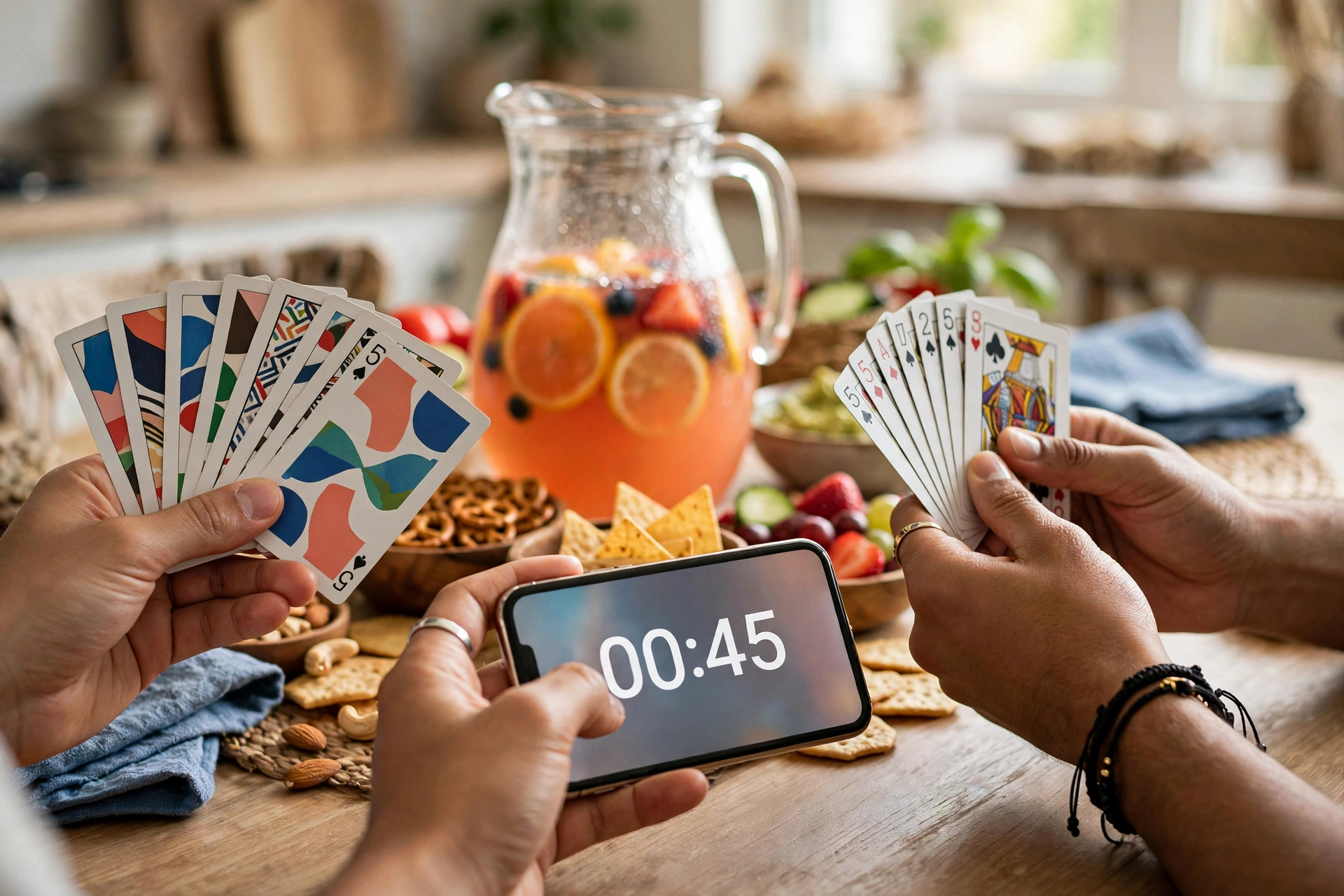
| Spoons | 3-12 | 15-20 min a match | Deck of cards, spoons (players minus one) |
| Two Truths and a Lie | 3+ | 15-30 min | Nothing |
| Who Am I | 4-8 | 15-30 min | Sticky notes, pen |
| Most Likely To | 3+ | 15-30 min | Nothing (or prompt cards) |
| Categories | 2-8 | 15-30 min | Paper, pens, timer |
| Would You Rather | 2+ | 15-30 min, open-ended | Nothing |
| Contact | 3+ | 10-20 min a round | Nothing |
| Pictionary | 4+ | About 30-60 min | Box or paper, pens, timer |
| Taboo, homemade | 4+ | 20-40 min | Index cards, timer |
On this page
Big-group games: 8 or more people
Large groups are where sober parties usually die. The room splits into side conversations, phones come out, and nobody commits to anything. The six games below solve the big-group problem directly: they either split the room into teams that stay busy, or they give everyone a role so nobody is a spectator.
1. Fishbowl
Players: 6-20 (sweet spot 8-14) | Time: 30-60 minutes for all three rounds | You need: paper slips, a pen, a bowl, a phone timer
Fishbowl is three games in one, and it is the best big-group party game that requires zero purchased anything. Everyone writes a few names or phrases on slips (celebrities, characters, objects everyone will recognise), folds them, and drops them in the bowl. Split into two teams. Round one is describe: a clue-giver draws slips and describes them in words, 60 seconds per turn, until the bowl is empty. Round two puts all the slips back and the clue-giver gets exactly one word per clue. Round three puts them back again and it is silent mime only. The joke is that by round three, the whole table has watched every clue twice, so the mime round becomes pure shared-reference comedy. Points across all three rounds decide the winner.
Why it works sober: it gets funnier as the night goes on, because the game builds on itself instead of repeating. Nobody needs liquid courage, because by round three everyone already knows the material. Watch out: quiet or very shy groups can stall in the one-word and mime rounds, and the slip-writing matters more than it looks: obscure or inside-joke clues that only one person knows will kill a round dead.
2. Mafia
Players: playable from 5-6, genuinely fun at 8-16 | Time: 15-30 minutes a round | You need: nothing (a deck of playing cards works for secret role assignment)
One person narrates. Roles are dealt secretly: a few mafia, a doctor, a detective, the rest ordinary citizens. At “night” everyone closes their eyes while the mafia silently pick someone to eliminate, the doctor picks someone to save, and the detective checks one suspect’s identity. At “day” everyone opens their eyes, the narrator reports what happened, and the group debates and votes to eliminate a suspect. Repeat until the mafia are all eliminated or outnumber the town. A deck of cards assigns roles easily (a king is mafia, a queen is the doctor, a jack is the detective).
Why it works sober: it is the rare party game where being clear-headed is an advantage. Sober players actually remember who voted for whom and catch liars better. Watch out: this game lives or dies on the narrator. A weak host means confused nights and slow, meandering days. First-timers should keep roles simple (mafia, doctor, detective only) and under 8 players the deduction collapses fast.

3. Reverse Charades
Players: 6+, in teams of 4-8 | Time: about 20-40 minutes | You need: a word list and a 60-second timer
Classic charades has one flaw at parties: most people would rather do anything than perform alone in front of a room. Reverse Charades fixes it by flipping the roles. Each round, one player is the guesser and the entire rest of the team acts together, no talking, no humming, no sounds. The guesser gets 60 seconds to get as many words right as possible, one point per correct guess, then teams switch and the guesser rotates so everyone acts and guesses. A boxed 2010 edition rates it ages 6 and up, which tells you how family-safe the whole concept is.
Why it works sober: group acting removes stage fright entirely, so the game gets loud fast without anyone needing to loosen up first. Watch out: a team that mimes five different interpretations of the same word will confuse its own guesser. Works best with high-energy, physical groups; very reserved players may hang back in the acting crowd.
4. Wink Murder
Players: 6-20 | Time: a few minutes a round (you will play many) | You need: nothing
One player is secretly the murderer, chosen by a moderator’s tap or a marked slip. Everyone mingles, making eye contact. The murderer “kills” by winking at someone without being seen; the victim waits a few seconds, then dies dramatically. Two common ways to catch the killer: the Detective variant, where one watcher gets two or three guesses to name the murderer, or the Two-Accuser variant, where any two living players can call “I accuse”, point simultaneously, and win only if they both point at the actual murderer. No talking about suspicions is allowed, which is the whole engine of the game.
Why it works sober: it runs on eye contact and nerve, not on drinks, and it fills dead time between other games since a round takes minutes. Watch out: under 6 players the murderer is obvious almost instantly, so do not waste it on a small table. And do not confuse it with Murder in the Dark (a lights-out variant) or Mafia (a narrated deduction game); Wink Murder is a live mingling game with no host required.
5. Minute-to-Win-It challenges
Players: any number (head-to-head, teams, or relay) | Time: 20-40 minutes for 5-6 challenges | You need: household items and a 60-second timer
The format is dead simple: each challenge gives you exactly 60 seconds. Three that are verified fun and need almost nothing: Cookie Face, place a cookie on your forehead and wriggle it to your mouth using only facial muscles; Stack Attack, stack plastic cups into a pyramid and collapse them back into a single stack (scale the cups to the group, 10 for kids up to 36 for the full version); and Elephant March, tie a pair of nylons around your forehead with a sock at the end and swing your head to knock over cups on the floor. Run them head-to-head, in teams, or as a relay.
Why it works sober: the 60-second clock creates its own adrenaline, which is the exact job alcohol usually does at parties. Anyone can join mid-stream, and kids and grandparents play the same games as adults. Watch out: setup and cleanup between challenges eats time, so prep stations ahead. Cookie Face is not great for guests with dietary restrictions, and Elephant March needs real floor space.
6. Psychiatrist
Players: 6-12 plus one psychiatrist | Time: 15-45 minutes (can overrun) | You need: nothing, just chairs in a circle
One player leaves the room as the “psychiatrist”. The rest agree on a secret shared condition, most commonly an answer-shifting pattern such as “everyone answers the question asked of the person to their left”. The psychiatrist returns and asks questions to diagnose the “condition”. If a patient thinks the psychiatrist is getting close, they shout “Psychiatrist!” and everyone swaps seats, which changes the pattern’s mapping. The round ends when the psychiatrist names the condition.
Why it works sober: the whole game is logic and misdirection, and one source notes it can genuinely “go on for literally hours” with a sharp group. Watch out: it is miserable for the psychiatrist if the pattern is too obscure, so agree that players can give up and be told. For family play, set ground rules upfront: keep questions clean and use a simple pattern.
Small-group games: 3 to 8 people
Smaller groups need a different kind of game: nothing that requires a crowd to hide in, nothing that leaves someone sitting out a turn. These nine all scale down gracefully, and most need supplies you already own.
7. Spoons
Players: 3-12 (sweet spot 4-8) | Time: 5-10 minutes a game, 15-20 for a full elimination match | You need: a standard deck (no jokers) and one FEWER spoons than players
Deal four cards to each player and place the spoons in the centre of the table. The dealer draws from the deck, keeps or discards, and passes one card left, face down, quickly; everyone always holds four. The first player to collect four of a kind quietly grabs a spoon, and the moment a spoon moves everyone else scrambles for one. The player left without a spoon loses the round. Play elimination, or collect letters spelling S-P-O-O-N for a longer match, then remove one spoon, redeal, and repeat down to one winner.
Why it works sober: the grab is pure reflex, and reflexes are sharper without drinks. It is the loudest five minutes you can buy for the price of a deck of cards. Watch out: the grab gets physical. Play at a sturdy table with breakables cleared, and set the fake-out rule before starting: some tables allow reaching for a spoon as a bluff, and that can upset sensitive players.
8. Two Truths and a Lie
Players: 3+ (sweet spot 6-12) | Time: about 2-3 minutes per person, 15-30 minutes total | You need: nothing
Each player thinks up three statements about themselves, two true and one a lie, delivered in any order with a straight face. The group gets to ask a few questions, then votes on which statement is the lie (a show of hands or holding up one, two, or three fingers). The player reveals the lie and usually tells the story behind the wildest truth. Optional scoring: a point for each person fooled, and a point for each correct guess. Rotate until everyone has had a turn.
Why it works sober: it is the family-safe cousin of Never Have I Ever, with none of the drinking baggage. It doubles as the best icebreaker on this list for guests who do not know each other. Watch out: shy players freeze when asked to invent statements on the spot, so give thinking time or a heads-up before the party. And groups who know each other too well will spot lies instantly.
9. Who Am I
Players: 4-8 | Time: 15-30 minutes | You need: sticky notes and a pen
Write a famous person, character, or animal on each sticky note without the wearer seeing it; everyone sticks one to their forehead. Players mingle and ask each other yes-or-no questions about their own identity (“Am I a musician?”, “Am I alive?”). One common rule: a yes answer earns another question, a no passes the turn. First to guess correctly wins, or play until everyone has guessed.
Why it works sober: it gets the whole room moving and talking within the first minute, which is exactly what a sober party needs early on. Watch out: it falls flat if the identities are not shared knowledge, so avoid niche references in mixed groups. Young kids need pictures instead of names.
10. Most Likely To
Players: 3+ (more is merrier) | Time: about 15-30 minutes | You need: nothing for homemade, just a list of questions
Players take turns reading a “Who is most likely to…” prompt aloud (“Who is most likely to forget their own birthday?”). On a count of three, everyone points at the person they think fits best. Defending yourself and arguing it out is half the fun. Keep score of who gets pointed at most if you want a winner. For family play, keep prompts clean and affectionate; a boxed family edition of the concept lists 3+ players and ages 14 and up, which is a decent guide to the right tone.
Why it works sober: zero prep, zero supplies, and the comedy writes itself. It is also the fastest game on this list to explain: one sentence and you are playing. Watch out: prompts can accidentally land on someone’s sore spot. The host should screen questions in advance, especially with teens in the room.
11. Categories
Players: 2+ (best 3-8) | Time: about 15-30 minutes for a few letters | You need: paper and pens, a timer, a list of categories
The homemade version of Scattergories. Pick 8-12 categories (animals, foods, movies, and so on) and draw one random letter. Everyone gets two or three minutes to write one answer per category starting with that letter. When time is up, players read answers aloud; any answer duplicated by another player scores nothing, and each unique answer scores one point (some versions give two points for alliterative doubles like “red rose”). Most points after an agreed number of letters wins.
Why it works sober: it rewards quick thinking over quick reflexes, so it is the pick for a group that wants to sit, snack, and think. If your group likes word games generally, our best word board games for adults roundup has the boxed follow-ups. Watch out: weak spellers or slow writers feel the timer pressure; team or pair play fixes that. Agree on a judge or majority vote for disputed answers before you start.
12. Would You Rather
Players: 2+ | Time: 15-30 minutes of play, open-ended | You need: nothing (a question list helps a lot)
Players take turns asking a “Would you rather…” question with two options (“Would you rather have a pet dragon that can talk or a unicorn that can fly?”). Everyone picks one and explains why; the debate is the entire point. A good party variant: everyone writes answers secretly, reveals at once, and players score a point for matching the asker’s answer. One family rule: keep questions clean and age-appropriate.
Why it works sober: it needs nothing, works with two people or twenty, and it is the best filler game here: it slides into car rides, dinner gaps, and the awkward first fifteen minutes of any party. Watch out: zero prep is also its weakness. With a flat question-asker it fizzles, so keep a list of good questions ready rather than relying on improv.
13. Contact
Players: 3+, no upper limit | Time: about 10-20 minutes a round | You need: nothing
One player is the word-master and thinks of a word (noun, no proper nouns), announcing only its first letter. The other players think of words starting with that letter and give one-word clue definitions (“a big yellow fruit” for banana). If a second player thinks of the same word as the clue-giver, they shout “Contact!” and count down from 10; at the end both say the word at once. If they match, the word-master reveals the next letter. During the countdown the word-master can break the contact by guessing the word being described. The round ends when someone guesses the word-master’s word, and the guesser becomes the next word-master.
Why it works sober: it is a word game with genuine suspense, and the countdown mechanic creates a ticking-clock thrill without any props at all. Watch out: the cleverest vocabulary player dominates, which can sideline younger or less confident players. Use short, common words for mixed groups, and you need at least a few sharp guessers or the game stalls.
14. Pictionary
Players: 4+ in 2-4 teams | Time: about 30-60 minutes for a full game | You need: the boxed game or homemade: paper, pens, a one-minute timer, your own word list
One player per team is the drawer. The drawer gets about five seconds to look at the word, then sketches it while teammates shout guesses, with one minute on the clock. No letters, no numbers, no spoken clues, no gestures. A correct guess moves the team forward on the board; the drawer role rotates each word. The first team to reach the finish square and guess correctly wins. An odd player count works fine: one person can draw for both teams.
Why it works sober: it is the classic for a reason. The terrible drawings are the entertainment, and sober players remember the running jokes the next morning. Watch out: genuinely bad drawers can find it embarrassing, so set the “stick figures are fine” expectation up front. Word choice matters too: abstract phrases stall the game, so homemade word lists should lean on concrete, drawable things.
15. Taboo, homemade
Players: 4+ in two teams | Time: about 20-40 minutes | You need: index cards and a timer
The host writes cards in advance: a guess word at the top and three to five forbidden words below. The clue-giver describes the top word to their team without saying any forbidden word (or forms of them), no spelling, no “sounds like”, no gestures. Teammates shout guesses for one minute; each correct card scores a point. An opponent watches for forbidden-word slips. Teams alternate; most cards at the end wins. One thing to settle before starting: the pass rule. Some versions let you skip a card freely, others give the opponents a point for every pass.
Why it works sober: the host writes the cards, which means you can theme the whole game to the group: family in-jokes, the birthday person’s life, your team’s office jargon. No boxed game does that. Watch out: the homemade version’s quality depends entirely on the host’s card-writing. Lazy forbidden words make cards trivially easy, so put real effort into the cards the day before.
What to skip (honest edition)
Most “party games without drinking” lists online are padded with games that do not actually belong there. Three to cut from your shortlist:
- Never Have I Ever. The default rules are drinking rules: sip if you have done the thing. You can rewrite it family-style, but at that point you are just playing Two Truths and a Lie with extra steps, and Two Truths is the better game.
- Spin the Bottle. The classic rules revolve around romantic or “playful” tasks for whoever the bottle points at. That is not a family-friendly game and it is not what anyone searching for sober party games actually wants.
- Saran Wrap ball. You will see this one on content-farm lists. It needs a huge ball of cling film, small prizes, oven mitts, dice, and about thirty minutes of wrapping before anyone plays. The payoff does not justify the prep when every game above needs a deck of cards at most.
Running a sober game night that works
The games are only half of it. Sober parties run on momentum, and momentum is a hosting problem, not a drinking problem. What actually works:
- Start moving, end talking. Open with something physical (Who Am I, Minute-to-Win-It, Reverse Charades) while energy is high and people are still arriving. Put the thinky games (Categories, Contact, Fishbowl’s later rounds) in the middle. Close with the voting and conversation games (Most Likely To, Would You Rather, Two Truths) when the room is relaxed.
- Feed people before the first game. The number one killer of a sober game night is not boredom, it is hunger. Snacks out before anyone arrives, a real meal or heavy appetisers within the first hour. A pitcher of something with fruit in it does more social work than you would expect.
- Plan two games, not five. Two games and the gaps between them will fill a 90-minute evening. Over-scheduling is how you end up rushing a good game to start a worse one. If the room is still going, Fishbowl’s three rounds expand to fill whatever time is left.
- Have a shy-player plan. The games that ask one person to perform (Pictionary’s drawing, Fishbowl’s mime round) can freeze a reserved guest. Seat a confident player next to them for the first round, or open with the team games where nobody performs alone.
For the full hosting playbook, food timing, guest flow, and table setup, our guide to how to host a game night covers the evening around the games, and the board game night checklist has the practical prep list. And if the group would rather play boxed games than improvised ones, our best party games for adults roundup picks eight store-bought games by group size.
Party games without drinking: FAQs
Do party games really work without alcohol?
Yes, and several work better. Deduction games like Mafia and Contact reward clear memory and attention, which alcohol only degrades. Reflex games like Spoons and the 60-second Minute-to-Win-It challenges run on adrenaline that a timer creates for free. The games that genuinely need alcohol are the ones whose only mechanic is embarrassment; none of the 15 above work that way.
What is the best no-drinking party game for a large group?
Fishbowl, for groups of 8-14. It needs no supplies beyond paper, it keeps both teams busy at once, and its three rounds mean one purchase-free game fills 30-60 minutes. For 10 or more who like arguing, Mafia is the runner-up.
What can we play with just 3 or 4 people?
Spoons (3+), Categories (2+), Contact (3+), and Would You Rather (2+) all work with tiny groups. Two Truths and a Lie plays fine at 4, though it is better at 6-12. Skip Mafia and Wink Murder at this size: both need at least 6 players to breathe.
What is a good sober party game for families with kids?
Minute-to-Win-It challenges, because kids and grandparents play the exact same games as adults. Would You Rather and Who Am I are strong seconds. Reverse Charades is rated ages 6 and up in its boxed edition. Avoid Psychiatrist with younger kids unless you set strict clean-question ground rules.
How many spoons do you need for Spoons?
Always one fewer than the number of players: six players means five spoons. Every source agrees on this, and it is the detail most other lists get vague about. That missing spoon is the entire game.
What is the difference between Wink Murder and Mafia?
Both have a secret killer, but they play nothing alike. Wink Murder is a live mingling game: everyone walks around making eye contact and the murderer winks victims out, no host required. Mafia is a narrated sit-down deduction game with night and day phases, a narrator, and group votes. Wink Murder takes minutes per round; Mafia takes 15-30.
Sources
Game rules and player counts cross-checked against Fun Party Tips’ Fishbowl rules, Wikipedia’s Mafia party game entry, Wikipedia’s Psychiatrist game entry, The Toy Insider on Reverse Charades, Icebreaker Spot’s Spoons guide, Icebreaker Game’s Two Truths guide, Wikipedia’s Pictionary entry, and PureWow’s minute-to-win-it games. All links verified live on 9 October 2026.
