
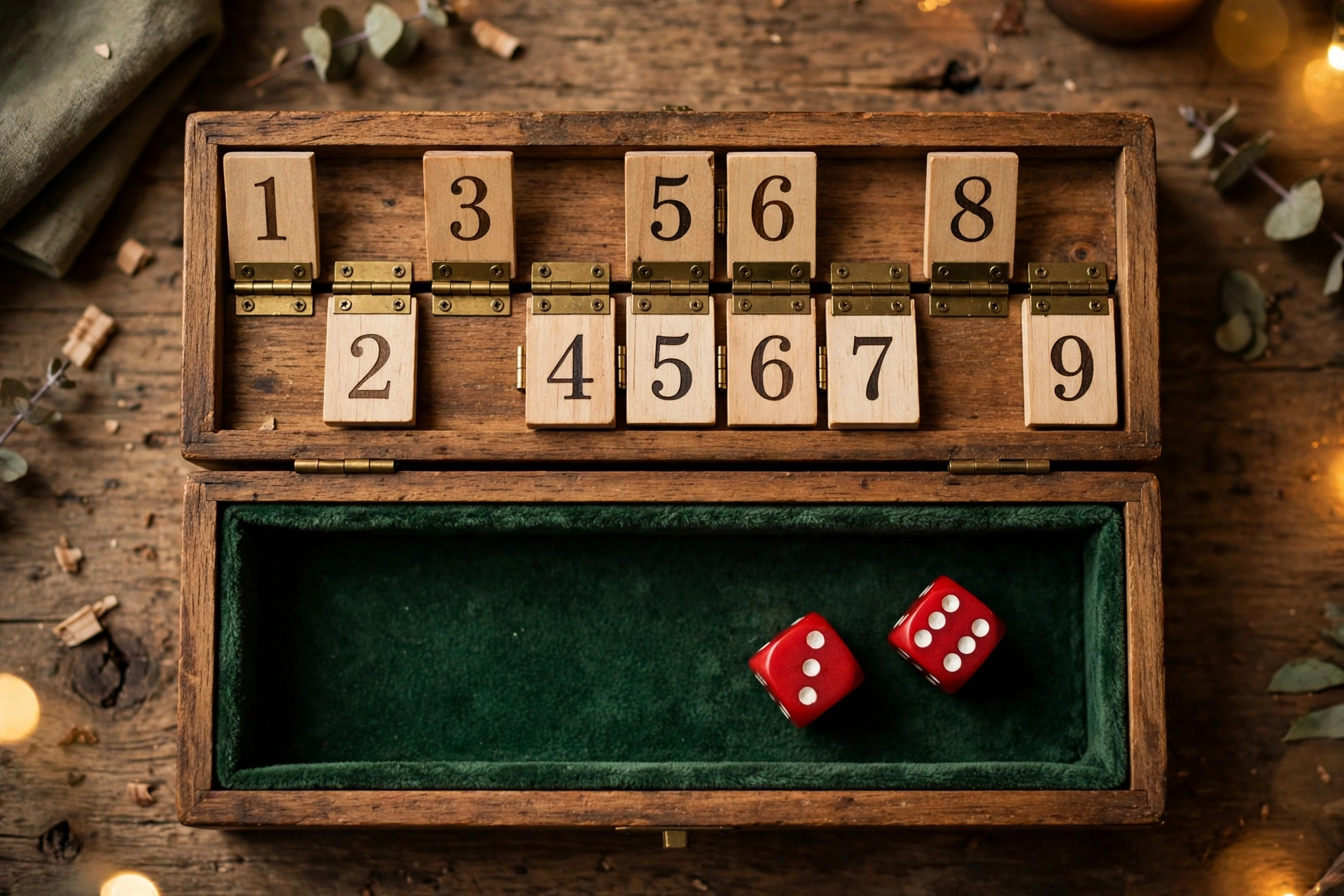
Picture a wooden box on the kitchen table, nine little tiles flipped up in a row, and two dice rattling in the tray. Your brother just rolled a 9 and shut the 9 tile like it was nothing. Now it is your turn, and this is one of those rare games where your score can be a single digit and still lose you the round. Shut the Box is a dice game for one or more players with a beautifully simple goal: roll the dice, flip down tiles that add up to your roll, and finish with the lowest score possible. Close every tile and you win on the spot. That is the whole game, and the rest of this guide is the detail that turns a first roll into a good round.
You need the box (or paper, see below), two dice, and about a minute to set up. A turn takes roughly two to three minutes per player, and you can play solo, head to head, or with the whole table taking turns. This guide covers the standard rules with a full worked example round, the one-die versus two-dice question that splits families, every scoring variant worth knowing, how to play with no box at all, a simple version for young kids, and the three decisions that actually change your score.
- What you need: the box, the tiles, the players
- How a turn works: a full worked example
- One die or two? The rule everyone argues about
- How scoring works: single rounds, leagues, and stakes
- No box? No problem: the paper method
- The family table: a simpler version for kids
- Four mistakes that cost you the round
- Three decisions that actually change your score
- A short history: pubs, Normandy, and a game show
- Shut the Box FAQs
- Sources
What you need: the box, the tiles, the players
The classic set is a wooden box with nine numbered tiles, 1 through 9, each on a little hinge or slider you can flip up and down, plus two dice that you roll in the tray. Some sets come with 10 or 12 tiles instead, which makes for a longer, tougher round. The dice are ordinary six-sided dice.
Player count is flexible. You can play solo and chase your own best score, which is genuinely satisfying, or take turns around a table. The usual setup is two to four players, often with a small stake or a round of drinks riding on it, and every player gets their own fresh turn with all tiles flipped back up. Setup takes about a minute, and a turn runs roughly two to three minutes per player, so a full four-player round is done in about ten minutes. That pace is half the charm: it is a game you can play between other games.
How a turn works: a full worked example
Here is the turn flow, shown with a real round. Maya starts with all nine tiles up and rolls two dice.
- Roll one: 6 + 3 = 9. Maya can shut the 9 tile alone, or any open combo that adds to 9 (8+1, 7+2, 6+3, 5+4, and so on). She shuts the 9. Open: 1, 2, 3, 4, 5, 6, 7, 8.
- Roll two: 5 + 2 = 7. She shuts the 7. Open: 1, 2, 3, 4, 5, 6, 8.
- Roll three: 4 + 4 = 8. She shuts the 8. Open: 1, 2, 3, 4, 5, 6. Tiles 7, 8 and 9 are all gone now, which changes the dice (see the next section).
- Roll four: one die, 6. Maya chooses a single die and shuts the 6. Open: 1, 2, 3, 4, 5.
- Roll five: one die, 4. She shuts the 4. Open: 1, 2, 3, 5.
- Roll six: one die, 5. She shuts the 5. Open: 1, 2, 3.
- Roll seven: one die, 3. She shuts the 3. Open: 1, 2.
- Roll eight: one die, 5. No open combination of 1 and 2 can make 5. Her turn ends.
Maya’s score is the sum of the tiles left open: 1 + 2 = 3. A score of 3 is excellent, and if everyone else finishes with more, she wins the round. Had her last roll been a 3 instead of a 5, she would have shut 1+2 and the box, winning immediately. That is the knife edge the whole game lives on: one roll can take you from nearly perfect to done.
Two small details worth fixing in your head now. First, the tiles reset between players: when the next person sits down, every tile flips back up and they start their own turn from scratch. Second, you shut exactly one combination per roll, one combination only, and you cannot pass on a roll you could play.
One die or two? The rule everyone argues about
This is the single most disputed rule in Shut the Box, and the honest answer is that it depends on whose table you are at. The three versions you will meet:
- The standard version: you must roll both dice while any of the 7, 8 or 9 tiles are still open. Once all three are shut, you may choose one die or two on each roll. This is the version most rule summaries describe, and it is the one we use in this guide.
- The low-total version: once the sum of your remaining open tiles is 6 or less, you switch to a single die (some sets print it this way). In practice it plays almost the same as the standard version, because when 7, 8 and 9 are gone your open tiles total 21 at most, and you usually drop to one die soon anyway.
- The two-dice-only version: some printed rule sheets skip the single-die option entirely and have you roll both dice for the whole turn. It is a tougher game this way, since two-dice totals of 11 and 12 can only be shut while the high tiles are still available.
Why does the choice matter? A single die can only roll 1 to 6, so it is precise: it lets you pick off low tiles one at a time, as Maya did in the worked round. Two dice give you totals from 2 to 12, which reach the high tiles but are much harder to aim. That is the trade the rule is built around, and it is why the game changes character halfway through a turn. Settle on one version before the first roll, because mid-game rule debates are how family game nights end.
How scoring works: single rounds, leagues, and stakes
In a single round, the scoring is the part everyone gets right: lowest open-tile total wins. Shut every tile and you win the round instantly, no scoring needed. But most groups play more than one round, and that is where the variants come in. Here is the honest comparison:
| Variant | How you score | Who wins | Best when |
|---|---|---|---|
| Standard / Golf | Sum of your open tiles each round | Lowest round score | You want a quick single round |
| Multi-round | Add your round scores together | Lowest total after the agreed rounds | You want a full evening with a real winner |
| Missionary | Count of open tiles, not their sum (3 open tiles = 3) | Lowest count | Kids are playing, since counting tiles beats adding them |
| Canoga (stakes) | Same as standard, then each loser pays their score difference to the winner; shutting the box doubles the payout plus the kitty | Lowest score takes the pot | Adults want stakes; agree the ante first |
The multi-round game is the natural default for a game night: play an agreed number of rounds, keep a running total for each player, and the lowest total takes the evening. It smooths out luck nicely, because one disastrous round where everything went wrong stops mattering so much across five rounds. Missionary is the sleeper pick for families: scoring is just “how many tiles are left”, which removes the arithmetic pressure for younger players while keeping every decision identical.
The stakes version deserves one honest warning. In English pubs the game is traditionally played for a pooled stake, and the Canoga variant formalises it: losers pay the winner the difference between their score and the winning score, and a player who shuts the box gets double plus the whole kitty. It is a good game for money precisely because rounds are short and the winner is unambiguous. It is a bad game for money when someone has not agreed to the ante in advance, so get that settled before anyone touches the dice.
One more scoring detail from the standard rule sheets: if two players tie for the lowest score, everyone antes again and a new round begins, with the first player to roll the tied score starting it. Ties are rare enough that most groups just play another round and add it to the totals.
No box? No problem: the paper method
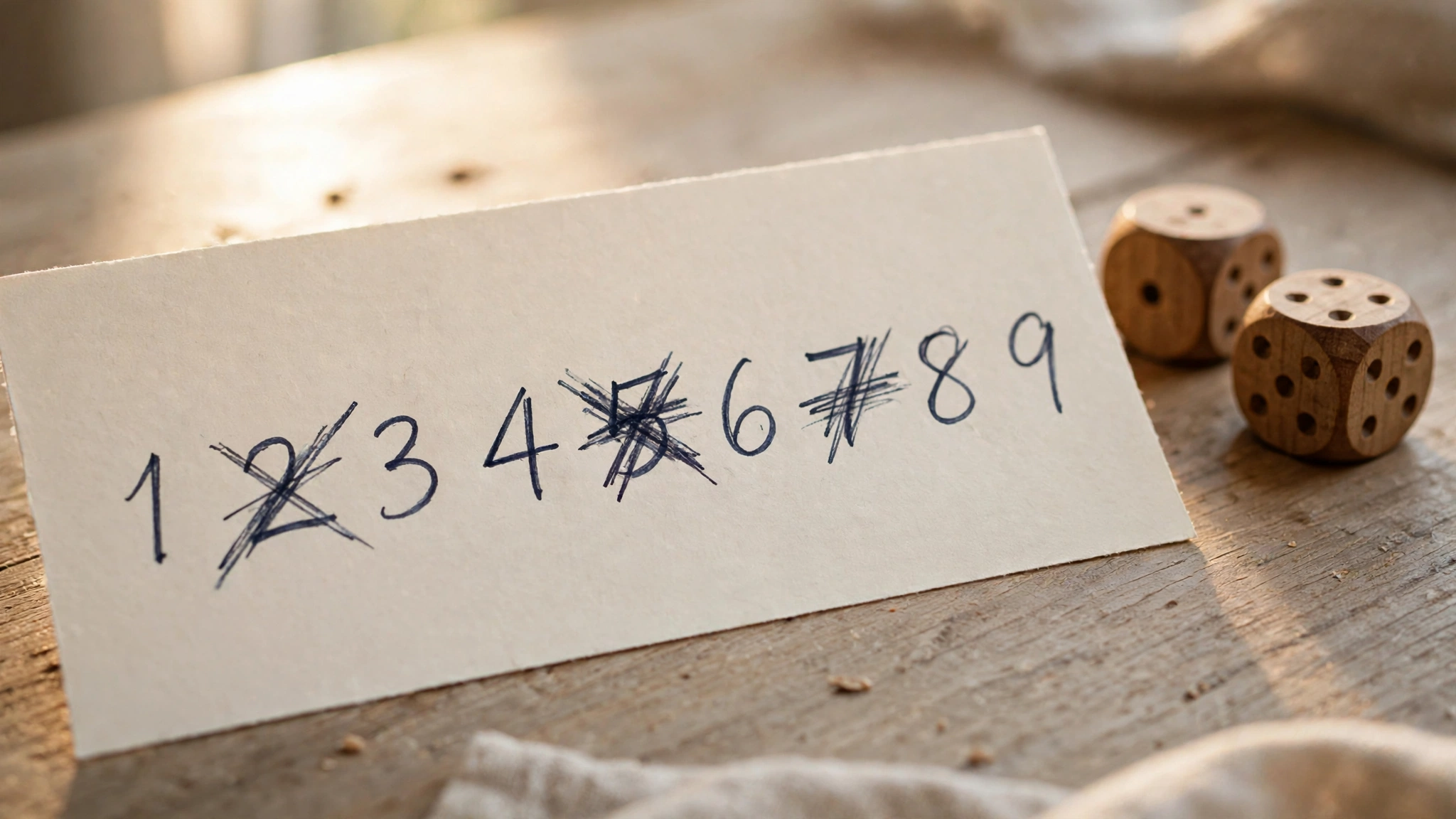
You do not need the box. Write the numbers 1 to 9 in a row on a piece of paper and cross each one out as you “shut” it. Give every player their own row (or a fresh sheet per turn), use the same two-dice rules, and score exactly the same way. The game plays identically, because the box was always just a convenient way to track which numbers are still open. A deck of cards works too: deal out the ace through 9 as your tiles and flip them face down as you shut them.
The paper version is more than a backup plan. It is how the game travels: a hotel room, a classroom, a picnic table, anywhere you have two dice and something to write with. And it is the version teachers reach for, because crossing out numbers makes the arithmetic visible in a way a wooden box never will.
The family table: a simpler version for kids
Shut the Box is already one of the better math games for children, and the simplified version makes it playable from about age six. The change is small: roll both dice as usual, but instead of shutting any combination that sums to the total, you shut the tile showing the total, or one or both of the tiles showing the individual dice. Roll a 6 and a 2, and you may shut the 8, or the 6 and the 2 together, or just the 6, or just the 2. First player to shut all their tiles wins the round.
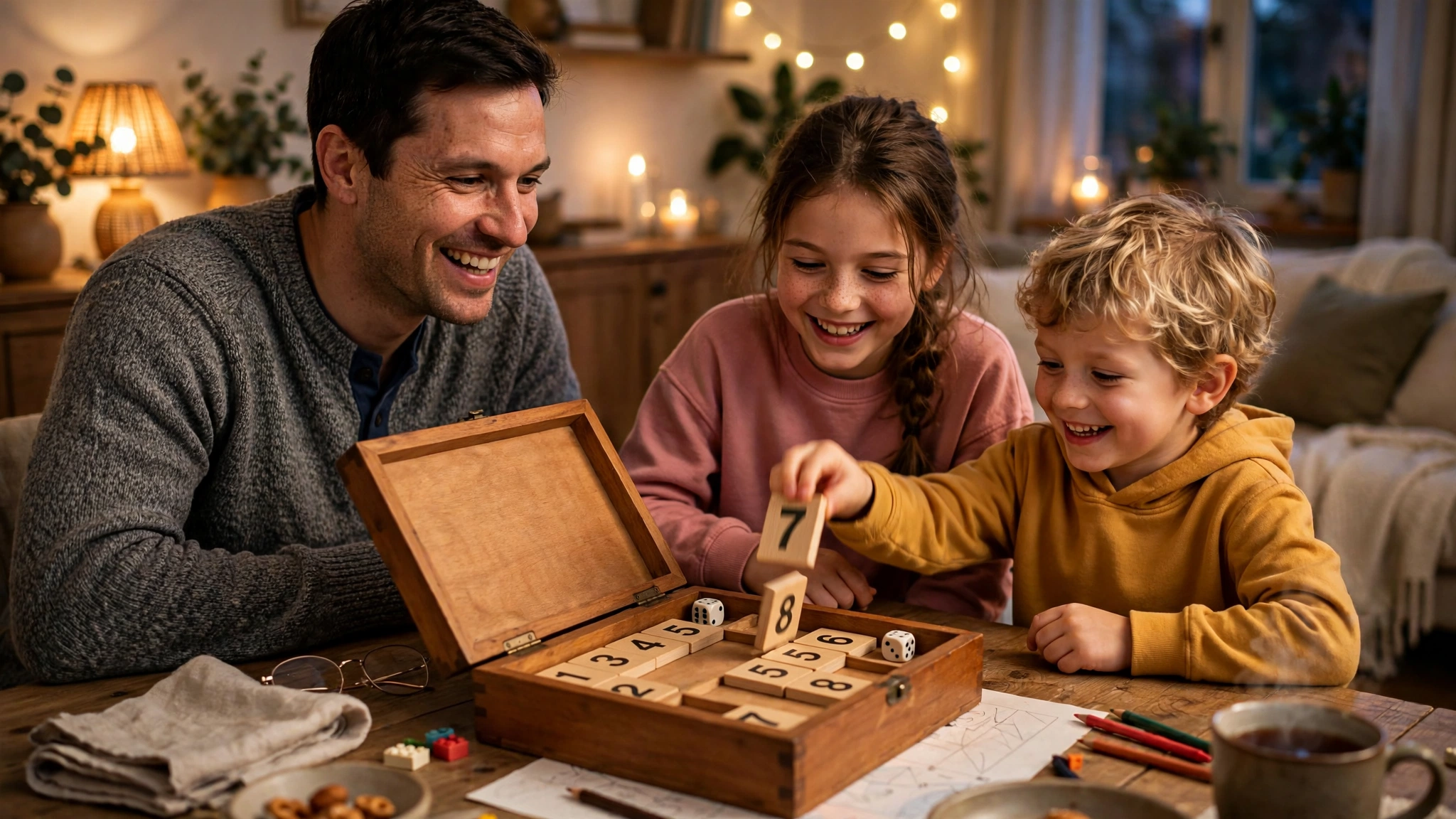
Why it works for kids: every roll is addition practice that feels like a game, the tiles give a visual picture of the numbers, and a turn is over in minutes so attention never drifts. Pair it with the Missionary scoring (count open tiles instead of adding them) and you have a full game night option for a mixed-age table where the seven-year-old can genuinely beat the adults.
Four mistakes that cost you the round
- Forgetting to reopen the tiles. Every player starts with all tiles up. If you inherit someone else’s half-shut box, your score is already ruined before you roll. Flip everything up between turns, every time.
- Rolling a die off the table. Dice that leave the box or the table are a classic dispute. Many groups play that a stray die ends your turn, or that you flip your highest shut tile back up as a penalty. Pick one and say it out loud before playing, because “we never decided” is the expensive version.
- Missing a combination and scoring early. Before you accept that you are stuck, list the options. Say tiles 4, 6 and 8 are open and you roll 11: 4+6 is 10, 6+8 is 14, 4+8 is 12, and all three is 18. No 11 anywhere, so the turn really is over and the score is 18. But say you rolled 10 instead of 11: 4+6 shuts two tiles and the turn continues. Rushing this check is the most common way to turn a good round into a bad score.
- Adding the score wrong. It sounds silly until the table argues about it. With 2, 3 and 5 open and a roll of 1 that matches nothing, the score is 2 + 3 + 5 = 10, not 9, not 11. Count the open tiles, add them slowly, say the total out loud, and let someone confirm it.
Three decisions that actually change your score
Shut the Box is mostly luck, and anyone who tells you otherwise is selling something. But three decisions genuinely matter, and they are all about the high tiles.
- Shut 7, 8 and 9 while you can. These are the only tiles a single die can never touch, and the rule forces you onto two dice while they are open. Every early roll that can remove one of them probably should. Leaving an 8 open late means you need a future two-dice total to land exactly where you need it, which is a worse bet than taking it now.
- Prefer the single high tile over the split. When your roll can be shut as one tile or two, shutting the single high tile usually keeps more options open. Roll an 8 with everything still up: shutting the 8 leaves 5+3, 6+2 and 7+1 all available later. Shutting 5+3 leaves only the 8, which now demands another 8. The trade-off is real, not automatic, but the single tile wins more often than the split.
- Count your outs on one die. Once you are on a single die, look at your open tiles and count which rolls keep you alive. Open tiles of 1 and 2 mean rolls of 1 or 2 continue the turn and everything else ends it. There is no decision to make most of the time, but knowing the odds keeps you from shutting a tile that shrinks your outs for no reason.
One house rule to know about before you sit down at a stranger’s table: some groups allow subtracting the dice as well as adding them, so a roll of 5 and 2 can shut 3 as well as 7. It is a legitimate old variant, not a mistake, but it changes the game enough that you should confirm it before the first roll.
A short history: pubs, Normandy, and a game show
Nobody knows for certain where Shut the Box comes from, and anyone who claims otherwise is guessing. The unconfirmed stories point to 12th-century Normandy or to the Channel Islands, where one account credits a man known as Chalky Towbridge. The first solid print evidence is a 1967 brewing trade magazine describing the game as native to the Channel Islands and recording it being played in Manchester pubs in the mid-1960s. The pub connection stuck: in England it became a traditional gambling game, played for a pooled stake that the winner takes home.
The game’s strangest claim to fame is television. Shut the Box was the basis of the American quiz show High Rollers, which ran on NBC from 1974 to 1976 and again from 1978 to 1980 with Alex Trebek hosting, then resurfaced from 1987 to 1988 with Wink Martindale. Contestants knocked numbers off a giant board, which is the game wearing a tuxedo. It has picked up other names along the way too: Canoga, Klackers, Batten Down the Hatches, Kingoball and Jackpot all refer to the same tiles-and-dice idea.
If Shut the Box has you in a dice mood, it sits naturally next to our other table games. Our game-night hosting guide covers the full setup for an evening built around quick games like this one, the board game night checklist makes sure the dice actually make it to the table, and our Yahtzee scoring guide is the natural next read when the dice cool down and you want a deeper scorecard.
Shut the Box FAQs
Can you play Shut the Box without the box?
Yes. Write the numbers 1 to 9 in a row on paper and cross each one out as you shut it, with a fresh row for each player. The rules, the dice and the scoring are identical, because the box is only ever a tracker for which numbers are still open. A deck of cards (ace through 9 as tiles) works the same way.
When do you switch from two dice to one?
In the standard version, you must roll two dice while any of the 7, 8 or 9 tiles are still open, and you may choose one or two dice once they are all shut. Some sets instead switch to one die when the remaining open tiles total 6 or less, and some rule sheets keep two dice for the whole turn. Agree on one version before playing.
What happens if two players tie for the lowest score?
The usual rule is that everyone antes again and a new round begins, with the player who first rolled the tied score starting it. In a casual multi-round game, most groups simply add the tied round to the running totals and keep playing.
How do you keep score across multiple rounds?
Write down each player’s score after every round and add them up. After the agreed number of rounds, the player with the lowest total wins. This smooths out the luck, since one bad round matters less across five.
Can young children play Shut the Box?
Yes, from about age six with the simplified version: roll both dice and shut either the tile showing the total, or one or both of the tiles showing the dice, with the first to shut all tiles winning. It is genuinely good addition practice, and scoring by counting open tiles (the Missionary variant) removes the harder arithmetic.
Sources
- Shut the box: Wikipedia: full rules including the single-die rule, the scoring example, the Golf/Missionary/Canoga/Tournament variants, the simplified kids variant, and the history of the game including High Rollers.
- Shut the Box official game rules: Flexcut (PDF): turn flow, the score-is-the-sum-of-open-tiles rule, the immediate win for shutting the box, tiles reopening for each player, and the tie re-ante rule.
- Shut the Box Game Rules: Our Pastimes: the 12-tile version, multi-round scoring with the lowest total winning, and the house penalty for dice rolled outside the box.
