
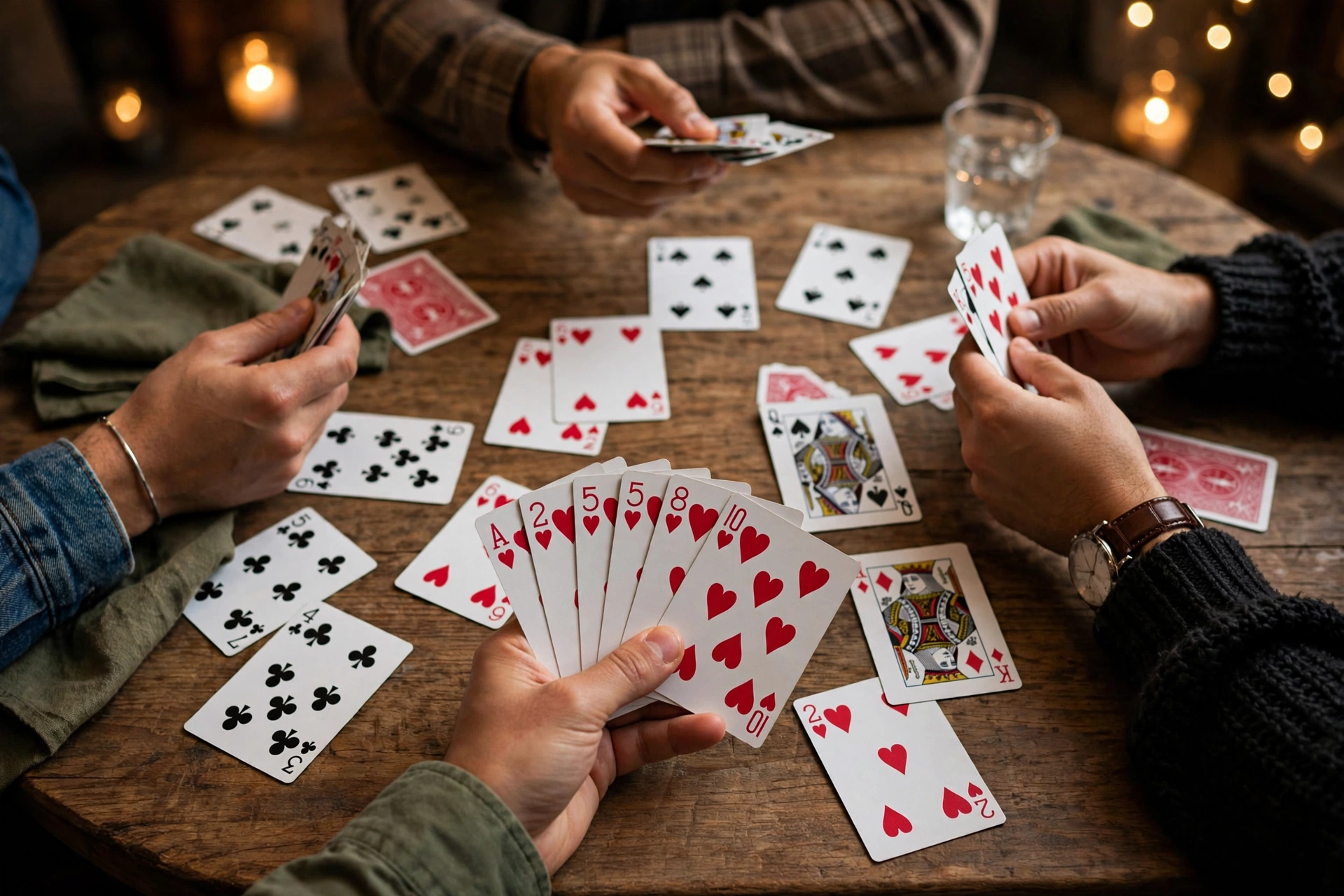
Hearts is the classic four-player card game where the goal is to finish with the lowest score. You do that by dodging every heart (one penalty point each) and, above all, the Queen of Spades (13 points). Each hand starts with everyone passing three cards, the table plays 13 tricks, and the game ends when someone reaches 100 points.
It is a brilliant fit for a regular game night: one deck, no special equipment, and a full game runs about 30 to 45 minutes. If you are building the whole evening around it, our guide on how to host a game night covers the food, timing, and guest flow that make card games land. This guide covers everything else: the setup, the passing rotation, trick-by-trick play, the scoring table, real strategy, and the famous “shoot the moon” play.
Quick rules: Hearts in 60 seconds
- Players: 4, with one standard 52-card deck (jokers out). Everyone gets 13 cards.
- The pass: before play, pass 3 cards face down. Hand 1 goes left, hand 2 goes right, hand 3 goes across, hand 4 is no pass, then the cycle repeats.
- First lead: the holder of the 2 of Clubs starts the first trick. You must follow the led suit if you can.
- Two hard rules: no hearts and no Queen of Spades on the first trick, and hearts cannot be led until they have been “broken” by an earlier discard.
- Tricks: the highest card of the led suit wins the trick, and the winner leads the next one.
- Scoring: each heart is 1 point, the Queen of Spades is 13. The game ends when someone reaches 100, and the lowest score wins.
- Shoot the moon: take all 26 penalty points in one hand and every other player gets 26 instead of you.
What is in This Guide
What You Need
Hearts asks almost nothing of you, which is part of its charm:
- One standard 52-card deck, jokers removed.
- Four players seated around a table. (Three to six can play with adjustments; see the FAQs.)
- Pen and paper or a notes app to track running scores.
- About 30 to 45 minutes for a full game to 100 points.
No chips, no board, no app required. One deck and a table is the entire kit, which is why Hearts has survived every gaming fad since long before game nights had a name.
The Deal and the Pass
The dealer shuffles and deals 13 cards to each player, one at a time, face down, moving clockwise. Once everyone has their hand, the most important part of the game happens before a single trick is played: the pass.
Each player chooses three cards from their hand and passes them face down to another player. Everyone passes at the same time, and you pick your three before you see what is coming to you. This is the first real decision of every hand, and good players treat it that way. Sloppy players treat it as housekeeping, and it shows in their scores.

The pass direction rotates from hand to hand, and the rotation is fixed:
The Passing Rotation, Hand by Hand
| Hand | Pass to | What changes |
| 1 | Left | You feed three cards to the player on your left. |
| 2 | Right | The direction flips; plan for cards coming the other way. |
| 3 | Across | Your cards go to the player opposite you. |
| 4 | No pass | Everyone keeps exactly what was dealt. Play tighter. |
After the fourth hand the cycle repeats: left, right, across, none. Memorise it, because the strategy section below changes depending on where your discards are going. On no-pass hands especially, remember that the hand you were dealt is the hand you play, so there is no safety net for a bad deal.
How a Trick Works (Step by Step)
A “trick” is one round of four cards, one from each player. A hand of Hearts is 13 tricks. Here is exactly how each one plays out:
- The 2 of Clubs leads. The player holding the 2 of Clubs plays it to open the first trick. Play then moves clockwise.
- Follow suit if you can. Each player must play a card of the led suit if they hold one. This is the single rule that shapes the whole game.
- If you cannot follow suit, play anything. This is where Hearts lives. Being void in a suit is permission to unload a heart, or even the Queen of Spades, onto someone else’s trick.
- The first trick is protected. In standard rules, no one may play a heart or the Queen of Spades on the very first trick, even if they cannot follow suit. Some groups relax this, so agree on it before you deal.
- Hearts must be “broken” before they can be led. Nobody may lead a heart until a heart has already been discarded on an earlier trick. Hearts usually get broken when someone who cannot follow suit throws one away.
- Highest card of the led suit wins. Only the led suit counts. A high card in any other suit cannot steal the trick, no matter how impressive it looks.
- The winner leads next. Whoever takes the trick collects all four cards (they count for scoring later) and leads the next trick with any card they like.
Scoring: Who Takes What
After all 13 tricks are played, everyone counts the penalty cards sitting in front of them. The scoring could not be simpler, which is why you should learn it cold:
| Card | Points |
| Each heart | 1 |
| Queen of Spades | 13 |
| Whole hand (all hearts + Queen of Spades) | 26 |
| “Shooting the moon” (one player takes all 26) | 0 for the shooter, 26 for every other player |
Every hand distributes exactly 26 penalty points across the table, no more and no less. Write down each player’s running total after every hand. The game ends as soon as any player reaches 100 points or more, and the player with the lowest total at that point wins. One common house variant: instead of giving 26 points to everyone else, the moon-shooter subtracts 26 from their own score. Both versions are widespread, so settle it before the first deal.
Strategy That Actually Works
Hearts looks like luck until you lose to the same person three games in a row. The difference is almost never card sense; it is discipline in the pass and patience in the tricks. Here is what good players do differently.
Pass like it matters
The pass is the only time you get to edit your hand, so use it with intent. First, dump your danger cards: high hearts (the Ace, King, and Queen) and the Queen of Spades are liabilities sitting in your hand, and passing them away is usually the safest move a beginner can make. Second, try to create a void by getting rid of every card in a short suit; once you hold nothing in a suit, every time it is led you get to unload penalty cards for free. Third, think about who receives your cards. On a left-pass hand, you are arming the player to your left, so avoid handing them a clean run at the Queen if you can help it.
Trick play basics
When you cannot follow suit, get rid of your highest cards first. A high card you cannot use is a trick you do not want to win later. Avoid winning tricks early in the hand; early tricks are cheap to lose and expensive to win once hearts start falling. When you do win the lead, play low cards from suits you are strong in rather than opening a new suit you barely hold. And keep a quiet count of the hearts as they fall, so you know exactly how many are still dangerous.
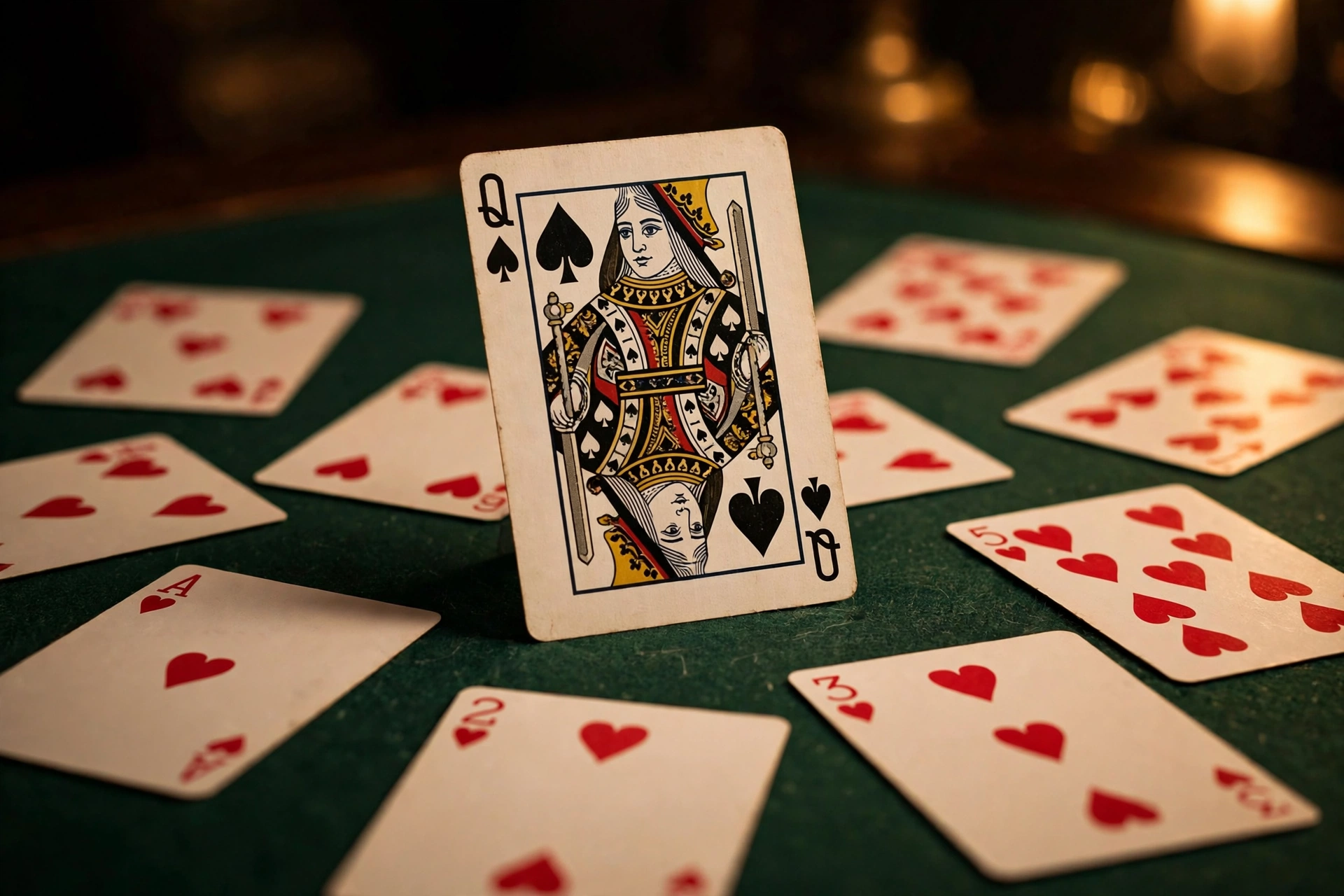
The Queen of Spades deserves her own plan
She is 13 of the 26 points in every hand, which makes her the single most important card in the game. The standard move: the first time spades are led and you can play her without winning the trick, do it. Holding her is only genuinely safe if you also hold the Ace and King of spades, or enough low spades to duck underneath them. Otherwise she is a 13-point accident waiting for someone to lead the Ace. If you were dealt the Queen and passed her away, you made the right call; if you kept her because your spades looked “protected”, watch the table the moment spades hit the felt.
Shooting the moon
Shooting the moon means taking every single penalty card in the hand: all 13 hearts plus the Queen of Spades, the full 26 points. Pull it off and you score 0 for the hand while every other player gets 26. It is the most dramatic swing in card games, and the fastest way to turn a losing game around.
Only attempt it when your hand is genuinely dominant: most of the high hearts, the Queen covered by high spades, and strength across the other suits so you can keep the lead. Watch the passes for clues; if the table keeps feeding you hearts, someone may have smelled the attempt and started sabotaging it. And know when to abort. The moment the attempt looks shaky, dump your penalty cards and take the normal loss. A failed moon usually lands all 26 points on your own score, which ends games.
6 Common Mistakes
- Passing without a plan. The pass is the first move of the hand, not housekeeping. Three random cards out the door is three missed decisions.
- Breaking hearts carelessly. Leading a heart early just because you can hands the whole table a weapon. Break hearts when it helps you, not out of habit.
- Holding the Queen of Spades too long. Hope is not a strategy. If she is not protected, get rid of her at the first safe chance.
- Forgetting the pass rotation. On a no-pass hand your dealt cards are final, so play tighter and protect your voids.
- Trying to shoot the moon every game. It is a rare play, not a lifestyle. Attempt it only when the cards genuinely demand it, and abort at the first sign of trouble.
- Playing hearts on the first trick. Standard rules forbid it, new players forget, and the table never lets it slide. Learn the protected-trick rule before your first game.
Where Hearts Came From
One reason Hearts feels so familiar: Microsoft bundled it with Windows from Windows 3.1 all the way through Windows 7, making it one of the earliest digital card games millions of people ever played. It first appeared in 1992’s Windows for Workgroups 3.1 under the name “The Microsoft Hearts Network”, built to show off Microsoft’s new NetDDE networking technology; you could play against other people on your office network. The Microsoft version was technically the Black Lady variant, the one with the Queen of Spades as the big penalty card, and it stayed in Windows until it was dropped in Windows 8. You can read the full story on Wikipedia’s Microsoft Hearts page.
Hearts FAQs
How many players do you need for Hearts?
Four is the classic number, and the whole passing rotation is built around it. Three to six players can be accommodated with adjustments to the deal, but those versions need house rules agreed before you start. If your group is a different size every week, four-player Hearts plus a rotating sit-out is the simplest setup that keeps the game pure.
What does “breaking hearts” mean?
Hearts cannot be led until the suit has been “broken”, which happens the first time a heart is discarded on a trick where hearts were not led (usually by a player who could not follow suit). After that, anyone may lead hearts. It is a pacing rule: it stops the leader from dumping hearts on the table before anyone has had a chance to get rid of their own.
Can you play the Queen of Spades on the first trick?
Under standard rules, no. The first trick is protected: nobody may play a heart or the Queen of Spades on it, even if they cannot follow suit. Plenty of casual groups relax this rule, which is exactly why you should agree on it before the first deal rather than mid-game.
What happens if someone shoots the moon?
If one player takes every penalty card in the hand (all 13 hearts plus the Queen of Spades, 26 points total), they score 0 for the hand and every other player gets 26 points instead. Some groups play a variant where the shooter subtracts 26 from their own score. Pick one version before you play; both are widespread.
How do you win at Hearts?
The game ends as soon as any player reaches 100 points or more at the end of a hand, and the player with the lowest total score wins. That means the real skill is not winning tricks; it is losing them cheaply, hand after hand, while everyone else picks up points.
Is Hearts the same as Black Lady?
Almost. Black Lady is the variant name for the Queen-of-Spades version of Hearts, and it is the version most of the world actually plays; the copy of Hearts that shipped with Microsoft Windows was technically Black Lady. Britain has its own cousin, Black Maria, which adds extra penalty cards in spades and dates to 1939. For a deeper dive into the variants, the Wikipedia article on Hearts covers them well.
The Short Version
Hearts is easy to learn and takes a lifetime to play well: pass with intent, follow suit, dodge the hearts, fear the Queen of Spades, and only shoot the moon when the cards beg you to. Teach it in five minutes, then spend the next year learning the pass.
Ready to put it on the table? Plan the evening with our how to host a game night guide, run the logistics with the board game night checklist, or browse the best party games for adults and the best trivia board games for what to play before or after the cards come out.
