
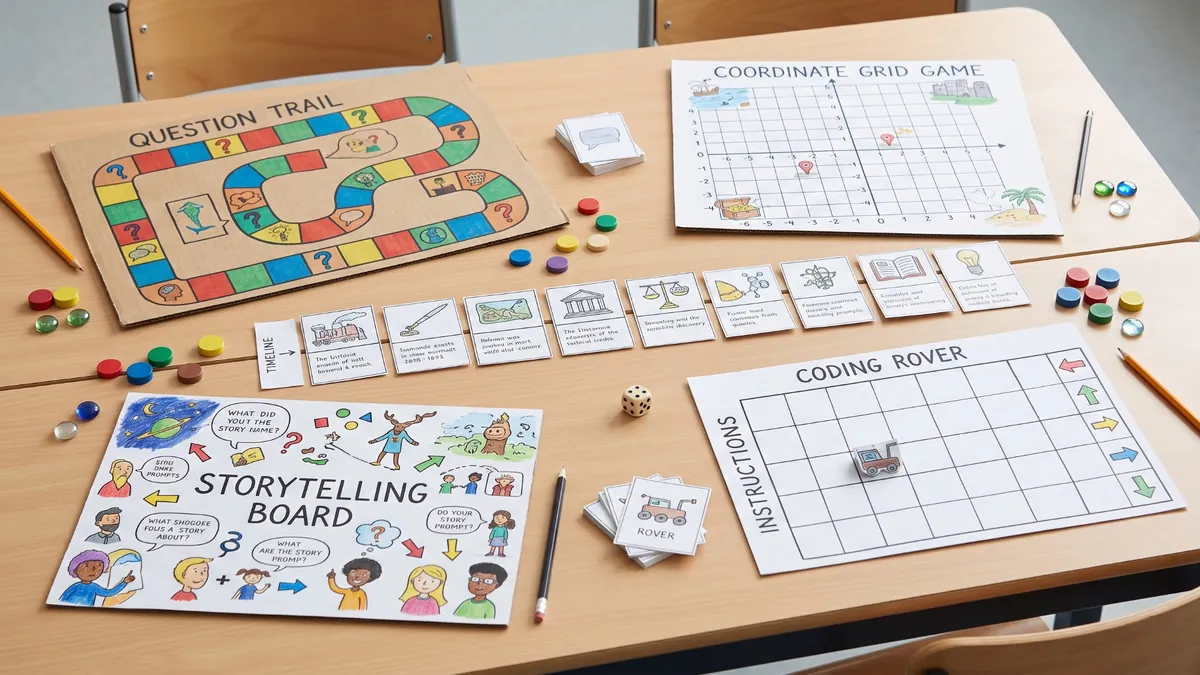
Start with Question Trail if you need a board game you can build from paper and use for almost any school subject. Choose Coordinate Courier for map reading, Timeline Table for putting events in order, Story Stops for creative writing, or Code the Rover for a programming puzzle without a computer.
Each design below includes the board, what happens on a turn, and how the game ends. They are original prototypes prepared for this guide, not classroom-tested products. Build a rough version and try it with classmates before spending time on decoration.
Choose a game that fits your assignment
| Game | What players practice | Players | Main materials | Game length in turns |
|---|---|---|---|---|
| Question Trail | Answering subject questions | 2 to 4 | Track, question cards, counters | 10 to 20 rounds |
| Coordinate Courier | Coordinates and route planning | 2 to 4 | Grid, one six-sided die, counters | 8 rounds |
| Timeline Table | Ordering dated events | 2 to 4, cooperative | Nine event cards, board, pencil | 8 turns total |
| Story Stops | Writing a connected story | 2 to 4, cooperative | Six-stop board, word cards, pencil | 6 turns total |
| Code the Rover | Writing and checking instructions | 2 to 4, cooperative | Grid, counter, command sheet | Up to 2 program attempts |
A round means every player takes one turn. Choose a first player for each game, then take turns clockwise. The turn limits come from the rules, not timed classroom sessions. Your playing time will depend on reading, discussion, and how much help people need.
Check your teacher’s instructions first. A science project may need accurate science questions, while a design assignment may focus on the rules and what you changed after testing. If you are new to the hobby, our tabletop games for beginners guide explains the kinds of games you can use as a starting point.
Gather the materials before building
Use paper or the clean inside of a cereal box for the board. Add a ruler, pencil, scissors, tape, and different counters. Folded paper pieces work if you do not have game tokens. Coordinate Courier is the only design here that needs a die.
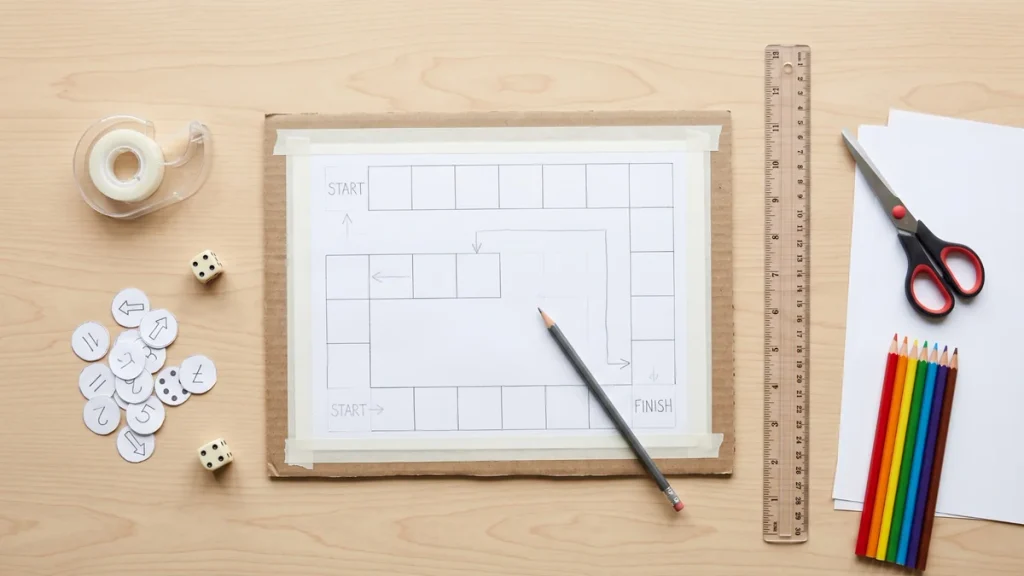
Keep writing and symbols readable without color. Give each player a letter or shape as well as a color, and make the spaces large enough for the counters you actually have.
TeachEngineering’s game-design activity also uses simple materials such as poster board, markers, and homemade pieces. You can build the first version without buying a commercial kit.
1 Question Trail
Question Trail is the simplest option when your assignment needs subject knowledge. Players answer a question to move farther, but everyone makes progress, so one difficult card cannot stop the game.
Build and set up: Draw a track with START outside the numbered spaces and FINISH on space 20. Give each player one counter at START, which counts as position zero. Prepare at least 12 question cards with a separate answer key. Shuffle the cards face down and choose a starting player; turns then go clockwise.
On your turn: The player to your left draws a card and reads the question without showing you the key. Give one answer, then check it together. A correct answer moves your counter two spaces. An incorrect answer or a pass moves it one space. Put the card in a discard pile. If the draw pile runs out, shuffle the discards to make a new one.
Counters can share a space. Stop at 20 if your move would go farther. There are no bonus turns, penalties, or special spaces in this starter version.
How to win Question Trail
When someone reaches FINISH, complete that round so everyone has had the same number of turns. Every player who reaches FINISH in that round shares the win. With movement of one or two spaces, the game ends within 10 to 20 rounds.
For example, a player on space 7 who answers correctly moves to 9. If they pass, they move to 8. This rule is useful when a group includes players who need more thinking time.
These sample cards are included in the printable pack:
| Question | Accepted answer |
|---|---|
| What is 8 multiplied by 7? | 56 |
| What is three quarters of 20? | 15 |
| Add two fifths and one fifth. | Three fifths |
| What is the perimeter of a 6 cm by 4 cm rectangle? | 20 cm |
For a science or history project, replace the math questions with facts from your class materials. Check the answers before playing. Keep the movement rule the same during the first test so you can tell whether problems come from the cards or the game.
2 Coordinate Courier
Coordinate Courier gives players a reason to read a map and choose a route. Each player has eight turns to deliver parcels around a fictional town and, if possible, return home.
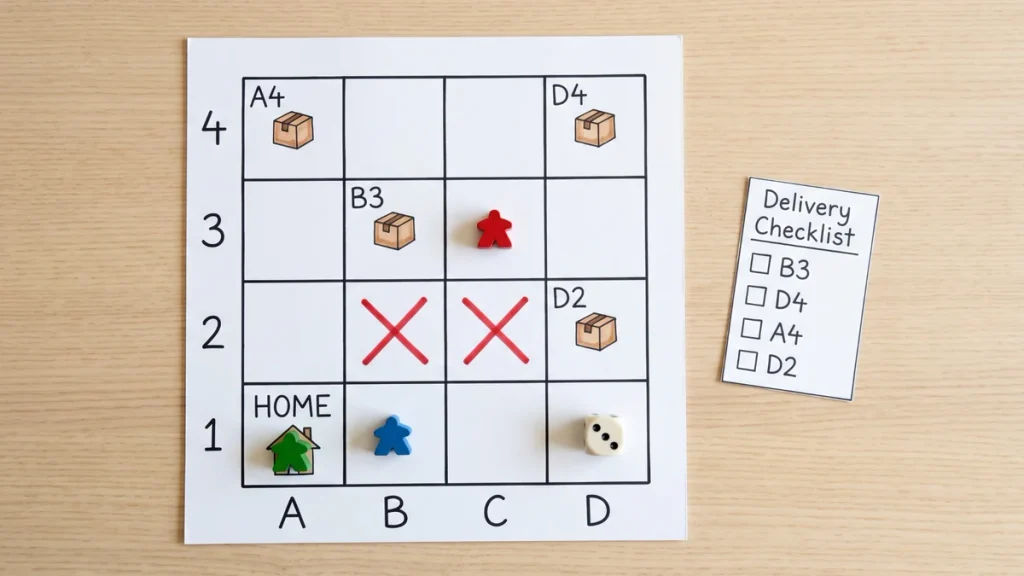
Build the board: Draw a four-by-four grid. Label columns A to D from left to right and rows 1 to 4 from bottom to top. Mark A1 as HOME. The delivery stops are B3, D4, A4, and D2. Shade B2 and C2 as closed spaces that nobody can enter.
Set up: Put every counter at A1. Each player gets a checklist with the four delivery stops and HOME. All players have their own deliveries, so one person’s visit does not remove a destination for anyone else. Choose a starting player and take turns clockwise.
On your turn: Roll one six-sided die. Move zero to that many spaces, one square at a time, up, down, left, or right. You may change direction and stop early. You cannot move diagonally, cross a closed space, or leave the grid. Other players do not block you.
If you end your turn on a delivery stop, mark it on your checklist. Passing through does not count. You can deliver to each stop only once. After completing all four deliveries, end a later turn at A1 to mark your return home. You may then leave your counter there for the remaining rounds.
Scoring: Play exactly eight rounds. Each delivery earns one point. Returning home after all four earns two extra points, for a maximum of six. The highest score wins; equal scores share the win.
For example, rolling 3 at A1 lets you follow A2, A3, B3 and make that delivery. The route A2, B2, B3 is illegal because B2 is closed. This small difference is something your classmates can check directly on the board.
3 Timeline Table
Timeline Table is a shared ordering challenge. The group earns points by placing events before, after, or between events already on the board.
The starter deck tells the history of an invented town. These dates are fictional, not historical facts. Study the starter dates together before hiding them; this makes the first game a memory and ordering exercise. For a history assignment, replace the deck with nine familiar events and checked dates from your course. Use distinct years for the first version.
| Card | Fictional event | Year |
|---|---|---|
| C | The first school opens | 1900 |
| G | The stone bridge opens | 1908 |
| D | The town library opens | 1915 |
| B | The first bus route starts | 1927 |
| H | Lake Park opens | 1936 |
| F | The town museum opens | 1952 |
| I | The market moves to the square | 1964 |
| E | A trail connects the neighborhoods | 1981 |
| A | The community garden opens | 1995 |
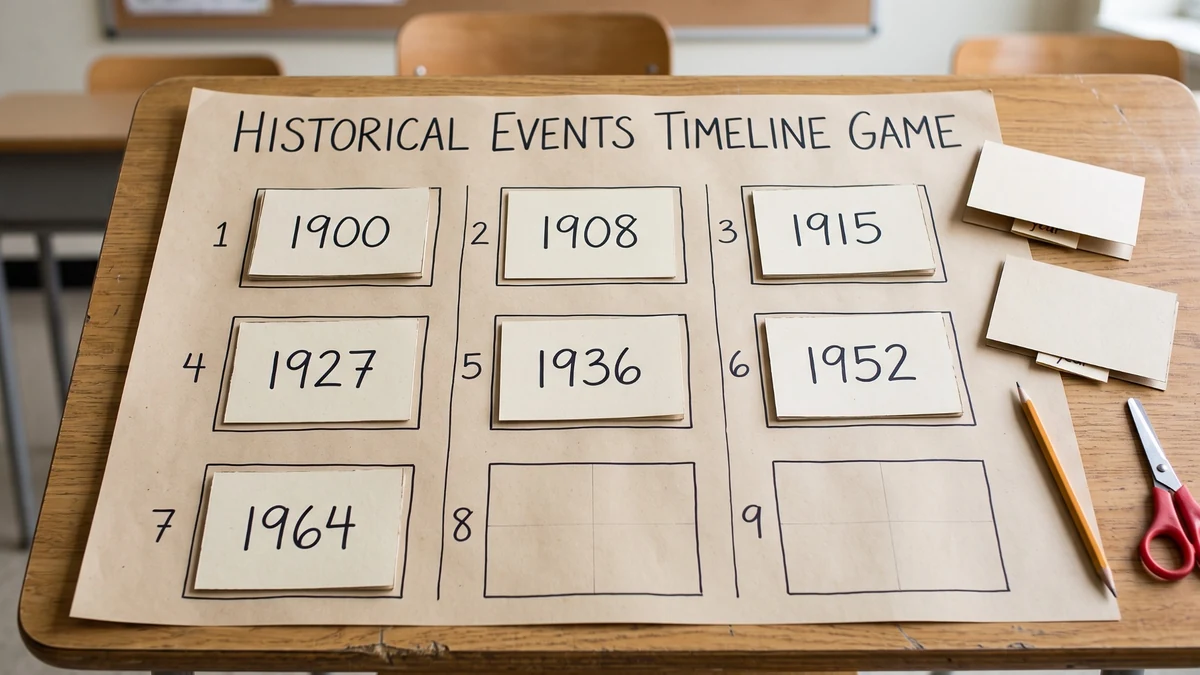
Build and set up: Make nine event cards with years that can be hidden. The printable cards have a year strip to fold behind the front. Draw nine board spaces in reading order, left to right across each row. Put card F, with its year visible, in space 1. Shuffle the other eight cards with their years hidden.
Placing and scoring event cards
Draw a card without checking its year. The group can discuss where it belongs, but the active player chooses its position among the visible events. Unfold the year to check. A correct position earns the group one point. Copy the revealed year onto the card front in pencil, then refold the strip so the card fits its board space. Whether the guess was right or wrong, insert the card in its correct place and slide later cards right. Keep the occupied spaces together from space 1 onward.
Pass the turn clockwise and repeat until all eight hidden cards are placed. The original F card does not earn a point. Erase the eight penciled years before starting a new game.
How to win: The group succeeds with six or more correct placements out of eight. For example, the 1927 bus card belongs between the 1908 bridge and 1952 museum if those are the neighboring dates currently visible. The finished board should always show the events in date order, even after wrong guesses.
4 Story Stops
Story Stops works as a cooperative writing game. The board gives the story a direction, while word cards make each turn less predictable.
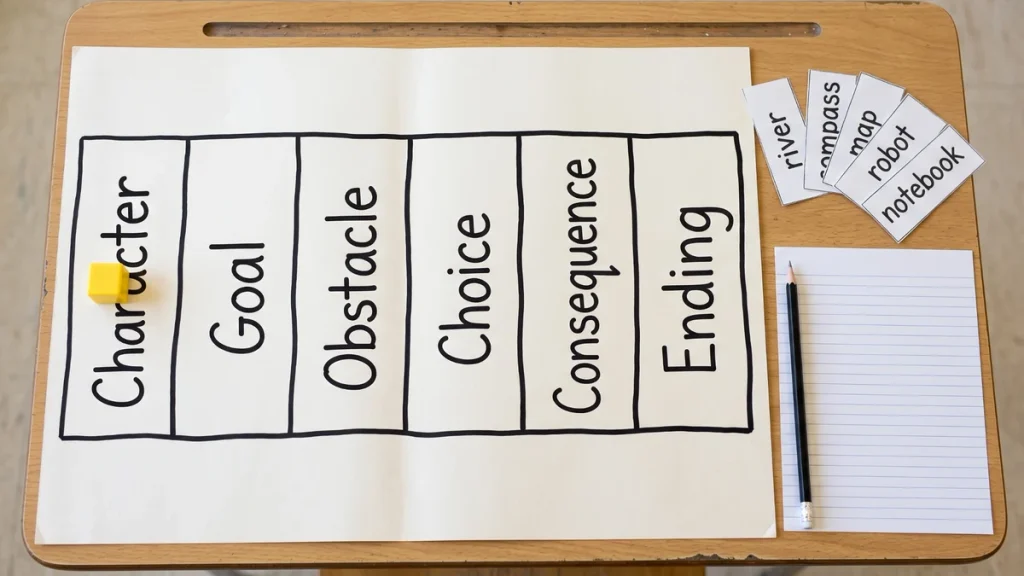
Build and set up: Draw six connected spaces labeled Character, Goal, Obstacle, Choice, Consequence, and Ending. Use one shared counter, starting before Character. Make these 12 word cards: river, compass, gate, map, library, clock, rope, bicycle, robot, sandwich, mirror, and notebook. Shuffle them face down.
On a turn: Move to the next story space. Draw two word cards, choose one, and put the unused card under the deck. Write one sentence that follows the space’s instruction and includes the chosen word. Keep that word card beside the sentence. Then pass the pencil clockwise.
The first sentence introduces a character. Each later sentence must carry forward at least one named character, object, or place from an earlier sentence. Do not undo an established fact without explaining the change. The Ending sentence must explain whether the goal was achieved.
After a sentence is read aloud, the group checks those conditions. If anyone identifies a specific missing condition, revise the sentence before moving on. There are no points for writing the longest sentence and no separate winner.
How the group succeeds: After six turns, the board must hold six connected sentences using six chosen words, with the character’s goal resolved. If a condition is missing during the final check, revise that sentence and check again. This is a cooperative completion game, so use another design if your assignment requires competitive scoring or a loss condition.
For the Choice space, a sentence might be: “Maya uses the rope to cross the stream and reach the locked gate.” It introduces a decision while keeping Maya and the gate from earlier in the story.
5 Code the Rover
Code the Rover asks players to write a short program on paper, then follow it exactly. The challenge is to collect a battery and reach the exit without moving through a wall.
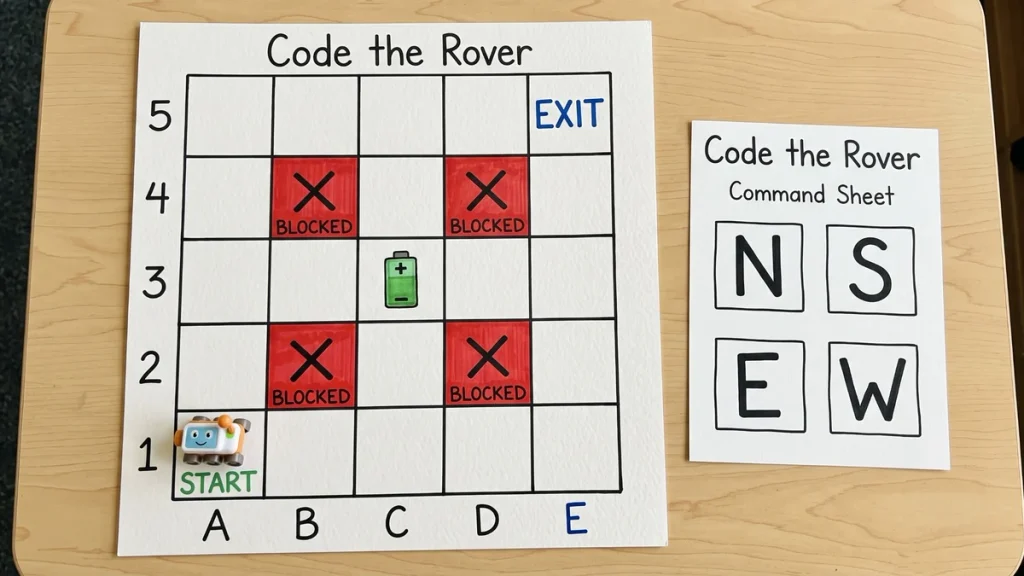
Build the board: Draw a five-by-five grid. Label columns A to E from left to right and rows 1 to 5 from bottom to top. START is A1, the battery is C3, and EXIT is E5. Close B2, D2, B4, and D4.
Commands: N moves up one row, S moves down one row, E moves one column right, and W moves one column left. These directions are fixed on the page; the rover does not have a facing direction.
Set up and plan: Put one shared counter at A1. Write a program of no more than ten commands. Take turns clockwise adding one command at a time, discussing the route as a group. Everyone must contribute at least one command before you finish planning. You can erase and revise during this planning stage.
Run the program: One player reads the commands while another moves the counter. Collect the battery when the rover enters C3. If a command would enter a closed square or leave the grid, stop: that attempt fails. You cannot edit a program while it is running.
How to win: After the final command, the rover must be at E5 with the battery collected. Reaching E5 earlier does not stop the program. If the first attempt fails, reset the rover and battery, revise the commands, and try once more. Success on either attempt is a group win. After two failed attempts, the challenge ends; review the route before starting a new game.
For a demonstration after players have tried it, E, E, N, N, E, E, N, N goes from A1 through C3 to E5 in eight commands. It avoids all four closed squares. Keep this solution off the player-facing board.
Write rules that another group can follow
A rule sheet needs enough detail for someone to start without asking the designer to explain every move. Use these fields:
1. Game name and the school subject or skill it covers.
2. Number of players and the exact components needed.
3. A setup diagram or written starting positions.
4. Who goes first and what happens on one turn.
5. Legal moves, scoring, and how answers are checked.
6. The ending, winner, and treatment of ties.
7. One example turn and what happens when supplies run out.
For example: “A correct answer moves you two spaces; a pass moves you one. Stop at 20 if you would move farther.” That settles movement and overshooting in two sentences.
Keep the first version focused on one main action. If you later want players to acquire cards or build systems that improve future turns, read our explanation of deck building and engine building before adding those rules.
Test the rough version before decorating it
Give another group the board and written rules. Watch where they hesitate, what they interpret differently, and whether they can finish. The Shell Centre’s board-game design guide uses this same practical approach of exchanging games and refining rules after observing play.
Write down the actual problem before changing anything. “They asked where the counter starts” suggests a clearer START label. “Three people disagreed about a pass” suggests a rule-sheet change. A game taking longer than the available class period may need fewer rounds or shorter questions.
Change one rule at a time and play again. Record the number of players, what confused them, the old rule, the replacement, and what happened in the second test. Check subject answers separately from whether the game is enjoyable.
Once the rules hold together, make the final board, attach the rule sheet, and keep the pieces in a labeled envelope. Photograph the actual prototype you built if your assignment asks for design evidence.
Use the printable project pack
The accompanying pack contains the five game boards, starter cards, answer key, a blank 20-space board, a rule-sheet worksheet, and a playtest log. Print only the pages for your chosen design. The pack uses labels and symbols that remain readable in black and white.
Free printable PDF
Build one of the five games
Print the board and cards you need, plus the rule sheet and playtest log.
Download the school project printables (PDF)The Timeline Table cards use invented events. The math cards are starter examples, and the rover solution belongs with the answer key. Replace lesson content where your teacher requires it, but keep the board and rules consistent with whatever you change.
Your submission can include the finished game, its instructions, and a short account of one change you made after testing. Use your teacher’s rubric as the final checklist.
