
Last reviewed: September 2026
The best Thanksgiving games for adults are quick to explain, easy to join, and timed around the meal. Use a five-minute arrival game, one 15- to 25-minute team game after dinner, and a quieter closer. The 21 options below include no-prep, seated, creative, competitive, and Friendsgiving-friendly choices.
Adult-friendly does not have to mean explicit, awkward, or alcohol-based. Here it means the game leaves room for wit, strategy, conversation, and friendly competition without asking guests to reveal private information. Every idea in this guide works with ordinary nonalcoholic drinks and can be adjusted for someone who would rather keep score than perform.
This page focuses on adult gatherings. If children and grandparents will be playing together, the broader Thanksgiving games for family gatherings guide offers mixed-age choices. For year-round boxed-game recommendations, use the party games guide for adults, families, and large groups.
Build a Three-Game Lineup, Not a 21-Game Marathon
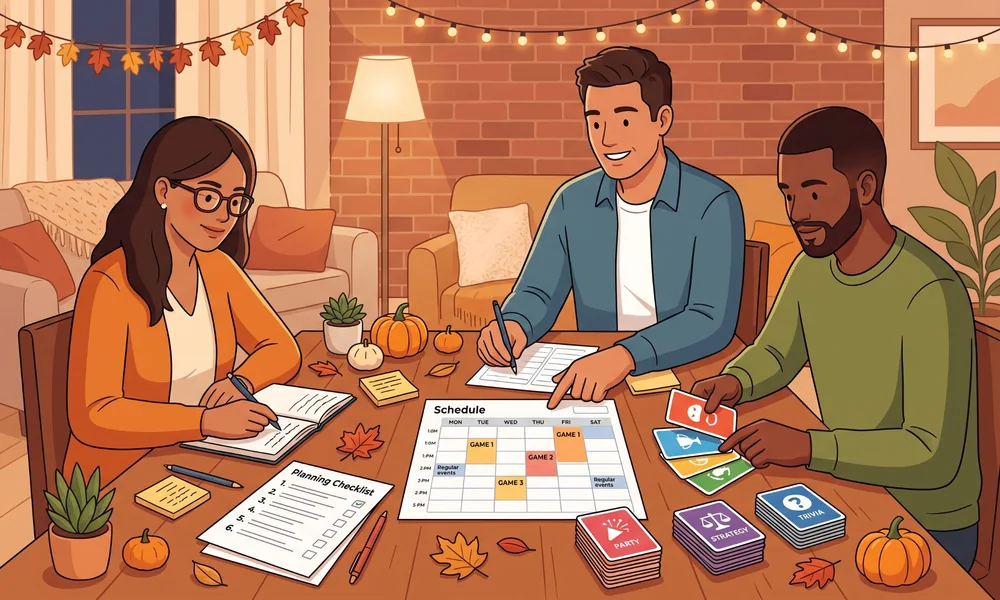
A strong plan usually needs an opener, one main event, and a closer. The host can keep one extra game ready, but announcing too many choices slows the room before anything begins.
| Moment | Choose From | Target Length | Host Goal |
|---|---|---|---|
| Guests arriving | Games 1-5 | 5-10 min | Let people join late |
| Dinner almost ready | Games 6-10 | 8-15 min | Fill an uncertain gap |
| Table cleared | Games 11-16 | 15-25 min | Run the main competition |
| Smaller late group | Games 17-21 | 10-15 min | Finish without forcing energy |
First, confirm who is actually playing. Next, choose the main game. Then add a short opener and a seated backup. The board game night checklist goes deeper into player count, setup, timing, and late arrivals when the gathering will also include boxed games.
Thanksgiving Day falls on the fourth Thursday in November, according to USAGov’s federal holiday calendar. In 2026, that date is November 26. Hosts planning a Friendsgiving on another day can use the same sequence; only the meal schedule needs to change.
The Lobby: Five Games Guests Can Join as They Arrive

Lobby games should survive interruptions. A guest can arrive late, put down a dish, greet the room, and still understand what is happening. These five Friendsgiving games create conversation without demanding everyone’s attention at once.
1. Guest Quest
Best with: 6-20 adults | Time: 5-15 minutes, running in the background | Supplies: Small paper slips and pens
Write light conversation missions on slips and give each guest one or two at the door. Useful missions include “find someone who prefers leftovers to the main meal,” “meet someone who has hosted Thanksgiving,” or “find two people who chose the same favorite pie.”
A guest completes a quest by learning the answer through normal conversation. The first person to finish two missions can earn one point, although the game also works without a winner. Keep every prompt observable or preference-based. Do not use age, relationship status, work, money, health, or other personal topics.
2. Thanksgiving Draft
Best with: 4-12 adults | Time: 10 minutes | Supplies: Paper or a notes app
Divide the room into two or three teams and name a category such as side dishes, desserts, holiday movies, or ways to spend the day after Thanksgiving. Teams alternate selecting one item, and no selection may be repeated. After three rounds, each team gets 30 seconds to explain why its lineup is strongest.
The host can award one point for the clearest pitch and one point for the most unexpected useful pick. For a larger group, let teams discuss every selection so one confident player does not control the full draft.
3. Six-Word Holiday Review
Best with: 3-20 adults | Time: 5-10 minutes | Supplies: Paper, pens, and a bowl
Each person writes a Thanksgiving review using exactly six words. It may describe a previous celebration or an imaginary one: “Perfect potatoes, questionable timing, excellent company” is the right level of detail. Fold the reviews and read them without names.
Players may guess the writer, or the host can simply award light categories such as sharpest review, best plot twist, and most relatable line. Because the responses are anonymous at first, tell guests they may reveal themselves or stay unknown.
4. Name the Group Chat
Best with: 6-20 adults in teams | Time: 8 minutes | Supplies: Paper or phones used only for writing
Give teams three neutral details about the gathering, such as “two pies,” “one delayed casserole,” and “a very competitive host.” Each team has two minutes to invent a fictional group-chat name and a one-line description for the night.
Read the entries aloud and vote for funniest, most accurate, and best title for a sequel. The prompt works especially well when different friend groups are meeting for the first time because nobody needs shared history. However, avoid using real screenshots, private messages, or jokes that exclude part of the room.
5. Dinner Forecast
Best with: 4-30 adults | Time: 3 minutes to enter, 5 minutes to reveal | Supplies: Slips, pens, and a bowl
As guests arrive, ask each person to predict three harmless outcomes: which dish will empty first, what time dessert will begin, and how many group photos will be attempted. Add one host-specific question if it remains kind and measurable.
Seal the entries until later. After dinner, read the closest predictions and give one point for each correct or nearest answer. This game quietly runs in the background, so it is useful when the arrival window is wide.
The Dinner Buffer: Five Games That Can Stop When Food Is Ready
Dinner timing moves. Therefore, games in this phase need clean stopping points and no setup that blocks serving space. Keep cards, pencils, and phones away from serving dishes; official FoodSafety.gov guidance emphasizes clean surfaces and proper hot or cold holding while food is being served.
6. Five-Second Feast
Best with: 4-15 adults | Time: 5-10 minutes | Supplies: None; optional timer
Choose a category such as foods served warm, things found in a kitchen, reasons dinner runs late, or words connected to autumn. Move around the circle, giving each player five seconds to say a new answer. Repeats and answers outside the category lose that round’s point.
Instead of eliminating anyone, reset with a new category after the first miss. That keeps every guest involved and lets the host stop the game as soon as dinner is ready.
7. The Emergency Menu
Best with: 6-18 adults in teams | Time: 10-12 minutes | Supplies: Paper and pens
Give every team three imaginary ingredients and one situation. For example: “cranberries, bread, apples; the oven stopped working” or “potatoes, herbs, corn; dinner must fit in one bowl.” Teams have four minutes to invent a dish, name it, and explain how it saves the meal.
No one prepares or tastes anything. Instead, the room awards points for most believable, best name, and boldest recovery plan. Because the ingredients are fictional game pieces, this avoids wasting food or turning allergy-sensitive dishes into props.
8. Pass the Plot: Dinner Edition
Best with: 5-16 adults | Time: 8-12 minutes | Supplies: None
Start with a simple setup: “Ten minutes before dinner, the host discovered…” Each player adds one sentence, but every sentence must continue the existing story rather than restart it. After one full circle, introduce a twist such as “the doorbell rang” or “the missing dish returned with a note.”
End after two rounds and let the final player give the story a title. A clear stopping point matters here; otherwise, a fun story can continue long after the food is ready.
9. Three Things, One Table
Best with: 4-16 adults | Time: 10 minutes | Supplies: Prepared clue list
The host reads three items that share a hidden connection. For example, “timer, apron, oven mitt” may connect as kitchen tools, while “parade, football, leftovers” may connect as Thanksgiving-day traditions. Teams write one answer instead of shouting.
Award one point for the correct link and a bonus point for a different connection the host can reasonably defend. Begin with obvious sets, then make the links more abstract. This game rewards lateral thinking without requiring specialized history knowledge.
10. House Rule Reveal
Best with: 5-20 adults | Time: 10 minutes | Supplies: Paper, pens, and a bowl
Ask everyone to complete this sentence: “A perfect Thanksgiving should always…” Encourage light rules such as “serve dessert twice” or “keep one chair away from the kitchen traffic.” The host reads each rule, and the group tries to identify the writer.
One point goes to the first correct guess, while the writer earns a point if nobody identifies them. Guests may pass, and the host should skip any entry that becomes personal or targets someone in the room.
The Main Quest: Six Thanksgiving Games After Dinner
Once dishes are cleared, the group can handle a longer round. These adult Thanksgiving party games use teams, creative decisions, and written answers, so nobody has to run across a crowded room or use food as equipment.
11. Leftover Ad Agency
Best with: 6-20 adults in teams | Time: 15-20 minutes | Supplies: Paper, pens, optional timer
Give every team two leftover foods and a customer type. A team might receive “stuffing plus cranberry sauce” for “someone leaving early for work.” In five minutes, the team must invent a product name, slogan, package idea, and 30-second sales pitch.
Score each pitch from zero to two points in three categories: clarity, creativity, and whether the product could plausibly be eaten. The game is about ideas only; no team should mix or sample actual leftovers.
12. Thanksgiving Charades Switch-Up
Best with: 6-20 adults | Time: 15-20 minutes | Supplies: Prompt cards and a timer
Prepare 20 Thanksgiving prompts, then split players into two teams. During round one, a player acts without talking, spelling, or pointing at the answer. During round two, use the same deck, but the clue giver may say only one word. Familiarity with the cards makes the second round faster and more strategic.
Allow one pass per turn and rotate clue givers. The free Gaming Station Charades Generator can provide clean general prompts; add Thanksgiving-specific cards such as “carving the turkey,” “watching the parade,” and “packing leftovers.”
13. Forbidden Feast
Best with: 6-18 adults in teams | Time: 15 minutes | Supplies: Homemade word cards and a timer
Each card needs one target and three forbidden clues. A “pumpkin pie” card might ban “dessert,” “orange,” and “slice.” The clue giver has 45 seconds to help the team say the target without using any forbidden word, part of the answer, initials, or spelling hints.
Award one point per correct card and subtract nothing for a pass. Harder cards should rely on familiar Thanksgiving ideas rather than obscure facts. As a result, the challenge comes from word choice, not from excluding guests who know less holiday trivia.
14. The Thankful Impostor
Best with: 6-16 adults | Time: 15-20 minutes | Supplies: Paired prompt cards
Give most players the same question and one player a related question. For example, the group may receive “Name the best Thanksgiving side,” while the impostor receives “Name the best Thanksgiving dessert.” Everyone writes a one- or two-word answer and reveals it together.
Players discuss the pattern for one minute, then vote on who received the different prompt. The impostor earns two points if not identified and one point if identified but able to guess the group’s question. Start a fresh round immediately; nobody sits out after the vote.
15. Friendsgiving Survey Showdown
Best with: 8-30 adults in teams | Time: 20 minutes | Preparation: Pre-event survey plus about 15 minutes to organize answers
Before the gathering, ask at least ten people six light questions, such as “Which side dish disappears first?” and “What is the most common reason dinner starts late?” Combine repeated answers and rank them by frequency.
At the party, teams take turns naming answers they think appeared in the survey. Reveal points equal to the number of survey responses. Use people who are not competing when possible, or collect guest responses several days early and keep the results private. This is not a 15-minute-prep game unless the survey already exists.
16. Fact, Folklore, or Family Tradition
Best with: 4-20 adults in teams | Time: 15-20 minutes | Supplies: Twelve verified statements and answer cards
Read one statement at a time. Teams label it fact, folklore, or family tradition. A family tradition is something true only for the host’s group, such as “dessert is served before the evening walk.” Award one point for the label and an optional bonus for a short explanation.
Historical questions need careful sourcing. The Smithsonian’s National Museum of the American Indian provides a useful Wampanoag-centered Thanksgiving inquiry that corrects simplified “First Thanksgiving” stories. Use that resource instead of turning stereotypes or inaccurate schoolbook claims into joke questions.
The Bonus Round: Five Quieter Games for Guests Who Stay Late
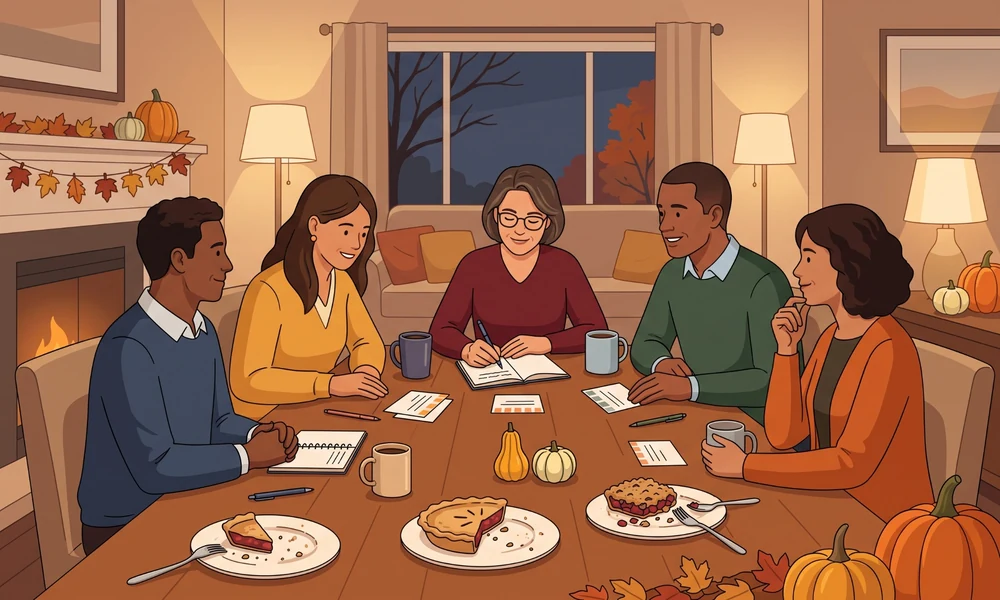
Late-night play should be easy to end. The meal is over, some guests may be leaving, and the remaining group may prefer conversation to performance. These games work well from a couch or table and do not depend on a fixed team size.
17. Headline From Next Thanksgiving
Best with: 3-15 adults | Time: 10 minutes | Supplies: Paper and pens
Players write a fictional headline dated one year in the future. Examples might report a new dessert record, a miraculous on-time dinner, or the return of a mysteriously missing serving spoon. Keep the headline to 12 words.
Read every entry without names. The room may vote for most believable, funniest, and best sequel potential. Then let writers reveal themselves if they want. This closer creates callbacks without requiring anyone to share a serious personal goal.
18. Consensus Countdown
Best with: 4-12 adults | Time: 10-15 minutes | Supplies: Paper and a five-minute timer
Give the group one ranking task: choose the five most important parts of a great Thanksgiving, rank the best leftover formats, or select five supplies for a fictional snowed-in holiday. Everyone must agree on one ordered list before time expires.
The group wins together if it finishes and each person gets one uninterrupted chance to argue for a choice. If one voice starts controlling the list, the host can require the next suggestion to come from someone who has not spoken recently.
19. Three-Clue Guest
Best with: 5-20 adults | Time: 10-15 minutes | Supplies: Paper, pens, and a bowl
Each guest writes three harmless clues about themselves: one preference, one skill, and one unusual but comfortable fact. The host reads a card, pausing after each clue. Players write a guess after clue one, may change it after clue two, and lock it after clue three.
Correct answers earn three, two, or one point depending on when the player guessed. Provide sample clues and let anyone replace a clue or skip the round. New friend groups should use easy public facts rather than shared-history references.
20. Recipe Riddle Round
Best with: 4-16 adults | Time: 10-15 minutes | Supplies: Prepared riddles, paper, and pens
Write short clues whose answers are foods, utensils, or hosting tasks. A clue might read, “I protect the table, catch every spill, and disappear into the laundry,” with “tablecloth” as the answer. Teams write simultaneously so the loudest player does not get every point.
Use ten to twelve riddles and reveal each answer before moving on. The host can accept a sensible alternate answer when it fits every clue. This makes a reliable quiet closer because the round has a clear endpoint.
21. Last Slice Awards
Best with: 4-20 adults | Time: 8-10 minutes | Supplies: Score sheet or paper
End by judging the games rather than ranking the guests. Ask everyone to nominate tonight’s best opener, funniest answer, strongest team moment, and game worth repeating next year. Tally the votes, then write the winning games on the next-year shortlist.
If one round fell flat, record why: wrong group size, unclear rules, low energy, or bad timing. That note is more useful than pretending every game worked equally well, and it makes next year’s plan faster.
Set the House Rules Before the First Round

Good hosting removes pressure before it appears. State that guests may pass on a prompt, join the next round, or take a seated role. Keep instructions short, demonstrate one example, and avoid early elimination. These rules matter more than making every score perfectly formal.
For a more accessible setup, read the rules aloud and keep a written copy in large, clear text. ADA guidance on effective communication discusses options such as large print and accessible electronic documents. At a private gathering, the practical lesson is simple: ask guests what format helps and make reasonable adjustments.
Also set these boundaries:
- Do not require alcohol, drinking penalties, or rapid consumption.
- Do not use food as a projectile, blindfolded tasting item, or timed eating challenge.
- Keep prompts away from politics, health, finances, relationships, and private history.
- Offer a scorekeeper, reader, or judge role when a guest does not want to act.
- Use written team answers when shouting would overwhelm the room.
- Stop a round when dinner is served instead of making the meal wait for the game.
When the Room Changes, Use These Pivots
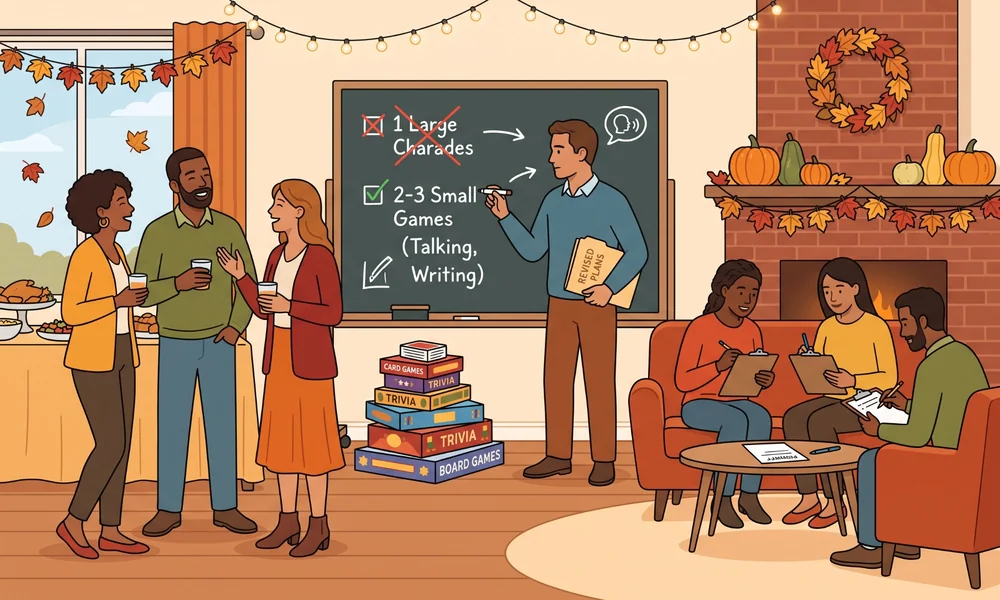
A hosting plan should bend without breaking. Use this table when the final group does not match the original plan.
| What Changed? | Best Pivot | Why It Works |
|---|---|---|
| Guests keep arriving late | Guest Quest or Dinner Forecast | Both run in the background |
| Only 3-5 people want to play | Six-Word Review or Recipe Riddle Round | No teams are required |
| The group grows beyond 20 | Survey Showdown or Five-Second Feast | Teams reduce waiting |
| Nobody wants to perform | Fact, Folklore, or Family Tradition | Everyone answers in writing |
| Energy drops after dinner | Consensus Countdown | Seated, social, and easy to end |
| The room gets too noisy | Three-Clue Guest | One reader controls the pace |
If a game still feels wrong, skip it. A shorter evening with two enjoyable rounds is better than forcing a full schedule because it was written in advance.
Download the Thanksgiving Adult Game-Night Score Sheet
The two-page printable helps you plan the game-night flow without repeating all 21 games. It includes a three-game lineup, round scoreboard, comfort check, results tracker, prompt bank, and notes for next year.
Free 2-Page Printable
Thanksgiving Adult Game-Night Score Sheet
Plan your opener, main game, and closer, track every round, save useful prompts, and record which games should return next Thanksgiving.
Download the Free Adult Game-Night Score Sheet (PDF)Lock In the Night’s Lineup
For most groups, the simplest route is Guest Quest during arrivals, one main game such as Leftover Ad Agency or Thanksgiving Charades Switch-Up after dinner, and Last Slice Awards as the closer. Keep Recipe Riddle Round ready if the room wants something quieter.
The best choice depends on the guests, not the game count. Pick one activity people can enter late, one that gives the main group a shared challenge, and one that can end cleanly. That three-game arc turns a list of Thanksgiving games for adults into a plan a host can actually run.
