
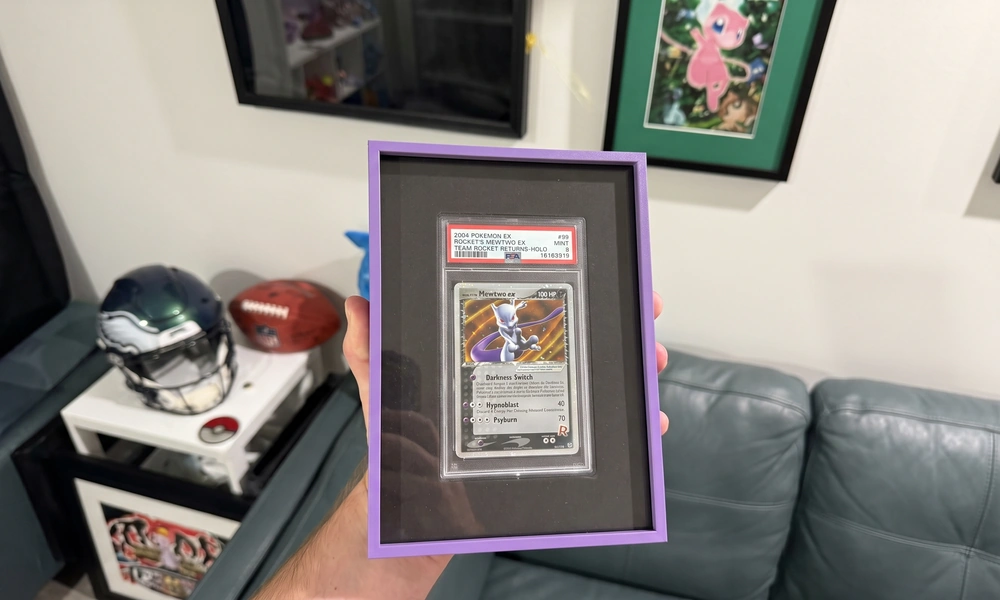
Displaying trading cards sounds easy until the collection starts getting bigger, more valuable or both.
A few favourite cards on a desk is simple enough. A wall of graded slabs, magnetic holders or cards from several different sets takes more thought.
The good news is that display and protection are not opposites. You do not have to choose between locking everything away forever and putting valuable cards at unnecessary risk. Most of the important decisions are fairly practical: keep the cards in proper holders, avoid bad light, use sensible materials and make sure whatever goes on the wall is actually secure.
That gets you a long way.
Start with the holder, not the frame
The card itself should already be protected before display even enters the conversation.
For higher-value cards, that often means graded slabs from PSA, CGC or BGS, or magnetic holders such as One Touch cases. Those formats work well for display because they are rigid and consistent. Once you have ten, twenty or thirty cards sitting in matching holders, the layout becomes much easier to control.
Trying to force cards out of their normal protection just to make them fit a display usually creates more problems than it solves. The display should work around the holder, not the other way around.
Sunlight is the obvious one
If there is one thing worth being strict about, it is prolonged direct sunlight.
Trading cards are printed objects, and repeated UV exposure can contribute to fading and changes in colour over time. That does not mean every collection needs to live in a dark room. Normal ambient light is completely different from putting a display on a wall that gets strong afternoon sun every day.
Good placement does a lot of the work for you.
The glazing in front of the cards can help as well. Acrylic is common because it is clear, relatively light and safer than glass once a display starts getting large. Some acrylic products also offer UV resistance, although the level varies depending on the material.
For particularly valuable cards, higher-grade UV-filtering acrylic or glass may be worth considering, but no glazing choice makes poor placement a great idea.
Larger collections punish sloppy spacing
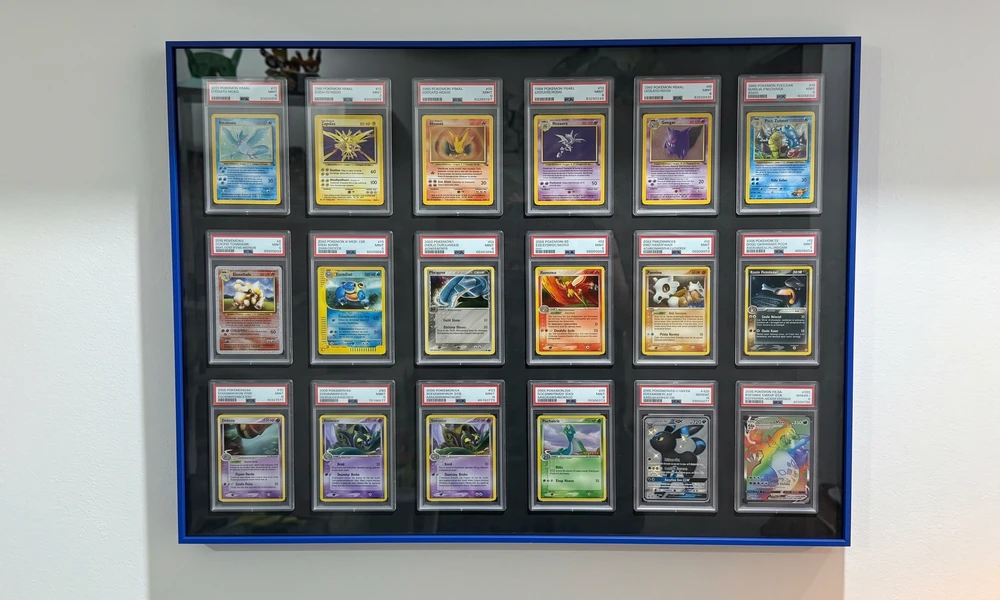
A small display can get away with quite a lot. A large one cannot.
If the spacing is slightly uneven across three cards, most people will never notice. Repeat that same inconsistency across ten columns and suddenly the whole thing starts to look off.
That is why layout becomes more important as the collection grows.
Before mounting anything, it is worth working out how many cards you actually want to display, whether the collection may grow later, how many rows and columns make sense and whether the wall suits a wide or tall layout.
Painter’s tape is surprisingly useful here. Mark the outside dimensions on the wall before committing to anything and you get a much better sense of how big the display will actually feel in the room.
Measurements on a screen can be deceptive. A metre-wide display sounds manageable until it is physically mapped out in front of you.
The Wall Doesn’t Care How Valuable Your Trading Cards Are
Once a display gets heavy, mounting becomes its own problem.
The wall only knows there is a large object hanging from it.
The combined weight of the frame, glazing, backing and cards can add up quickly, especially once dozens of slabs are involved. The mounting hardware therefore needs to suit both the weight of the display and the type of wall.
Plasterboard, masonry and timber all behave differently, and a tiny picture hook is not suddenly a good idea because the cards inside happen to be expensive.
For larger displays, multiple mounting points usually make more sense.
Height matters too. If the whole reason for displaying cards is to actually see them, the top row should not end up somewhere near the ceiling.
You probably should not display everything
One of the easiest mistakes is assuming that once you start displaying cards, the entire collection needs to come out.
It does not.
Most larger collections make more sense as a mix of storage and display. Bulk cards can stay boxed, complete sets can stay in binders, and cards that need more careful storage can remain exactly where they are.
The display can focus on the part of the collection that works visually or simply means the most to the owner.
That could be one favourite Pokémon, a sports player, a set of graded cards, a colour theme or a handful of cards that simply look good together. Sometimes the best display cards are not even the most expensive ones.
Make it easy to change your mind
Collectors change their minds constantly.
A better grade turns up. A favourite card gets replaced. A new set releases. One card gets sold and another suddenly deserves the spot.
A display that looks great but is a nightmare to access becomes annoying very quickly.
The cards should sit securely, but swapping one should not feel like rebuilding furniture. That matters even more with larger displays because the chances of the collection changing over time are much higher.
Materials should solve problems, not create new ones
The materials around the cards do not need to be complicated. They just need to make sense.
The front should be clear enough to see the cards properly. The backing should keep the holders stable. The cards should not rattle around, shift or sit under unnecessary pressure.
For larger displays, weight becomes a much bigger factor, which is one reason acrylic is so common. It gives a clear protective front without adding the same weight as an equally large sheet of glass.
There are now businesses focused specifically on this part of collecting, including The Card Collective, but the basic principles are the same whether the display is bought, built or put together from something more improvised.
Displaying Trading Cards Safely Is Mostly About Avoiding Mistakes
You do not need to turn card display into a science experiment.
Most of the important stuff is straightforward.
Keep the cards in decent holders. Do not leave them in direct sunlight. Plan the layout before drilling holes. Use hardware that can actually support the display. Make sure the cards can still be accessed, and do not force valuable cards into a setup that was never designed for them.
That is really the balance.
The collection stays protected enough to make sense, but it is also somewhere you can actually see and enjoy it.
That is usually the whole point.
If you’re still deciding how much of your collection is worth putting on display, it’s worth reading why more collectors are treating their cards as part of the room rather than something to store away.
