
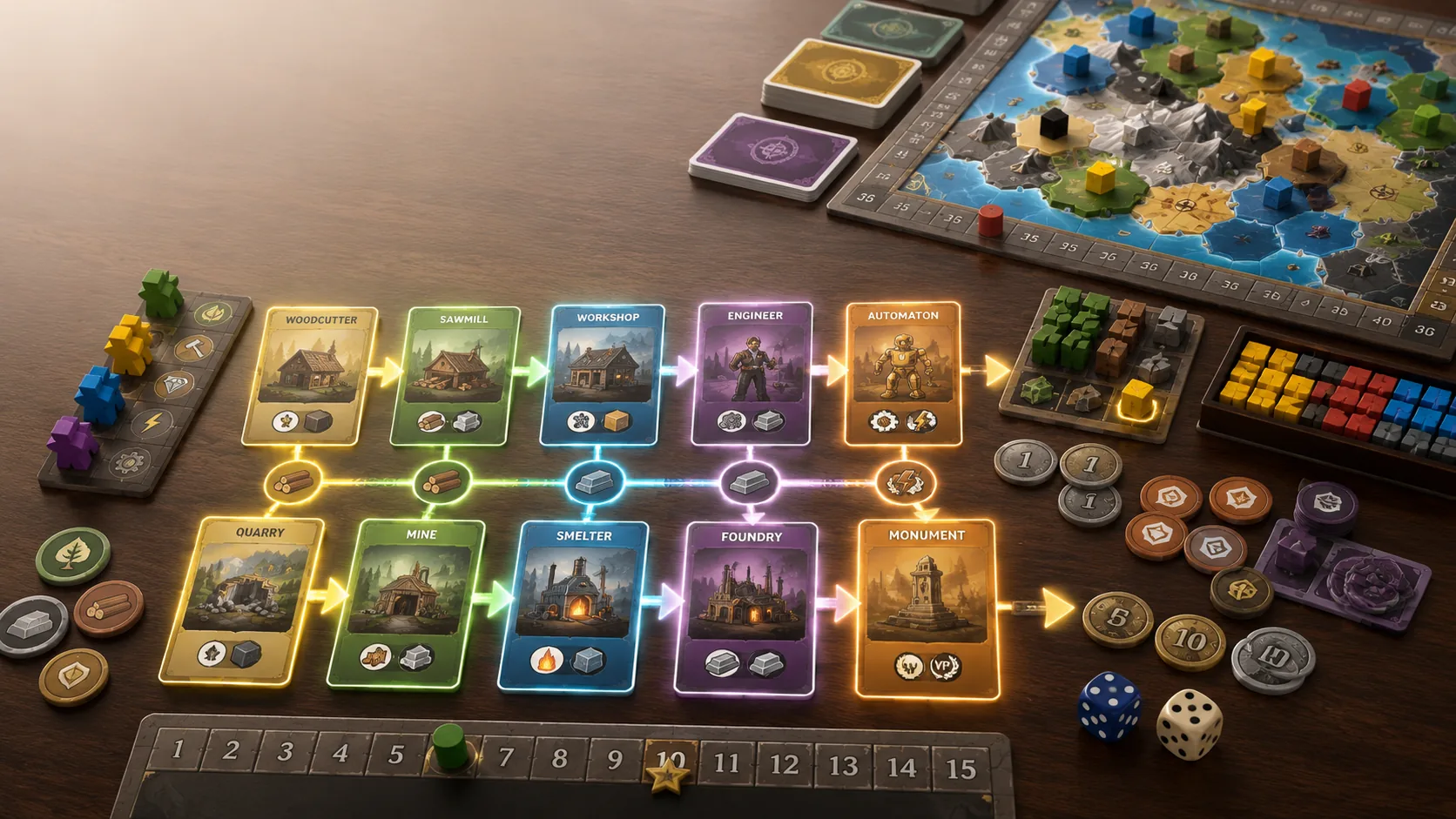
Direct Answer: Engine building board games let players create systems that become stronger or more efficient as play continues. Early cards, resources, or abilities generate better later actions, which can then produce more resources, discounts, combos, or victory points. Strong examples include Wingspan, Terraforming Mars, Earth, Space Base, Res Arcana, Gizmos, and It’s a Wonderful World.
Last reviewed: September 2026
The appeal of engine building board games is progression.
Instead of starting each turn with roughly the same capabilities, players gradually construct a system in which earlier decisions improve later ones. A card might generate food, that food may activate another ability, the second effect can produce cards or resources, and those resources can finance even stronger additions.
AEG describes tableau/engine-building games as games in which players build something that becomes stronger or more efficient over time, with combo-driven play and strategic development as central characteristics. Its examples include Wingspan and Space Base.
That basic concept appears in very different designs. Wingspan creates chains of bird abilities, Terraforming Mars increases resource production, Earth builds a self-supporting ecosystem tableau, and Space Base improves sectors that can pay out even during opponents’ turns.
This guide explains the engine-building mechanic, how it differs from deck building, what makes an engine effective, and which games provide the strongest entry points for different types of strategy players.
If you are still learning modern tabletop terminology, begin with our tabletop games for beginners guide before comparing heavier engine builders.
Best Engine Building Board Games at a Glance
| Rank | Game | Best For | Players | Play Time |
|---|---|---|---|---|
| 1 | Wingspan | Best overall | 1–5 | 40–90 min |
| 2 | Terraforming Mars | Deep strategy | 1–5 | 90–120 min |
| 3 | It’s a Wonderful World | Card drafting + production | 1–5 | 30–60 min |
| 4 | Earth | Combo-heavy tableau building | 1–5 | ~60 min |
| 5 | Space Base | Dice-driven engines | 2–5 | ~60 min |
| 6 | Res Arcana | Tight efficiency puzzles | 2–4 | ~45 min |
| 7 | Gizmos | Accessible combo building | 2–4 | ~45 min |
| 8 | Point City | Best beginner engine builder | 1–4 | 15–30 min |
Player counts and playtimes above come from current publisher listings.
What Is the Engine-Building Mechanic?
An engine-building mechanic is a system in which a player’s earlier investments improve the power, efficiency, frequency, or value of future actions.
A simplified engine looks like this:
Acquire resource → build ability → ability generates more resources → use increased resources to build stronger abilities → convert final engine into victory points
In abstract form:
Resources → Investment → Increased Output → Reinvestment → Scoring
The important part is compounding efficiency.
If Turn 1 gives a player three resources and an upgrade eventually lets the same type of turn produce six, the player’s economic system has improved.
AEG’s own description is concise: engine builders revolve around building something that becomes stronger or more efficient as the game progresses.
What Does an Engine Look Like in a Board Game?
Not every engine generates coins.
An engine can improve almost any repeatable game system.
| Engine Type | What Improves |
|---|---|
| Production engine | Generates increasing resources |
| Card engine | Draws or plays more cards |
| Discount engine | Makes future purchases cheaper |
| Conversion engine | Turns common resources into valuable ones |
| Action engine | Makes actions stronger or more frequent |
| Trigger engine | One effect activates several others |
| Point engine | Generates recurring victory points |
| Dice engine | Improves rewards linked to dice results |
Different games emphasize different versions.
Terraforming Mars has players build production through project cards, while Earth explicitly describes its tableau as a self-supporting engine of growth, expansion, and supply. Space Base improves a fleet whose rewards can trigger across player turns.
1. Wingspan — Best Engine Building Board Game Overall
Wingspan is one of the clearest introductions to engine building because players can see their systems develop directly across three habitats.
Stonemaier Games describes Wingspan as a competitive, medium-weight, card-driven, engine-building board game for 1–5 players, with current listed playtimes around 40–90 minutes.
Players attract birds into three habitats:
- Forest
- Grassland
- Wetlands
Each habitat is associated with a core action. Adding birds expands the row and can add abilities that trigger whenever that habitat is activated.
Why the engine feels satisfying
Suppose an early forest action produces a small amount of food.
After several bird cards are added, the same activation can potentially:
- Generate food.
- Trigger a bird ability.
- Generate an additional resource.
- Activate another bird.
- Produce another benefit.
The action has become more productive because previous turns improved it.
That visible improvement is why Wingspan is such a useful teaching example of the mechanic. Stonemaier itself categorizes the game as an engine builder.
Best for: Players new to medium-weight strategy games
Engine style: Tableau + activation chains
Players: 1–5
Time: 40–90 minutes
2. Terraforming Mars — Best Deep Engine Builder
Terraforming Mars is a stronger choice for players who want the engine itself to become a long-term strategic project.
FryxGames describes Terraforming Mars as a game where players control corporations, play project cards, build production, place cities and greenery, and compete for milestones and awards. The base game supports 1–5 players and lists a duration of 90–120 minutes.
Players develop production across resources such as:
- Megacredits
- Steel
- Titanium
- Plants
- Energy
- Heat
Project cards can increase production, create permanent effects, provide discounts, place map tiles, or create scoring opportunities.
Why its engine is deeper
The central question is not simply:
“Is this card good?”
It is:
“Does this card improve my system enough to justify paying for it now instead of advancing the endgame?”
That timing issue matters because building an enormous economy is pointless if opponents finish terraforming before the investment pays back.
Best for: Experienced strategy groups
Engine style: Production + card synergies
Players: 1–5
Time: 90–120 minutes
3. It’s a Wonderful World — Best Card-Drafting Engine Builder
It’s a Wonderful World combines card drafting with a highly visible production engine.
Lucky Duck Games officially describes it as a card drafting and engine building game for 1–5 players, typically lasting 30–60 minutes.
Each round, players draft seven cards and decide whether to:
- Keep a card for construction, or
- Recycle it immediately for resources.
Completed developments then improve production and/or generate victory points.
What makes the system interesting
Production occurs in a sequence.
That means something built early enough in the production chain can potentially generate resources that help complete another development during the same round.
The result is a cascading optimization puzzle:
Build → produce → complete another card → increase later production
This creates some of the clearest “engine just switched on” moments among medium-light strategy games.
Best for: Players who enjoy drafting and resource optimization
Engine style: Sequential resource production
Players: 1–5
Time: 30–60 minutes
4. Earth — Best Combo-Heavy Tableau Engine
Earth is built around constructing a large interconnected tableau in which cards repeatedly interact with one another.
Asmodee describes Earth as a tableau builder for 1–5 players in which players create a self-supporting engine of growth, expansion, and supply from a large pool of unique cards. Its listed average playtime is approximately 60 minutes.
The game contains hundreds of cards involving:
- Flora
- Fauna
- Climate
- Islands
- Ecosystems
Players search for synergies among these elements while expanding a personal tableau.
Why combo players should consider Earth
The game rewards players for thinking spatially and mechanically at the same time.
One new card may:
- Generate resources
- Trigger nearby effects
- Improve future actions
- Fit a scoring condition
- Strengthen another card’s ability
That makes Earth less about one linear production track and more about constructing an interconnected ecosystem.
Best for: Players who enjoy large combo chains
Engine style: Tableau + multi-card triggers
Players: 1–5
Time: About 60 minutes
5. Space Base — Best Dice-Driven Engine Building Game
Space Base demonstrates that engine building does not need to revolve around cards activating only on your own turn.
AEG describes Space Base as a fleet-management dice game for 2–5 players, ages 14+, with an approximate playtime of 60 minutes. Players draft ships into 12 sectors and can receive rewards on every player’s turn depending on dice results.
Rewards can include:
- Income
- Credits
- Influence
- Other ship effects
What makes the engine unusual
A new ship can improve what happens when specific numbers are rolled.
As the fleet develops, more dice outcomes become productive.
That creates a probability-based engine:
Dice result → sector activates → reward → buy better ship → stronger future activation
AEG also explicitly lists Space Base among its examples of tableau/engine-building games.
Best for: Players who enjoy dice without wanting purely luck-driven gameplay
Engine style: Probability + recurring activation
Players: 2–5
Time: ~60 minutes
6. Res Arcana — Best Engine Builder for Efficiency
Res Arcana creates substantial engine-building depth from a remarkably small personal deck.
Asmodee’s current listing describes each player as a mage working with a personal deck of only eight artifacts. Players collect different essences, create artifacts, and compete for monuments and Places of Power. It supports 2–4 players, ages 14+, and takes approximately 45 minutes.
Why the eight-card structure matters
Many engine builders ask:
“Which cards should I acquire?”
Res Arcana often asks:
“How do I extract maximum efficiency from the small system I already have?”
That shifts emphasis toward:
- Resource conversion
- Timing
- Card interactions
- Action efficiency
- Planning several activations ahead
The result is a compact but demanding engine puzzle.
Best for: Experienced players who dislike excessive card accumulation
Engine style: Tight resource conversion
Players: 2–4
Time: ~45 minutes
7. Gizmos — Best Accessible Combo Engine Builder
Gizmos centers its engine around building inventions that make future actions more powerful.
The current Asmodee listing for Gizmos 2nd Edition supports 2–4 players, ages 14+, with an average playtime of approximately 45 minutes.
The core attraction is chaining effects.
A player may build something that rewards a particular action, then later build another Gizmo that rewards the first reward.
The publisher describes these connected effects as chain reactions that can create increasingly powerful turns.
Instead of:
One action → one result
the engine can become:
One action → trigger → bonus → another trigger → additional bonus
Why it is useful for beginners
The game’s central lesson is easy to understand:
Build things that make other things better.
That makes the underlying engine concept more visible than in heavier economic games where several subsystems compete for attention.
Best for: Casual strategy groups learning combo engines
Engine style: Trigger chains
Players: 2–4
Time: ~45 minutes
8. Point City — Best Beginner Engine Builder
Point City is the easiest recommendation here for players who want to understand engine building without committing to a long game.
AEG describes Point City as a card-drafting engine-building game for 1–4 players, ages 10+, with a playtime of only 15–30 minutes.
Players take adjacent cards from a shared grid, gather resources, construct buildings, and use bonuses to improve the developing city. Civic structures provide additional scoring opportunities.
Why it works as an introduction
The decisions are recognizable:
- Gain resources.
- Build something.
- The building improves your future position.
- Use that improvement to construct better combinations.
AEG explicitly says the design adds resource management and engine building while keeping the rules easy to learn.
Best for: First-time engine-building players and families
Engine style: Resource cards + buildings
Players: 1–4
Time: 15–30 minutes
Best Engine Builder Board Games by Experience Level
| Experience | Recommended Game | Why |
|---|---|---|
| New to strategy games | Point City | Short and clear engine loop |
| Beginner/intermediate | Gizmos | Easy-to-see combos |
| Intermediate | Wingspan | Strong engine identity with broader strategy |
| Intermediate | Space Base | Adds probability management |
| Intermediate | It’s a Wonderful World | Drafting + production optimization |
| Intermediate/advanced | Earth | Large synergy network |
| Advanced | Res Arcana | High efficiency with limited tools |
| Advanced | Terraforming Mars | Long-term economic planning |
The classifications above are Gaming Station editorial recommendations rather than official publisher difficulty ratings.
Deck Building vs. Engine Building
Deck building means changing your personal deck during the game. Engine building means developing a system that makes later actions more productive. They can overlap: the deck you improve may also be the engine that supplies your actions or resources.
| What to compare | Deck building | Engine building |
|---|---|---|
| What you develop | The contents of your personal deck | A system of actions, abilities, production, or discounts |
| How improvements become useful | You draw or otherwise access the cards you acquired | You use an improved action or meet an ability’s trigger |
| What to consider before an upgrade | How the card fits your deck and how often you can use it | What the upgrade produces and how many uses remain |
| Can the mechanics overlap | Yes, a deck can provide a repeatable engine | Yes, an engine can operate through a changing deck |
Deck Building
In a deck-building game, you make changes to your deck as part of play. This differs from selecting a deck before a match, often called deck construction. The interesting decision is what to add or remove, given the cards and goals already in front of you.
Drawing and reshuffling rules vary by game. The Dominion example below shows one specific version of the mechanic.
Engine Building
An engine is the system you develop to make future actions more useful. It could increase production, reduce costs, or let one effect trigger another. AEG’s description of engine-building games focuses on systems that gain strength or efficiency as play progresses.
A card’s presence on the table does not mean its ability runs every turn. Check its activation condition. The useful question is how often your planned actions will actually benefit from that upgrade.
Deck Building vs. Engine Building Example
These worked examples use Dominion Second Edition and Wingspan with the original base-game player mat. They illustrate the published rules, rather than report a recorded play session.
Game A
Dominion: a purchase changes a later hand. Assume there are no extra effects changing costs or income.
1. Your hand contains three Coppers and two Estates. Play the Coppers for three coins and buy a Silver, which costs three.
2. Put the Silver in your discard pile. At cleanup, discard your hand and played cards, then draw five cards, shuffling the discard pile when needed.
3. On a later turn, suppose you draw Silver, two Coppers, and two Estates. Those Treasures provide four coins: two from Silver and one from each Copper.
The Silver helps when it reaches your hand. Buying it does not provide its income immediately. See the official Dominion rules, pages 4 and 5.
Game B
Wingspan: adding birds improves a habitat action. This example uses the original player mat, without expansion boards or overlays.
1. With an empty forest, choose Gain Food. The first slot lets you take one food token from a birdfeeder die.
2. On separate Play a Bird turns, fill the first two forest spaces with eligible birds, paying their food and placement costs.
3. The next time you choose Gain Food, place your cube in the third forest slot, now the leftmost uncovered space. Take food from two dice, one at a time.
4. Then resolve any brown powers you choose in that row, moving from right to left. Follow each card’s conditions.
The forest now provides two food tokens before any bird powers. Those powers can be used again on later forest activations. Playing a bird is a separate action; it does not also activate the row. See the official Wingspan rules reference.
Can a Game Be Both Deck Building and Engine Building?
Yes. A deck can be the mechanism that runs an engine. In Dominion, Village supplies a card draw and extra Actions; Smithy supplies more card draw. Acquiring compatible cards develops the deck. Repeatedly using them together can develop an engine. The Dominion rulebook explains these card effects.
Engine building therefore does not require a separate display of permanent upgrades. When comparing games, look at both what you improve and what makes those improvements available during play.
Engine Building vs. Tableau Building
These terms also overlap but are not identical.
A tableau is a set of cards or components displayed in front of a player.
An engine is a functional system that becomes increasingly productive.
Therefore:
A tableau describes where components are organized.
An engine describes what those components do together.
Earth is officially described as a tableau builder, but its publisher also explicitly says players create a self-supporting engine.
A tableau can therefore be the physical structure of an engine.
Engine Building vs. Resource Management
Resource management means deciding how to acquire, save, spend, or convert limited resources.
Engine building goes one step further:
the system producing or transforming those resources improves over time.
For example:
Resource management only
You receive five coins every round and decide how to spend them.
Engine building
You begin receiving five coins, invest in production, and eventually receive nine coins plus a bonus whenever another condition occurs.
Terraforming Mars is a clear example because project cards can increase a corporation’s production as the game develops.
What Makes a Good Engine?
From a strategy perspective, the strongest engines normally balance cost, timing, synergy, and payoff.
1. Early Returns
An upgrade purchased early has more turns in which to produce value.
If a card produces one resource every round:
Played with 6 rounds remaining = potentially 6 resources
Played with 2 rounds remaining = potentially 2 resources
This does not automatically make early production better than late scoring, but it explains why timing is central to engine-building strategy.
2. Synergy
A good engine is more than several individually strong components.
The pieces should interact.
Example:
Card A generates plants.
Whenever those plants are generated, Card B awards points.
You can then use Card C to convert plants into another valuable resource.
Now the same event contributes to several goals.
3. Efficiency
Players should compare input and output.
A simple evaluation is:
Net value = Total expected output − Cost of building the engine piece
If a costly upgrade cannot reasonably repay its investment before the game ends, building it may be inefficient.
This is a strategic model, not a universal scoring formula; individual games value resources differently.
4. Conversion
Efficient engines often solve resource mismatches.
If a player produces excessive stone but needs coins, an ability that converts stone into coins can make the existing engine more flexible.
5. Victory-Point Conversion
Eventually, production must contribute to winning.
A common engine-building mistake is creating a spectacular economy that produces resources faster than they can be converted into points.
The strongest engine is not necessarily the one producing the most pieces.
It is the one producing the right outputs before the game ends.
Three Stages of an Engine-Building Game
Many strategy board games using engine development can be understood in three phases.
Early Game — Build Infrastructure
Priorities often include:
- Resource production
- Card draw
- Discounts
- Extra actions
- Flexible conversions
The objective is future efficiency.
Midgame — Exploit Synergies
Now players begin triggering combinations and using the system they created.
The question changes from:
“How do I build my engine?”
to:
“How do I make this engine work repeatedly?”
Late Game — Convert to Points
Pure economic improvements become less useful as the remaining number of turns decreases.
Late-game priorities increasingly shift toward:
- Direct victory points
- Objectives
- Endgame multipliers
- Milestones
- High-value constructions
That shift is especially visible in longer engine games such as Terraforming Mars, where the global terraforming objectives eventually end the game.
Common Engine-Building Strategy Mistakes
Building Everything
A card being useful does not mean it fits your engine.
Prioritize pieces that support the same resource path or scoring goal.
Ignoring the Endgame
Every engine has a payback period.
If a production upgrade requires four turns to recover its cost and the game likely ends in two, the investment is too late unless it provides another benefit.
Producing Resources Without a Sink
A resource is valuable only if the game lets you convert it into useful actions or points.
Chasing Combos That Never Arrive
Do not build an entire strategy around one specific card unless the game’s systems make finding it reasonably reliable.
Ignoring Opponents
Engine builders can feel multiplayer-solitaire-like, but shared cards, milestones, objectives, markets, or endgame timing may still create substantial interaction.
Terraforming Mars, for example, includes competition for milestones, awards, and map positioning in addition to each corporation’s internal engine.
Best Engine Building Board Games for Beginners
For a first engine builder, prioritize:
- Short rules
- Visible outputs
- Limited resource types
- Clear improvement over time
- Moderate play length
1. Point City
Only 15–30 minutes, 1–4 players, and explicitly designed around accessible card drafting and engine building.
2. Gizmos
Its chain reactions make the “build something that improves future actions” concept extremely visible. The current 2nd Edition supports 2–4 players and runs approximately 45 minutes.
3. Wingspan
A step up in complexity, but its habitat rows provide a clear visual representation of engines becoming stronger. Stonemaier officially describes it as a medium-weight engine builder.
Best Engine Building Games for Experienced Players
Terraforming Mars
Best when the group wants a longer economic arc and a huge card-driven decision space. FryxGames describes players building production through project cards while racing to terraform Mars.
Res Arcana
Best for players who want efficiency and interaction with a very limited card set. Each mage has only eight artifacts to work with.
Earth
Best when players enjoy discovering complex card synergies across a large tableau. The current game offers 364 unique cards across its broader card pool and is explicitly built around interconnected engine development.
Best Engine Building Game for Two Players
Res Arcana is especially strong at low player counts because of its tight economy and short 45-minute structure.
For players wanting an even more specifically tailored duel, Res Arcana Duo is a standalone two-player entry in the same game family. Asmodee lists it for exactly two players with an average playtime of roughly 20 minutes.
For more games designed around smaller player counts, compare our best two-player board games for couples and duos.
Other strong two-player-capable choices from this list include:
- Wingspan
- Terraforming Mars
- Space Base
- Earth
- Gizmos
- Point City
Their publishers currently support two-player games within their listed player ranges.
Best Engine Building Game for Solo Play
Several games in this guide officially support one player:
- Wingspan
- Terraforming Mars
- It’s a Wonderful World
- Earth
- Point City
Their publisher listings currently include solo play in the supported player counts.
For players primarily interested in optimizing systems without table negotiation, solo engine builders can make the efficiency puzzle particularly clear.
Quick Buying Guide
After choosing a title, use our board game night checklist to organize the players, session length, setup, and snacks.
| You Want… | Choose |
|---|---|
| Best overall engine builder | Wingspan |
| Deep economic strategy | Terraforming Mars |
| Fast production chains | It’s a Wonderful World |
| Huge combo tableau | Earth |
| Dice-based engine | Space Base |
| Tight efficiency puzzle | Res Arcana |
| Accessible combo chains | Gizmos |
| Beginner-friendly game | Point City |
| Very short two-player engine | Res Arcana Duo |
Final Verdict
The best engine building board games make improvement itself part of the reward.
The defining pattern is simple:
Invest now → become more efficient later → use that efficiency to generate stronger actions, combos, or victory points.
AEG summarizes the category as games where players build something that grows stronger or more efficient over time.
For most players, Wingspan is the best overall introduction because its habitat rows make engine development easy to see while still supporting meaningful strategy.
Point City and Gizmos are better starting points for lighter groups, while It’s a Wonderful World adds drafting and sequential production.
Experienced groups looking for deeper systems should move toward Terraforming Mars, Earth, or Res Arcana, each of which approaches efficiency from a different direction: economic production, interconnected tableau synergies, or tightly constrained resource conversion.
If your group prefers question-based competition instead of long-term resource optimization, explore our best trivia board games.
The central strategy lesson applies across all of them: do not build an engine simply because you can. Build one that becomes productive early enough to help you win.
Frequently Asked Questions
Engine building board games are strategy games in which players create systems that become stronger or more efficient over time. Engines may generate resources, trigger card combinations, provide discounts, improve actions, or create recurring victory points. AEG uses this increasing-efficiency concept to describe the category.
Strong choices include Wingspan, Terraforming Mars, It’s a Wonderful World, Earth, Space Base, Res Arcana, Gizmos, and Point City. They range from 15–30 minute beginner games to 90–120 minute strategic engine-building experiences.
Deck building primarily improves the cards contained in a player’s personal deck. Engine building improves a repeatable production or action system. The mechanics can overlap, but engine building is defined more broadly by increasing efficiency over time.
Yes. Stonemaier Games explicitly describes Wingspan as a competitive, medium-weight, card-driven engine-building board game. Bird cards added to habitats can increase the value and number of effects produced when those habitat actions are activated.
Yes. Terraforming Mars uses project cards and production tracks to improve a corporation’s recurring resources and capabilities over time, which fits the engine-building mechanic.
