
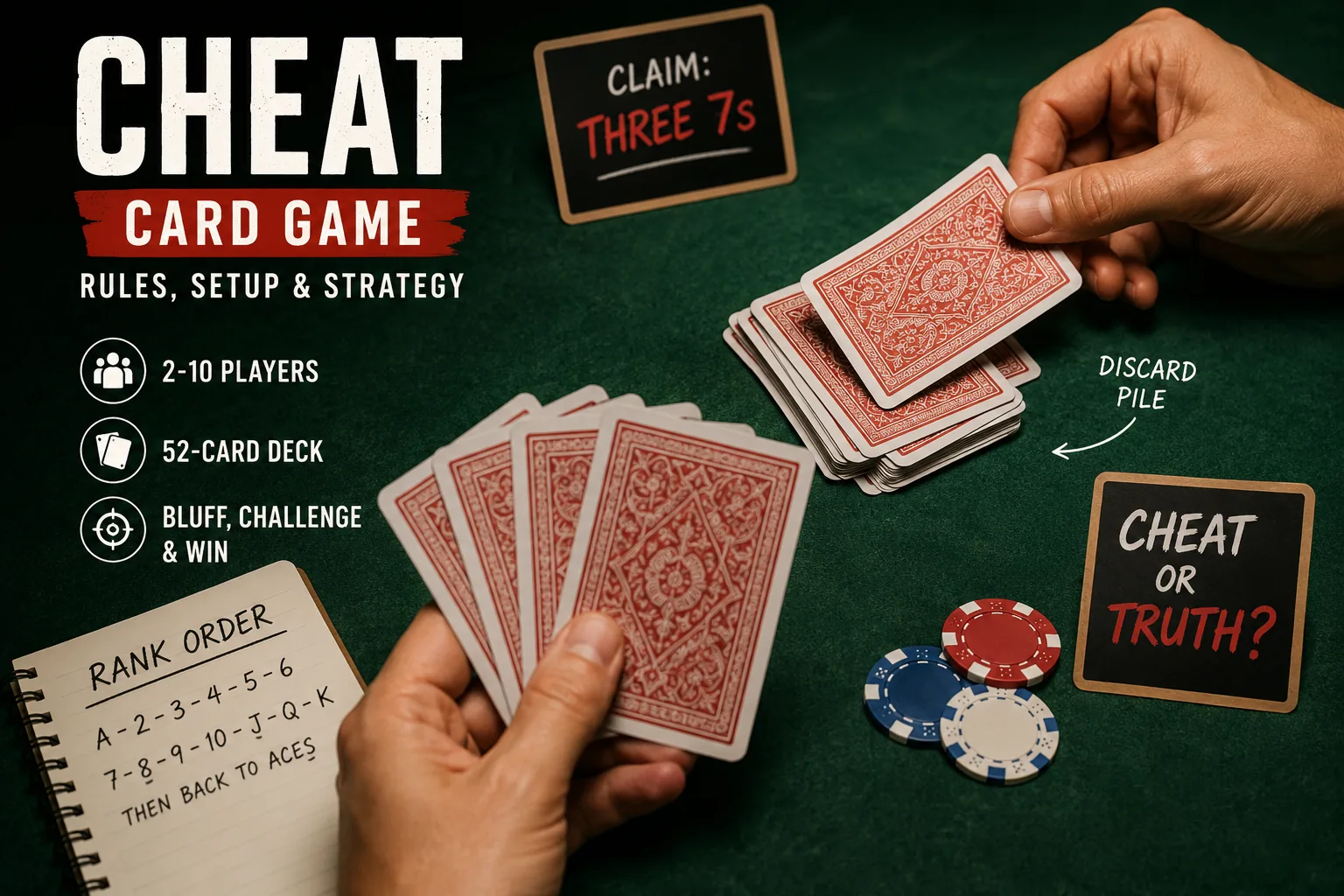
Direct Answer: Under common Cheat card game rules, players take turns placing cards face down while claiming they match the required rank—Aces, then Twos, Threes, and so on. Players may tell the truth or bluff. If someone challenges a false claim, the liar takes the discard pile; a failed challenger takes it instead.
By Gaming Station Editorial Team
Last reviewed: August 2026
The Cheat card game is a shedding and bluffing game built around one simple question: is the player who just put cards down telling the truth?
The game is commonly called Cheat in Britain, Bullshit or BS in the United States, and I Doubt It in many rulebooks. Pagat notes an important complication, however: another closely related game also called I Doubt It uses a different rank structure, so not every published ruleset is identical.
This guide uses the widely documented ascending-rank version as its default: Aces → Twos → Threes → … → Kings → back to Aces. That structure appears in both Bicycle’s current rules and Pagat’s Cheat/Bullshit rules.
If you are completely new to traditional card and board games, start with our tabletop games for beginners guide.
Cheat Card Game Rules at a Glance
| Rule | Standard Approach |
|---|---|
| Players | 2–10 in Pagat’s rules |
| Cards | Standard 52-card deck |
| Goal | Be first to get rid of all cards |
| Direction | Clockwise |
| Cards played | Face down |
| First required rank | Aces |
| Rank sequence | A, 2, 3, 4 … 10, J, Q, K, then A again |
| Must claims be truthful? | No |
| Who can challenge? | Any player |
| Correct challenge | Player who lied takes the whole pile |
| Wrong challenge | Challenger takes the whole pile |
| Winning | Empty your hand and survive any challenge to the final play |
Pagat documents the game for 2–10 players with one standard 52-card pack, while Bicycle lists the game for 2, 3, 4, and 5+ players, while Pagat documents the ascending version for 2–10 players.

What Is the Cheat Card Game?
Cheat is a bluffing card game in which players try to discard their entire hand while hiding the true identity of the cards they play.
Every play goes face down, which means opponents cannot immediately verify whether a claim is true.
For example, suppose the required rank is Sevens.
A player might place two cards face down and announce:
“Two sevens.”
Those cards could actually be:
- Two Sevens
- One Seven and one Queen
- Two unrelated cards
- Any other combination allowed by the group’s rules
The other players must decide whether to accept the statement or challenge it. Pagat specifically describes this hidden-card bluffing mechanism as the defining feature of Cheat/Bullshit.
For a quick game requiring only a standard deck, learn the Cheat card game rules and its basic bluffing strategy.
Cheat, Bullshit, and I Doubt It: Are They the Same Game?
Usually, the names refer to the same broad bluffing family, but regional and house-rule differences matter.
Pagat identifies:
- Cheat as the common British name
- Bullshit as the common U.S. name
- I Doubt It as another widely used name
Bicycle publishes essentially the same ascending-rank format under the name I Doubt It.
However, Pagat also documents a separate version called I Doubt It in which everyone continues claiming the same rank until a challenge occurs, rather than progressing Ace → Two → Three and so forth.
For a group starting from scratch, agree on the rank system before dealing.
This guide uses:
A → 2 → 3 → 4 → 5 → 6 → 7 → 8 → 9 → 10 → J → Q → K → A
Cheat Game Setup
The standard Cheat game setup requires almost nothing.
What You Need
- One standard 52-card deck
- 2–10 players
- A central space for the discard pile
Pagat specifies one 52-card deck for groups of up to 10 and suggests additional packs as a variation when many people are playing.
Step 1: Shuffle the Deck
Shuffle all 52 cards thoroughly.
Jokers are not part of the standard Bicycle or Pagat rules described here.
Step 2: Deal All the Cards
Deal the full deck among the players.
Hands may not be exactly equal when the number of players does not divide evenly into 52. Pagat notes that some players may therefore receive slightly more cards than others.
Bicycle describes dealing two or three cards at a time and distributing the remaining cards individually at the end, while another published ruleset deals them one at a time. Either method produces the same essential result: all cards are distributed.
Step 3: Choose the First Player
One documented version begins with the player to the dealer’s left, while Pagat allows the first player to be selected randomly.
For casual play, either method is fine—just agree before starting.
Step 4: Create the Discard Area
Leave an empty space in the center of the table.
Every played card goes there face down, forming one growing discard pile.
How to Play Cheat Card Game
Once the cards are dealt, gameplay follows a repeating rank sequence.
Step 1: First Player Claims Aces
The opening player places cards face down and announces that they are Aces.
Under Bicycle’s version, the player lays one to four cards.
Examples:
- “One Ace.”
- “Two Aces.”
- “Four Aces.”
The cards do not actually have to be Aces.
That is the bluff.
Step 2: Decide Whether to Challenge
Before the game continues, the other players decide whether they believe the claim.
If nobody objects, the cards remain face down and become part of the central pile.
If somebody believes the claim is false, that player calls:
- “Cheat!”
- “Bullshit!”
- “BS!”
- “I doubt it!”
The exact phrase does not affect the game.
PlayingCardDecks specifies that the challenge is made before the next player lays down their cards, which is a useful timing rule for preventing disputes.
Step 3: Reveal the Challenged Cards
Only the cards from the most recent play need to be checked.
Two outcomes are possible.
The Player Lied
If even one of the cards does not match the declared rank, the challenge succeeds.
The player who made the false claim takes the entire discard pile into their hand.
The Player Told the Truth
If every card matches the declared rank, the challenge fails.
The challenger takes the entire discard pile.
Challenge Resolution Table
| Cards Played | Claim | Result | Who Takes Pile? |
|---|---|---|---|
| 7♠, 7♥ | “Two Sevens” | Truth | Challenger |
| 7♠, Q♦ | “Two Sevens” | Lie | Player |
| 4♣ | “One Four” | Truth | Challenger |
| K♣, 3♦ | “Two Kings” | Lie | Player |
The penalty is significant because the player takes the whole accumulated pile, not merely the cards from the latest turn.
How the Rank Sequence Works
Each turn advances to the next rank.
A standard round follows:
- Aces
- Twos
- Threes
- Fours
- Fives
- Sixes
- Sevens
- Eights
- Nines
- Tens
- Jacks
- Queens
- Kings
- Return to Aces
Both Bicycle and Pagat document this ascending sequence.
Importantly, the rank you must claim is determined by the turn—not by what is actually in your hand.
Do You Have to Lie in Cheat?
No.
The strongest play may be completely truthful.
Suppose it is your turn to play Queens and you actually hold three Queens.
You can place all three face down and announce:
“Three Queens.”
Because every card is face down, opponents may still suspect a bluff.
That uncertainty creates one of the most useful strategic opportunities in the game: telling the truth when other players expect deception.
Pagat explicitly notes that players may place the correct rank or secretly substitute any cards when bluffing.
What If You Don’t Have the Required Rank?
Under the common rules described here, you still have to make a play.
PlayingCardDecks explicitly states that players lay down at least one card even when they do not hold the required rank.
Suppose the turn requires Fives, but your hand contains:
- 2♠
- 8♦
- J♣
- K♥
You must therefore bluff.
You could place the Jack face down and announce:
“One Five.”
Or put down two unwanted cards and claim:
“Two Fives.”
The risk increases when the other players have enough information to know your statement cannot be true.
Example Round of Cheat
Four players—Alex, Blake, Casey, and Drew—begin a game.
Turn 1: Aces
Alex places two cards face down.
Alex: “Two Aces.”
Nobody challenges.
The pile now contains two cards.
Turn 2: Twos
Blake places one card.
Blake: “One Two.”
Casey suspects a bluff and calls Cheat.
The card is revealed.
It is actually a Two.
Casey made a false accusation and therefore takes all three cards currently in the pile. The discard pile becomes empty. This follows the standard challenge penalty described by Bicycle and Pagat.
Turn 3: Threes
Casey still takes the next normal turn in rotation and must claim Threes.
Pagat specifies that after a challenge is settled, normal rotation continues and the next required rank still advances.
How Do You Win Cheat?
The basic goal is simple:
Be the first player with no cards remaining.
However, the final play has an important condition.
If you place your final card or cards and nobody challenges, you win.
If your final play is challenged and your declaration was truthful, you still win.
If your final play is challenged and you were lying, you must take the discard pile and continue playing.
Final-turn example
You hold only:
9♣
It is a Nine turn.
You play it and say:
“One Nine.”
An opponent calls Cheat.
The card is revealed as the Nine of Clubs.
The accusation fails, and your hand is empty—you win.
Cheat Card Game Strategy
Good Cheat card game strategy is less about lying constantly and more about controlling what opponents believe.
1. Remember Which Ranks You Hold
If you have three Kings in your own hand and another player claims:
“Three Kings.”
That claim is impossible in a standard single deck because only four Kings exist and you already control three of them.
This is the most important information-based skill in the game.
Practical rule
Pay special attention whenever your hand contains:
- Three cards of one rank
- All four cards of one rank
Holding all four is especially powerful because any opponent claiming that rank must be bluffing under the standard single-deck rules.
2. Don’t Challenge Every Suspicious Play
A correct challenge is valuable.
A wrong challenge can be disastrous because you take the entire accumulated discard pile.
The risk changes as the pile grows.
Challenging when three cards are in the middle is very different from challenging when 25 cards are there.
Better question
Do not ask only:
“Do I think they’re lying?”
Also ask:
“How confident am I, and how expensive is being wrong?”
3. Mix Truth With Lies
If every unusual play from you is a bluff, opponents will adjust.
A stronger pattern is:
- Sometimes play honestly
- Sometimes lie with one card
- Sometimes dispose of several cards at once
- Occasionally make a completely truthful play look suspicious
The hidden-card format makes reputation part of the game.
4. Use Truthful Large Plays as Traps
Suppose you actually hold all four Sixes.
On the Six turn, place all four and say:
“Four Sixes.”
The declaration can look so aggressive that somebody may challenge automatically.
If they do, they take the entire pile because your statement was completely true. This follows directly from the standard failed-challenge rule.
5. Bluff More Carefully Near the End
A player with one or two cards remaining becomes a natural target for challenges.
Everyone knows they are close to winning.
Consequently, an obvious bluff on the final play is riskier than the same bluff early in the game.
If possible, plan several rounds ahead so your final remaining cards line up with their required rank.
6. Track What Has Already Been Claimed
Exact card counting is difficult because unchallenged plays remain hidden, but declarations still provide information.
Imagine several players have already claimed a total of:
six Queens
in a single-deck game.
At least some of those claims must have been false because only four Queens exist.
The complication is that the false cards remain hidden unless challenged, so declarations provide clues—not certainty about who lied.
7. Watch How Players Bluff
Useful behavioral patterns can include:
- Sudden changes in speed
- Always playing one card when lying
- Large plays only when truthful
- Hesitating when lacking the required rank
- Challenging mainly when the pile is small
- Becoming more aggressive near victory
These are social observations rather than hard rules. Strong players can deliberately reverse their own patterns.
8. Discard Awkward Cards Before the Endgame
If your remaining hand contains ranks whose turns are far away, you may eventually need an obvious bluff.
When you have a relatively safe opportunity earlier, consider hiding inconvenient cards inside a plausible claim.
The objective is not merely to reduce hand size; it is to reach a final hand that can survive scrutiny.
A Simple Beginner Cheat Strategy
New players can use this five-rule approach:
- Know the four cards of your current rank whenever possible.
- Do not challenge without a reason.
- Use truthful plays frequently enough to remain unpredictable.
- Watch players with only a few cards left more closely.
- Remember that losing a challenge gets more expensive as the pile grows.
This produces better results than simply bluffing on every turn.
When Should You Call Cheat?
There is no formula that guarantees a correct challenge, but some situations provide stronger evidence.
Strong Reason to Challenge
You hold all four cards of the declared rank.
Example:
You hold:
- 10♠
- 10♥
- 10♦
- 10♣
Another player announces:
“One Ten.”
In a single 52-card deck, the claim cannot be true.
Challenge immediately.
Moderate Reason
You hold three cards of the rank and somebody claims two or more.
If you hold three Queens, only one Queen exists elsewhere.
A declaration of “two Queens” must therefore contain at least one false card.
Weak Reason
A player hesitated.
That might indicate bluffing, but it is not card-based evidence.
The size of the pile should affect whether this weaker read is worth the risk.
When Should You Bluff?
Bluffing is unavoidable when you lack the required rank under rules that require a play.
But voluntary bluffs can also be useful.
Good bluffing opportunities
- The pile is small.
- Opponents have little information about the rank.
- You need to discard an awkward card.
- Your previous plays have been truthful.
- Several players appear reluctant to challenge.
- Someone else is close to winning and attracting attention.
Riskier bluffing opportunities
- You are playing your final card.
- An opponent may hold three or four of the claimed rank.
- You have repeatedly lied.
- The discard pile is huge.
- Your claim involves an implausibly large number of cards.
Common Cheat Card Game Mistakes
| Mistake | Why It Hurts | Better Approach |
|---|---|---|
| Bluffing every turn | Becomes predictable | Mix truthful and false claims |
| Never challenging | Gives opponents free bluffs | Challenge when evidence is strong |
| Challenging on instinct alone | Wrong challenge means taking the pile | Use card information first |
| Ignoring your own ranks | Misses guaranteed challenges | Track triples and four-of-a-kinds |
| Forgetting rank order | Causes disputes | Keep A→K sequence visible |
| Showing cards accidentally | Removes hidden information | Keep every play face down |
| Celebrating too early | Final bluff can still be challenged | Resolve final challenge first |
| Changing house rules mid-game | Creates unfairness | Agree on variations before dealing |

Cheat Card Game Variations
There is no single universal ruleset. Pagat documents several established Cheat card game variations, which explains why players from different families or countries may remember the game differently.
1. Descending Rank Order
Instead of:
A → 2 → 3 → … → K
play:
A → K → Q → J → 10 → …
Pagat specifically records downward rank order as a known variation.
2. Higher-or-Lower Rank Choice
Instead of automatically moving to the next rank, the next player may claim either the rank immediately above or below the previous claim.
For example:
Previous claim: Tens
Next player may claim:
- Nines
- Jacks
Pagat documents this as another Cheat variation.
3. Same, Higher, or Lower
Some groups expand that rule further and allow:
- Same rank
- One rank higher
- One rank lower
This creates more choice and makes card counting substantially harder.
4. Multiple Decks
Large groups can shuffle two or more decks together.
This changes strategy.
With two decks, there are eight cards of each rank rather than four, so arguments such as “I hold three Kings, therefore your claim is impossible” no longer work the same way.
If combining decks, agree whether Jokers are removed.
5. Play More Cards Than You Claim
Pagat records a variation in which players can secretly place more cards than the number they announce.
For example:
A player says:
“Three Eights.”
but actually places:
- 8♠
- 8♥
- 8♦
- J♣
The hidden extra card counts as cheating and can be challenged.
This variation makes attention to the number of cards physically played part of the game.
The Other I Doubt It Variation
Pagat distinguishes Cheat from another bluffing game also called I Doubt It.
In that version, everyone continues playing—or claiming—the same rank until somebody challenges, rather than advancing the required rank every turn.
That is a significant difference.
If one player learned:
Aces → Twos → Threes → Fours
and another learned:
Everyone plays Aces until challenged
both may believe they know the standard game.
Neither table needs to be “wrong”; they are using different documented variants.
Recommended House Rules for a First Game
For the cleanest beginner experience, Gaming Station recommends agreeing on these rules before dealing:
| Question | Recommended Beginner Rule |
|---|---|
| Rank order | A → 2 → 3 → … → K |
| Cards per play | 1–4 |
| Passing | Not allowed |
| Challenge timing | Before next player plays |
| Who may challenge | Any opponent |
| Failed challenge | Challenger takes whole pile |
| Successful challenge | Bluffer takes whole pile |
| Final card | Can be challenged |
| Jokers | Remove them |
| Decks | One standard 52-card deck |
This aligns closely with the Bicycle/Pagat-style ascending game while eliminating the most common sources of table disagreement.
Before everyone arrives, use our board game night checklist to prepare the cards, table, seating, snacks, and agreed house rules.
Cheat Card Game Rules for Two Players
Pagat lists Cheat as playable with two players, although the social bluffing becomes more direct because every claim is made against the same opponent.
The core rules do not need to change:
- Deal all 52 cards.
- Alternate turns.
- Advance through the rank sequence.
- Challenge normally.
- First player to empty their hand legally wins.
Two-player games also make card tracking easier because there is only one unknown hand.
For a more unpredictable party experience, three or more players generally creates more hidden information and more potential challengers.
If you want more games designed specifically for a pair, explore our guide to the best two-player board games.
Can You Play Cheat With More Than One Deck?
Yes.
Pagat recommends using two or more packs shuffled together as a variation when there are many players.
Remember that adding decks changes the logic behind challenges.
With:
- 1 deck: four cards of each rank exist.
- 2 decks: eight cards of each rank exist.
- 3 decks: twelve cards of each rank exist.
So always establish the number of decks before applying card-counting strategy.
Quick Cheat Card Game Rules
For players who need a 30-second explanation:
- Deal the entire 52-card deck.
- The first turn claims Aces.
- Put 1–4 cards face down and announce how many Aces you are supposedly playing.
- You may lie.
- Any player can challenge before the next turn.
- If you lied, take the entire pile.
- If you told the truth, the challenger takes the entire pile.
- The next turn claims Twos, then Threes, continuing through Kings and back to Aces.
- First player to empty their hand and survive any final challenge wins.
Final Verdict
The Cheat card game rules are easy to learn because almost the entire game rests on three mechanics:
Play cards face down → claim a rank → decide whether to challenge.
The common ascending version uses a standard 52-card deck and moves through Aces, Twos, Threes, and onward through Kings before cycling back to Aces. Players can tell the truth or bluff, but a successful challenge forces the liar to take the entire discard pile. A failed challenger takes the pile instead.
The best Cheat card game strategy is therefore not constant deception. Strong players combine truthful plays, carefully selected bluffs, rank counting, risk assessment, and attention to how opponents behave.
Most disputes come from variations rather than the underlying game. Before the first deal, agree on rank order, number of cards allowed per turn, challenge timing, passing, Jokers, and whether you are playing the ascending Cheat/Bullshit format or the separate fixed-rank I Doubt It variation.
Groups that prefer knowledge-based competition instead of bluffing can also compare the best trivia board games for game night.
Once those details are settled, all that remains is deciding whether the person across the table really has three Queens.
Frequently Asked Questions
What are the basic Cheat card game rules?
Players take turns placing cards face down while claiming the required rank. Ranks normally progress from Aces through Kings. Anyone may challenge a claim. If it was false, the player takes the discard pile; if it was true, the challenger takes it.
How do you play the Cheat card game?
Deal all cards, then begin with Aces. Players place cards face down and announce that they match the required rank, whether true or false. The required rank advances each turn. The first player to discard their entire hand and survive any final challenge wins.
What happens when someone calls Cheat?
The most recently played cards are revealed. If any card does not match the claimed rank, the player who lied takes the whole discard pile. If every card is correct, the challenger takes the whole pile instead.
Do you have to play a card if you don’t have the correct rank?
Under the common rules covered here, yes. PlayingCardDecks explicitly states that the player must put down at least one card even if they do not hold the required rank, forcing them to bluff in that situation.
Can you lie about how many cards you put down?
In the standard Bicycle-style version, players announce the same number of cards they physically place. Pagat documents a separate variation where players may secretly place extra cards, making the number itself part of the bluff.
Are Cheat and Bullshit the same card game?
They are commonly different regional names for the same ascending-rank bluffing game. Pagat identifies Cheat as the common British name and Bullshit as the common U.S. name. The name I Doubt It can refer either to this game or to a related variation.
Can two people play Cheat?
Yes. Pagat lists the game for 2–10 players using a standard 52-card deck. Two-player games use the same essential rules, although larger groups create more hidden information and more possible challengers.
What is the best strategy for Cheat?
Track ranks you hold, challenge strongest when card counts make a claim impossible, mix honest plays with bluffs, consider the size of the discard pile before risking a challenge, and plan your final few cards carefully because the winning play can still be challenged.
