
Looking for the best word board games for adults? Our top three picks are Codenames (the best all-rounder for groups of four or more), Just One (the easiest cooperative word game to teach), and Bananagrams (the fastest filler when you want wordplay without the commitment). All 12 games below were picked with one test in mind: would a normal adult group actually have fun, or would half the table be checking their phones by round two?
Word games live or die on the group. A brilliant game with the wrong crowd is a chore, and a simple game with the right people becomes the night everyone talks about. That is why every pick below comes with an honest note on who it suits, how long it really takes, and the catch nobody mentions on the box. For the full evening plan around any of these, see our guide on how to host a game night.
TL;DR – the short version:
- Best overall: Codenames – teams, one-word clues, works for 4 to 8 adults and teaches in 5 minutes.
- Easiest co-op: Just One – everyone writes one clue, duplicates get cancelled, zero sore losers.
- Fastest filler: Bananagrams – your own crossword grid, done in 15 minutes, no board required.
- Best classic: Boggle and Scrabble still hold up, but only pick Scrabble if your group likes a slow burn.
- 12 games total below, with player counts, real play times, and who each game suits.
What is in This Guide
- The 12 Picks at a Glance (comparison table)
- 1. Codenames – best all-rounder
- 2. Just One – easiest co-op
- 3. Bananagrams – fastest filler
- 4. Boggle – the classic that still holds up
- 5. Anomia – loudest party energy
- 6. Tapple – best under timer pressure
- 7. So Clover! – best for word nerds
- 8. Scrabble – best for two serious players
- 9. Quiddler – best card-based word game
- 10. Paperback – best for board gamers
- 11. Letter Jam – brainiest co-op
- 12. Wordle: The Party Game – for Wordle addicts
- How We Picked These 12
- Word Board Game FAQs
- The Short Version
The 12 Picks at a Glance
Scan the table, find your group size and mood, then read the full notes on the games that fit.
| Game | Players | Time | Best for |
| Codenames | 2-8 (best 4+) | 15-30 min | Groups; the safest pick on this list |
| Just One | 3-7 | 20 min | Co-op fans; nobody loses |
| Bananagrams | 1-8 | 15 min | Fast filler; no board, no turns to wait for |
| Boggle | 2+ | 15 min | Classic 3-minute rounds; quiet thinkers |
| Anomia | 3-6 | 25-30 min | Loud parties; quick recall under pressure |
| Tapple | 2-8 | 15-20 min | Timer pressure; big mixed groups |
| So Clover! | 3-6 | 30 min | Word nerds who outgrew Just One |
| Scrabble | 2-4 | About 60 min | Two serious players; the slow burn |
| Quiddler | 1-8 | 20-30 min | Card-game lovers; gin rummy meets Scrabble |
| Paperback | 2-5 | 45 min | Board gamers; deck-building with words |
| Letter Jam | 2-6 | 45 min | Brainy co-op; the thinkiest pick here |
| Wordle: The Party Game | 2-4 | 20-30 min | Wordle addicts; familiar rules, social twist |
1. Codenames – Best All-Rounder
If you only buy one word game for adult game nights, make it Codenames. Two teams, a 5×5 grid of word cards, and one spymaster per team giving one-word clues to point their team at the right words. Touch the assassin card and your team loses on the spot, which keeps every round tense right to the end.
What makes it the safest pick is the range. It works with casual players who have never touched a hobby board game and with competitive groups who will spend ten minutes arguing about whether “bridge: 3” was a genius clue or a war crime. The teach takes about five minutes, and the 400 double-sided word cards mean it takes a long time before rounds start repeating. It won the Spiel des Jahres in 2016, which is the board game world’s biggest prize, and it earned it.
The honest catch: it needs at least four to sing. Two or three players can technically play, but the team dynamic is the whole point. With eight, it is one of the best large-group word games ever made.
The facts: 2-8 players (best with 4 or more), about 15-30 minutes, published by Czech Games Edition in 2015.
2. Just One – Easiest Co-op to Teach
Just One is the game we hand to groups that include non-gamers, and it has never failed. One player is the guesser, everyone else writes a single one-word clue on a dry-erase board, and then all identical clues are cancelled before the guesser sees them. That one rule creates the whole game: you have to write a clue that is helpful but not so obvious that someone else writes the same thing.
It is fully cooperative, so there are no sore losers and no kingmaking, which makes it ideal for mixed groups, couples’ nights, and family gatherings where competition gets personal. Thirteen cards, twenty minutes, done. The 550 words in the box keep it fresh for a long time.
The honest catch: with a group of very literal thinkers, rounds can stall when everyone writes the same safe clue. The fix is simple, play with people who enjoy a bit of creative risk.
The facts: 3-7 players, about 20 minutes, published by Repos Production in 2018.
3. Bananagrams – Fastest Filler
Bananagrams is Scrabble without the board, the turns, or the hour-long commitment. Everyone builds their own crossword grid at the same time from a shared pool of 144 letter tiles, and the game ends when the tiles run out and someone uses up their whole grid. A hand takes about 15 minutes, sometimes five.
Because everyone plays simultaneously, there is zero downtime, which is the thing that kills most word games for impatient groups. It travels in a banana-shaped pouch, needs no table space to speak of, and works from two players up to eight. It is the game that lives in our bag for restaurants, bars, and trips.
The honest catch: it is pure speed, so thoughtful players who like to polish a perfect word can find it stressful. If your group prefers thinking to racing, Boggle or Scrabble will suit them better.
The facts: 1-8 players, about 15 minutes, published by Bananagrams Inc. in 2006.
4. Boggle – The Classic That Still Holds Up
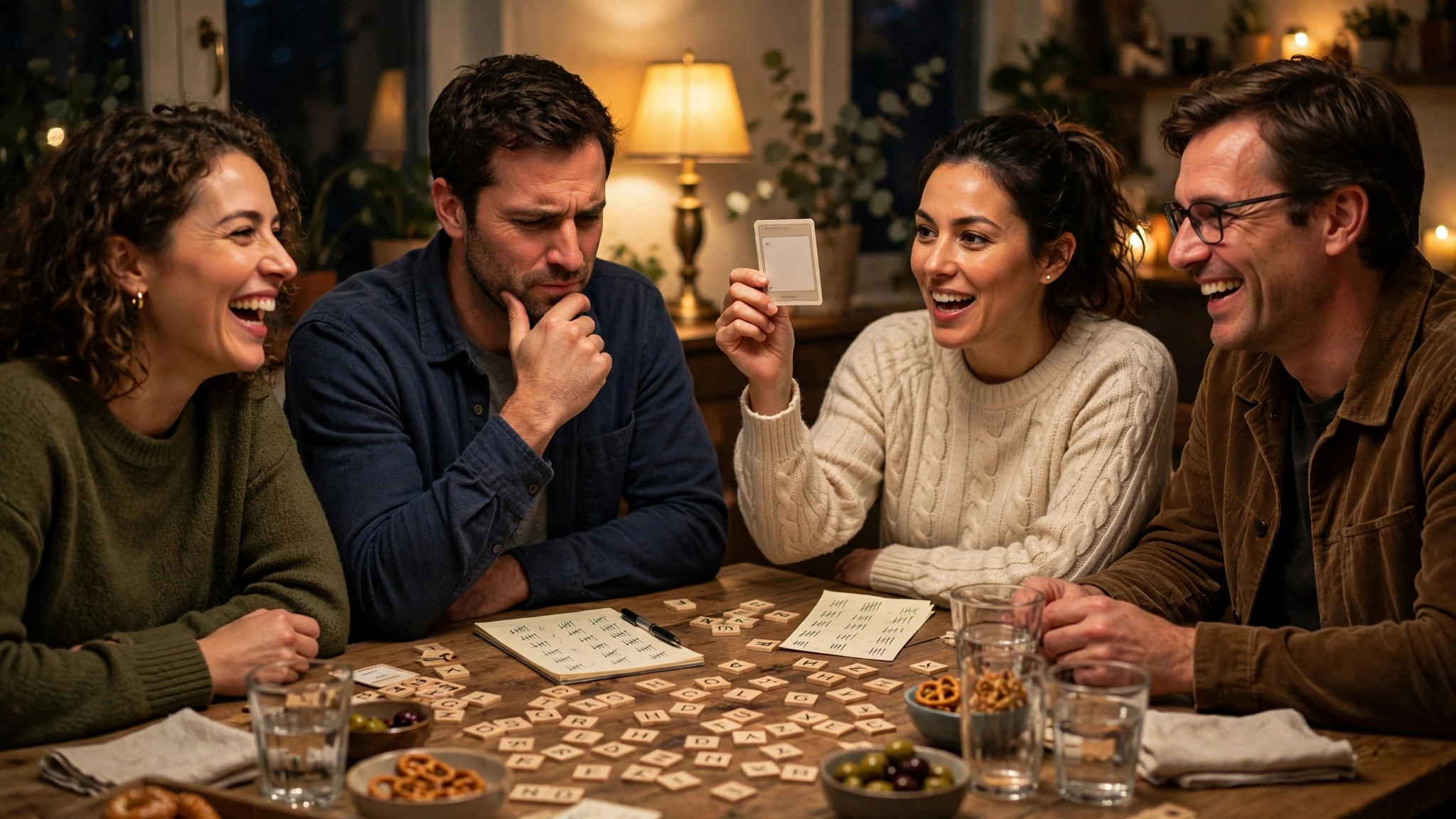
Shake the grid, start the 3-minute timer, and find as many words as you can in the jumble of letter cubes. Boggle is over fifty years old (Parker Brothers, now Hasbro) and the core loop has not aged a day, because three minutes of frantic word-hunting is a format that does not need updating.
What keeps it on this list instead of the nostalgia shelf: it scales to any number of players, the rules fit in one sentence, and duplicate words get thrown out, which punishes the obvious answers and rewards the weird ones. Quiet, thoughtful players who hate being put on the spot in party games tend to love Boggle, because everyone works alone and nobody has to perform.
The honest catch: it is a solitary experience in a group setting. If your night needs conversation and laughter, pick Codenames or Anomia instead.
The facts: 2 or more players, about 15 minutes per game (3-minute rounds), originally Parker Brothers, now Hasbro.
5. Anomia – Loudest Party Energy
Anomia is the simplest concept on this list and somehow the funniest. Flip a card, check whether its symbol matches another player’s card, and if it does, race to shout out an example of the category on their card before they shout one from yours. Naming a breakfast cereal under pressure turns out to be genuinely hard, and the whole table loses it every time someone blanks on something obvious.
It is a Mensa Select winner, which sounds serious until you play it and spend the whole game yelling about dog breeds. Setup takes about a minute, the box is tiny, and it works as a warm-up before the main game or as the main event for a loud group. Wild cards that force unlikely symbol matches keep the tension high.
The honest catch: it is a shouting game. Great for a lively living room, terrible for thin apartment walls or anyone with a headache. Know your venue.
The facts: 3-6 players, about 25-30 minutes, published by Anomia Press in 2010.
6. Tapple – Best Under Timer Pressure
Tapple is built around a plastic wheel with a 10-second timer. Draw a category, name something in it starting with an available letter, tap the letter to lock it out, and pass the wheel before the timer runs out. Letters disappear fast, and by the end of a round you are desperately trying to think of a breakfast food starting with X.
It went viral on TikTok in 2024, and the appeal is obvious: rounds are quick, the rules need no explanation, and it handles up to eight players without breaking a sweat. The adult version, Tapple: After Dark, exists for groups that want spicier categories. For mixed-age or mixed-company groups, the original is the safer buy.
The honest catch: the wheel needs batteries, and the timer is the game, so a dead wheel is a dead game night. Keep spares in the box.
The facts: 2-8 players, about 15-20 minutes, published by The Op Games (formerly USAopoly) in 2012.
7. So Clover! – Best for Word Nerds
If your group loves Just One but finds it a bit light, So Clover! is the next step. Each player secretly writes one-word clues linking pairs of keywords on their clover board, then the group works together to reconstruct everyone’s pairs. The twist is that one keyword gets removed before the guessing starts, so the clues have to survive without their anchor.
It is from the same publisher as Just One (Repos Production), it is cooperative, and it rewards the kind of lateral thinking that word nerds live for. The Record of Legends sheet, where you track your high scores across sessions, gives it a campaign feel that keeps groups coming back.
The honest catch: it is thinkier than it looks, and the teach is fiddlier than Just One. Do not open with this one for non-gamers.
The facts: 3-6 players, about 30 minutes, published by Repos Production in 2021.
8. Scrabble – Best for Two Serious Players
Scrabble needs no introduction, which is exactly why it earns a qualified spot here. Two to four players, a 15×15 board, triple word scores, and the eternal argument about whether that word is actually in the dictionary. At its best it is a deep, satisfying duel; the 1948 classic still has around 4,000 clubs worldwide for a reason.
For adults specifically, Scrabble shines at two players with a glass of something and no clock. That is the honest framing. What does not work is treating it as a party game: with four casual players it drags, turns take forever, and someone always ends up staring at a rack of vowels while everyone else waits.
The honest catch: a full game runs about an hour, and the skill gap matters more here than in any other game on this list. Pair evenly matched players or the same person wins every time.
The facts: 2-4 players, about 60 minutes, published 1948; made by Hasbro in the US and Canada, Mattel elsewhere.
9. Quiddler – Best Card-Based Word Game
Quiddler is what you get when Scrabble has a baby with gin rummy. Eight rounds, and each round your hand gets one card bigger, from three cards up to ten. You draw, discard, and try to arrange your whole hand into words, scoring the letter values and eating the points of whatever is left unplayed.
It is a 1999 Mensa Select winner, it fits in a pocket, and it is one of the few word games that genuinely works solo (the box includes solitaire rules). Card players who find tile games fiddly tend to prefer this, and the escalating hand size gives every game a natural arc. Bonus points for the longest word and most words each round keep everyone hunting.
The honest catch: the scoring takes a minute to learn, and the first game runs longer than the 20-30 minutes on the box while everyone gets the hang of going out. Round two is where it clicks.
The facts: 1-8 players, about 20-30 minutes, published by Set Enterprises in 1998.
10. Paperback – Best for Board Gamers
Paperback is the odd one out here, and board gamers will love it for exactly that reason. It is a deck-building game where your deck is made of letter cards: each turn you spell a word from your hand, earn ink based on the word’s value, and spend it on better letters with special abilities. You are, thematically, an author racing to finish novels. It is as charming as it sounds.
This is the pick for the group that already plays hobby board games and finds most word games too light. The deck-building gives it real strategic depth, the letter abilities (draw extra cards, double a letter’s value) reward clever play, and a 10th anniversary edition refreshed the whole package.
The honest catch: it is the heaviest teach on this list, and non-gamers will bounce off it. Keep it for the game group, not the family reunion.
The facts: 2-5 players, about 45 minutes, published by Fowers Games in 2014.
11. Letter Jam – Brainiest Co-op
Letter Jam is the thinkiest game on this list. Everyone holds a letter they cannot see (the other players can), and the group cooperates to help each person deduce their own letters through numbered word clues. At the end, everyone unscrambles their letters into a final word. It is deduction, spelling, and teamwork braided together.
From Czech Games Edition (the Codenames publisher), it is the rare cooperative game with zero quarterbacking problem, because nobody can see their own information to boss others around with. Groups that love puzzles will find it deeply satisfying; it genuinely feels like cracking a code together.
The honest catch: 45 minutes is real, the teach is the longest here, and it can stall if one player gets stuck on a letter. Not a late-night, one-more-game pick. Play it first, while brains are fresh.
The facts: 2-6 players, about 45 minutes, published by Czech Games Edition in 2019.
12. Wordle: The Party Game – For Wordle Addicts
If your group still does the daily Wordle, this is the box version. One player (the host) writes a secret five-letter word, everyone else gets six guesses on dry-erase boards with green and yellow tiles, and the fewest tries wins the round. Four modes come in the box: classic, fast, timed, and team.
The appeal is pure familiarity: nobody needs to learn anything, because everyone already knows Wordle. The dry-erase boards mean unlimited play, and the host role rotates so everyone gets to pick the evil word. It is a solid choice for groups that do not think of themselves as “board game people” but play Wordle every morning.
The honest catch: it only seats four (the box includes three guess boards plus the host), and the novelty fades faster than the hobby games above. Great gift, good occasional game, not a collection cornerstone.
The facts: 2-4 players, about 20-30 minutes, published by Hasbro in 2022.
How We Picked These 12
Three criteria, applied the same way to every game. First, fun per minute for a normal adult group: not a tournament crowd, just friends who want to laugh and maybe argue a little. Second, replayability: games that survive ten plays beat games that are solved in two. Third, table-time honesty: the play time listed is the time it actually takes with real people, not the optimistic number on the box.
We left out pure trivia games (we have a separate guide to the best trivia board games) and drawing games, and we skipped games that need an app or a subscription to function. Everything here works with what is in the box.
Word Board Game FAQs
What is the best word board game for adults overall?
Codenames. It handles 4 to 8 players, teaches in five minutes, and works for both casual players and competitive groups. If your group prefers cooperating to competing, Just One is the equivalent pick.
What word games work for a large group of adults?
Codenames (up to 8), Tapple (up to 8), and Bananagrams (up to 8) all handle big groups well. Anomia seats 6 and is the loudest option. Avoid Scrabble and Letter Jam with more than 4, they slow down badly.
What is a good 2-player word game for adults?
Scrabble at two players is the classic duel, deep and unhurried. For something quicker, try Bananagrams head-to-head or Letter Jam as a two-player co-op. Our guide to the best two-player board games has more options beyond word games.
Are there cooperative word games where nobody loses?
Yes: Just One, So Clover!, and Letter Jam are all fully cooperative, so the group wins or loses together. They are the best picks for groups where competition gets personal.
What is the fastest word game on this list?
Bananagrams, at about 15 minutes a hand (sometimes five). Boggle’s 3-minute rounds are the fastest single rounds, and Tapple plays in 15-20 minutes. The slowest are Scrabble and Paperback at around 45-60 minutes.
If I only buy one word game, which should it be?
Codenames, and it is not close. It is our number one pick for a reason: it teaches in under five minutes, plays just as well with two people as with eight, and no two games ever feel the same. One box covers quiet nights and loud parties alike, which is more than any other game on this list can say.
The Short Version
Most adult groups only need three word games: Codenames for the main event, Just One for the warm-up, and Bananagrams for the filler slot. Add Anomia when the night needs noise and Scrabble when it needs a slow duel. Everything else on this list is for when one of those stops being enough.
Pick your game, then plan the night around it with our how to host a game night guide, and keep a second option ready from our best trivia board games roundup in case the word games run out of steam.
