
Last reviewed: September 2026
Thanksgiving minute to win it games turn paper cups, soft props, index cards, and painter’s tape into 60-second challenges for kids, teens, and adults. Pick four to eight games, give every player identical materials, and score each station separately. The 24 ideas below avoid eating races, blindfolds, balloons, glass, and shared mouth-contact props.
The clock adds energy, but the host still controls the pace. A one-minute attempt usually needs several more minutes for a demonstration, reset, and score check. Therefore, this guide treats the games as a flexible challenge circuit rather than a 24-round marathon.
This page focuses on timed skill games. For quiet, untimed, and conversation-led options, use the broader guide to Thanksgiving games for family gatherings. More year-round group activities are available in the Party Games collection.
Start With a Circuit, Not a 24-Game Marathon
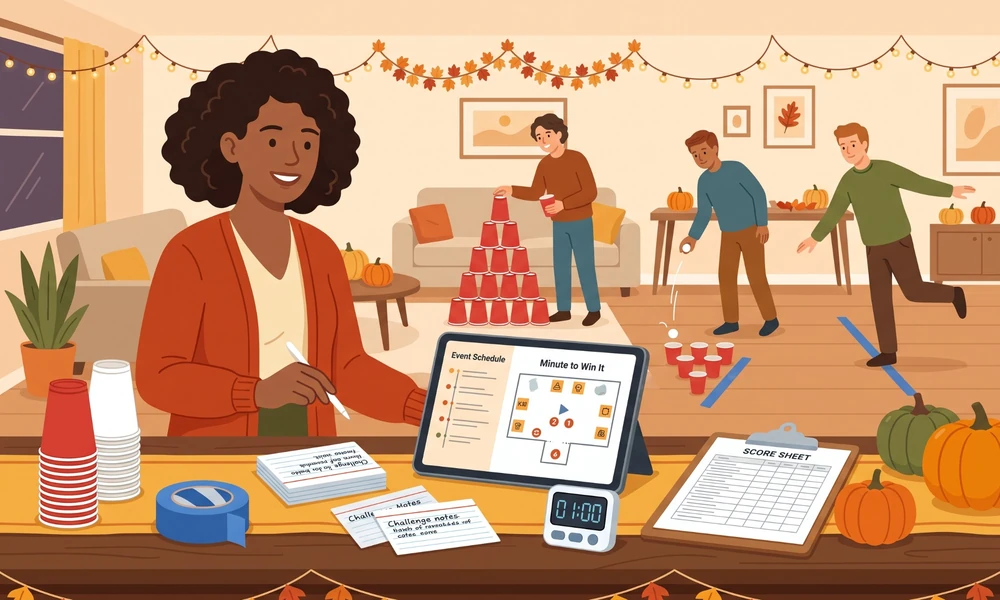
Four to eight Thanksgiving challenges are enough for most gatherings. First, choose a play format. Then select games that use different skills, such as stacking, sorting, aiming, memory, and teamwork. That mix keeps one fast or coordinated player from dominating every round.
| Format | How it runs | Best fit |
|---|---|---|
| Spotlight | One player or team attempts the challenge while the group watches. | Small groups with one supply kit |
| Head-to-head | Two players use matching setups at the same time. | Quick family or Friendsgiving rounds |
| Circuit | Teams rotate through separate stations on the same schedule. | Classrooms and groups of 12 or more |
For any format, announce one measurable objective before the timer starts. A player might complete a cup cycle, land soft objects in a target, or record the highest valid count. Meanwhile, the host should decide how ties, dropped pieces, and late movements will be handled. Changing those rules after a round creates avoidable disputes.
Use one practice attempt when the task is unfamiliar. After that, run one scored 60-second attempt. A 90-second round can work better for beginners or a mixed-ability group, but use the same announced limit for everyone in that round.
Choose a Ready-Made Route
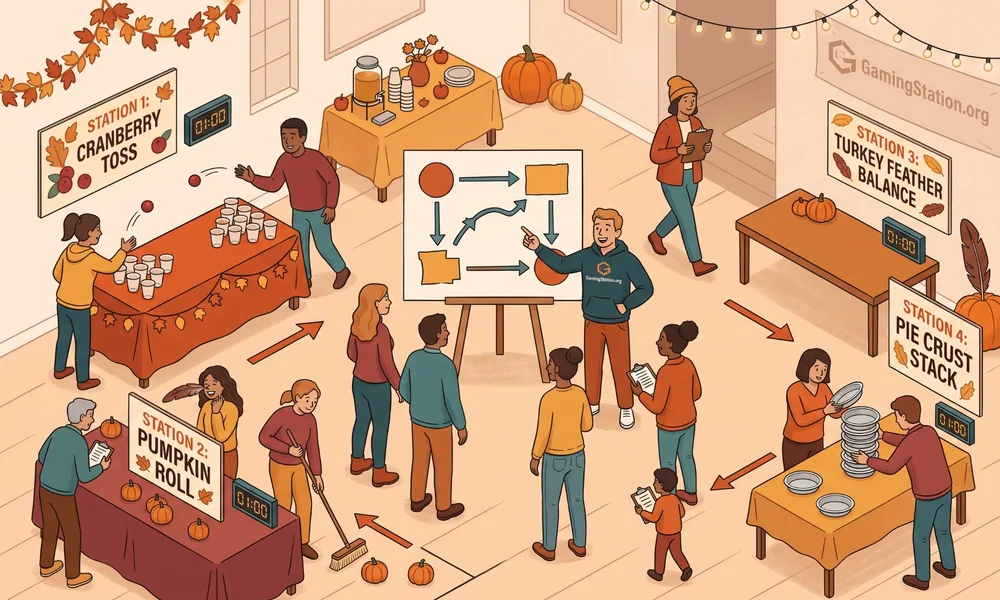
The routes below prevent the game list from becoming another hosting job. Total time includes short explanations and resets, not just the active minutes.
Hosts searching specifically for turkey minute to win it games can build a themed mini-route from Turkey Tail Clip-On, Turkey Tail Target, and Turkey Blueprint Relay.
| Route | Game order | Total time | Best use |
|---|---|---|---|
| Quick Three | Harvest Cup Pyramid → Feather Color Draft → Thanksgiving Charades Blitz | 15-20 min | A short wait before dinner |
| Balanced Five | Pumpkin Perch → Menu Pair Dash → Turkey Tail Target → Parade Pattern Copy → Turkey Blueprint Relay | 30-40 min | Mixed ages after dinner |
| Full Circuit | Pie-Plate Pantry → Cranberry Crate Transfer → Leaf Lane Sweep → Harvest Basket Toss → Pie Plate Slide → Place-Setting Snapshot → Harvest Word Scramble → Turkey Blueprint Relay | 55-70 min | Planned teams or stations |
If the gathering is mostly children, the age-grouped Thanksgiving games for kids page offers additional low-mess options. An adults-only group may prefer the wit and conversation in these Thanksgiving games for adults.
Build One Supply Crate
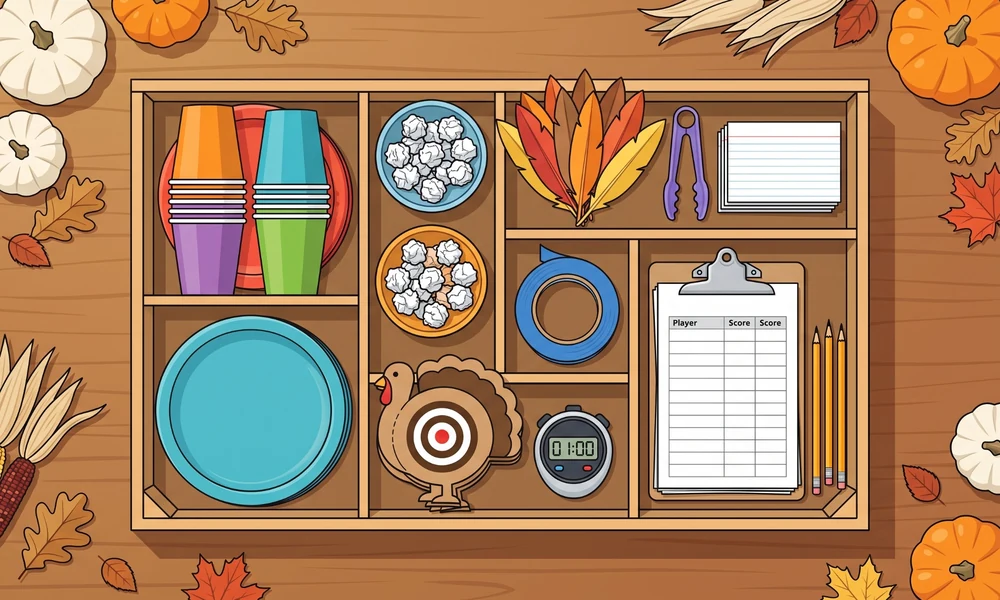
Most of these one minute Thanksgiving games use the same small set of reusable materials. Gather supplies only for the selected route, then place each game’s pieces in a labeled bag or tray.
- Containers: paper cups, paper plates, bowls, cardboard boxes, and shallow trays
- Large game pieces: crumpled paper balls, large pom-poms, rolled socks, paper leaves, and cardstock feathers
- Handling tools: child-safe tongs, large spoons, jumbo clothespins, and index cards
- Targets: painter’s tape, printed target sheets, cardboard gates, and lightweight paper-plate rings
- Host gear: a visible timer, pencils, rule cards, a clipboard, and the score sheet
Real cranberries, candy, apples, and meal dishes are not required. Paper versions create less mess and keep game materials away from the food. In addition, avoid breakable containers, sharp fasteners, hard throwing pieces, and objects that must be held in the mouth.
Zone 1: Stack and Balance
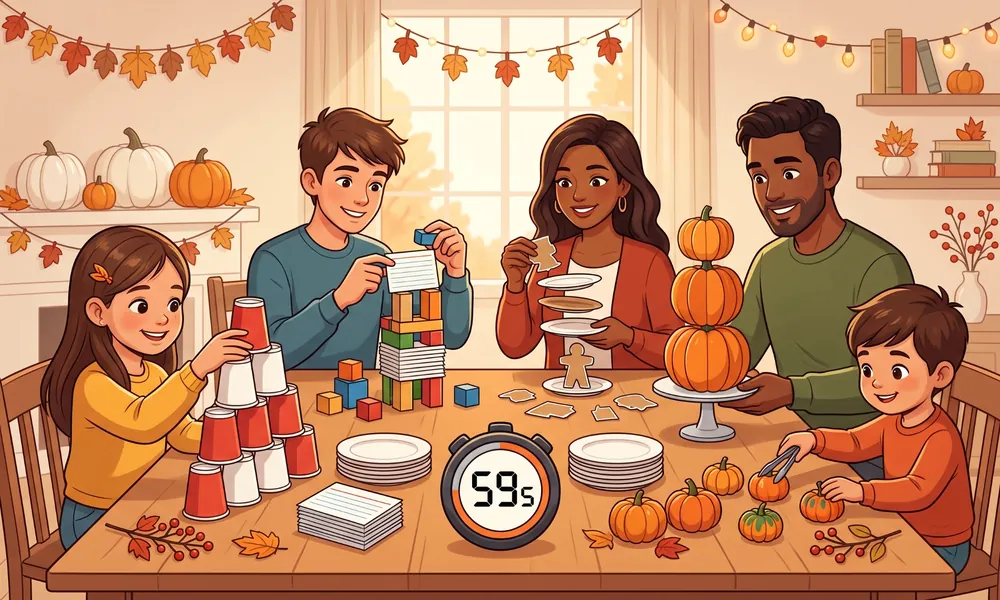
These six games reward steady hands rather than speed alone. Run them at a clear table, and keep every setup far enough from the edge that fallen pieces do not create a floor hazard.
1. Harvest Cup Pyramid
Best for: Ages 6+, solo or head-to-head
Supplies: 10 matching paper cups per player
Reset: About 20 seconds
Start with all ten cups nested. First, build a 4-3-2-1 pyramid. Then, take it down from the top and return the cups to one nested stack. Each complete build-and-collapse cycle earns one point. However, a partial pyramid at the buzzer does not count as a cycle.
For an easier round, use six cups in a 3-2-1 pyramid. A seated player can use the same setup without changing the scoring.
2. Turkey Tail Clip-On
Best for: Ages 6+, seated play
Supplies: Cardboard turkey body, 12 cardstock feathers, 12 jumbo clothespins
Reset: About 30 seconds
Lay the turkey body flat with its tail edge facing the player. Next, clip one feather at a time around the tail, using only one hand. Count feathers that remain attached when the timer ends. If two feathers share one clip, only one feather scores.
For younger players, use six feathers and allow both hands. If gripping a clothespin is uncomfortable, place the feathers into marked slots instead.
3. Pie-Plate Pantry
Best for: Ages 7+, individual play
Supplies: 8 paper cups and 5 sturdy paper plates
Reset: About 20 seconds
Build a freestanding tower by alternating one upside-down cup with one paper plate. The first level begins with a cup on the table, followed by a plate. Then, continue the pattern until time ends or the tower falls. Score one point for each plate that remains supported at the buzzer.
Only paper or lightweight reusable dishes should be used. For a simpler version, make the goal three stable plates rather than the highest total.
4. Thankful Card Tower
Best for: Ages 8+, quiet tabletop play
Supplies: 16 plain index cards
Reset: About 15 seconds
Players may fold, lean, or interlock the cards. However, they cannot use tape or another object for support. At the buzzer, count the number of cards held above the table in one connected, freestanding structure. The tower must stay up for a three-count.
Instead of comparing height, this scoring method rewards a stable build. Partners may alternate cards for a cooperative version.
5. Pumpkin Perch
Best for: Ages 6+, seated or standing play
Supplies: 8 upside-down paper cups, 8 large orange paper balls, child-safe tongs
Reset: About 20 seconds
Arrange the cups in one row. Next, use the tongs to place one paper “pumpkin” on each cup base without steadying the cup with the free hand. Each pumpkin that remains perched for three seconds earns one point. A fallen pumpkin may be tried again while time remains.
Move the cups closer together for beginners. A large spoon can replace the tongs when that grip is more comfortable.
6. Parade Float Slide
Best for: Ages 7+, solo or partner play
Supplies: Paper plate, 5 empty paper cups or small cardboard blocks, painter’s tape
Reset: About 30 seconds
Mark a start line and a finish line about 24 inches apart on a table. First, stack the five pieces on the plate. Then, slide the entire “float” across the finish without lifting the plate. A complete delivery earns one point; reset and continue until the buzzer.
For a partner round, one person builds and the other slides. Keep the course on the tabletop rather than carrying the stack across the room.
Zone 2: Sort and Transfer
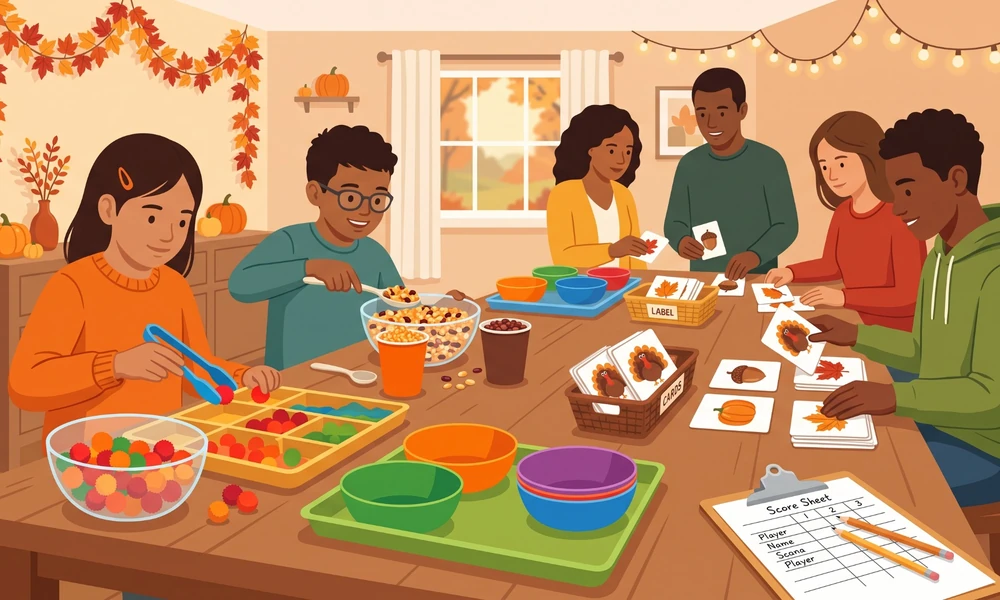
This zone uses quick hand movements with clear counting rules. Each piece should begin in the same position for every opponent, so take a photo of the starting layout before the first round.
7. Cranberry Crate Transfer
Best for: Ages 6+, seated stations
Supplies: 2 bowls, 15 large red pom-poms or paper balls, child-safe tongs
Reset: About 15 seconds
Place the full bowl on the player’s non-dominant side and the empty bowl on the other side. Then, transfer one “cranberry” at a time with the tongs. The free hand must stay flat on the table. Count only pieces resting in the second bowl at the buzzer.
For easier play, move the bowls closer or use a spoon. Do not use real food from the meal as game equipment.
8. Feather Color Draft
Best for: Ages 5+, visual sorting
Supplies: 18 cardstock feathers in 3 colors and 3 matching paper cups
Reset: About 20 seconds
Mix the feathers in one shallow tray. Next, players move one feather at a time into the matching cup. Correctly sorted feathers earn one point, while a feather in the wrong cup earns no point until corrected. Players may fix mistakes before time expires.
Use two colors for an easier round. For a non-color version, print a shape on each feather and the matching cup label.
9. Cornucopia Clip Count
Best for: Ages 7+, fine-motor play
Supplies: Cardboard cone or printed cornucopia board, 16 jumbo clothespins
Reset: About 15 seconds
Set the cornucopia flat on the table. Using one hand, clip as many clothespins as possible around its outer edge. Every clip must grip the cardboard and remain attached at the buzzer. Then, count one point per valid clip.
Allow two hands or a partner who steadies the board when needed. Players who prefer not to pinch clips can place large paper shapes onto printed spaces instead.
10. Menu Pair Dash
Best for: Ages 6+, quiet tables
Supplies: 12 face-up picture cards forming 6 matching pairs
Reset: About 20 seconds
Scatter the cards face up inside a taped square. Next, move one card at a time to a pairing area and place it beside its exact match. Each correct pair earns one point. An unmatched card may remain in the pairing area, but it does not score.
Use familiar icons rather than written food names for early readers. For a harder round, turn the cards face down and score memory matches.
11. Pumpkin Parcel Pass
Best for: Ages 7+, two-player teams
Supplies: Large orange paper ball, 2 paper plates, 2 trays
Reset: About 10 seconds
Partners sit or stand beside the same table. First, they use the paper plates as scoops to move the pumpkin from the first tray to the second without touching it with their hands. Then, they reverse direction. Each successful tray-to-tray delivery earns one point.
Place the trays 18 to 24 inches apart. If the ball falls, return it to the last tray instead of reaching toward the floor during play.
12. Leaf Lane Sweep
Best for: Ages 6+, low-mess movement
Supplies: 12 paper leaves, index card, two tape lines
Reset: About 20 seconds
Spread the leaves behind the start line on a clear table. Next, fan them with the index card until they cross the finish line. Hands and the card may not touch a leaf. Finally, score one point per leaf fully beyond the line when time ends.
This version replaces blowing games and shared straws. Shorten the lane or use larger leaves when the first setup is too difficult.
Zone 3: Aim and Land
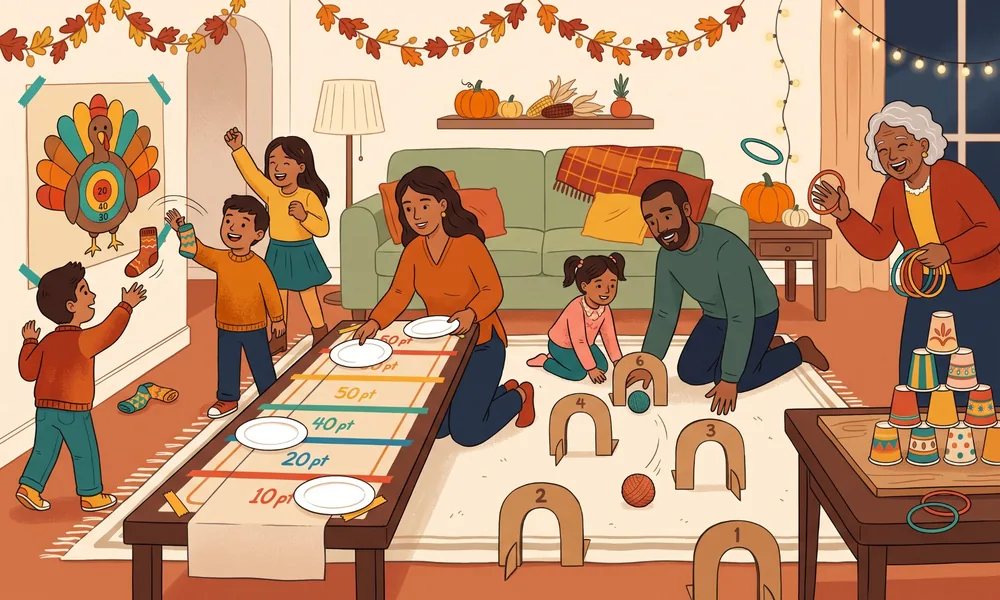
Mark every throwing or sliding line before play. Use only soft, lightweight objects, and ask players to retrieve them after the host closes the round.
13. Turkey Tail Target
Best for: Ages 6+, indoor target play
Supplies: 6 rolled socks, large turkey-tail target, tape line
Reset: About 20 seconds
Place the target flat on the floor or against a stable cardboard box. From the marked line, toss one rolled sock at a time. The center tail section scores three points, the next sections score two, and the outer sections score one. Then, add the value of socks touching a scoring area at the buzzer.
Move the line closer for children or seated players. If a sock touches two zones, award the lower value announced before play.
14. Harvest Basket Toss
Best for: Ages 6+, head-to-head play
Supplies: 10 crumpled paper balls and 3 cardboard boxes
Reset: About 30 seconds
Set three boxes at increasing distances. Label the closest basket one point, the middle basket two, and the far basket three. Next, players toss one paper ball at a time and may collect a second batch only after all ten have been used. Finally, add the value of balls inside the boxes when time ends.
For a cooperative round, set one group target, such as 15 total points, and let teammates alternate throws.
15. Pie Plate Slide
Best for: Ages 7+, open floor space
Supplies: 6 paper plates and painter’s-tape scoring zones
Reset: About 20 seconds
Create three wide floor zones worth one, two, and three points. From behind the line, slide one paper plate at a time. A plate scores according to the zone containing most of it after every slide stops. However, plates knocked outside the course score zero.
Run this game away from foot traffic and food service. A tabletop version with smaller paper circles works for seated players.
16. Parade Route Roll
Best for: Ages 6+, controlled movement
Supplies: Soft foam ball, 2 cardboard gates, finish box
Reset: About 20 seconds
Place two wide cardboard gates in a straight line and the finish box beyond them. Next, roll the ball from the start so it passes through both gates and reaches the box. Each complete route earns one point. Then, reset the ball after every attempt.
The player should roll, not throw or kick. Widen the gates or remove the second gate for an easier version.
17. Landing Leaves
Best for: Ages 5+, seated play
Supplies: 15 cardstock leaves and one paper plate
Reset: About 15 seconds
Hold one leaf about 18 inches above the plate and release it without guiding it after the drop. A leaf that comes to rest with any part touching the plate earns one point. Then, continue with fresh leaves until time ends.
Use a larger tray for beginners. Because the leaves drift differently, this game works best as a light skill round rather than the final tiebreaker.
18. Cornucopia Ring Land
Best for: Ages 6+, solo or head-to-head
Supplies: 6 lightweight cardboard rings and 3 weighted paper cups
Reset: About 20 seconds
Place the cups at three marked distances and add a little crumpled paper inside each for stability. Next, toss one ring at a time. The closest cup scores one point, the middle cup two, and the far cup three. However, a ring must settle around the cup to count.
Use wide rings and move every cup closer for beginners. Do not use glass bottles or hard rings.
Zone 4: Think and Team Up
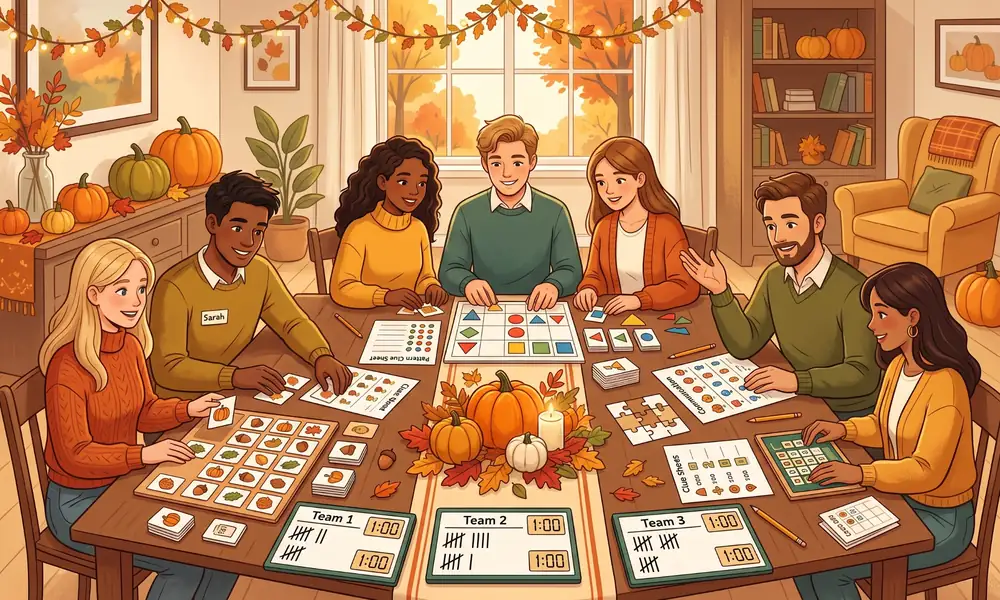
The last zone gives quick thinkers, readers, and communicators a path to score. These games also balance a circuit that already contains several hand-skill or target challenges.
19. Parade Pattern Copy
Best for: Ages 6+, memory and sequencing
Supplies: Two identical sets of 8 colored parade cards
Reset: About 20 seconds
First, show a six-card pattern for ten seconds. Then, cover it. The player uses the second set to rebuild the sequence from left to right. A fully correct sequence earns three points. Otherwise, award one point for each card in the correct position, up to two points.
Start with four cards for younger players. A host may name the colors or symbols aloud before covering the sample.
20. Place-Setting Snapshot
Best for: Ages 7+, visual memory
Supplies: Printed paper plate, cup, napkin, spoon, and fork pieces; reference card
Reset: About 20 seconds
First, display the reference arrangement for ten seconds. Next, cover it, mix the paper pieces, and start the timer. The player rebuilds the layout inside a taped place mat. Finally, score one point for each piece in the correct position and orientation.
Use printed pieces only, not meal dishes or utensils. For team play, one teammate studies the card and describes the layout without touching the pieces.
21. Thanksgiving Charades Blitz
Best for: Ages 7+, teams of 3 or more
Supplies: Prompt cards and timer
Reset: About 15 seconds
One actor draws a prompt and mimes it without speaking, spelling, or pointing to the answer in the room. The team earns one point for every correct answer in 60 seconds, and the actor may pass once. Then, rotate actors after each attempt.
The free Charades Generator can create clean general prompts. For this round, the printable pack adds Thanksgiving-themed cards. Acting from a chair or with a partner remains valid.
22. Harvest Word Scramble
Best for: Ages 8+, readers and small teams
Supplies: Printable scramble card, pencil, answer key
Reset: About 10 seconds
Give each player or team the same card with six scrambled seasonal words. Start with familiar answers such as LEAF, PIE, PARADE, and THANKS. Each correctly solved word earns one point. Spelling must match the answer key; however, capitalization does not matter.
Read the scrambled letters aloud when needed. An easier card can include a small picture clue beside each word.
23. Thankful Categories Relay
Best for: Ages 8+, teams of 2-5
Supplies: Category sheet and one pencil per team
Reset: About 15 seconds
The sheet lists six neutral categories, such as games, places, people who help a community, useful objects, enjoyable sounds, and things found outdoors. Teammates take turns writing one answer. Then, they pass the pencil. Score one point per relevant, readable answer with no repeats.
Nobody must disclose a private memory or personal relationship. For a non-writing version, one player records answers spoken by the team.
24. Turkey Blueprint Relay
Best for: Ages 7+, two-player teams
Supplies: Blueprint card, paper turkey pieces, privacy folder
Reset: About 30 seconds
One teammate sees a completed paper turkey while the builder sees only the loose shapes. The describer may explain colors, positions, and directions. However, the describer cannot point or touch the pieces. The builder has 60 seconds to recreate the design. Finally, score one point for each correctly placed piece.
For younger teams, remove two decorative pieces. Partners may sit side by side with the blueprint hidden behind a folder.
Score the Circuit Without Arguments
Raw results make sense inside one challenge: seven successful tosses can beat five successful tosses. However, seven tosses should not automatically beat twelve sorted feathers because the tasks use different units.
For a multi-game circuit, rank teams within each station and then convert the results to circuit points:
- First place: 3 circuit points
- Second place: 2 circuit points
- Third place: 1 circuit point
- All other completed attempts: 0 circuit points
Teams that tie can receive the same circuit points. Alternatively, use one short tiebreaker that was announced before play. Record the raw result first, because it makes recounts and tie decisions easier.
Also keep the starting conditions consistent. Use the same cups, distances, number of pieces, timer, and practice allowance for every opponent. The printable score sheet includes space for both raw results and circuit points.
Keep the Games Fair, Comfortable, and Meal-Safe

A good circuit lets people participate without requiring the same movement, reading speed, or comfort level. Before the first round, show one complete example, read the rule aloud, and keep a printed version at the station. The U.S. Department of Justice’s effective communication guidance lists options such as large print and accessible electronic copies; for a private gathering, the useful hosting principle is to ask what format helps.
Use these checks as the room is set up:
- Offer seated play, a partner role, or jobs such as timer, reader, reset helper, and scorekeeper.
- Keep targets away from doorways, stairs, hot dishes, cords, pets, and busy walkways.
- Do not use blindfolds, running, backward movement, body restraints, or eating races.
- Use large, soft pieces and store them after play. The U.S. Consumer Product Safety Commission explains why products with small parts require special caution around young children. This list also avoids balloons; the CPSC warns that uninflated or broken balloons can be dangerous to children.
- Run games on a separate table from cooking and serving. FoodSafety.gov’s four food-safety steps emphasize clean hands, utensils, and surfaces, as well as separating items that can spread germs.
Finally, stop the timer if someone enters the play area or a prop reaches the meal space. A clean reset matters more than finishing the minute.
Download the Thanksgiving Minute-to-Win-It Challenge Pack
The nine-page printable supports the article without repeating all 24 games. It includes challeng e cards, a circuit planner, consistent timer rules, a reusable team score sheet, and a host setup page.
Free 9-Page Printable
Thanksgiving Minute-to-Win-It Challenge Pack
Get all 24 challenge cards, a circuit planner, consistent timer rules, and a reusable team score sheet for an easier Thanksgiving game night.
Download the Free Challenge Pack (PDF)Five Quick Questions Before You Host
Choose four to eight challenges, give competing players identical materials, explain and demonstrate one attempt, and start a visible 60-second timer. Record only the valid result reached before the buzzer. For a large gathering, prepare duplicate kits or use stations so players spend less time waiting.
Plan three games for a 15- to 20-minute activity, five games for a 30- to 40-minute session, or up to eight for a full circuit of about an hour. Those estimates include explanations and resets. Trying to run all 24 games at one gathering will usually feel rushed.
A scored attempt normally lasts 60 seconds, but the complete round takes longer because the host must explain, demonstrate, reset, and record the score. A 90-second limit can suit beginners or a mixed-ability group. Announce the limit first and use it consistently for everyone in that round.
Record each team’s raw result at its station, rank the teams within that same game, and then award circuit points such as three for first, two for second, and one for third. Do not add unrelated raw results, such as landed tosses and sorted pieces, because the challenge scales are different.
Harvest Cup Pyramid, Feather Color Draft, Turkey Tail Target, Parade Pattern Copy, and Turkey Blueprint Relay create a balanced five-game route. To widen access, offer seated play, partners, fewer pieces, or a closer target. Keep the published time and scoring rule identical for players competing in the same round.
End With One Winning Round
The strongest Thanksgiving minute to win it games have one clear objective, a visible timer, equal materials, and a score that can be checked quickly. Select four to eight rather than all 24. Then mix steady hands, aiming, thinking, and teamwork so different players get a moment to help their team.
For a simple starting circuit, use Harvest Cup Pyramid, Feather Color Draft, Turkey Tail Target, Parade Pattern Copy, and Turkey Blueprint Relay. Keep one seated game ready as a backup, record which rounds the group wants again, and leave the rest for another gathering.
Want the spooky-season version? These Minute to Win It Halloween games work for kids, teens, and adults.
