
Trading cards have always been physical objects, but they have not always been treated the way they are now.
For a long time, the default was simple: cards went into sleeves, binders, deck boxes or storage tubs. Some were played, some were traded, and some were tucked away because they were too valuable to risk damaging.
That still happens, obviously. But there is now a much bigger middle ground between “playing card” and “stored collectible”.
More collectors are choosing to actually live with part of their collection.
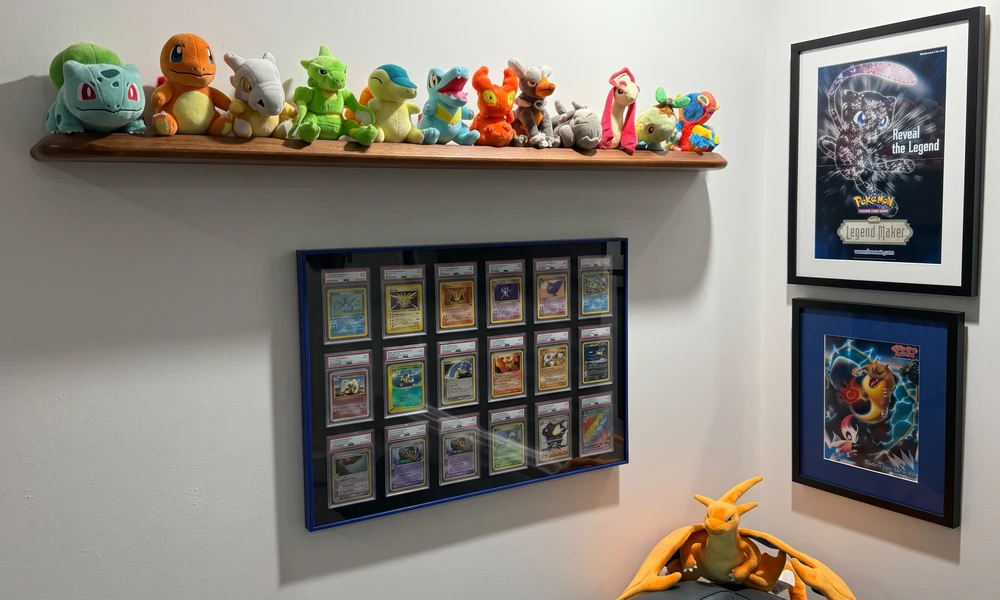
That might mean a few graded cards on a desk, a row of favourite slabs above a gaming setup, or an entire wall built around one player, set, character or era.
The cards have not suddenly changed.
What has changed is what people expect a collection to be.
Storage is useful, but it does not have to be the end point
Binders and boxes are still some of the best ways to organise a collection. They are compact, practical and easy to move around.
But storage solves a very specific problem: keeping things safe and organised.
It does not necessarily solve the other side of collecting, which is actually enjoying what you own.
A collection can spend years getting better while becoming almost completely invisible. You buy the cards, grade them, sleeve them, catalogue them, and put them back into storage.
For some collectors, that is exactly what they want.
Others eventually reach a point where they start thinking, “Why do I own all of this if I never actually see any of it?”
That is usually where display starts becoming interesting.
Grading changed more than just protection
Grading has probably played a big part in this shift.
A loose trading card still feels like something you could pick up, shuffle or move between a binder and a deck. A graded card feels much more permanent.
The slab gives it a fixed size, a label, a grade and a consistent shape. Put a few together and they start to feel more like a group of objects than a stack of cards.
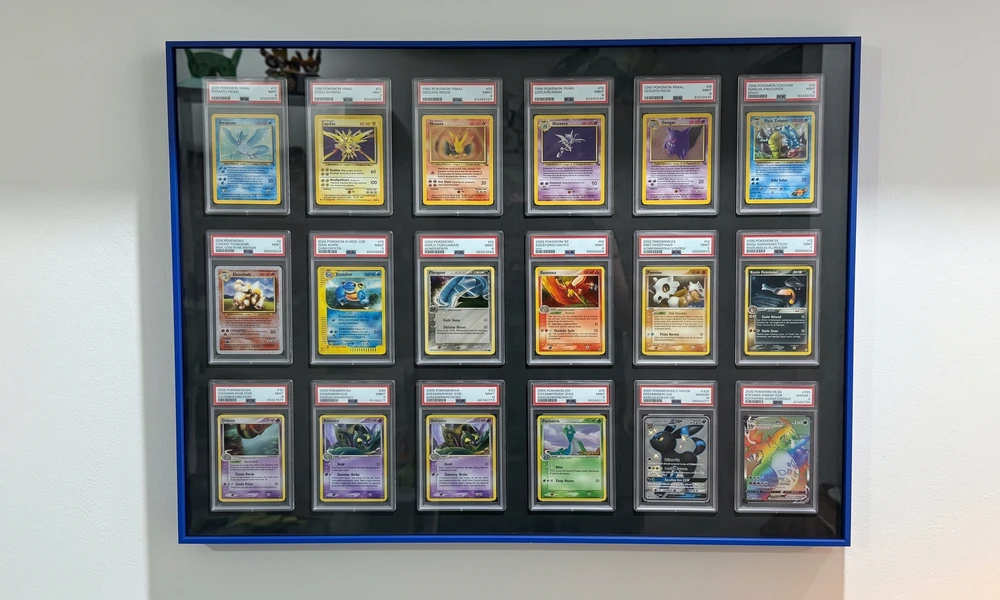
Put twenty together and the whole thing changes again.
Suddenly there is repetition. Rows. Labels. Colour. Spacing.
The collection starts to have a visual structure.
The same thing happens with cards in matching magnetic holders. Once the holders become consistent, the cards are much easier to think about as a group.
That has opened up a completely different way of presenting collections.
Once cards hit the wall, layout starts to matter
A binder decides the layout for you.
Nine pockets per page. Turn the page. Keep going.
A wall gives you far more freedom, but that also means you actually have to make decisions.
Do the cards sit in a tight grid or have more space around them? Should they be grouped by set, character, player, or colour? Would one large display work better than several smaller ones?
These sound like small details until you start displaying larger numbers.
Three cards can be arranged almost anywhere and still look fine.
Thirty cards cannot.
Once a collection takes up a meaningful amount of wall space, the room becomes part of the decision.
That is when measuring, spacing and proportion start to matter far more than people expect.
Trading cards were already made to be looked at
It makes sense that this has happened because modern trading cards are incredibly visual.
Pokémon cards can have full-art illustrations, textured surfaces, unusual foils and artwork that spreads across almost the entire card. Sports cards use photography, team colours, signatures, patches and memorabilia pieces.
Magic: The Gathering and Yu-Gi-Oh! have huge visual identities of their own, often tied closely to particular eras, artists or card styles.
These are not plain pieces of cardboard with numbers printed on them.
A lot of the hobby revolves around design.
Collectors already care about centring, print quality, foil patterns, artwork and presentation. Display is really just an extension of that.
Once several cards are put together, the overall effect can be much more interesting than looking at them one at a time.
You do not need to put everything on the wall
This is where people sometimes overthink it.
Displaying cards does not mean emptying every binder and turning the entire house into a card room.
Most collections work better when storage and display are used together. If you haven’t worked out the details on choosing holders, glazing and safe mounting yet, that’s worth sorting before anything goes on the wall.
Bulk cards can stay boxed. Complete sets can stay in binders. Cards that are rarely handled can stay exactly where they are.
The display can simply be the part of the collection worth seeing.
That might be a favourite player, a specific Pokémon, a run of graded cards, an entire set or just a handful of cards that look good together.
There is no rule saying the most expensive card has to be the one on display either.
Sometimes the cards that work best visually are not the ones with the highest value.
Bigger displays create different problems
Once displays start getting large, the conversation becomes more practical.
A 50-card display is not just a bigger version of a five-card display.
The total weight changes. The wall matters more. Spacing errors become easier to notice. Different slab sizes become more annoying. Acrylic or glass starts to contribute real weight. Mounting hardware suddenly matters quite a lot.
Even the dimensions of the room start to become important.
A display can look perfectly reasonable on a screen and then completely dominate the wall once it exists at full size.
This is also why trading-card display has started becoming a category of its own. Businesses such as The Card Collective now exist specifically around the way collectors present cards rather than treating them like generic photographs or ordinary memorabilia.
That is probably a sign of where the hobby has moved.
People are not just thinking about what cards they want anymore.
They are thinking about what they want the collection to look like once they have them.
The hobby is much more visual online now
Social media has helped push this along, mostly because collectors now share far more than individual cards.
You see full shelves, graded-card walls, gaming rooms, desk setups and entire collections arranged as part of a space.
That changes what people think is possible.
Someone who has only ever kept cards in a binder suddenly sees a wall of slabs organised by set or colour and thinks, “That actually looks good.”
The idea spreads from there.
You see more experimentation, more unusual layouts and more people thinking about presentation as part of collecting rather than something separate from it.
At Some Point, Trading Cards Become Part of the Room
That is probably the biggest change.
Once you display cards properly, they stop feeling like objects that happen to sit in the same place.
They start working together.
You notice the relationship between cards more easily. Sets make sense at a glance. A favourite character becomes obvious. A player collection suddenly feels complete in a way it never did when spread across three storage boxes.
The room changes too.
A display says something about what the person living there actually cares about.
That is no different from records on a shelf, framed jerseys, books, artwork or models.
Trading cards are simply joining that group.
They can still be played, stored, and traded.
But for a lot of collectors, they are also becoming something worth seeing every day.
And once that happens, they stop being just game pieces sitting in a box.
They become part of the room.
