
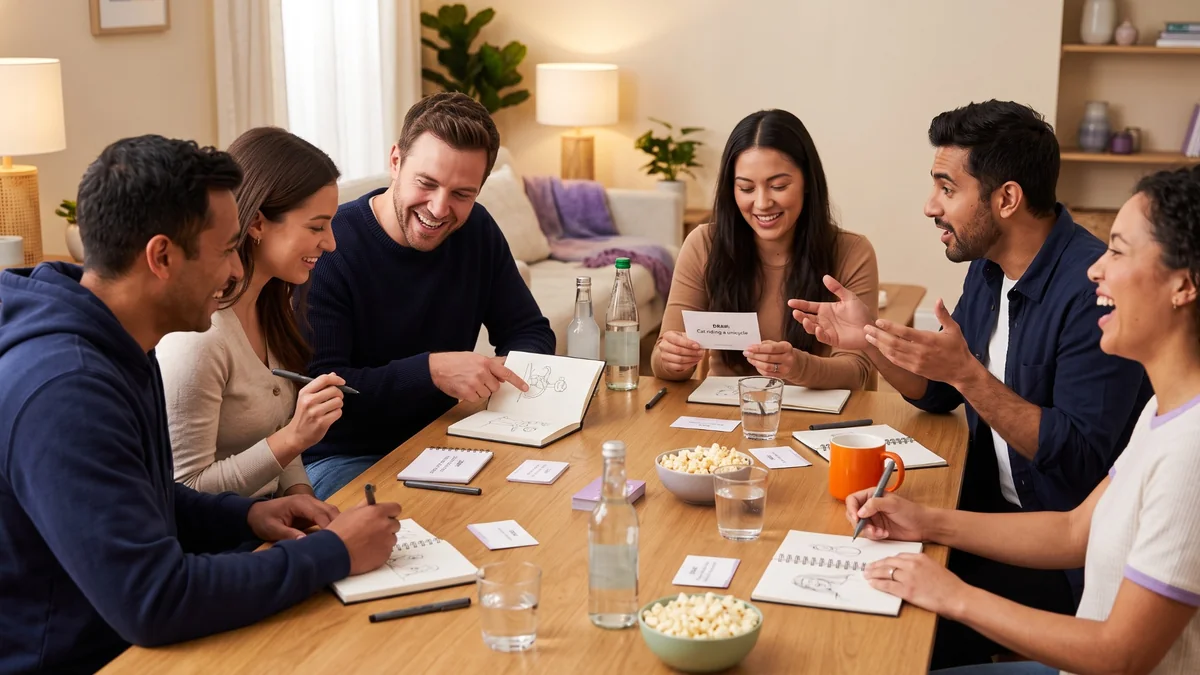
The best party games for adults fit the people in the room. For four to seven guests who want to work together, start with Just One. If eight to twelve people want to draw and laugh, choose the 12-player edition of Telestrations. For a crowd of up to twenty, Herd Mentality lets everyone answer at the same time. A good pick gives guests something to do together without a long rules lesson or a long wait between turns.
Below, the games are grouped by the kind of evening they create: conversation, clues, drawing or movement. Player counts refer to the standard editions linked to their publishers. Check the exact box before inviting a group around a game, especially when several editions share a name.
Best party games for adults by group size
| Guests playing | A good starting choice | Why it fits |
|---|---|---|
| 3-7 | Just One | Everyone writes clues for the same shared goal. |
| 8-12 | Telestrations 12 Player | Each person draws and guesses; the 8-player box stops at eight. |
| 13-20 | Herd Mentality | The publisher supports up to twenty, and answers are written together. |
However, head count is only the first filter. A crowded room with little table space may suit a team word game better than a drawing game with twelve books. Likewise, people who have just met may enjoy a cooperative round before a game built around bluffing.
For a group that wants to talk
Wavelength: debate where the clue belongs
In Wavelength, two teams try to judge where a clue sits on a scale between two ideas. Much of the fun happens while teammates explain why a clue belongs closer to one end than the other. For example, the same clue can feel mild to one teammate and extreme to another. It is a good match for a seated group that likes discussing opinions more than racing a timer.
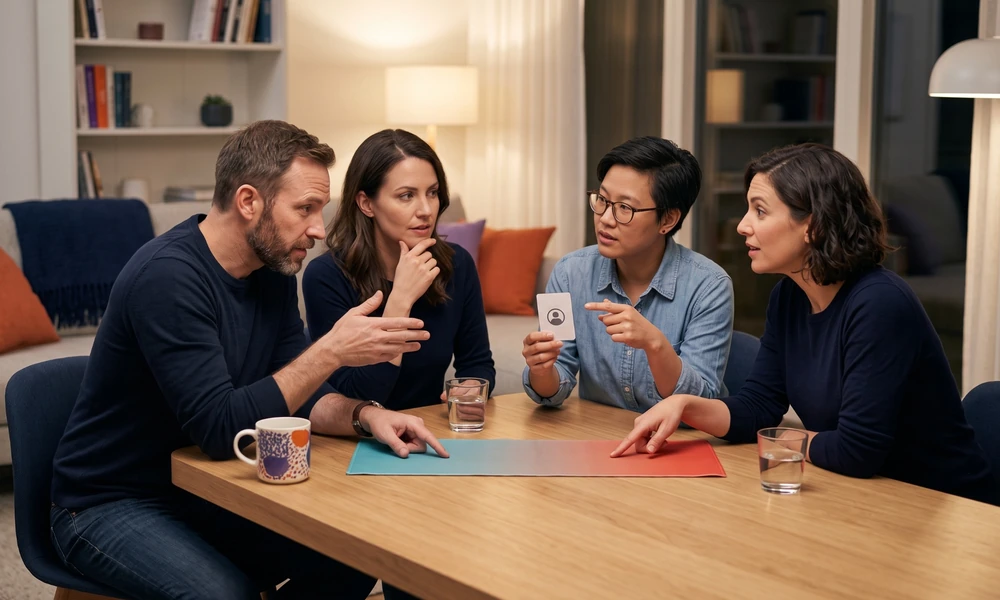
Give the table room to hear both teams. If guests mostly want quick rounds or dislike explaining their choices aloud, bring out a shorter clue game instead. CMYK describes the game as a two-team social guessing game; confirm the player guidance on your copy before you set the teams.
Just One: work together without putting a newcomer on the spot
Just One supports 3-7 players. One person tries to guess a word while the others write separate one-word clues. Matching clues are removed, so obvious answers can vanish before the guesser sees them.
Because everyone is helping one guesser, the table has a clear shared task. The setup is easy to explain to guests who have never played a modern party game. Still, check that everybody can see and write their own clues comfortably; the game depends on written words.
Herd Mentality: keep a big table in one game
The publisher lists Herd Mentality for 4-20 players, with a typical game around 20 minutes. A question is read aloud, everyone writes an answer, and players try to match the majority rather than give the cleverest reply. The simultaneous reveal gives a large group a reason to talk after every question.
For a dinner party, this works especially well when people are seated but do not all know one another. Read each prompt clearly and give everyone enough space to write. If the room is too large for a single conversation, split into separate games rather than expecting distant guests to hear every answer.
For people who like clues and a little tension
Codenames: make guesses as a team
Codenames is listed for 4-8+ players and about 15 minutes. Two clue-givers know which words belong to their teams. They give a one-word clue and a number; teammates then decide which cards to reveal. One ambitious clue can lead to a memorable discussion, although a wrong card may end the turn.
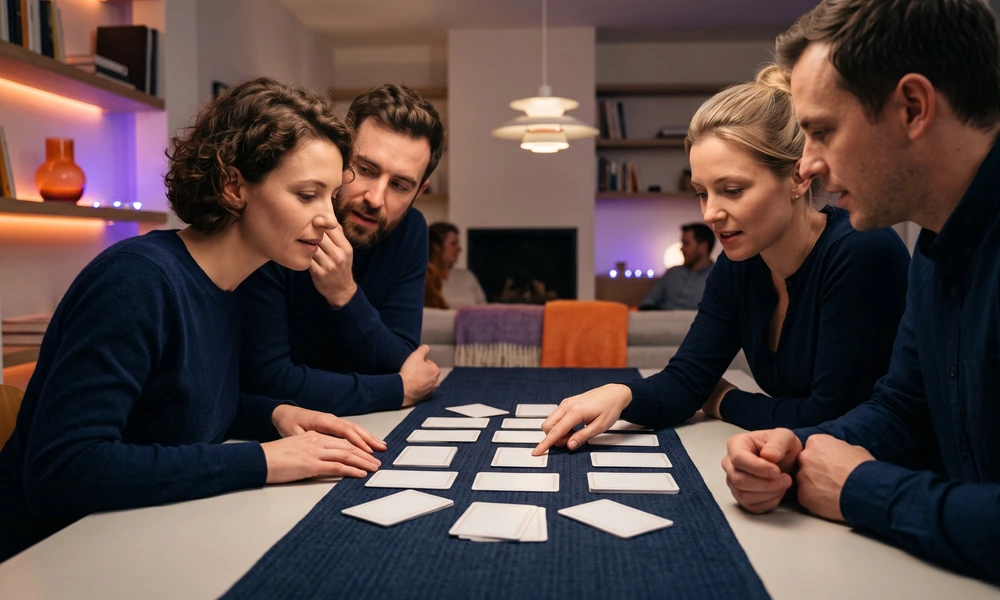
It suits a group happy to listen to teammates and weigh several possible meanings. Set out the word grid where everyone can read it. At higher player counts, keep teams small enough that quieter guests can contribute; the publisher’s open-ended player count does not guarantee that every room will hear every suggestion.
The Chameleon: bluff with a shared topic
In The Chameleon, most players know a secret word and give a related clue. One player lacks that word and tries to blend in. After hearing the clues, the group discusses who might be bluffing. Big Potato lists 3-8 players and a 15-minute game.
Choose this when guests enjoy reading each other’s clues and do not mind being briefly suspected. Explain the secret-word step before the first round; otherwise, a new player can give away the answer by mistake. For a group that would rather cooperate than accuse anyone, Just One is the gentler opening game.
Poetry for Neanderthals: make ordinary clues unexpectedly hard
The standard Poetry for Neanderthals asks players to help teammates guess words using only single-syllable clues. Its publisher lists 2 or more players and about 15 minutes. Restricting the clue words turns a familiar guessing task into a lively team challenge.
Keep it for a group comfortable speaking up and listening closely. Agree on the printed rules before play, and let anyone skip a word they find difficult to describe. If the group wants a calmer word game, return to Just One or Wavelength.
For drawing, movement and quick bursts of energy
Telestrations: let the drawing tell the joke
Players in Telestrations alternate between drawing a phrase and guessing what the previous person drew. Then the reveal shows how far the original idea traveled. No one needs to be a skilled artist; recognizable mistakes are often the most entertaining part.

The 8-player edition supports 4-8 people. A separate 12-player edition supports 4-12, and both publisher listings give an approximate 30-minute playtime. Check which box you own before choosing this for nine or more guests. Everyone needs a place to draw, so set out pens and books before the first round.
Happy Salmon: use a short round to wake up the room
The standard Happy Salmon is listed for 3-8 players, with a round of about 90 seconds. Players call out the actions on their cards, find someone with a matching action and complete it together. The first person to finish their cards wins.
As a result, it makes an energetic opener or a reset between seated games. Clear enough floor space for people to move and make sure every guest is comfortable with the actions before starting. If a quiet room or limited space makes shouting and movement awkward, use a written-answer game instead.
A simple 90-minute party-game plan
Plan the evening around the actual guests rather than trying to play every title above. For a group of six, a workable example is 10 minutes to arrive and settle, 15 minutes of Just One, 5 minutes for a break, 30 minutes of Telestrations, 10 minutes to chat over the drawings, and 20 minutes for another game or an easy finish. These are hosting estimates, not official playtimes for Just One or guarantees that a game will finish on schedule.
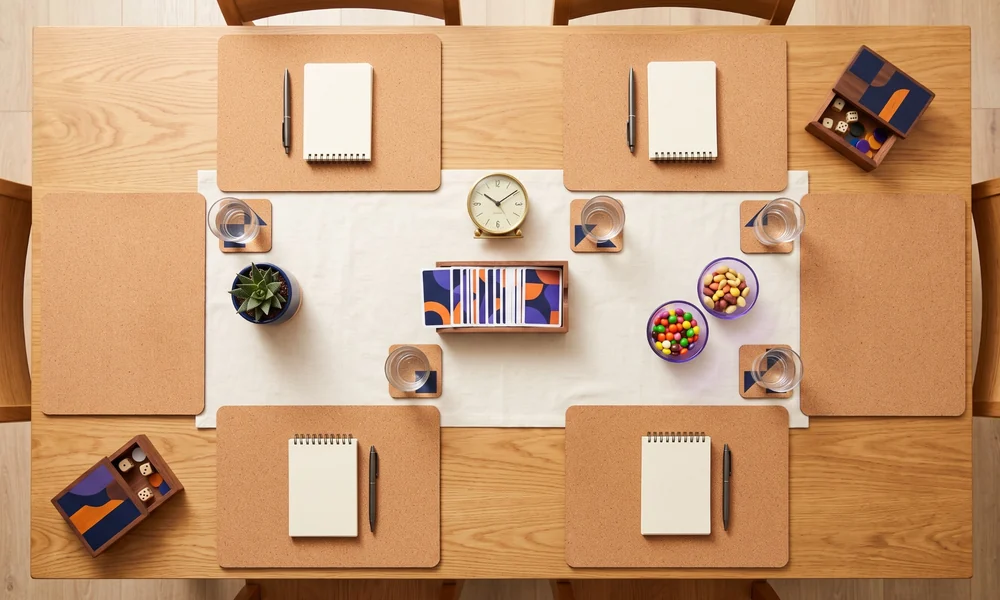
With twelve guests, use the Telestrations 12-player box or switch to Herd Mentality. At fifteen, start with Herd Mentality and keep a separate activity ready if smaller groups naturally form. If a guest arrives late, finish the current round and check that the next game’s printed player range still fits.
To make the night easier, choose a main game and one backup before guests arrive. Learn one sample turn, clear the table, and keep the rules nearby. Our board game night checklist covers the rest of the setup, including timing, seating and a backup plan. If your group prefers questions over clues, see our trivia board game picks. For an activity that needs no boxed game, the charades generator can supply prompts on a phone.
Frequently asked questions
At a party of 13-20 guests, Herd Mentality is a practical choice because its publisher lists that range and everyone writes an answer to each question. Above twenty, run separate tables and choose a game that fits each table.
Start with a shared task such as Just One for three to seven people or Herd Mentality for a bigger table. Both give guests a reason to talk about the round. Save bluffing games for later if the group seems comfortable with them.
Yes, if you have the 12-player edition, which the publisher lists for four to twelve people. The standard 8-player box is listed for four to eight; do not assume it contains the extra books and markers.
Happy Salmon uses cards and open space for movement instead of a large drawing area. If guests need to remain seated, Just One uses writing surfaces for a small group, while Codenames needs a visible word grid. Choose based on the space and the way your guests want to play.
Planning ahead for December? Our Christmas party games for adults has 21 funny, easy ideas for your holiday gathering.
