

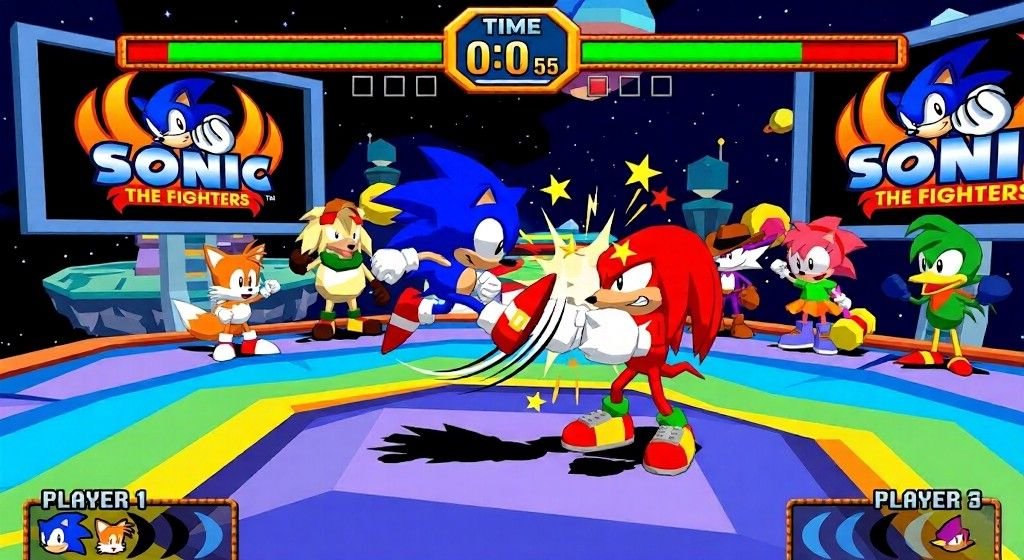
I still remember hearing about Sonic Championship back in 1996, when Sega was pushing new ideas in the arcade space. Even though my focus here starts later, that early idea shaped how this fighting game feels today. It came from AM2, running on the Model 2 system, which already powered strong titles. That origin explains why players got fast one-on-one battles built around a tight roster of characters.
What stands out to me is how the Sonic the Hedgehog series adapted to a 3D engine inspired by Fighting Vipers from 1995. You can feel how a programmer likely experimented with each model and animation to keep speed intact. From a design view, it is simple but intentional. The style avoids clutter, which keeps gameplay readable during quick matches.
The development path is also interesting from a production angle. Sonic Team worked on the project, but plans for a console version on the Sega Saturn were canceled. That left it as an arcade exclusive, which gave it a certain rarity. In my experience, that limitation actually made the game feel more focused and polished.
Things changed later when it returned in 2005 through Sonic Gems Collection on GameCube and PlayStation Vita. Then again, in 2012, it appeared on PlayStation 3 and Xbox 360, now playable with online versus mode. That addition made a big difference for modern access. It even showed up as a bonus in Like a Dragon, which was a fun surprise.
Looking at reviews, I see mixed thoughts, mostly about graphics and depth. From my perspective, the charm is in its speed and clarity rather than complexity. The gameplay loop is easy to learn but still engaging in short bursts. It may not compete with modern fighters, but it holds a unique place in Sonic history.
Let’s Talk About “Sonic the Fighters”
Gameplay of Sonic the Fighters
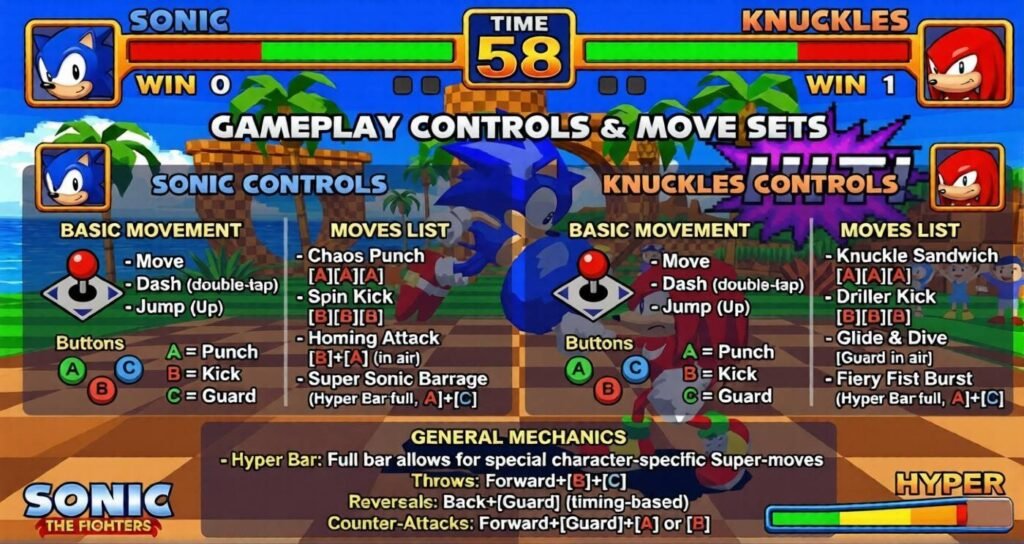
When I revisit Sonic the Fighters, I see a 3D fighting game that keeps things simple for players. The one-on-one battles feel quick, and each of the characters brings a clear style. Even though the earlier context shaped it, the gameplay stands on its own. It connects well with the Sonic the Hedgehog franchise and its light scenario.
In matches, I notice how friends compete over Chaos Emeralds in a fast tournament setting. The goal around the emeralds and a spaceship adds purpose without slowing the pace. You are still aware of antagonists like Doctor Robotnik and Metal Sonic building an evil fortress in space. This mix keeps fights focused but still tied to the story.
From my experience, the arcade roots and the 2005 release made the mechanics easy to pick up. Every fighter feels playable, from Miles Tails Prower to Knuckles the Echidna and Amy Rose. I also enjoyed using Espio the Chameleon and Fang the Sniper in short sessions. The original set even included eight fighters like Bean the Dynamite and Bark the Polar Bear.
Later, the 2012 re-release added more depth with Honey the Cat, plus hidden options once tied to hacking. This version made more content accessible and felt new again. I could sense the influence of Fighting Vipers from 1996 in how movement and hits connect.
What stands out most is how everything flows toward a clear goal to stop the threat. The system avoids clutter and keeps inputs readable under pressure. From a design view, that clarity is a smart choice. It makes each round easy to follow while still rewarding timing.
Development and release
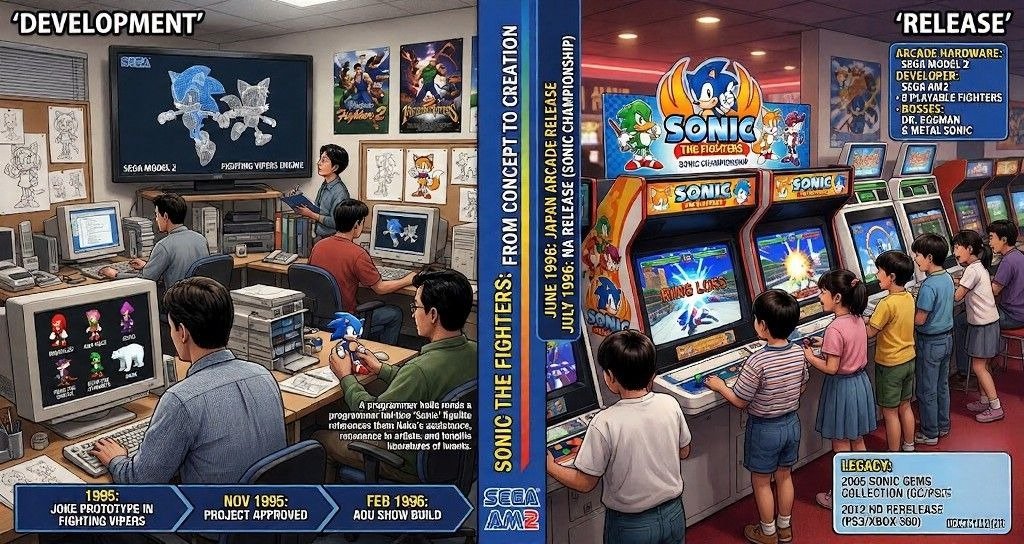
Looking beyond gameplay, I see Sonic the Fighters as a bold development effort by Sega AM2. Under Yu Suzuki, the idea of a Sonic the Hedgehog fighting game came from a simple model test by Masahiro Sugiyama. That early spark, tied to Fighting Vipers, shaped the direction. It showed how fast ideas can grow inside a skilled team.
From what I understand, Hiroshi Kataoka worked closely with Sonic Team, while Yuji Naka guided key choices. Even Naoto Ohshima supported how the animation turned out. The team used the Sega Model 2 arcade board and built on an existing engine. This helped them push clean 3D graphics without overcomplicating the process.
I find it interesting how a small figurine helped define character faces during production. The barrier mechanism, along with visual rings and a clear health bar, made fights easier to read. Simple controls were added with beginners in mind. Early prototypes even showed Tails in Green Hill Zone, setting a familiar tone.
As the roster grew, Bean the Dynamite and Bark the Polar Bear joined, with roots linked to Dynamite Düx from 1989. Later, Honey, an anthropomorphic cat, appeared through hackers, finding hidden data. These details show how flexible the project was. It kept evolving even after the main build felt complete.
The release path also tells a clear story. It started in June 1996 in Japan, then reached North America in July. Years later, it returned in 2005 with Sonic Gems Collection on GameCube and PlayStation 2. Then in 2012, it arrived on PlayStation 3 and Xbox 360, giving it a wider audience again.
Abandoned Sega Saturn port
After looking at its development, I find the story of the Sega Saturn port of Sonic the Fighters just as important. Sega had this in planning during the early stages, with release windows set for late 1996. This was meant to follow the arcade release closely. At that time, the goal felt realistic from a production view.
Things became more visible during E3 1996, a major video game convention. A SquareSoft representative saw a private demonstration using new development software. The press later shared a report that a Saturn version was shown. That moment made many believe the release was near.
By 1997, Computer and Video Games spread a rumor about launches in Japan and North America. The timeline pointed to a mid-year debut, then other regions months later. In 1998, it was still scheduled, though some plans had already been dropped. From experience, this kind of delay often signals deeper technical issues.
Looking back, Yojiro Ogawa from Sonic Team explained this in retrospect. He said it was difficult to reproduce the same experience as the arcade version. That gap between systems was a real limit at the time. It shows how hardware can shape design choices.
So the project was ultimately never released on that platform. A similar feel only arrived when it was re-released in 2005. The tools and software had improved enough by then. For me, this missed version remains one of the more interesting “what if” cases.
Reception
| Reception | |||
| Aggregate Scores | Review Scores | ||
| Aggregator | Score | Publication | Score |
| Metacritic | 47/100 (6 reviews) | GamesMaster | 50% |
| Official Xbox Magazine (US) | 5.0/10 |
| X360 | 2/10 |
Looking past development, I see the Reception of Sonic the Fighters as mixed but interesting. In Japan, Game Machine ranked it the 13th most popular arcade game in June 1996. That shows it had strong early attention. From my view, that kind of ranking reflects curiosity more than long-term depth.
Early impressions also came from events like a Japanese arcade expo. GamePro praised the cartoon-like animation and compared it to Looney Tunes. Next Generation gave an average review, liking the visuals but not the gameplay. They said backgrounds and character animations looked good, yet hardcore fighting game fans might feel let down.
The score of 3 out of 5 stars summed that up as a fun game using the Sonic milieu without going too far. Later, the 2005 re-release in Sonic Gems Collection brought new criticism. IGN, GameSpy, and GameSpot compared it to Virtua Fighter and Virtua Fighter 2. Most felt it was a simplified version with rudimentary, simple, and dated systems.
A common issue was the lack of extensive combos and real depth in strategy. Still, some reviewers suggested it to fans of the Sonic series for its novelty. Seeing a large roster using cartoon-like moves had its own charm. At the time, this was also the only easy way to play it at home.
The 2012 release faced more unfavorable reviews. Official Xbox Magazine called it interesting, obscure, and part of Sega’s history, but said it lacked seriousness as a fighting game. GamesMaster and X360 pointed to repetitive and simplistic gameplay. Even so, the graphics, with their squash and stretch style, still stood out as uncommon.
Gaming Overview Table:
| Category | Details |
| Genre | 3D Fighting |
| Developer | Sega AM2 |
| Release Year | 1996 (Arcade), later on GameCube, PS3, Xbox 360 |
| Main Characters | Sonic, Tails, Knuckles, Amy, Dr. Eggman |
| Gameplay Style | Fast-paced arena fighting with simple controls and ring-out mechanics |
FAQ’s
Q. What is Sonic the Fighters about?
Ans: It is a fast-paced 3D fighting game where Sonic characters compete in battles to collect Chaos Emeralds and stop Dr. Robotnik.
Q. When was Sonic the Fighters originally released?
Ans: It first launched in arcades in 1996 in Japan and shortly after in North America.
Q. Who developed Sonic the Fighters?
Ans: The game was developed by Sega AM2 with involvement from Sonic Team.
Q. What makes the gameplay unique?
Ans: Its simple controls, quick matches, and ring-out mechanics make it easy to learn but engaging.
Q. Which characters are playable in the game?
Ans: Players can choose from characters like Sonic, Tails, Knuckles, Amy, Espio, and others, including Bean and Bark.
Q. Was Sonic the Fighters ever released on consoles?
Ans: Yes, it was later released in 2005 on GameCube and PS2, and again in 2012 on PS3 and Xbox 360.
Q. Why was the Sega Saturn version canceled?
Ans: Developers found it difficult to replicate the arcade experience on the Saturn hardware.
Q. How was the game received by critics?
Ans: Reviews were mixed, praising visuals but criticizing limited depth and simple mechanics.
Q. What inspired the game’s design?
Ans: It was heavily influenced by Fighting Vipers and built using similar 3D fighting mechanics.
Q. Is Sonic the Fighters still relevant today?
Ans: While not as deep as modern fighters, it remains a fun and unique part of Sonic’s history.
