


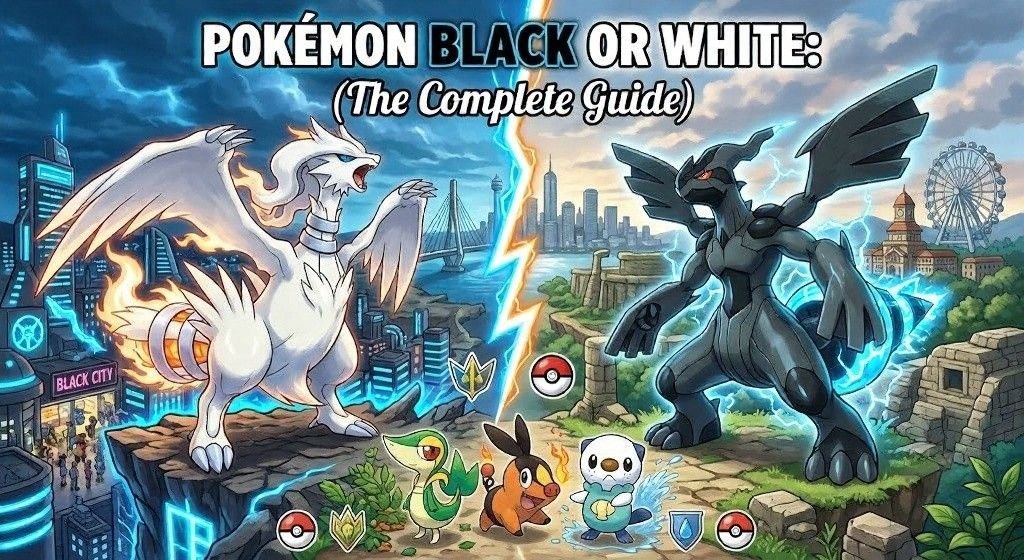
Picking Pokémon Black or White feels like a big decision. Both games share the same core story. Yet small details make each one unique. This guide covers everything about Pokémon Black or White. You’ll learn the plot, the features, and the differences. We’ll also look at Gym Leaders and exclusive Pokémon. By the end, you’ll know exactly what sets them apart.
So why does Pokémon Black or White matter so much? Each version offers its own legendary dragon. Each one shapes cities and battle styles differently. Fans still debate Pokémon Black or White to this day. This guide breaks that debate down simply. No fluff, just clear facts and honest comparisons. Let’s dive into what makes each version special.
Overview and Plot

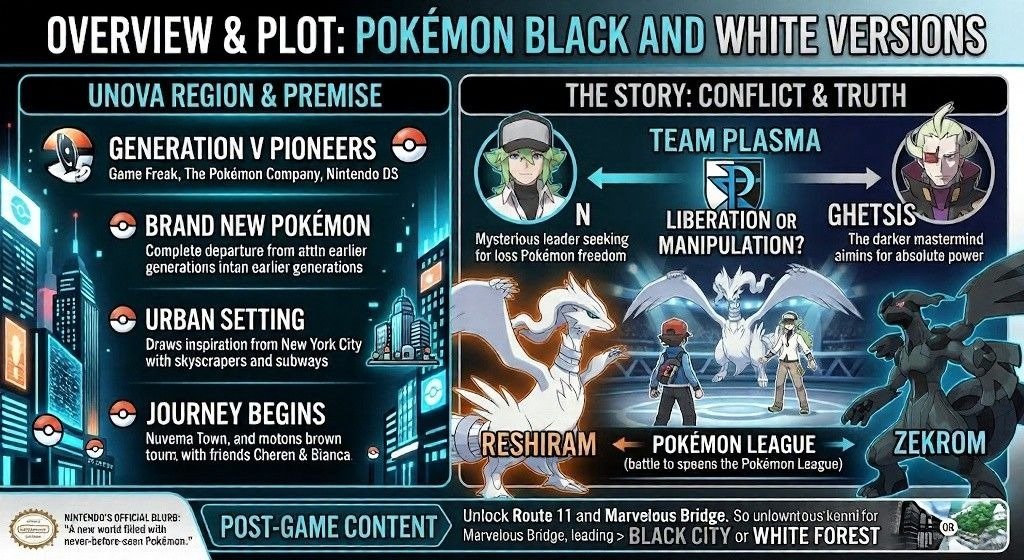
Pokémon Black and White Versions launched as true Generation V pioneers. Developed by Game Freak and published by The Pokémon Company, they were released on Nintendo DS consoles worldwide. Japan received them first, on September 18, 2010. North America followed six months later, in March 2011.
These games introduced something the series had never tried before. Every single Pokémon felt brand new again. Nothing carried over visually or thematically from earlier generations. The Unova region itself drew inspiration from New York City. Skyscrapers, subway-style transit, and urban sprawl replaced quainter, rural towns.
The Story Behind Pokémon Black or White
Your journey begins in quiet Nuvema Town. Two friends join you immediately, Cheren and Bianca. Professor Juniper hands you your first partner Pokémon. From there, the three of you chase Gym Badges together.
But this isn’t just another badge-collecting adventure. Team Plasma emerges as a genuine ideological threat. Their message argues that Trainers exploit their Pokémon. A mysterious young man named N leads them.
N isn’t your typical antagonist, though. He genuinely believes Pokémon deserve freedom from humans. Behind him lurks a darker mastermind. Ghetsis, a member of the Seven Sages, pulls every string. His real goal has nothing to do with liberation. Power, plain and simple, drives his actions.
As you defeat eight Gym Leaders, tension builds steadily. Eventually, you face N at the Pokémon League. He summons a legendary dragon to fight you. Depending on your version, you’ll catch either Reshiram or Zekrom. That legend becomes your key to victory.
Ghetsis’s true colors show themselves after N’s defeat. He attacks you directly, revealing his manipulation. Afterward, N reflects on everything he believed. The story doesn’t fully end there, either. Kyurem waits within the Giant Chasm for capture. Roaming legendaries Tornadus and Thundurus also appear later. Even Cynthia, the Sinnoh region’s Champion, makes a cameo.
Quick Fact: Post-game content unlocks Route 11 and Marvelous Bridge. These paths lead to Black City or White Forest.
Official Game Blurb
Nintendo’s own tagline captures the spirit well. It promises a new world filled with never-before-seen Pokémon. That promise, largely, holds up throughout the adventure.
Gameplay Features
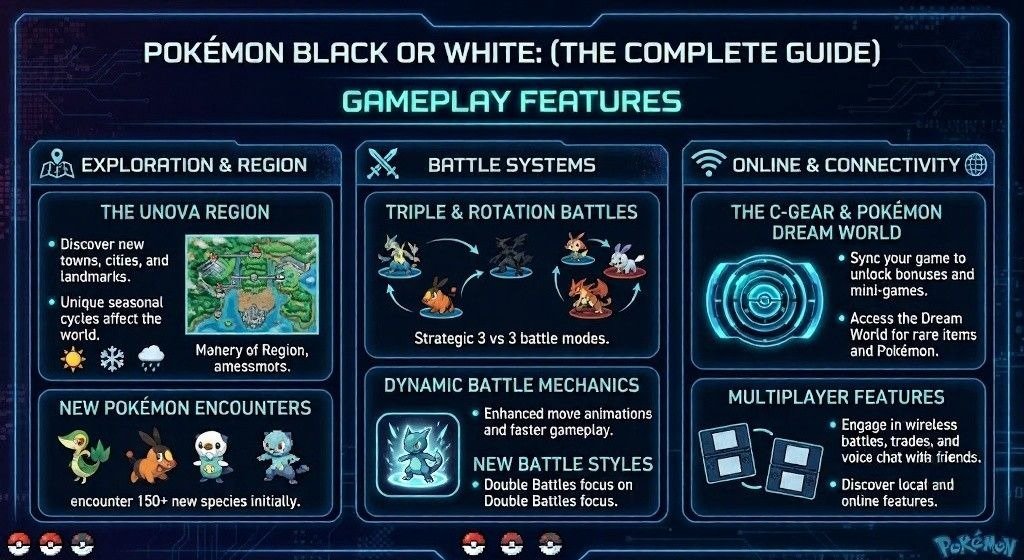
Pokémon Black and Pokémon White reshaped core series mechanics significantly. Below, we break down every major feature. Each one changed how players experienced Unova.
C-Gear: The Connectivity Hub Overview
The C-Gear replaced the older Pokétch system entirely. It fills your bottom screen with useful tools. Wireless, Wi-Fi, and infrared connections all work through it.
One quirky detail involves the in-game clock display. Midnight shows as zero, not twelve. This differs from standard 24-hour clock formats. Players can also chat using the Xtransceiver feature. It even uses your DSi’s front-facing camera.
Pokémon Global Link and the Dream World
The Pokémon Global Link served as your online headquarters. It replaced Generation IV’s Global Terminal system entirely. Through it, players accessed Random Matchup battles instantly. You could also download exclusive C-Gear skins here.
Note: This online service became defunct back in February 2020. Modern players can no longer access these features.
Pokémon Dream World Explained
The Pokémon Dream World operated through a dedicated website. Players sent Pokémon online to explore and interact. Many species found here weren’t available in Unova. Every Dream World Pokémon carried its Hidden Ability too. Competitive players valued this feature enormously back then.
Sadly, the Dream World shut down permanently in 2014. January 14th marked its final operational day.
Entralink: Pass Powers and Entree Forest
Entralink connected players through local wireless signals directly. It created a shared multiplayer space within Unova. Inside this space sits the Entree Forest area. Pokémon caught in the Dream World appeared here. Combined with C-Gear, cooperative exploration became genuinely seamless.
Pokémon Musical: A Fresh Take on Contests
Traditional Pokémon Contests disappeared entirely in this generation. Pokémon Musical replaced them with something more theatrical. Trainers dressed their Pokémon using various accessories. Then, their Pokémon danced across a Nimbasa City stage. It echoed the Super Contest format from Sinnoh games.
Seasons: A Living, Breathing Unova
Generation V introduced true seasonal cycles for players. Seasons rotate monthly, completing three full cycles yearly. This affects daylight hours in noticeable ways. Winter nights start earlier than summer nights do.
Certain Pokémon respond directly to seasonal changes, too. Deerling and its evolution, Sawsbuck shifts appearances accordingly. Some map areas only open during specific seasons.
Sprite Animations: Battles Come Alive
For the first time, battle sprites moved constantly. Previous generations only animated sprites briefly, then stopped. Sprite animations in Black and White stayed active throughout. Full back sprites also appeared for every Pokémon.
Interestingly, most human Trainers kept static, unanimated sprites. Only Bianca, Cheren, and N received animated designs.
Changing Music: A Dynamic Soundtrack
Battle music no longer stayed frozen in place. Facing a Gym Leader’s final Pokémon triggers a remix. Low-HP situations get their own musical cue too. Rare wild encounters even receive unique musical treatment.
Overworld music shifts with the seasons as well. Undella Town’s soundtrack changes dramatically between different seasons. Street musicians add layered music near their location.
Weather: Simplified Yet Atmospheric
Weather effects display differently from past games. An icon now shows current conditions on-screen. This icon appears just once per battle, not repeatedly. Unused code hints at planned hail and fog. Sandstorm text exists in the game files too.
Version-Exclusive Areas: Black City vs White Forest
This generation introduced genuinely distinct location design. Opelucid City looks futuristic in Black Version specifically. In White Version, it feels traditional and historic instead. Mistralton City swaps greenhouses for simple vegetable patches.
Most notably, Black City vs White Forest stands out. These are the series’s first fully exclusive towns. Each town offers a different Pokémon encounter pool entirely.
Triple Battles: Three-on-Three Combat
Triple Battles send three Pokémon out per side. Positioning matters enormously in this battle format. Middle Pokémon can attack every opposing Pokémon freely. Side Pokémon, however, can’t reach the far end.
Certain moves bypass these positional restrictions completely. Flying-type moves like Pluck ignore normal limitations. This format appears most often in White Version.
Rotation Battles: A Strategic Twist
Rotation Battles place three Pokémon on a wheel. Players rotate their team without losing a turn. Only the front-facing Pokémon actively battle at once. Predicting your opponent’s rotation becomes the real challenge.
Think of it like a chess opening sequence. You’re guessing your opponent’s next move constantly. This format leans heavily toward Black Version instead.
Word Filter: Keeping Communication Safe
Black and White introduced a strict word filter system. It blocked inappropriate names during online play. This marked the series’s first name-blacklist feature ever. Nintendo prioritized safety for its younger player base.
Gyms, Champions, and Pokémon
Battling through Unova means facing eleven total Gym Leaders. Eight Gyms stand between you and the Champion.
Gym Leaders and Badges
| Gym Leader | Type | City | Version Note |
| Cilan, Chili, Cress | Grass, Fire, Water | Striaton City | Depends on starter choice |
| Lenora | Normal | Nacrene City | Both versions |
| Burgh | Bug | Castelia City | Both versions |
| Elesa | Electric | Nimbasa City | Both versions |
| Clay | Ground | Driftveil City | Both versions |
| Skyla | Flying | Mistralton City | Both versions |
| Brycen | Ice | Icirrus City | Both versions |
| Drayden / Iris | Dragon | Opelucid City | Drayden in Black, Iris in White |
Notice something clever about the first Gym battle. Your Gym Leader depends on your starter choice. Water starters face Cilan; Fire starters face Chili. Grass starters, meanwhile, battle against Cress instead.
Elite Four and Champion Alder
Something else changed here, too, for players. You can battle the Elite Four in any order. Prior games forced a strict, linear battle sequence. This four-member team includes a real variety.
Shauntal commands Ghost-types with eerie precision. Marshal brings raw Fighting-type power to battles. Grimsley relies on cunning Dark-type strategies throughout. Caitlin rounds things out with Psychic-type mastery.
Standing beyond them waits Champion Alder. You can’t challenge him immediately, though. Defeating Team Plasma first unlocks that final battle. Alder uses a genuinely diverse type roster.
Technical and Hidden Machines
This generation expanded TM options significantly for players. Technical Machines (TMs) now total ninety-five available items. Only six Hidden Machines (HMs) exist this time around. Just one HM, Cut, blocks story progress.
What Changed From Previous Generations
- TMs became infinitely reusable, just like HMs.
- Replacing a move now keeps its remaining PP.
- Defog, Whirlpool, and Rock Climb dropped HM status.
- Rock Smash became TM94 instead of an HM.
- Dive returned, now numbered as HM06.
- Gym Badges no longer restrict HM usage outdoors.
New Pokémon: A Genuinely Fresh Pokédex
Generation V delivered something remarkable for longtime fans. 156 new Pokémon joined the roster, more than ever. This pushed the total Pokédex count to 649 species. None of these new Pokémon evolved from older ones.
Zoroark and Zorua debuted first, back in February 2010. Their reveal was tied directly to a theatrical movie release. Starter Pokémon Snivy, Oshawott, and Tepig followed shortly after. CoroCoro magazine revealed them in May 2010.
Version-Exclusive Pokémon Breakdown
| Category | Black Version | White Version |
| Legendary | Reshiram (Dragon/Fire) | Zekrom (Dragon/Electric) |
| Dark/Flying | Murkrow, Honchkrow | Rufflet, Braviary |
| Bug Line | Weedle, Kakuna, Beedrill | Caterpie, Metapod, Butterfree |
| Psychic Line | Gothita, Gothorita, Gothitelle | Solosis, Duosion, Reuniclus |
| Exclusive Town | Black City encounters | White Forest encounters |
Some Pokémon require clever workarounds between versions. Cottonee and Petilil trade through Nacrene City NPCs. Breeding Volbeat and Illumise can also produce the other. Wild Huntail appears only in Black Version games. Wild Gorebyss, meanwhile, only appears in White.
Compatibility and DSi Features

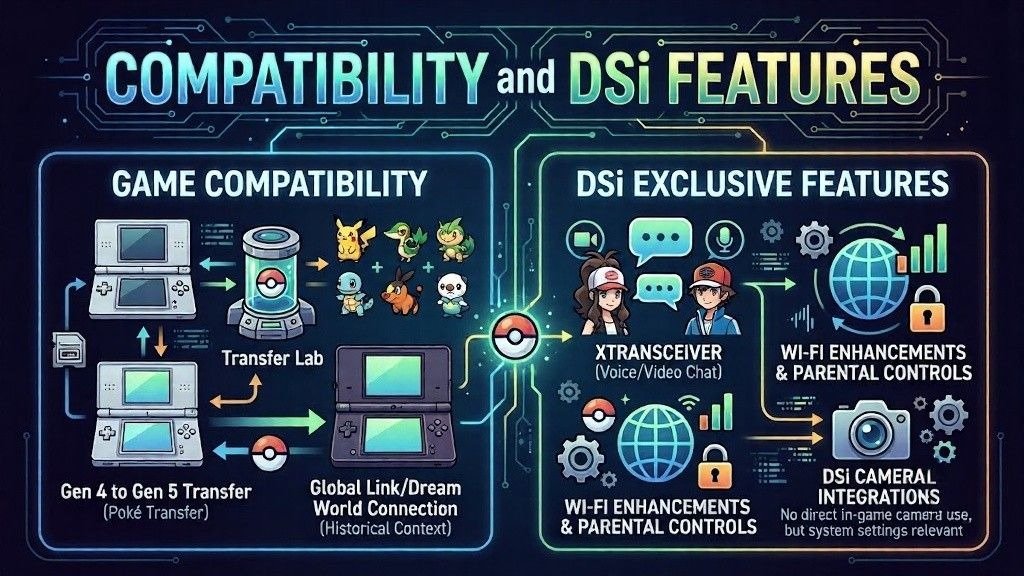
Pokémon transfer compatibility connects these games to earlier titles. Diamond, Pearl, Platinum, HeartGold, and SoulSilver all qualify. The Poké Transfer feature moves Pokémon into Unova permanently. Note that transfers only flow in one direction.
Certain Generation IV event Pokémon unlock hidden content here. Raikou, Entei, Suicune, and Celebi trigger something special. Using the Relocator, they unlock Zorua and Zoroark access. A rare Lock Capsule item theoretically unlocks TM95, Snarl.
DSi-Specific Features and Functionality
Playing on DSi-enhanced hardware unlocks extra functionality entirely. Here’s what changes on DSi or Nintendo 3DS compatibility systems:
- Games recognize and connect to WPA-secured routers.
- The front camera activates during Xtransceiver calls.
- C-Gear shows three battery bars, not two.
- Home screen icons animate with a wiggling Poké Ball.
- Menus scroll faster and load noticeably quicker.
Region-locking applies specifically to Japanese cartridge versions. Original DS and DS Lite consoles bypass this restriction. Korean and Western releases avoid region-locking entirely, too.
Localization and Regional Changes
Translating these games required more than direct wording swaps. Nintendo adjusted mechanics, dialogue, and even probability values. Localization changes shaped how each region experienced Unova.
One notable tweak involves the Poison Touch ability. Its poison chance rose from 20% to 30%. International versions also fixed a Victini shiny-lock bug. C-Gear skin counts varied by region as well. Japan offered 31 skins, while America received 22.
A particularly fun example involves a Ferris wheel character. Named Hiker Andy, his dialogue changed dramatically between regions. The Japanese version framed him as bold and flirtatious. English localizers rewrote him as nervous about heights instead. It’s a small but memorable localization choice.
Shared Changes Across Black, White, Black 2, and White 2
- A strict word filter blocked certain English Pokémon nicknames.
- Cofagrigus, Froslass, Nosepass, and Probopass needed renaming for trades.
- Generation VI later removed this frustrating trading restriction.
- A quiz question, Aha’s riddle, varies by language completely.
- English players choose between “Mail” and “Marill” as answers.
Reception
Critics responded to Pokémon Black and White with genuine enthusiasm. Reviewers praised the fresh Pokédex and new mechanics.
Critical Reception and Reviews
| Publication | Score |
| Famitsu score | 40/40 (Perfect Score) |
| Metacritic rating | 87% |
| IGN review | 9.0/10, “Amazing” |
| Game Informer | 8.75/10 |
| Nintendo Power | 9.0/10 |
That Famitsu score deserves special attention here. Perfect scores from this magazine remain incredibly rare. The Legend of Zelda: Ocarina of Time earned it first. Black and White joined an exclusive, historic club.
Sales Performance
Commercial success followed the critical praise closely. In their first fiscal year, sales reached 11.51 million. By March 2021, lifetime units sold hit 15.64 million. That figure makes them the lowest-selling paired versions.
Japanese Sales Figures in Detail
Japanese sales figures showed a strong opening week. Combined, both versions sold 2,557,779 units immediately. The black version alone moved 1,323,423 copies that week. The white version followed closely, with 1,234,356 copies sold.
| Week | Units Sold | Total Units |
| Week 1 | 2,557,779 | 2,557,779 |
| Week 2 | 828,580 | 3,386,358 |
| Week 5 | 168,541 | 4,161,397 |
| Week 10 | 39,883 | 4,450,879 |
| Week 172 | — | 5,516,542 |
The sell-through rate also impressed industry analysts significantly. Black Version hit 89.21%, White reached 86.09%. Both numbers reflect strong initial retailer demand.
Conclusion
Choosing between Pokémon Black and White ultimately comes down to preference. Both versions share the same core storyline throughout. Team Plasma, N, and Ghetsis drive that narrative equally.
Where they differ is genuinely interesting, though. Version-exclusive Pokémon, cities, and battle formats separate them clearly. Black offers Reshiram, Rotation Battles, and a futuristic Opelucid. White offers Zekrom, Triple Battles, and a traditional Opelucid.
Neither choice is objectively better than the other. It simply depends on which dragon appeals more. Consider which exclusive Pokémon and city vibe fit. Either way, you’re getting a genuinely excellent RPG. Critics agreed, awarding near-perfect scores across major publications.
If you love this generation’s fresh Pokédex approach, don’t stop here. Pokémon Black 2 and White 2 continue this same story. They’re worth exploring once you finish this adventure.
FAQ’s
Q: Which Is Better, Pokémon White or Black?
Ans: Neither version outranks the other in overall quality. Your choice depends entirely on personal gameplay preference. Prefer Triple Battles and Zekrom? Choose White then. Prefer Rotation Battles and Reshiram? Choose Black instead.
Q: Why Was Pokémon Black and White Controversial?
Ans: Team Plasma’s messaging sparked real discussion among older fans. Their argument that Trainers exploit Pokémon felt provocative. Some longtime players also disliked the “all-new Pokédex” approach. Familiar early-game Pokémon simply weren’t available anymore.
Q: Is the Pokémon Black Version Good?
Ans: Yes, critical reception strongly supports this game’s quality. Famitsu awarded it a rare perfect score. Metacritic ratings sit comfortably at 87 percent overall. Many fans still call it a series highlight.
Q: Is Pokémon Black a DS or 3DS Game?
Ans: Pokémon Black launched originally as a Nintendo DS game. It later received DSi-enhanced features for compatible hardware. The game remains fully playable on Nintendo 3DS systems. Original DS and DS Lite consoles work too.


Welcome to Gaming Station! I’m Hussain Umer, an AI-Powered SEO and Content Writer with 4 years of experience. I help websites rank higher, grow traffic, and look amazing. My goal is to make SEO and web design simple and effective for everyone.
Let’s achieve more together!