
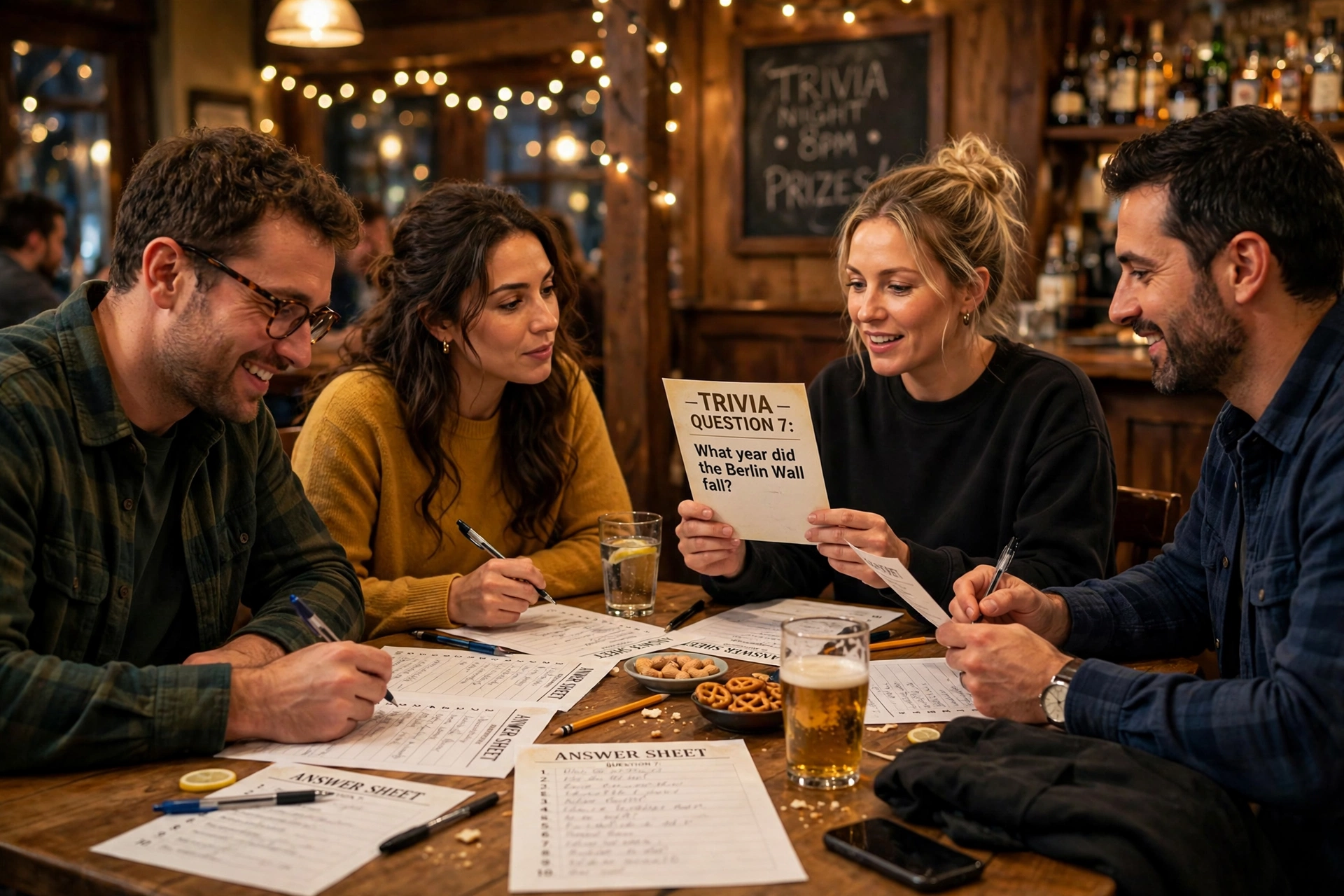
The starters are cleared, the wine is poured, and somebody at the table says the words that change the whole evening: “I know a few good quiz questions.” Two hours later, half the table is arguing about the capital of Australia and the other half is Googling it under the tablecloth. A grown-up quiz night should never come down to phones and shouting. This bank of 100 trivia questions for adults is built for exactly that evening: five proper rounds, honest difficulty levels, answers with the story behind them, and scoring that keeps the history buff and the sports fan on the same team without anyone feeling carried.
Read the question, let the table argue, then read the answer and the one-line Context underneath it. That context is your secret weapon as host: it turns “correct” into a story people remember, which is what separates a good quiz night from a forgettable one.
Adult trivia works best when it respects the room. Nobody wants questions pitched at schoolchildren, and nobody wants a pub exam either. Every question below sits in that middle ground: the kind of thing a curious adult has heard of but might not quite pin down. The difficulty tags keep it honest, so teams know exactly what they are risking.
How this quiz bank works
- 100 questions, 5 rounds of 20: History, Science & Nature, Pop Culture, Sports, and Geography, Arts & Potpourri.
- Point ladder: Easy questions are worth 1 point, Medium questions 2 points, Hard questions 3 points. Mixed-knowledge teams stay competitive because nobody is locked out of the easy ones.
- Context notes: every answer comes with a one-line explanation, so the host can sound like an expert without any prep.
- Tie-breaker ladder: five sudden-death questions at the end, shortest correct answer wins.
- Playing time: about 60 minutes for all 100 questions, or pick any two rounds for a 25-minute game.
Pick your round
- Round 1: History
- Round 2: Science & Nature
- Round 3: Pop Culture
- Round 4: Sports
- Round 5: Geography, Arts & Potpourri
- Sudden Death: 5 Tie-Breakers
Round 1: History (20 questions)
Ancient empires to the modern age. Expect the classics everyone half-remembers, plus a few that will split the table. The Hard questions here reward the readers in the group.

1. In which year did the Berlin Wall fall? (Easy · 1 pt)
Answer: 1989.
Context: The Wall came down on 9 November 1989; German reunification followed on 3 October 1990.
2. Which ocean liner sank on its maiden voyage in 1912 after striking an iceberg? (Easy · 1 pt)
Answer: The Titanic.
Context: It struck the iceberg on the night of 14 April 1912; more than 1,500 people died.
3. Who was the first president of the United States? (Easy · 1 pt)
Answer: George Washington.
Context: He was inaugurated on 30 April 1789 and served two terms before stepping down voluntarily.
4. Which ancient civilisation built the Parthenon in Athens? (Easy · 1 pt)
Answer: The ancient Greeks.
Context: It was built between 447 and 432 BC under the statesman Pericles, as a temple to Athena.
5. Who wrote the 95 Theses in 1517, sparking the Protestant Reformation? (Easy · 1 pt)
Answer: Martin Luther.
Context: He nailed them to the door of Wittenberg’s Castle Church on 31 October 1517.
6. In which year did the first manned moon landing take place? (Easy · 1 pt)
Answer: 1969.
Context: Apollo 11 touched down on 20 July 1969, with Neil Armstrong and Buzz Aldrin walking on the surface.
7. Which ancient wonder of the world was built as a tomb for Pharaoh Khufu around 2560 BC? (Medium · 2 pts)
Answer: The Great Pyramid of Giza.
Context: It was the tallest human-made structure in the world for more than 3,800 years.
8. In which century did the Black Death peak in Europe? (Medium · 2 pts)
Answer: The 14th century.
Context: The plague reached Europe in 1347 and killed an estimated 30 to 60 percent of the population.
9. Which empire built the mountain city of Machu Picchu in the 15th century? (Medium · 2 pts)
Answer: The Inca Empire.
Context: It was built around 1450 under the emperor Pachacuti and abandoned about a century later.
10. Who was the British prime minister for most of the Second World War? (Medium · 2 pts)
Answer: Winston Churchill.
Context: He led Britain from 1940 to 1945, then returned as prime minister from 1951 to 1955.
11. In which year did India gain independence from Britain? (Medium · 2 pts)
Answer: 1947.
Context: Independence came on 15 August 1947; Pakistan was created as a separate state the same year.
12. Who was the last Tsar of Russia, executed with his family in 1918? (Medium · 2 pts)
Answer: Nicholas II.
Context: He abdicated in March 1917 and was executed in Yekaterinburg in July 1918.
13. Which Chinese dynasty built most of the Great Wall that tourists visit today? (Medium · 2 pts)
Answer: The Ming dynasty.
Context: The Ming ruled from 1368 to 1644 and rebuilt the wall in brick and stone.
14. Which country was the first in the world to grant women the right to vote? (Medium · 2 pts)
Answer: New Zealand.
Context: New Zealand granted women’s suffrage in 1893, decades ahead of Britain and the United States.
15. What was the name of the last Western Roman emperor, deposed in 476 AD? (Hard · 3 pts)
Answer: Romulus Augustulus.
Context: His deposition in 476 AD is the traditional date given for the fall of Rome in the West.
16. Which war was ended by the Treaty of Westphalia in 1648? (Hard · 3 pts)
Answer: The Thirty Years’ War.
Context: Signed in Munster and Osnabruck, it devastated Central Europe and redrew its map.
17. Which divided capital city is split by the “Green Line” buffer zone? (Hard · 3 pts)
Answer: Nicosia, Cyprus.
Context: The line was drawn after the 1974 conflict and is still patrolled by UN peacekeepers.
18. Which 1066 battle is depicted in the Bayeux Tapestry? (Hard · 3 pts)
Answer: The Battle of Hastings.
Context: William the Conqueror defeated Harold II on 14 October 1066, beginning Norman rule of England.
19. At which 1884-85 conference did European powers formalise the carve-up of Africa? (Hard · 3 pts)
Answer: The Berlin Conference.
Context: Convened by Germany’s Otto von Bismarck, it set the rules for the “Scramble for Africa.”
20. In which year did the Ottoman Empire conquer Constantinople? (Hard · 3 pts)
Answer: 1453.
Context: The city fell on 29 May 1453 to Sultan Mehmed II, ending the Byzantine Empire.
Round 2: Science & Nature (20 questions)
Real-world science, no lab coat required. The human body, the planet, and the sky above it. Watch for the deliberate trick question hiding in this round.
21. What is the chemical symbol for gold? (Easy · 1 pt)
Answer: Au.
Context: It comes from aurum, the Latin word for gold.
22. Which planet is known as the Red Planet? (Easy · 1 pt)
Answer: Mars.
Context: Its red colour comes from iron oxide, essentially rust, coating the surface.
23. How many legs does a spider have? (Easy · 1 pt)
Answer: Eight.
Context: All arachnids, including scorpions and ticks, have eight legs; insects have six.
24. Which gas do plants absorb from the air for photosynthesis? (Easy · 1 pt)
Answer: Carbon dioxide.
Context: Plants take in carbon dioxide and release the oxygen we breathe as a by-product.
25. What is a baby frog called? (Easy · 1 pt)
Answer: A tadpole.
Context: Tadpoles breathe through gills and grow legs as they metamorphose into frogs.
26. Which is the largest ocean on Earth? (Easy · 1 pt)
Answer: The Pacific Ocean.
Context: It covers about a third of the Earth’s surface, larger than all land combined.
27. What is the hardest natural substance on Earth? (Medium · 2 pts)
Answer: Diamond.
Context: Diamond scores 10 on the Mohs hardness scale, which is why it cuts glass and other gems.
28. Which blood cells carry oxygen around the body? (Medium · 2 pts)
Answer: Red blood cells.
Context: They use haemoglobin to carry oxygen, and the body makes about 2 million of them every second.
29. What is the largest organ of the human body? (Medium · 2 pts)
Answer: The skin.
Context: An adult’s skin weighs around 3.5 to 5 kg and covers roughly 2 square metres.
30. Which part of the cell contains most of its DNA? (Medium · 2 pts)
Answer: The nucleus.
Context: The nucleus acts as the cell’s control centre, holding the genetic instructions for the whole body.
31. Which vitamin does the body produce when skin is exposed to sunlight? (Medium · 2 pts)
Answer: Vitamin D.
Context: About 10 to 30 minutes of midday sun a few times a week is enough for most people.
32. What is the boiling point of water at sea level? (Medium · 2 pts)
Answer: 100°C (212°F).
Context: At altitude the boiling point drops, which is why pasta takes longer to cook in the mountains.
33. In which year did Isaac Newton publish his laws of motion in the Principia? (Medium · 2 pts)
Answer: 1687.
Context: The full title was Philosophiae Naturalis Principia Mathematica, and it also set out universal gravitation.
34. How long does light from the Sun take to reach the Earth? (Medium · 2 pts)
Answer: About 8 minutes (8 minutes 20 seconds).
Context: Sunlight travels 150 million kilometres at 300,000 km per second, so you always see the Sun as it was 8 minutes ago.
35. What is the most abundant gas in the Earth’s atmosphere? (Hard · 3 pts)
Answer: Nitrogen.
Context: Nitrogen makes up about 78 percent of the air; oxygen is only about 21 percent.
36. Which element has the highest melting point of all the elements? (Hard · 3 pts)
Answer: Tungsten.
Context: Tungsten melts at 3,422°C, which is why it was used for the filaments in old light bulbs.
37. The “God particle” announced at CERN in 2012 is better known by what name? (Hard · 3 pts)
Answer: The Higgs boson.
Context: Predicted in 1964 by Peter Higgs, it explains how other particles get their mass.
38. Which layer of the atmosphere contains the ozone layer? (Hard · 3 pts)
Answer: The stratosphere.
Context: The ozone layer sits 15 to 35 km up and absorbs most of the Sun’s harmful ultraviolet radiation.
39. Which force, described by Newton, keeps our feet on the ground? (Hard · 3 pts)
Answer: Gravity.
Context: Trick wording: it is the easy word hiding in a Hard slot, and someone at the table will overthink it.
40. How many bones are there in the adult human body? (Hard · 3 pts)
Answer: 206.
Context: Babies are born with around 300 bones; many fuse together as they grow.
Round 3: Pop Culture (20 questions)
Music, movies, TV and books across the decades. The round where generations at the table finally stop agreeing. Older teams dominate the music questions; younger ones own the streaming era.

41. Who played Jack Dawson in the 1997 film Titanic? (Easy · 1 pt)
Answer: Leonardo DiCaprio.
Context: The film won 11 Academy Awards, tying the all-time record.
42. Which band released “Bohemian Rhapsody” in 1975? (Easy · 1 pt)
Answer: Queen.
Context: Written by Freddie Mercury, it stayed at UK No. 1 for nine weeks.
43. Who wrote the Harry Potter book series? (Easy · 1 pt)
Answer: J.K. Rowling.
Context: The seven books have sold more than 600 million copies worldwide.
44. Which TV series follows the transformation of Walter White? (Easy · 1 pt)
Answer: Breaking Bad.
Context: It ran from 2008 to 2013 and won 16 Primetime Emmy Awards.
45. What was Disney’s first feature-length animated film? (Easy · 1 pt)
Answer: Snow White and the Seven Dwarfs (1937).
Context: Hollywood called it “Disney’s Folly” before release; it became the highest-grossing film of its time.
46. Who sang “Like a Prayer”? (Easy · 1 pt)
Answer: Madonna.
Context: Released in 1989, its video was so controversial that Pepsi cancelled her sponsorship deal.
47. Which film won the first ever Academy Award for Best Picture? (Medium · 2 pts)
Answer: Wings (1927).
Context: The silent First World War epic won at the first Oscars ceremony in 1929.
48. Who is known as the “King of Pop”? (Medium · 2 pts)
Answer: Michael Jackson.
Context: His 1982 album Thriller remains the best-selling album of all time.
49. Who painted the Mona Lisa? (Medium · 2 pts)
Answer: Leonardo da Vinci.
Context: He worked on it between roughly 1503 and 1519, and it now hangs in the Louvre in Paris.
50. In which year did the Beatles officially break up? (Medium · 2 pts)
Answer: 1970.
Context: Paul McCartney announced his departure in April 1970, days before his first solo album.
51. Which actress played Hermione Granger in the Harry Potter films? (Medium · 2 pts)
Answer: Emma Watson.
Context: She was nine years old when cast and appeared in all eight films.
52. Which Netflix series features a parallel dimension called the Upside Down? (Medium · 2 pts)
Answer: Stranger Things.
Context: The show premiered in 2016 and revived 1980s nostalgia, from D&D to Kate Bush.
53. Which film features the line “Here’s looking at you, kid”? (Medium · 2 pts)
Answer: Casablanca (1942).
Context: Humphrey Bogart says it to Ingrid Bergman; the film won Best Picture at the 1944 Oscars.
54. Which singer is known as the “Queen of Soul”? (Medium · 2 pts)
Answer: Aretha Franklin.
Context: Her 1967 hit “Respect” became an anthem of the civil rights and feminist movements.
55. Which novel opens with the line “Call me Ishmael”? (Hard · 3 pts)
Answer: Moby-Dick.
Context: Herman Melville’s 1851 novel flopped on release and was only rediscovered in the 1920s.
56. Who directed Pulp Fiction (1994)? (Hard · 3 pts)
Answer: Quentin Tarantino.
Context: It won the Palme d’Or at Cannes and revived John Travolta’s career.
57. Which band released the best-selling 1977 album Rumours? (Hard · 3 pts)
Answer: Fleetwood Mac.
Context: The band recorded it while two couples in the lineup were breaking up with each other.
58. What was Elvis Presley’s first No. 1 single on the US Billboard chart? (Hard · 3 pts)
Answer: “Heartbreak Hotel” (1956).
Context: It was inspired by a newspaper story about a lonely man who took his own life.
59. Who created Sherlock Holmes? (Hard · 3 pts)
Answer: Arthur Conan Doyle.
Context: Holmes first appeared in A Study in Scarlet in 1887; Doyle was a trained doctor.
60. Which 1960 Alfred Hitchcock film features the famous shower scene? (Hard · 3 pts)
Answer: Psycho.
Context: Hitchcock bought up copies of the novel to keep the twist secret from audiences.
Round 4: Sports (20 questions)
Records, rules and famous firsts. Even the non-fans at the table will know more of these than they expect. The dates in the Hard questions are worth memorising if your group plays often.
61. How many players does a football (soccer) team field at the start of a match? (Easy · 1 pt)
Answer: 11.
Context: Ten outfield players plus a goalkeeper; a team cannot continue with fewer than seven.
62. In which sport would you perform a slam dunk? (Easy · 1 pt)
Answer: Basketball.
Context: The term was coined by Lakers announcer Chick Hearn in the 1960s.
63. How many holes are played in a standard round of golf? (Easy · 1 pt)
Answer: 18.
Context: The 18-hole standard was set at St Andrews in 1764; earlier rounds had 22 holes.
64. The ancient Olympic Games originated in which country? (Easy · 1 pt)
Answer: Greece.
Context: The first recorded games were held at Olympia in 776 BC; the modern revival began in 1896.
65. In which sport is a puck used instead of a ball? (Easy · 1 pt)
Answer: Ice hockey.
Context: A regulation puck is made of vulcanised rubber and weighs about 170 grams.
66. How often are the Summer Olympic Games held? (Medium · 2 pts)
Answer: Every four years.
Context: The Tokyo 2020 Games were the exception, postponed to 2021 by the pandemic.
67. In tennis, what is a score of zero called? (Medium · 2 pts)
Answer: Love.
Context: The leading theory is that it comes from the French l’oeuf, meaning “the egg”, for the shape of a zero.
68. Which country has won the most FIFA World Cups? (Medium · 2 pts)
Answer: Brazil.
Context: Five titles: 1958, 1962, 1970, 1994 and 2002. Germany and Italy have four each.
69. How long is a marathon? (Medium · 2 pts)
Answer: 42.195 kilometres (26.2 miles).
Context: The odd distance comes from the 1908 London Olympics, when the course was extended so the royal family could watch the start.
70. In which sport is the Stanley Cup awarded? (Medium · 2 pts)
Answer: Ice hockey.
Context: First awarded in 1893, it is the oldest professional sports trophy in North America.
71. How many rings are there on the Olympic flag? (Medium · 2 pts)
Answer: Five.
Context: Designed in 1913 by Pierre de Coubertin, they represent the five inhabited continents.
72. In cricket, how many balls are bowled in one over? (Medium · 2 pts)
Answer: Six.
Context: Six balls per over has been standard since the 1979-80 season in most of the cricket world.
73. In basketball, how many points is a shot from beyond the three-point line worth? (Easy · 1 pt)
Answer: Three.
Context: The NBA adopted the three-point line in 1979; it sat 23 feet 9 inches from the basket.
74. Which men’s tennis player was the first to win 20 Grand Slam singles titles? (Hard · 3 pts)
Answer: Roger Federer.
Context: He reached 20 with victory at the 2018 Australian Open, over Marin Cilic.
75. In which year did Usain Bolt set the 100m world record of 9.58 seconds? (Medium · 2 pts)
Answer: 2009.
Context: He set it at the World Championships in Berlin; the record still stands.
76. Which boxer was known as “The Greatest” and “The Louisville Lip”? (Hard · 3 pts)
Answer: Muhammad Ali.
Context: Born Cassius Clay, he won Olympic gold in 1960 before becoming three-time world heavyweight champion.
77. Which country hosted the 2016 Summer Olympics? (Hard · 3 pts)
Answer: Brazil (Rio de Janeiro).
Context: It was the first Olympic Games ever held in South America.
78. Who won the FIFA World Cup in 2022? (Hard · 3 pts)
Answer: Argentina.
Context: They beat France on penalties in Qatar after a 3-3 draw, one of the great finals.
79. Which golfer has won the most major championships? (Hard · 3 pts)
Answer: Jack Nicklaus.
Context: Nicklaus won 18 majors between 1962 and 1986; Tiger Woods is second with 15.
80. Which nation won the first Rugby World Cup in 1987? (Hard · 3 pts)
Answer: New Zealand.
Context: The All Blacks beat France 29-9 in the final at Eden Park, Auckland.
Round 5: Geography, Arts & Potpourri (20 questions)
Capitals, classics and curveballs. The round that decides most quiz nights. Geography rewards travellers; the arts questions reward anyone who paid attention in school.
81. What is the capital of France? (Easy · 1 pt)
Answer: Paris.
Context: Paris has been France’s capital, with interruptions, since the 10th century.
82. What is the largest hot desert in the world? (Easy · 1 pt)
Answer: The Sahara.
Context: It covers about 9.2 million square kilometres, nearly the size of the United States.
83. How many colours are there in a rainbow? (Easy · 1 pt)
Answer: Seven.
Context: Newton named seven: red, orange, yellow, green, blue, indigo and violet.
84. On which continent is Egypt mainly located? (Easy · 1 pt)
Answer: Africa.
Context: A small part of Egypt, the Sinai Peninsula, lies in Asia.
85. What is the smallest country in the world by area? (Medium · 2 pts)
Answer: Vatican City.
Context: It covers about 0.49 square kilometres and has around 800 residents.
86. Which country has the most natural lakes in the world? (Medium · 2 pts)
Answer: Canada.
Context: Canada holds an estimated 62 percent of the world’s lakes.
87. Mount Everest sits on the border of Nepal and which other country? (Medium · 2 pts)
Answer: China (Tibet).
Context: The summit, at 8,849 metres, lies exactly on the border line.
88. What is the capital of Australia? (Medium · 2 pts)
Answer: Canberra.
Context: It was purpose-built as a compromise between rivals Sydney and Melbourne.
89. Who painted the ceiling of the Sistine Chapel? (Medium · 2 pts)
Answer: Michelangelo.
Context: He painted it between 1508 and 1512, mostly lying on scaffolding.
90. Which musical instrument has 88 keys? (Medium · 2 pts)
Answer: The piano.
Context: 52 white keys and 36 black keys; the modern 88-key layout was standardised in the 1880s.
91. What does the Latin phrase “carpe diem” mean in English? (Medium · 2 pts)
Answer: “Seize the day.”
Context: It comes from the Roman poet Horace, writing around 23 BC.
92. The Great Barrier Reef lies off the coast of which country? (Medium · 2 pts)
Answer: Australia.
Context: It stretches over 2,300 km and is the world’s largest coral reef system.
93. Which river is commonly cited as the longest in the world? (Easy · 1 pt)
Answer: The Nile.
Context: Usually given as about 6,650 km, though the Amazon runs it close and the debate continues.
94. Which African country was formerly known as Abyssinia? (Hard · 3 pts)
Answer: Ethiopia.
Context: Ethiopia is one of only two African nations never formally colonised (the other is Liberia).
95. What is the only continent with no active volcanoes? (Hard · 3 pts)
Answer: Australia.
Context: Antarctica has active volcanoes (Mount Erebus); Australia’s last eruptions were about 5,000 years ago.
96. Which strait separates Spain from Morocco? (Hard · 3 pts)
Answer: The Strait of Gibraltar.
Context: At its narrowest it is only about 13 km wide, linking the Atlantic to the Mediterranean.
97. Which artist painted The Starry Night? (Hard · 3 pts)
Answer: Vincent van Gogh.
Context: He painted it in 1889 from his asylum room in Saint-Remy-de-Provence, France.
98. Which Shakespeare play is the longest? (Hard · 3 pts)
Answer: Hamlet.
Context: At around 30,000 words, a full uncut performance runs over four hours.
99. Which language has the most native speakers in the world? (Hard · 3 pts)
Answer: Mandarin Chinese.
Context: Roughly 940 million people speak it natively; English leads only when second-language speakers are counted.
100. Which Italian city is known as the “City of Canals”? (Easy · 1 pt)
Answer: Venice.
Context: The city is built on 118 small islands connected by more than 400 bridges.
Sudden Death: 5 Tie-Breakers
Scores level after 100 questions? Read these one at a time. The first team to answer correctly takes the round; if two teams answer the same question, the shortest correct answer wins.
Tie-breaker 1: In which year did the Titanic sink?
Answer: 1912.
Tie-breaker 2: How many players are there in a netball team?
Answer: Seven.
Tie-breaker 3: What is the capital of Japan?
Answer: Tokyo.
Tie-breaker 4: Which planet is closest to the Sun?
Answer: Mercury.
Tie-breaker 5: What is 12 multiplied by 12?
Answer: 144.
House Rules That Actually Work for Grown-Up Groups
Good questions are only half of a good quiz night. These are the rules that keep adult groups happy, based on what actually goes wrong at real tables.
Phones face-down, no exceptions
One phone on the table kills the game for everyone. Stack them in the middle or leave them in pockets; the first team caught searching loses 5 points. Announce the penalty before you start and you will never need to enforce it.
Teams of two to six
Pairs work, but teams of four to six hit the sweet spot: enough combined knowledge to attempt the Hard questions, small enough that nobody hides. Above six, split the team.
Let the point ladder do the balancing
Do not handicap strong teams. The 1/2/3 point ladder already does it: a team of casual players can win on Easy and Medium questions alone if they answer consistently, while the know-it-alls have to risk the Hard ones. Over 100 questions the maximum score is 200 points (6 Easy + 8 Medium + 6 Hard per round = 6 + 16 + 18 = 40 points per round, times 5).
Allow steals, but price them
If a team gets a question wrong, let another team steal for half points (round down). It keeps every team listening on every question, and the half-point price stops wild guessing.
Always read the Context line out loud
The Context note under each answer is not decoration. Reading it turns every question into a two-minute story, which keeps energy up between rounds and gives losing teams something to take home. Skip it and the night feels like an exam; read it and it feels like a conversation.
Run it in about an hour
Read each question once, allow 30 seconds of arguing, then read the answer and the Context line. That pace clears 100 questions in roughly an hour, with a drinks break after Round 3. Short on time? Play any two rounds for a tight 25-minute game.
Keep the quiz night going
If this bank lands well with your group, there is plenty more where it came from. Start with the main trivia questions and answers hub for the full collection, try the trivia questions for kids when the little ones want a turn, and turn a winning night into a regular thing with our guide to how to host a game night. Prefer a box to a printout? Our best trivia board games roundup covers the ones worth buying.
Trivia for Adults FAQs
How many questions should an adult trivia night have?
Between 50 and 100 questions works best. Fewer than 50 feels thin; more than 100 drags past the two-hour mark. This bank has exactly 100, split into five rounds of 20, and plays in about an hour.
How do you score a trivia game fairly when teams have mixed knowledge?
Use weighted scoring: 1 point for Easy, 2 for Medium, 3 for Hard. Casual players stay competitive by sweeping the easy questions, while strong teams must risk the hard ones. Every question in this bank carries its point value.
What is a good tie-breaker for a trivia quiz?
A sudden-death ladder of short-answer questions, where the shortest correct answer wins ties. This bank includes five tie-breakers designed exactly for that: one-word or one-number answers, no ambiguity.
How long should a trivia night last?
About 60 to 90 minutes of actual quizzing. At roughly 35 seconds per question, all 100 questions here take about an hour, plus a drinks break after Round 3. Any longer and attention fades, however good the questions are.
Can you play trivia with just two people?
Yes. One person hosts and reads, the other answers, then swap roles for the next round. The point ladder keeps it competitive even one-on-one, since the reader cannot answer their own round.
Where can I find more themed trivia questions?
The trivia questions and answers hub collects every themed bank on the site, including decade quizzes and holiday specials, all with the same answer-and-context format.
Sources
- Encyclopaedia Britannica (general fact verification: history, science and arts answers)
- NASA (space and astronomy facts)
- Olympics.com (Olympic records and host cities)
- FIFA (World Cup winners and records)
- Academy of Motion Picture Arts and Sciences (Best Picture winners)
