
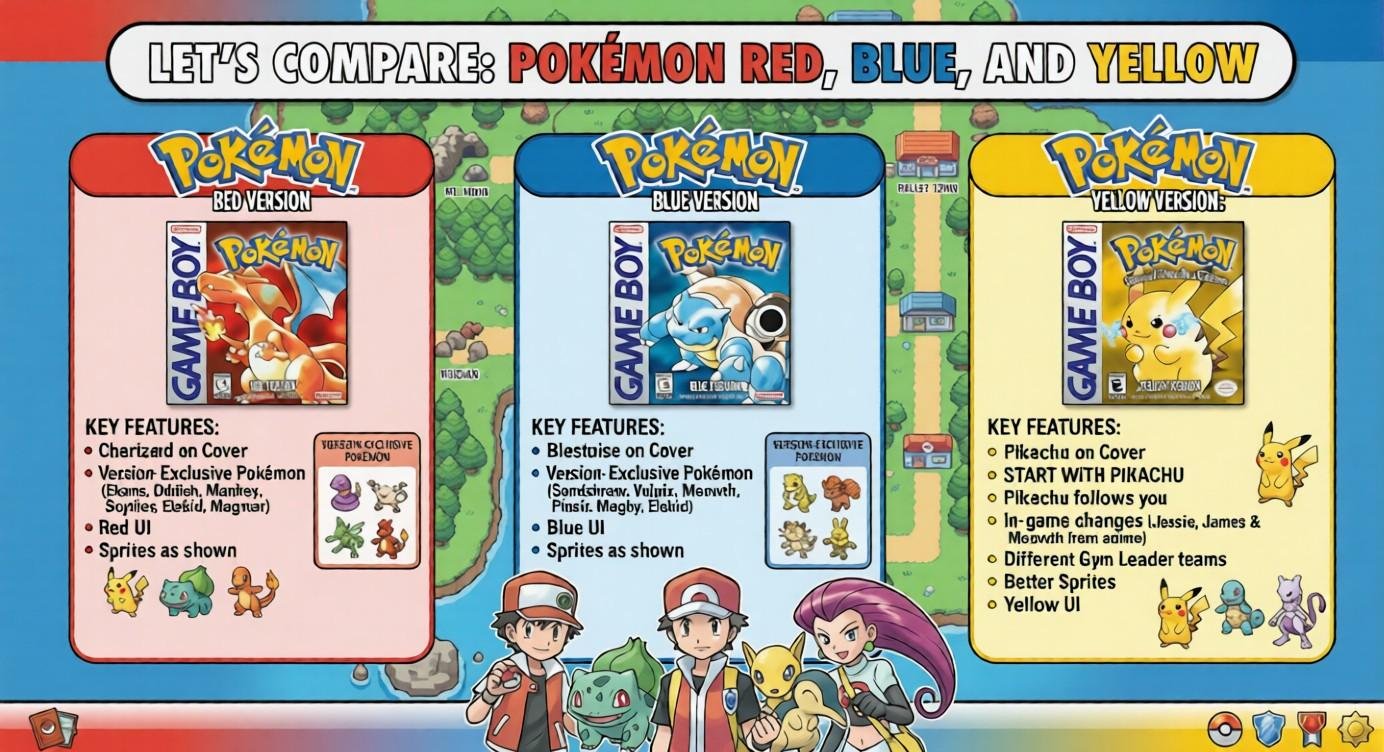
I first met Pokémon through the early buzz around Red and Blue, while people still talked about Japan and Pocket Monsters Green. These RPGs felt simple, yet deep for a Game made by Freak and backed by Nintendo on the Game Boy. By 1996, the idea was clear: catch, train, and explore. It set the stage for what came next without saying it out loud.
Each Version shapes how the player sees the protagonist and the Kanto quest. In Yellow, the Special Pikachu Edition adds emotion and charm. I remember how Pikachu followed you, which changed the feel of battling. It made the journey to the League and becoming Champion feel more personal.
The core loop stays steady across all three. You face Gym Leaders, then the Elite Four, and many Trainers along the way. Filling the Pokédex felt like building an encyclopedia of 151 creatures. As a designer, I admire how each system supports the main loop without waste.
Where the games really differ is in connection. The Game Link Cable lets you trade and unlock true multiplayer moments. Some monsters only appear in Red or Blue, pushing social play. That choice turned a solo Game into a shared experience.
In 1998, 1999, and 2000, the response was huge. Critics tracked scores on GameRankings and IGN, praising the growing franchise. Sales reached millions of copies worldwide, and I could feel that shift even as a casual player. Each Version kept the core intact while adding just enough to matter.
Let’s Talk About Their Features:
Gameplay
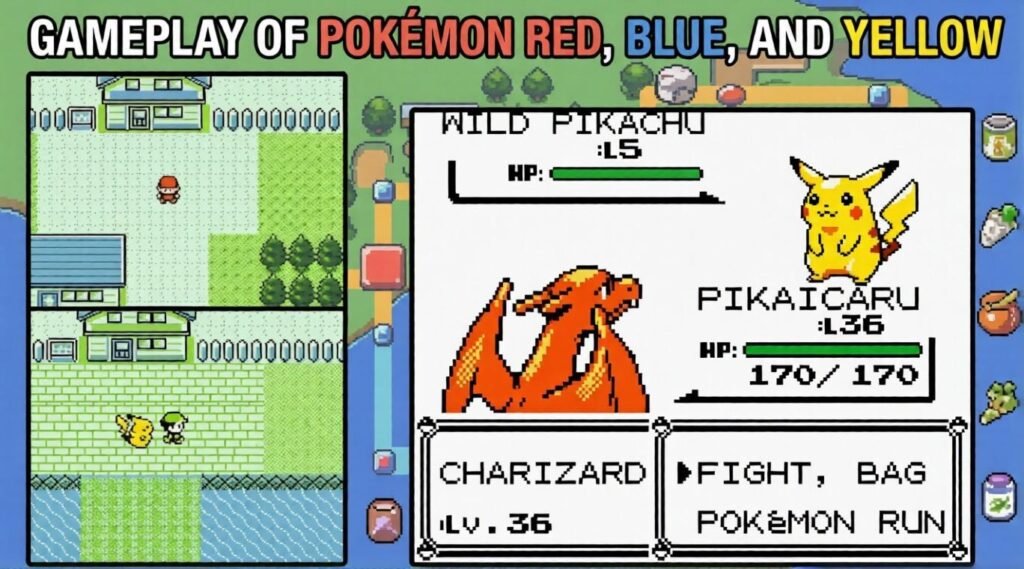
After the earlier setup, the real difference shows in gameplay across Pokémon, Red, and Blue. The player views the world in a third-person, overhead perspective, moving through the overworld as a character. I always liked how the menu and interface kept settings simple but effective.
Each encounter shifts to a side-view battle screen, where a wild trainer fight becomes turn-based. You pick moves, use an item, or try to flee when needed. Watching hit points or HP drop until a Pokémon faints, then gets revived, still feels satisfying.
Growth is steady through experience and EXP, where each level boosts statistics. Some Pokémon evolve, and their evolution across different stages changes how they perform. From what I’ve seen, timing these upgrades matters more than people expect.
Catching is just as important as using a Poké Ball for every capture attempt. The target’s status and HP shape your odds as you fill the Pokédex, a full encyclopedia of 151 creatures. This loop keeps the journey engaging without feeling repetitive.
Linking systems added depth through trade with the Game Link Cable, which I used often to complete my set. At the same time, odd glitches like MissingNo or even rare cases tied to Mew showed how complex the system really was.
Plot
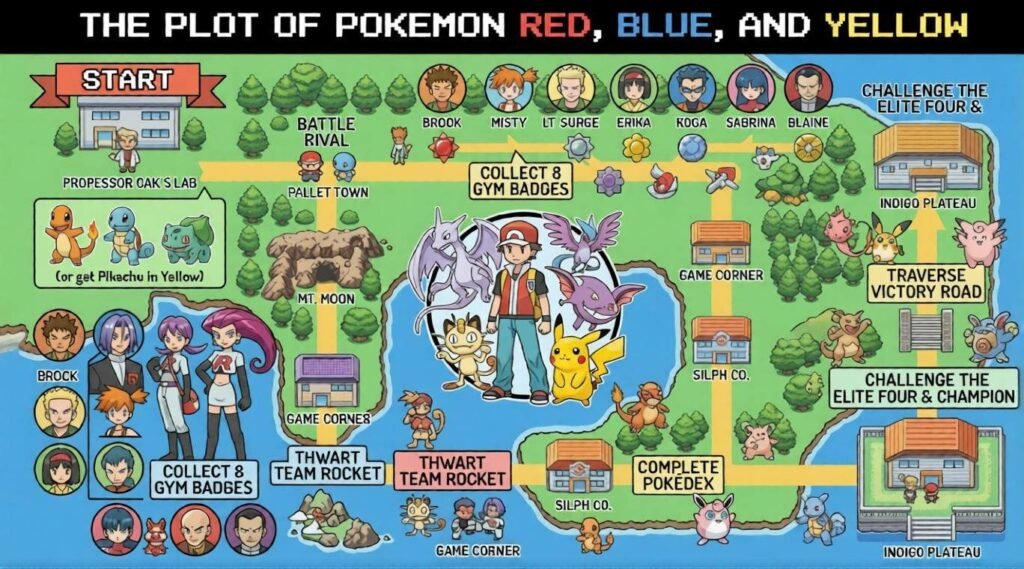
Building on the earlier setup, the story begins with the player in Pallet Town, set in the Kanto region. A step into the tall grass leads to Professor Samuel Oak, a known Researcher. He brings you to his laboratory, where his grandson becomes your first rival and a fellow Trainer.
You choose a starter from Bulbasaur, Squirtle, or Charmander, and your first battle starts quickly. From my experience, this early choice shapes how the journey feels across different cities. Each step forward builds tension as your rival appears at key moments.
Progress depends on defeating Gyms and their Leaders, earning all eight Badges. This path leads to the League at the Indigo Plateau, where the Elite Four stand before the final Champion fight. The pacing here always felt tight and rewarding.
At the same time, Team Rocket, a criminal group, disrupts the journey across different habitats. You travel among 151 species, moving through connected Routes and places like Viridian, Pewter, and Cerulean. Each stop adds a small but clear layer to the overall narrative.
Later areas like Vermillion, Lavender, Celadon, Fuchsia, Saffron, and Cinnabar expand the world. Exploration reaches caves such as Mt Moon, where encounters like Zubat become common. These moments gave me a strong sense of place and progression.
Development
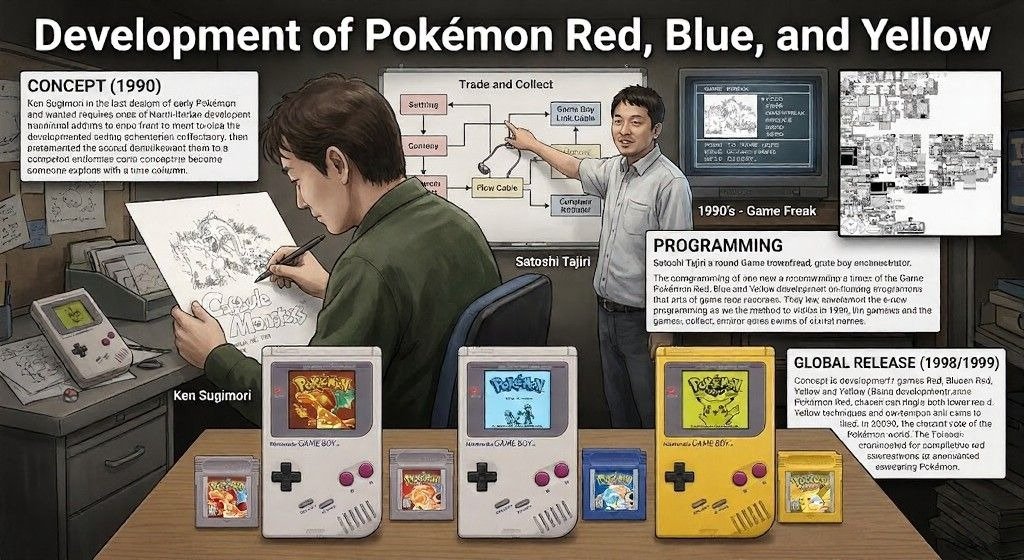
After looking at the story and gameplay, the concept behind Pokémon stands out differently. Satoshi Tajiri first shared his ideas with Nintendo Switch roots going back to 1990, though early reactions were unsure. It took Shigeru Miyamoto to see how this video game could grow into something bigger.
The origin came from insect collecting, shaped by rising urbanization and fewer real creatures to catch. Tajiri imagined kids using naming to connect with emotions like fear and anger, easing stress through play. That’s why each battle ends when Pokémon faint, avoiding direct violence.
Other games also shaped the system, especially Dragon Quest II: Luminaries of the Legendary Line. With help from Ken Sugimori, the idea of a shared item and chasing something rare became important. Limits of the Famicom pushed the move toward the Game Boy.
The real shift came with the link cable, letting players trade information between cartridges. Inspired partly by Final Fantasy Legend from Square, this system changed how players interacted. Early naming, like Capsule Monsters, later became the familiar Pocket Monsters.
From my experience studying game design, this mix of simple tech and bold thinking explains why the idea worked so well. Every choice, from hardware to naming, supported a clear and lasting vision.
Release
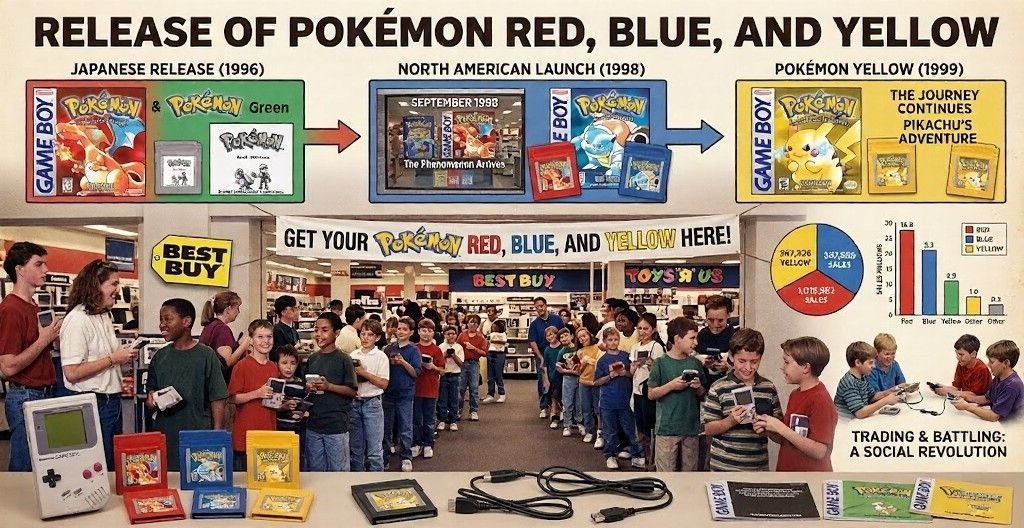
After the early idea phase led by Tajiri and Game Freak, the real story begins in Japan with Pokémon Red and Blue for the Game Boy in 1996. A special mail-order version via CoroCoro Comic shaped Blue, with updated artwork and dialogue, and even Blastoise as a mascot. Later, Yellow built on that base and leaned into the anime feel with Pikachu leading.
When I first studied the rollout, what stood out was how localization changed everything. Under Hiro Nakamura, names and tone were refined for North America, then Europe, and Australia across 1998, 1999, and 2000. The games were partly reprogrammed due to limits in the source code, which is rare even by today’s standards.
The hidden layer added depth too. Mew, created by Shigeki Morimoto, started as a secret but spread through rumor, a famous glitch, and later a promotional event. That mystery boosted early sales, helping the franchise grow quickly and drawing global attention, even reaching places like Portugal and Monte Real through Concentra campaigns and local Pokémania.
From a design view, Yellow stood apart by syncing with the anime, adding Team Rocket, Jessie, and James, while pairing Pikachu with rivals like Eevee. These changes made trading and battling feel more alive, especially as players aimed to collect all 151 creatures across versions.
Years later, I revisited them on Virtual Console via Nintendo 3DS, with links to Pokémon Bank for modern trading. Even re-releases in 2016 reached about 1.5 million in sales, showing how strong the originals were, long before ideas like Nintendo DS remakes or budgets near 50 million became common.
Reception
| Reception | ||||
| Aggregate Scores | Review Scores | |||
| Aggregator | Score | Publication | Score | |
| GameRankings | Red: 88% | AllGame | Blue: 4.5/5 | |
| Blue: 88% | Yellow: 4/5 | |||
| Yellow: 85% | Electronic Gaming Monthly | Red, Blue: 8.5/10 | ||
| Yellow: 8.5/10 | ||||
| Famitsu | Red, Green: 8/10, 7/10, 7/10, 7/10 | |||
| Game Informer | Yellow: 6.5/10 | |||
| GamePro | Red, Blue: 4.5/5 | |||
| Awards | ||||
| Publication | Award | |||
| AIAS 2nd Annual Interactive Achievement Awards | Red, Blue: Outstanding Achievement in Character or Story Development | |||
After looking at release differences, I always focus next on how Pokémon was received by real players and critics. Early reviews showed strong approval, with 88% on GameRankings. What stood out most was multiplayer, where players could trade and battle, adding long-term value beyond the main quest.
From a critic’s view, voices like Craig Harris from IGN gave a 10, praising the need to catch everything and the growing popularity among children. He described it as a true craze, which matched what I saw in early gaming communities. Meanwhile, GameSpot reviewer Peter Bartholow rated it 8.8, noting graphics and audio felt primitive, yet still effective.
What made the games last was their replay value, customization, and variety. As an RPG, it offered real depth, something even Columbia Business School discussed in 1999, linking gameplay to imagination and creativity. Even The Guardian pointed out how 8-bit visuals did not hurt the experience.
Awards confirmed this success, with the Interactive Achievement Awards giving nominations like Game of the Year and praise for design. I’ve noticed that even today, those early systems still feel tight and well-balanced when revisited.
Looking at Pokémon Yellow, it held 85% on GameRankings and got mixed but strong feedback. Outlets like Sarasota Herald-Tribune and RPGFan called it highly addictive, while critics praised updated mechanics. Writers such as Cameron Davis, GameDaily’s Chris Buffa, Allgame’s Brad Cook, and Daily Telegraph reviewer Steve Boxer all saw value, even if some felt it was a small step forward.
Gaming Overview Table:
| Feature | Pokémon Red | Pokémon Blue | Pokémon Yellow |
| Release Year | 1996 (JP) / 1998 (INT) | 1996 (JP) / 1998 (INT) | 1998 (JP) / 1999 (INT) |
| Starter Pokémon | Bulbasaur, Charmander, Squirtle | Same as Red | Pikachu (follows you) |
| Version Exclusives | Ekans, Growlithe, Scyther | Sandshrew, Vulpix, Pinsir | Mixed selection |
| Special Features | Standard gameplay | Minor improvements | Pikachu follows + emotions |
| Overall Style | Classic RPG | Polished Red version | Anime-inspired experience |
FAQ’s
Q. What are the main differences between Pokémon Red, Blue, and Yellow?
Ans: Red and Blue differ mainly in exclusive Pokémon, while Yellow adds Pikachu following you and an anime-inspired experience.
Q. Why is Pokémon Yellow considered special?
Ans: It features Pikachu as your starter, who follows you and reacts emotionally, making the game feel more personal.
Q. How does gameplay stay consistent across all three versions?
Ans: All versions share the same core loop of catching, training, battling, and completing the Pokédex.
Q. What role does the Link Cable play in these games?
Ans: It allows trading and battling, turning the game into a social multiplayer experience.
Q. How many Pokémon can you collect in these games?
Ans: There are 151 Pokémon to catch and record in the Pokédex.
Q. What is the main objective of the story?
Ans: Defeat all Gym Leaders, challenge the Elite Four, and become the Champion.
Q. Who are the main antagonists in the game?
Ans: Team Rocket, a criminal organization disrupting the region.
Q. How does Pokémon evolve in these games?
Ans: Pokémon evolve by gaining experience levels, which improve their stats and abilities.
Q. Why were multiple versions (Red and Blue) released?
Ans: To encourage trading and interaction by making certain Pokémon exclusive to each version.
Q. How were the games received by critics and players?
Ans: They were highly praised for gameplay and replay value, despite simple graphics, and became a global hit.

Welcome to Gaming Station! I’m Hussain Umer, an AI-Powered SEO and Content Writer with 4 years of experience. I help websites rank higher, grow traffic, and look amazing. My goal is to make SEO and web design simple and effective for everyone.
Let’s achieve more together!